Guides
Part of The floor fails first: deciding what to keep in vintage diner interiors
Vintage diner interiors planning: a timing guide
A practical guide to vintage diner interiors planning, with quiet-hour timing, corridor choices, accessibility questions and advice for thoughtful visits.
What to take away
- Build the day around service times, not mileage. Between two and four is when you can actually look.
- Pick a corridor with a real history behind it, so the stops connect into something.
- Check the floor before you commit to standing around. Old tile and worn terrazzo are harder underfoot than they look.
Vintage diner interiors planning works best when you resist the rushed version: a list of six places and a schedule that gets you to all of them. You will see all six and remember none, because every visit lands in the middle of somebody's lunch rush.
The slow version has half as many stops and is a different experience entirely.
Plan around the clock, not the map
A working diner has three states: busy, closed, and the quiet stretch between them.
Diner day states
- Morningbefore the rush
- Middaybusy
- 2-4pmquiet stretch, room is yours
- Eveningclosed
The quiet stretch, roughly two to four in the afternoon, is when the room is yours. The staff have time to talk, the counter is empty enough to photograph, and nobody minds you standing in the middle of the floor looking at the ceiling.
So build the day backwards from that window. One stop in the quiet afternoon, and one the next morning between six and seven, before the breakfast rush. That rush typically runs from about seven thirty to nine, so the earlier hour is the one that works, and the driving fits in between.
Choose a corridor with a history
Stops that connect are worth more than stops that are merely good. A route with a shared history gives you comparisons rather than a set of isolated rooms.
The National Park Service's Route 66 travel pages are a reasonable starting point for the best-documented corridor in the country, and the same logic applies to any old highway. Find out why the road ran there, and the buildings along it start to make sense as a group.
The Lincoln Highway, laid out in 1913 and now mostly US 30, is the second corridor to start with. Its Ohio stretch runs east from Van Wert through Upper Sandusky and Mansfield, small downtowns close enough together to compare in one day.
Reading that first also tells you which towns were bypassed, which is usually where the intact interiors are.
Two stops a day
This is the discipline that makes the difference. Two stops means ninety minutes at each, a meal, a conversation and time to write notes.
Three is possible if one of them is brief. Four means eating four times in eight hours and remembering none of it.
The floor, the aisle and the stools
You will spend a lot of a diner visit on your feet on a hard floor, and old floors are not uniform.
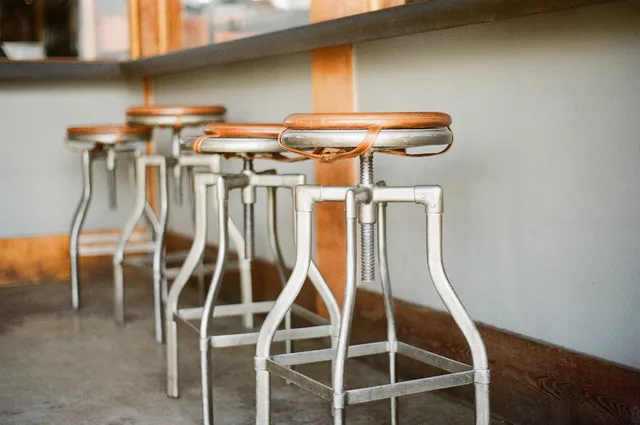
In a classic diner, the walking route is the strip between the counter stools and the booth backs, often only about three feet wide. The stools are bolted to the floor, so you cannot move them, and the server carries plates through the same gap.
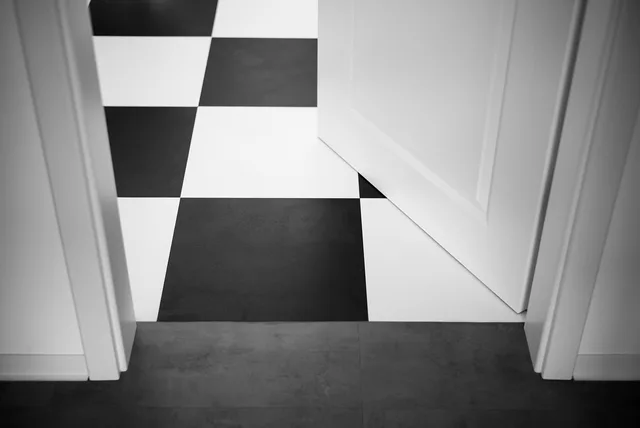
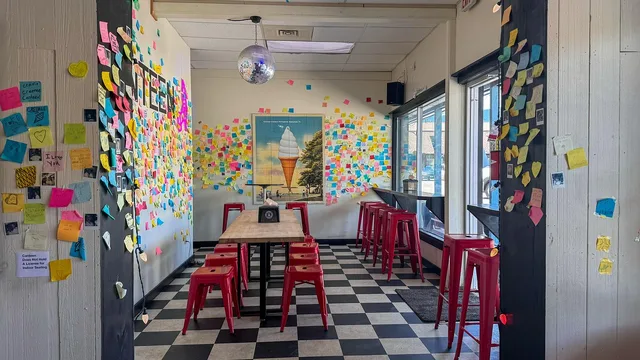
The floor under all of that is usually the original: small hexagonal tile, terrazzo, or checkerboard linoleum. Polished terrazzo is slick when it is wet, and a loose mat over it slides.
Watch the raised threshold at the entrance vestibule, which is the trip point most people miss.
The Access Board's guide to floor and ground surfaces explains what makes a surface firm, stable and slip resistant. Reading it changes how you look at a worn tile floor with a patched section and a step you did not see.
For anyone in the group with mobility or balance considerations, ask about the floor and the door threshold when you call ahead. It is a much more useful question than asking whether a place is accessible.
The week before
- Telephone every stop. Confirm the date, the quiet hours and that the counter is in use.
- Book the accommodation on the route rather than off it.
- Read whatever documentation exists for each building.
- Write down two specific questions per stop. Vague interest gets vague answers.
Two that work on almost any call: "Is the counter in use that day, or is it tables only?" and "What time does your breakfast rush finish?"
On the day
Order properly. Sit at the counter if there is one, because that is the seat the room was designed around and the conversations happen there.
Ask before photographing, and ask again before photographing people. Write your notes in the car afterwards, not at the table.
Leave when it gets busy. That is the whole etiquette of this, and it is why the afternoon plan works.
For destination ideas, see the stops worth adding; use the timing and observation advice here to make each visit more rewarding.