Rules
Part of Eleven habits of modern roadside design that actually read at speed
USA Travel: Roadside Accessibility Checklist
USA travel checklist for assessing access at roadside motels, diners, and filling stations, with ADA measurements and questions to ask before you go.
What to take away
- Ask for measurements and photographs, not for reassurance. "Accessible" is used to mean six different things.
- The failure point on roadside trips is almost never the door. It is the surface between the car and the door.
- Know the numbers yourself, so you can tell whether an answer is plausible.
- Confirm on the day. Small independent properties change without telling anyone.
Roadside architecture presents a specific accessibility problem for USA travel. The buildings are usually single story, which helps, and they sit behind large areas of gravel, broken paving and unmarked parking, which does not. Trips to places such as the Wigwam Motel in Holbrook, Arizona, still call for property-specific questions; distinctive roadside design alone cannot tell you whether a route is accessible.
Planning this well means asking better questions than most booking systems are set up to answer.
Know the standard before you ask
You do not need to become an expert, but knowing roughly what the requirements say makes it obvious when an answer is wrong.
Title III of the Americans with Disabilities Act (ADA) applies to privately operated public accommodations such as motels, diners, and filling stations. New construction and alterations are governed by the 2010 ADA Standards for Accessible Design; existing public accommodations have barrier-removal obligations where removal is readily achievable. The U.S. Access Board's Guide to the ADA Accessibility Standards, Chapter 4, including its guide to ramps and curb ramps, explains what compliant slopes, landings, and handrails look like.
Ask for the rise and the run, or for a photograph with something in it for scale.
The surface between the car and the door
This is the part that fails on roadside sites and the part nobody mentions.
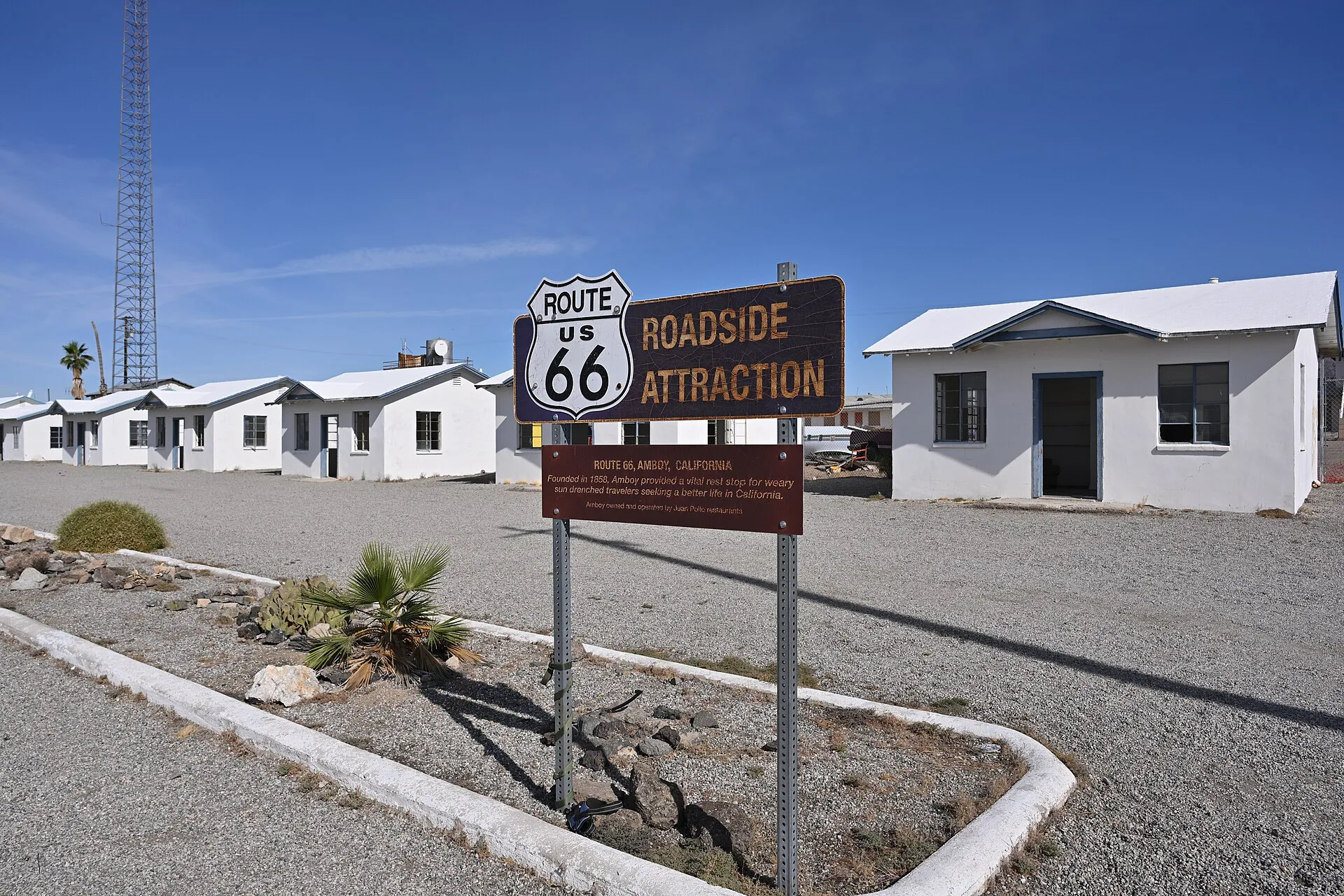
A restored motor court can have a step-free entrance reached across 30 feet of loose gravel. Ask specifically: what is the surface from the accessible parking space to the entrance, is it firm, and is it continuous.
The same question applies to the forecourt of a filling station, the gravel apron of a diner, and the grass verge beside a sign somebody wants you to photograph.
Public land sets a useful benchmark
Where your route includes federal sites, the standard of published information is much higher and worth using as a comparison.
The National Park Service's accessibility information for visitors shows what a complete answer looks like: specific routes, surfaces, gradients, available services and what is honestly not accessible. Independent businesses rarely publish anything like this, but knowing the shape of a good answer helps you ask for one.
The questions that get real answers
Use these as a field-screening checklist: check each applicable measurement, and ask for a photo or measurement when you cannot verify it yourself. This is not a complete compliance determination; exceptions and historic-property provisions can affect how a requirement applies.
- Parking:A car space is at least 96 inches wide with an access aisle at least 60 inches wide. A van space is at least 132 inches wide with a 60-inch aisle, or at least 96 inches wide with a 96-inch aisle. The space and aisle slope no more than 1:48 (2010 ADA Standards §502).
- Route to the entrance:The route is continuous, firm, stable, and slip-resistant, with at least 36 inches of clear width, subject to limited exceptions. A walking surface slopes no more than 1:20 in the direction of travel and 1:48 across it; steeper routes must meet the ramp requirements (§§302.1, 403.3, 403.5.1).
- Steps, thresholds, and ramps:A level change up to 1/4 inch may be vertical; one from 1/4 to 1/2 inch must be beveled no steeper than 1:2. A ramp’s slope is no steeper than 1:12, and each run rises no more than 30 inches. Ramp landings are at least 60 inches long; ramps with a rise over 6 inches require handrails. A doorway threshold is no more than 1/2 inch, with a limited existing-or-altered threshold exception up to 3/4 inch if beveled no steeper than 1:2 (§§303, 404.2.5, 405.2, 405.6–405.8).
- Door:The clear opening is at least 32 inches with the door open 90 degrees, measured between the door face and the stop (§404.2.3).
- Restroom turning and toilet clearance:There is a 60-inch-diameter turning space or a compliant T-shaped turning space. At the toilet, clearance is at least 60 inches wide and 56 inches deep for a floor-mounted toilet, or 59 inches deep for a wall-mounted toilet (§§304.3, 604.3).
- Restroom grab bars and lavatory:Grab-bar gripping surfaces are 33–36 inches above the floor; the side-wall bar is at least 42 inches long and the rear-wall bar at least 36 inches long. The lavatory rim or counter is no more than 34 inches high, with the required knee and toe clearance (§§604.5, 609.4, 606.3, 306).
- How many steps between the parking area and the room or entrance, and is there an alternative route?
- What are the accessible parking space and access-aisle widths, and where does the accessible route from them begin?
- What is the door clear width, measured with the door open?
- Is the accessible restroom a full one or a standard cubicle with a rail?
- Is there seating within the building, and how far apart?
- Where can a vehicle with a side lift unload without blocking traffic?
- Is there somewhere quiet and shaded to break for twenty minutes?
- Is any of this seasonal, and what changes in winter?
Send them as a numbered list. A list gets answered point by point. A paragraph gets answered with reassurance.
Who actually controls each part
On a roadside trip the journey crosses several owners in a single afternoon: a highway authority, a municipal parking area, a private forecourt and a business interior.
Nobody has authority over all four, so confirm each separately. A tour operator can promise their coach and their timing, and cannot promise the surface outside a privately owned motel.
On the day
Telephone in the morning. Ask whether anything has changed, whether the accessible restroom is in service, and whether any work is happening on site.
Small independent properties are the heart of this subject and they run on small margins. A broken lift or a resurfaced forecourt is not going to reach a website.
For related trip-planning ideas, see the packing list and the two-day itinerary; neither replaces a direct access check with each property.