Features
International roadside architecture: how to read imported styles
How to spot imported styles in US and Canadian roadside buildings, from Bauhaus roofs to Art Deco parapets, and what those materials mean for preservation.
What to take away
- Imported styles reach the roadside in fragmentsa roofline, a window band, a color rule, a sign shape.
- Name the origin before judging the building. Art Deco traces to Paris in 1925, and the International Style to Germany and France in the 1920s.
- Read three zones in orderroof, wall, ground. The roof usually shifts first when a style crosses the Atlantic.
- Materials decide what can be repaired. Porcelain enamel and neon have documented repair methods, while later plastic panels often do not.
- Codes decide what survives. NFPA 101 sets fire safety requirements for existing buildings, including historic motels.
Imported styles arrive as fragments
The International Style received its English name from a 1932 exhibition at the Museum of Modern Art in New York, organized by Henry-Russell Hitchcock and Philip Johnson. Roadside builders adopted the parts, not the philosophy.
Art Deco arrived the same way. The 1925 Exposition Internationale des Arts Decoratifs in Paris supplied the stepped parapets and geometric panels that later appeared above small town storefronts and diner counters.
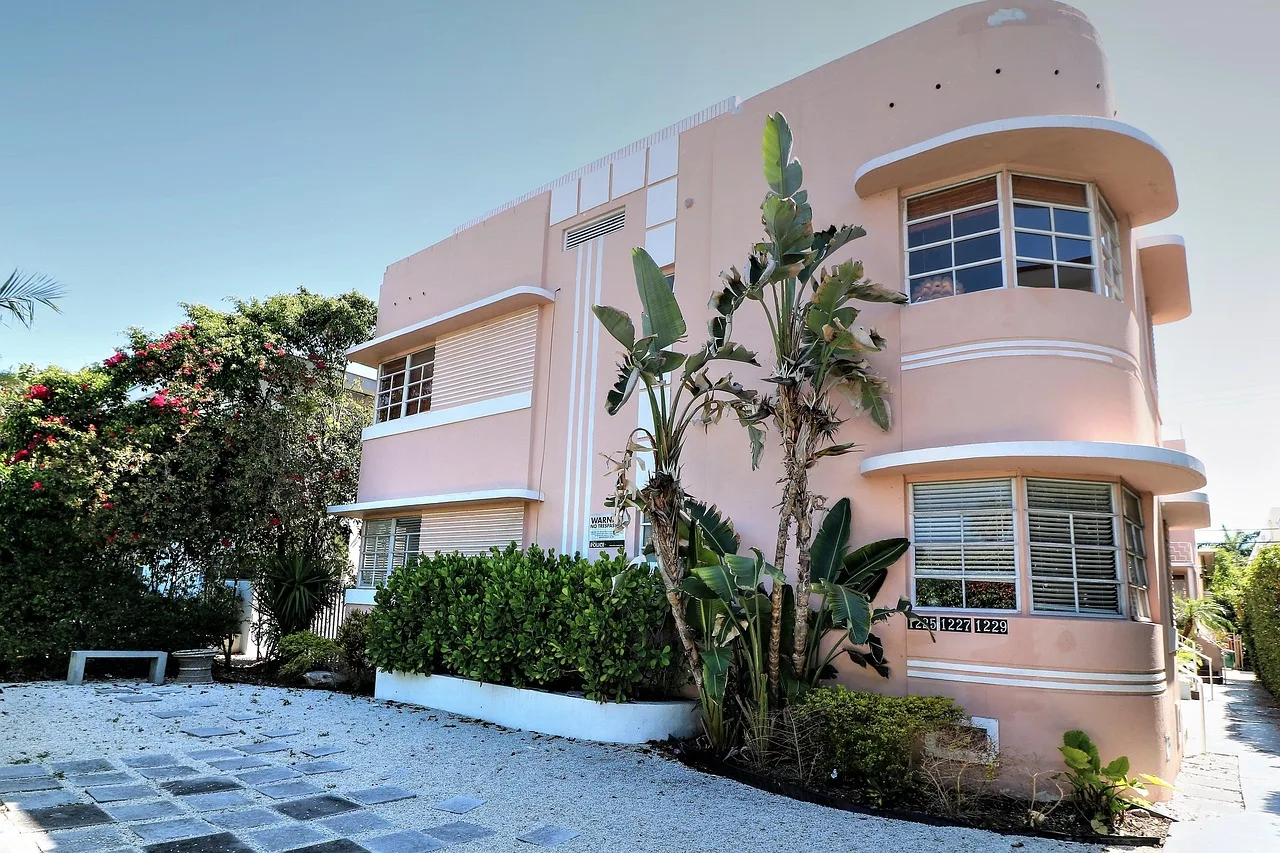
A 1950s motel could take the flat roof, the white stucco wall and the horizontal window band, then keep an American parking court in front. Separate the imported parts from the local ones and the building starts to make sense.
Read the roof, the wall, and the ground
Work through every facade in the same order. Each zone tells you something about origin and about repair.
- Start at the roof. A flat roof behind a plain parapet suggests the International Style or Streamline Moderne. A steep roof with dormers and heavy brick suggests French Canadian Chateau work.
- Move down to the wall. Stucco, brick, glass block and porcelain enamel each carry different repair costs and different preservation guidance.
- Finish at the ground. Canopies, plinths and curb cuts show how the building meets the pavement, the sidewalk and the car.
A table of imported signals and their origins
| Signal on the building | Likely origin | Where you see it |
|---|---|---|
| Flat roof, white stucco, ribbon windows | International Style, Germany and France, 1920s | 1950s motels on US 1 and Route 66 |
| Stepped or zigzag parapet | Art Deco, Paris, 1925 | downtown diners and theater fronts |
| Steep roof, dormers, heavy brick | Chateau style, French Canada | roadside inns in Quebec and Ontario |
| Curved corner, glass block, speed lines | Streamline Moderne, 1930s, with European roots | filling station offices and diner fronts |
No single signal proves a date. Use the table to form questions, then check materials, signs and local records.
Example: reading a 1955 diner with a Chateau roofline
Picture a diner in Ontario with a stainless steel body, a steep dormered roof and a neon sign in script. The body is American, the roof is French Canadian, and the sign is local commercial work.
Read the sign last. Signs were replaced far more often than roofs, so a sign dates the business more than the building.
Dating a motor court from postcards and paint
The Wikipedia article on motels traces how the motor court shed its separate cabins for a single flat roofed block, which gives you a sequence to check against old cards.
Postcard stock helps as well. Linen cards gave way to chrome cards in the 1950s, so the card in your hand can bracket a repaint or a new sign.
Neon, porcelain enamel, and repairs you can document
The National Park Service brief on neon signs documents period color palettes for diners and other roadside buildings, which helps when a repaint has erased the original scheme.
Porcelain enamel panels on station facades and signs can often be cleaned and rehung instead of replaced. Plastic and vinyl substitutes rarely match the original gloss.
Salvage yards and heritage groups sometimes hold original enamel and neon parts, which is often the only route to a faithful repair.
Documenting a building before anything changes
The Wikipedia article on historic preservation reviews legal and ethical considerations, including photography permits for historic sites, which matters before you publish images of a privately owned motel.
For canopy inspections, OSHA rules on ladders and fall protection apply to anyone working above grade.
From the roadside to the house next door
The same reading habits transfer to houses. Climate, snow load and local trades reshape an imported style again, and international homes architecture shows what happens when those forces act on a dwelling rather than a motor court.