Guides
Part of Gas station preservation fundamentals: how to report reuse stories with evidence
Gas station preservation fundamentals: a 2027 records checklist
Build a gas station preservation file that separates dated records from current observations, so every claim in the draft can be traced and checked.
Gas station preservation fundamentals start with a file organized well enough to check. Before anyone writes that a station is historic, original, or restored, the notes should show which source supports the words and what that source leaves open.
What to take away
- Give every item a source type and a date, and keep undated material labeled undated.
- Record what you saw on site separately from what a document says.
- Cite a public record only for the facts it actually identifies.
- Treat a photograph as evidence of its own moment, not of current condition.
- Keep unanswered questions in a log the next editor can pick up.
Build the property file
A property file is a set of fields, not a folder of clippings. Fill each field with the source that answers it, and leave the field blank when nothing does.
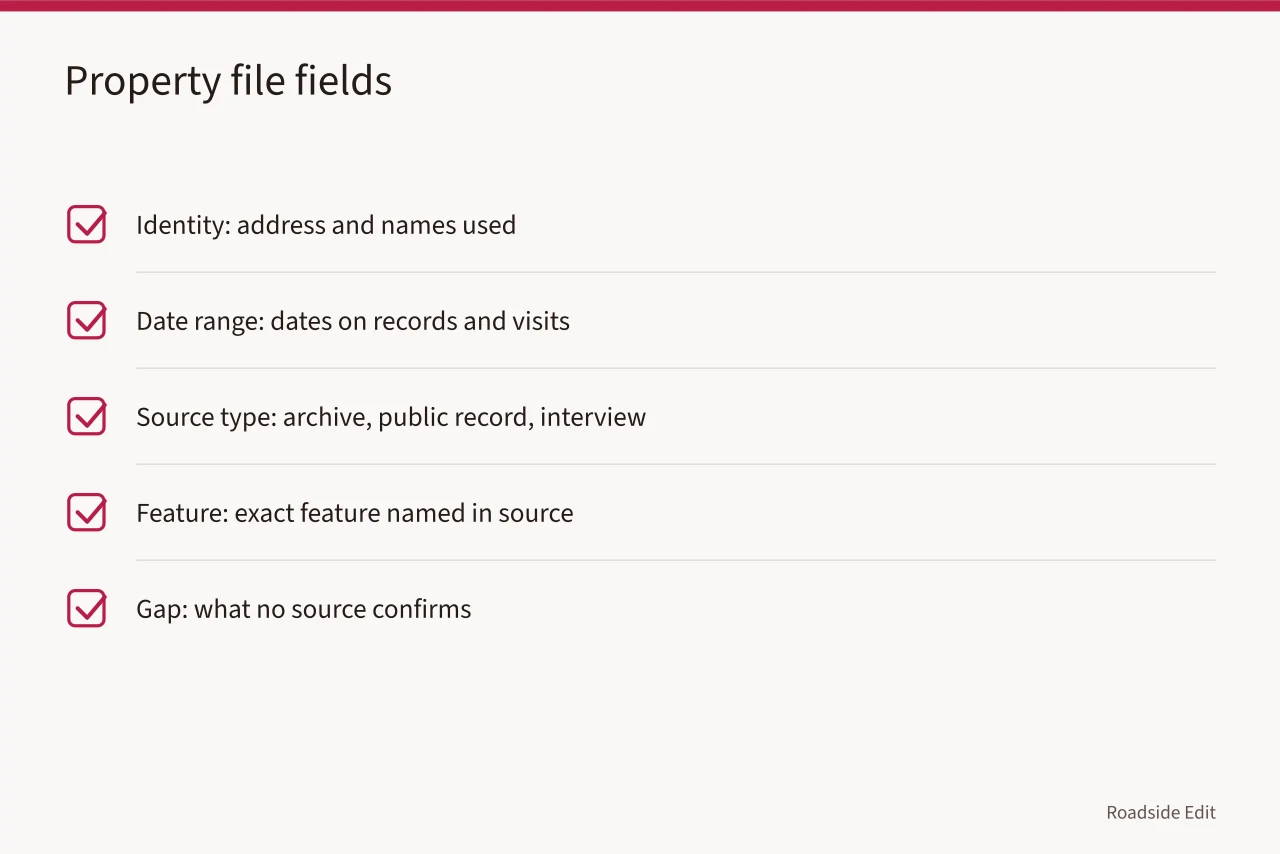
| Field | What goes in it | What it cannot tell you |
|---|---|---|
| Identity | Address, current name, names used in earlier records | That two similar names are one property |
| Date range | Dates printed on records, images, and site visits | That undated material is recent |
| Source type | Archive, public record, interview, supplied copy | That every source carries equal weight |
| Feature | The exact feature named in the source | That the feature is original or intact |
| Gap | What no source confirms | A full history from partial material |
The Historic American Buildings Survey record for the Benton Filling Station Building is a working model. It states the surveyed building, its location, its documented date range, and an architectural description. It supports statements about what that survey says, and nothing about a station it never covered.
Run the claim review in five steps
Use this sequence on a short feature or a directory profile, claim by claim:
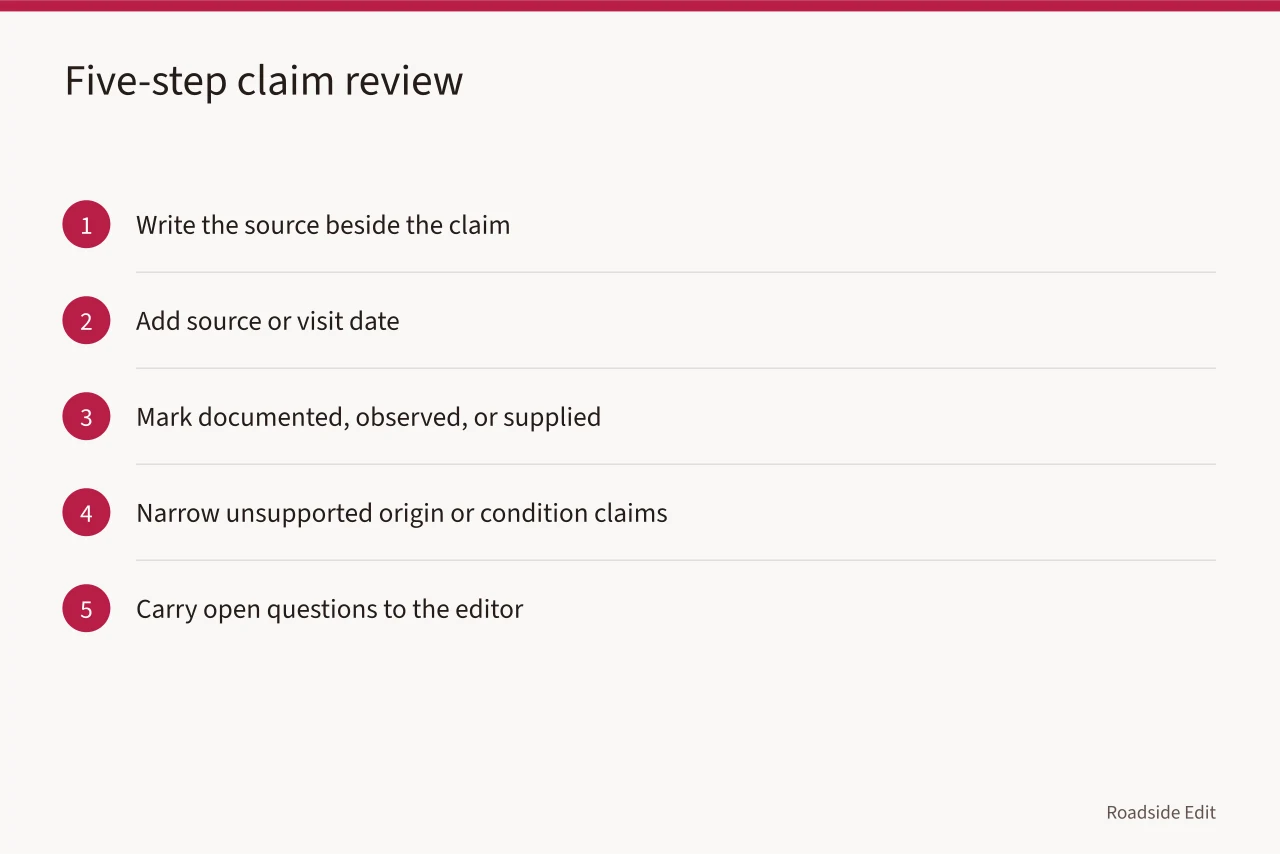
- Write the source beside the claim in the working notes.
- Add the source date or the visit date.
- Mark the fact as documented, observed, or supplied by a named person.
- Narrow any sentence that asserts origin, condition, or significance without direct support.
- Carry the remaining questions forward to the editor instead of resolving them in the draft.
A photograph taken last spring shows an overhead door, a roofline, a pump island on that date. A 1940 survey describes a different moment. When the gap matters, print both dates. A reader can follow a timeline; a reader cannot audit a leap from an old image to a present-tense claim.
Write captions that stay inside the evidence
The National Archives explains what makes a source primary. It asks who made the record, when, and from what vantage point. A 1939 station photograph is strong evidence of 1939 and silent about everything after it.
The National Archives records-management overview supports keeping source, date, and review decision in one place. That habit lets an editor trace a property claim and correct the page when a better record turns up.
The Federal Trade Commission's endorsement guidance covers disclosure when a business relationship could sway a reader. A disclosure line gives context. It does not turn a supplied history into a verified one.
A caption should name the source and say whether the image is illustrative. For a property image, keep the photographer, the date, the location, and the original source page. For a supplied photo, say it was supplied rather than presenting it as independent reporting.
Keep past and present in separate fields
One field holds what a dated record identifies. A second holds what a current visit or operator update reports. The split stops an old photograph from becoming present evidence, and stops an owner's statement from reading as a public designation. When the two records disagree, say so or leave the point open.
Check the short elements too before the article goes live. A title, summary, caption, or table label can claim more than the body does. A source that names a service bay in a 1940 image does not support saying an original bay survives today.
Log the questions you cannot close
An answer log holds the missing archive reference, the conflicting property name, the uncertain alteration date, the image credit still to confirm. It hands the next editor a research list and keeps the published page from filling a gap with a story that merely sounds right.
When the log itself becomes the deliverable, building a gas station preservation case study method with dated evidence turns those open questions into a repeatable structure.
Status questions leave the file entirely. Eligibility for listing goes to the State Historic Preservation Office. Canopy repair review goes to the local landmarks commission. Easement constraints on the sign go to a licensed engineer or an attorney. The article points there.
Common questions
Does a completed checklist establish historic status?
No. It organizes reporting evidence. Eligibility or designation runs through the appropriate review, and the file should say which office holds that decision.
Can an owner interview go in the file?
Yes. Attribute it to the person by name, date it, and keep it in the supplied field rather than the documented one.
What if a source cannot be verified?
Find a stronger source, attribute and narrow the claim, or cut it. A blank field is more useful than a confident guess.