Guides
Gas station preservation fundamentals: how to report reuse stories with evidence
Learn gas station preservation fundamentals for 2027, including evidence, historic context, transparent features, reuse stories, and editorial boundaries.
Historic gas stations are easy to romanticize and hard to describe well. A canopy, pump island, service bay, or porcelain sign may be visually memorable, but an article should not mistake a striking feature for proof of a building's age, significance, integrity, or condition. The best coverage begins with evidence and tells readers where that evidence stops.
This guide is for editors, local writers, photographers, and businesses planning an editorial feature about a former or operating gas station. It explains how to shape a careful story. It does not establish a property's historic status, recommend construction work, or replace local professional advice.
What to take away
- Start with an identified property and a specific reporting question.
- Distinguish a current observation from a historical record and from an owner's account.
- Describe visible features without treating them as proof of originality or condition.
- Label illustrative photography honestly and verify its credit before publication.
- Keep sponsored profiles, directory entries, and editorial rankings visibly separate.
Start with the right reporting question
"Historic gas station" is a broad label. It can refer to a small roadside building, a multi-bay service garage, an associated sign, a pump island, or a whole commercial corridor. A useful article identifies one subject, its location, and the period or question being covered.
One question: What do public records and dated photographs show about the building at this address? Another: How has an operator described the station's shift from fuel sales to a new use?
Neither question assumes a visible detail is original, that an old building qualifies for a particular program, or that a reuse plan is appropriate.
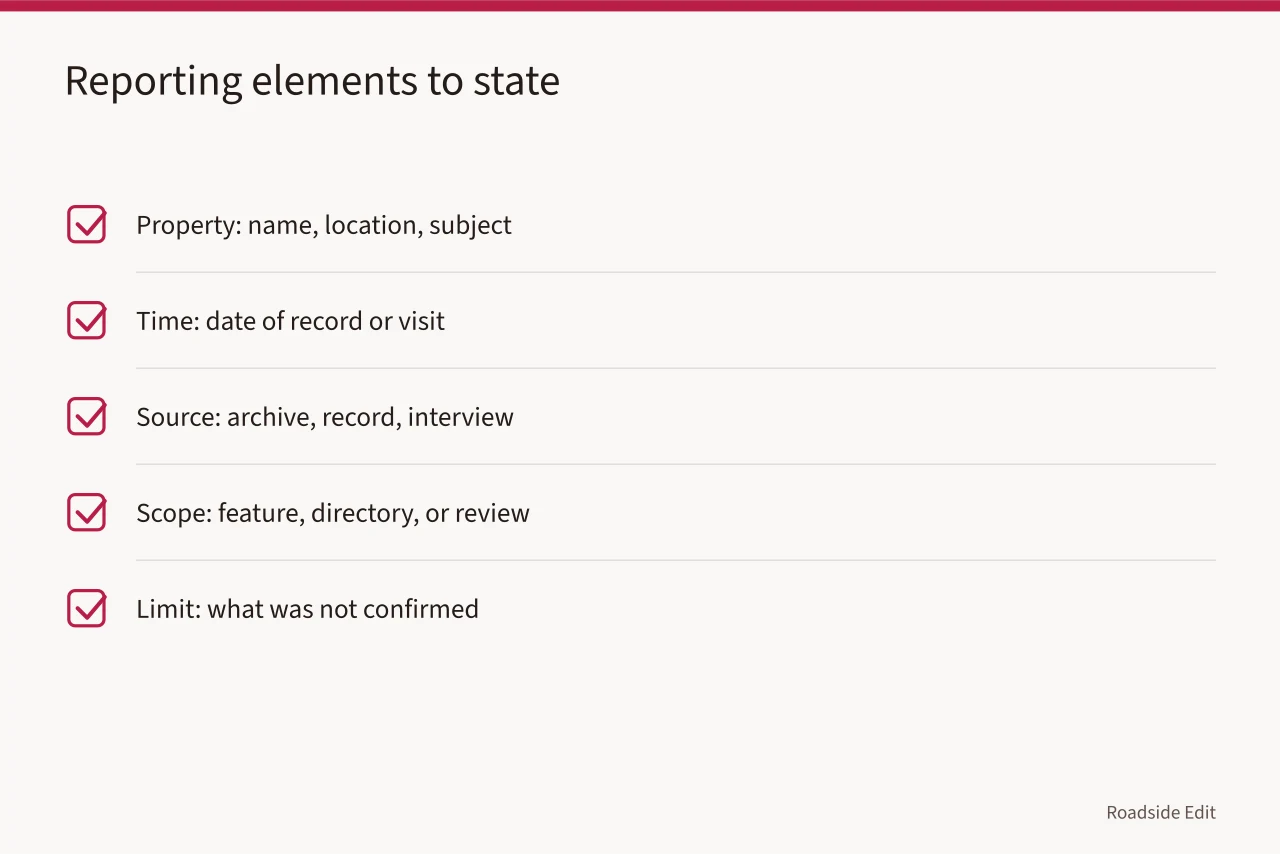
| Reporting element | State it clearly | Do not assume |
|---|---|---|
| Property | Name, location, and what is being discussed | That similarly styled stations share its history |
| Time | Date of the record, visit, or interview | That an image represents the present |
| Source | Archive, public record, interview, or observation | That every source verifies every claim |
| Scope | Editorial feature, directory entry, or review | A technical assessment |
| Limit | What was not inspected or confirmed | That readers will infer uncertainty |
This first step matters because a gas station can be important for many reasons. Its architecture may be notable. Its place in a community story may be notable. A specific event may be notable. Those are different claims, and they need different support. An article is more trustworthy when it says which one it is making.
Learn what the available evidence can support
Evidence is not interchangeable: a public survey may identify a resource and summarize its history. A historic photo shows an exterior at a stated date, and an owner interview reports the owner's account.
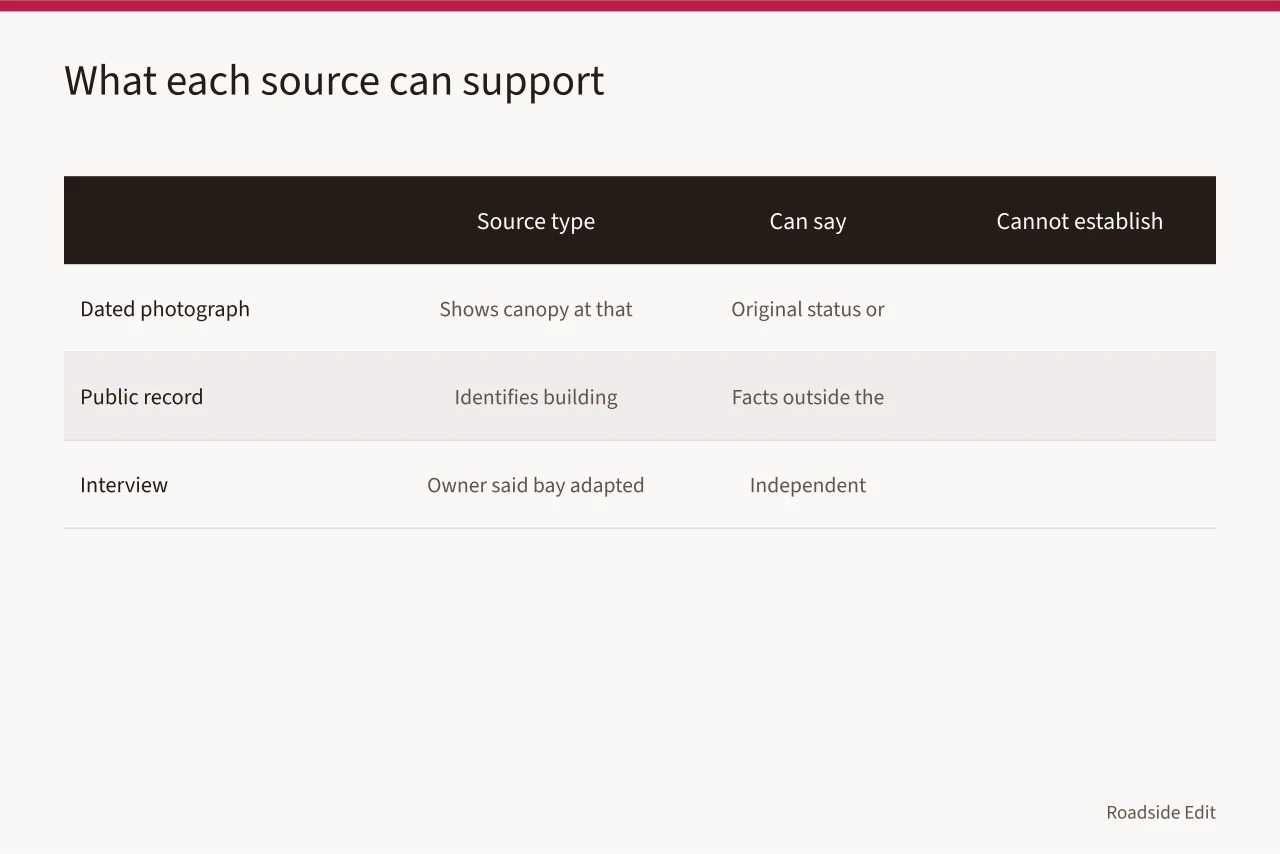
A current photograph shows what the photographer observed, and each contributes to a good story, but the article should not merge them into an unsupported conclusion.
The National Park Service's Preservation Brief on historic gas stations discusses preservation and reuse in relation to a property's character-defining features and documented context. For editorial work, the useful lesson is modest: features need to be identified in their actual setting before a writer turns them into a broad claim.
Use a private evidence sheet while reporting. It can be a simple table, but it should be detailed enough that a second editor can understand why a sentence appears in the draft.
| Source type | A careful sentence can say | It cannot establish alone |
|---|---|---|
| Dated photograph | "The 1940 photograph shows a canopy at that time." | Original status, later changes, or current condition |
| Public record | "The record identifies the building and its documented history." | Every fact outside the record |
| Interview | "The owner said the service bay was adapted in 2025." | Independent verification of the statement |
| Site visit | "The writer observed this feature on the visit date." | Hidden fabric or a full condition analysis |
| Sponsor submission | "The business describes its current use as..." | An editorial endorsement or historic designation |
Writers sometimes think this caution makes a feature dry. In practice, it creates more interesting reporting. Instead of repeating a label, the article can show the reader how an address changed, what a photograph captures, what a local archive collected, and what remains unknown. Specificity gives a roadside story its texture.
Describe character without declaring a verdict
Visible features are excellent starting points for description. A writer can note the roof shape, placement of a service bay, massing of a small office, configuration of a pump island, materials visible in a dated image, or relationship between a station and the road. The phrasing should match the evidence.
For example, "the 1962 view shows a broad front canopy" is a description of a dated record. "The original canopy remains intact" is a much larger statement. It makes claims about origin, survival, and condition. Unless the source supports each part, it should be narrowed, attributed, or omitted.
This distinction is especially important in listicles. A list like "10 former stations to notice on a road trip" is useful if it explains each entry's inclusion. Reasons may be an accessible public record, an interpretive program, a publicly documented history, or a local event.
Avoid rankings using vague words like "best preserved" or "most authentic" unless the article states a defensible and consistent method.
Build a clear timeline
Most problems in historic-place coverage come from time getting flattened. A building may have opened in one decade, been documented in another, changed use after that, and be photographed today. Put those moments in order so the reader does not have to guess.
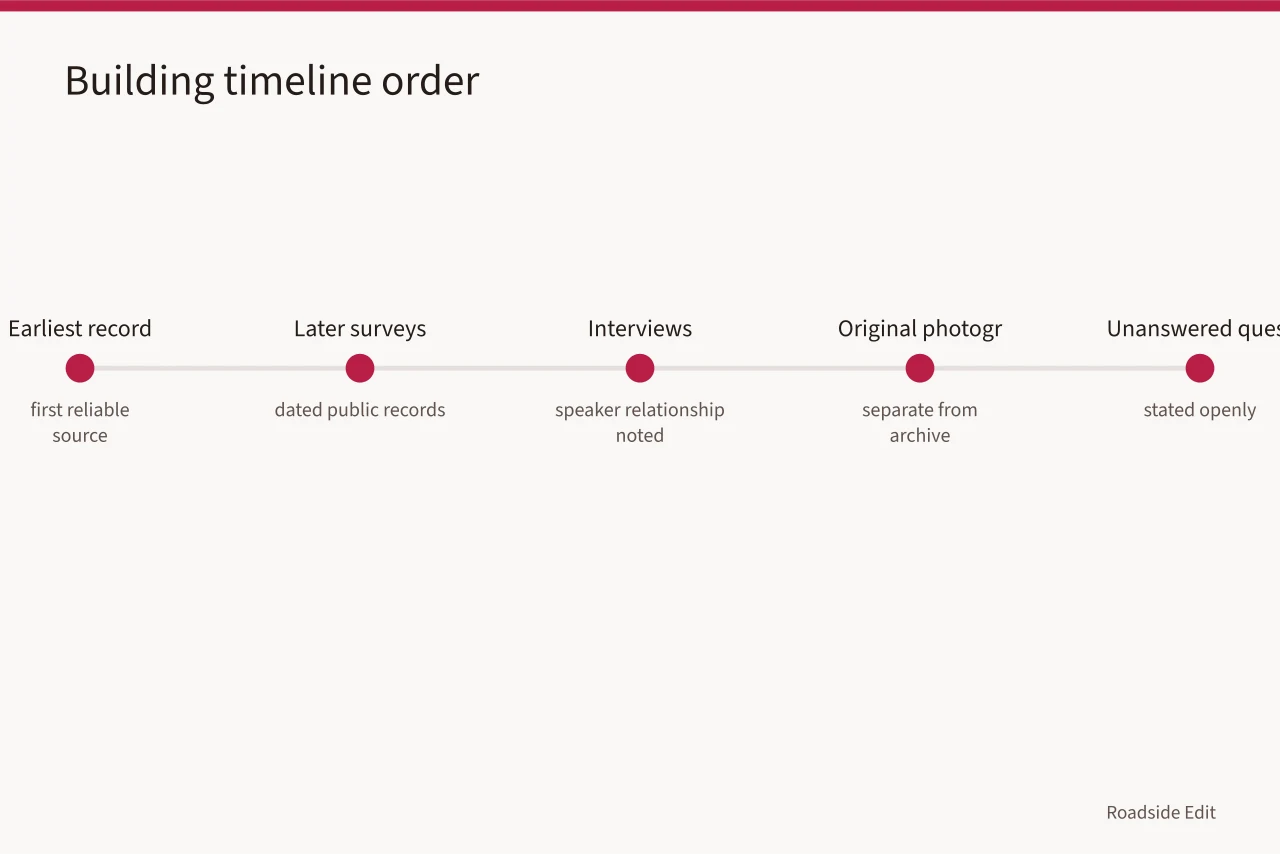
- Identify the earliest reliable record that the article will use.
- Record later surveys, news reports, permits, or public histories with their dates.
- Date interviews and identify the speaker's relationship to the property.
- Date original photography and distinguish it from archive material.
- State unanswered questions rather than using a smooth but unsupported bridge.
The timeline should not become a pile of dates. Choose dates that explain a change in function, appearance, ownership, use, or public interpretation. When an item does not change the reader's understanding, it can stay in the working file rather than crowding the article.
Make reuse stories transparent
Gas stations often outlive their first purpose. A former station may become a small shop, a restaurant, an office, a museum display, a community gathering place, or a vacant property. Reuse can be an interesting editorial angle because it invites a writer to ask how the building's past and present meet.
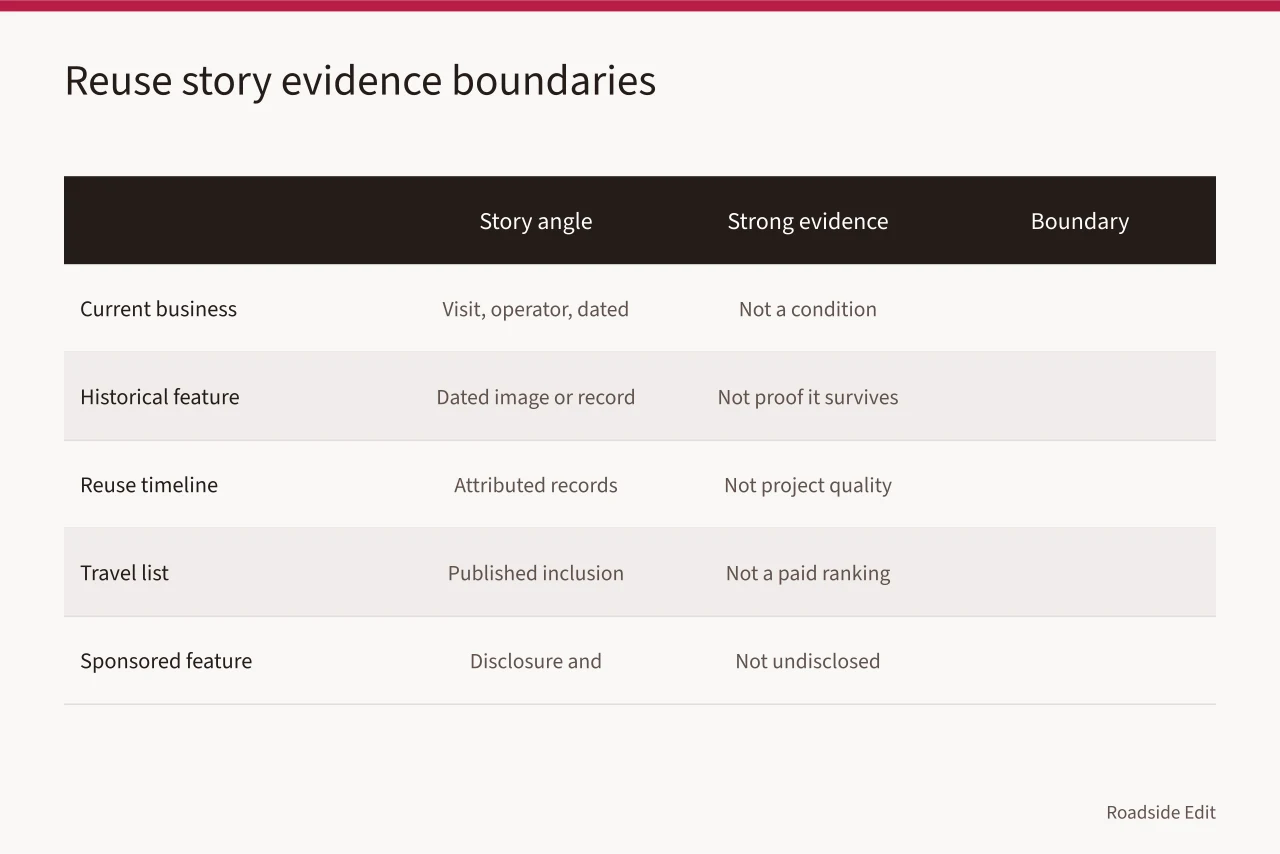
The reporting standard stays the same. Name the current use, date it, and attribute claims to the proper source. Do not imply that an adaptive use is historic preservation, a design success, or financially viable simply because a business occupies the space. Those are distinct questions that require more evidence than a photo and a menu.
| Story angle | Strong evidence | Boundary to keep |
|---|---|---|
| Current business profile | Visit, named operator, dated information | Not a condition or significance assessment |
| Historical feature | Dated image or public record | Not proof that the feature survives |
| Reuse timeline | Attributed records with dates | Not a claim about project quality |
| Travel list | Published inclusion criteria | Not a paid ranking disguised as editorial |
| Sponsored feature | Clear disclosure and supplied details | Not an undisclosed endorsement |
This is also the right place to make commercial relationships plain. A business can buy a clearly labeled profile or submit details for a directory. It cannot quietly buy a place in an editorial list or determine the final wording of fact-checked history. Clean separation protects readers and gives potential advertisers a predictable product.
Use photographs with a precise caption
An image is not a substitute for reporting. It can show a visual atmosphere, explain a physical layout, or help a reader recognize a documented subject. But it must be credited and captioned according to what it actually represents.
For original reporting, retain the original image file, visit date, location, photographer, consent notes when relevant, and any editing history. For archival or licensed material, retain the source page and applicable rights information. A caption should identify the source and date if known, then say whether the image documents the featured property or is illustrative.
Do not use an image of one station to imply the condition or design of another. That can seem obvious in an editor's working folder and become misleading after an image is shared without its original context.
Edit claims in layers
Before publication, read the article in three passes. The first pass checks that every central claim has a source, observation date, or clear attribution. The second checks whether one sentence accidentally claims more than its evidence allows. The third checks whether commercial language has crossed into editorial language.
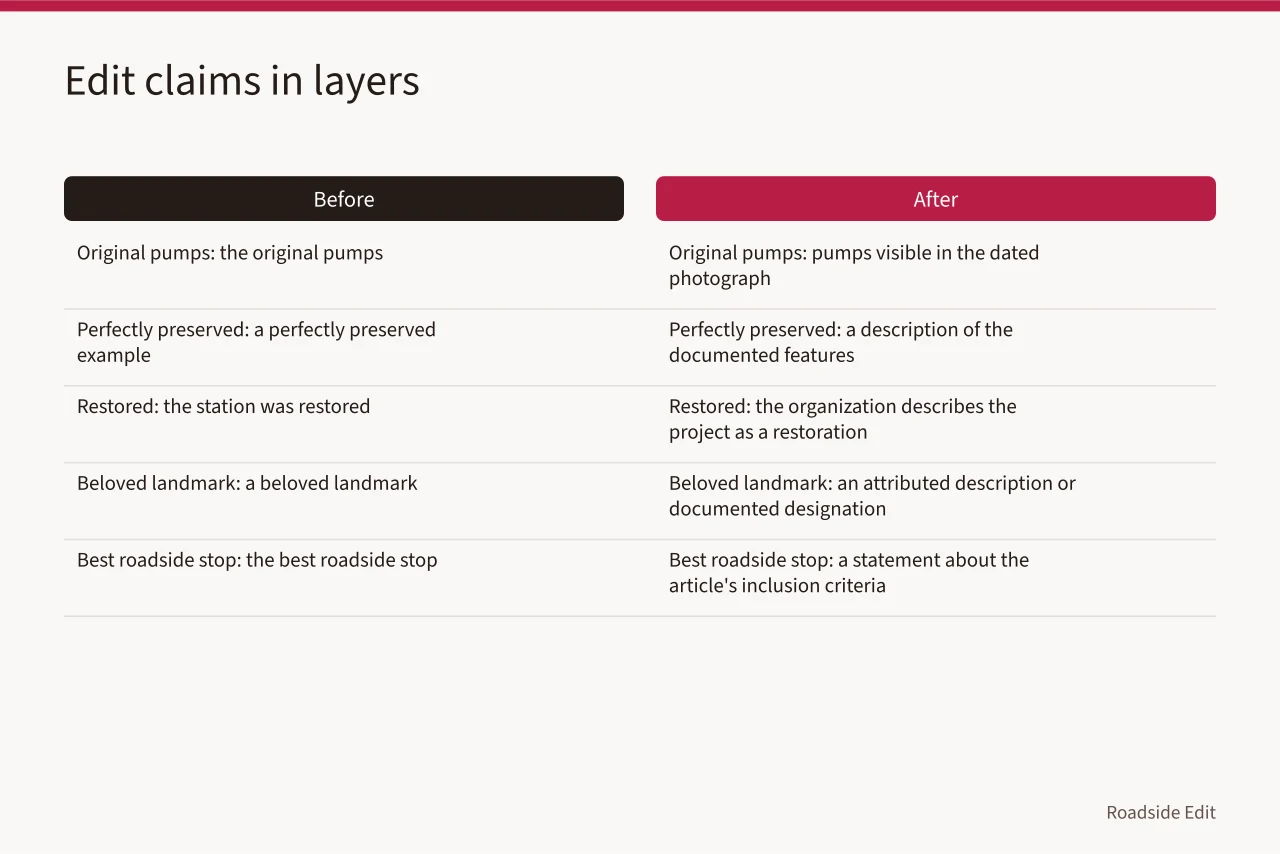
Common revisions are small but meaningful:
- Change "the original pumps" to "pumps visible in the dated photograph."
- Change "a perfectly preserved example" to a description of the documented features.
- Change "the station was restored" to "the organization describes the project as a restoration," unless independent material supports the technical term.
- Change "a beloved landmark" to an attributed description or a documented designation.
- Change "the best roadside stop" to a statement about the article's stated inclusion criteria.
The goal is not to strip a story of voice. It is to make the voice answerable to the evidence. Readers will still get color, history, and practical context. They will also know which parts are documented, observed, or reported by someone with a direct connection to the place.
Create a correction path
Historic-place information changes. An archive may digitize a new photograph. A family may provide a dated record. A business may change hands or close. The page should have an editorial contact and a simple correction practice.
When a correction is needed, identify the claim that changed, update only what the new evidence supports, and note the date of the update. Avoid silently rewriting a statement in a way that hides a material correction. A modest correction note is more credible than a polished page that leaves a known error in place.
The National Archives records-management overview supports keeping an identifiable source and review trail for information that may need later management. In a gas-station feature, that means preserving the record behind an important sentence and the reason it was changed, not treating the page as a property assessment.
The National Archives explains what makes a source primary. Its method supports the guide's basic sequence: establish what a record shows at its date, then ask what additional evidence would be needed for a larger historical claim.
The Federal Trade Commission's endorsement guidance supports a clear disclosure when a material relationship could affect how readers evaluate a feature. Paid participation can be visible and useful without being presented as an independent historic judgment.
Common questions
Does an old gas station qualify as historic because it looks old?
No. Visual age alone does not establish a designation, integrity, significance, or eligibility. An article can describe what it sees and point readers to an appropriate public record or local preservation resource.
Can an article call a canopy original from one historic photo?
No. A photo can show a canopy on its stated date. It does not by itself prove that the feature was original, survives today, or has not been altered.
Can a business sponsor a gas-station feature?
Yes, if the sponsorship is clearly disclosed and business-supplied claims are attributed. Sponsorship should not control an undisclosed editorial ranking or conclusion.
What should a writer do when the sources conflict?
State the conflict when it matters, identify the sources and dates, seek another reliable record, and avoid choosing the more dramatic version without support.
In this guide
- Gas station preservation fundamentals: a 2027 records checklistBuild a gas station preservation file that separates dated records from current observations, so every claim in the draft can be traced and checked.
- Gas station preservation fundamentals: research questions to ask before 2027Frame 2027 gas station research questions around what each source can prove, so a dated record, a photo, or an owner account never carries more than it can.
- Gas station preservation fundamentals: how to build a 2027 records fileA 2027 gas station records file works when six named folders hold dated sources, credits, and caption changes beside the claims they support.