Reviews
Part of Gas station preservation fundamentals: how to report reuse stories with evidence
Gas station preservation fundamentals: research questions to ask before 2027
Frame 2027 gas station research questions around what each source can prove, so a dated record, a photo, or an owner account never carries more than it can.
A research question should narrow a claim, not push a thin record toward a better story. Gas station preservation fundamentals start here: decide what a source can prove before you decide what the article says.
What to take away
- Write the question first, then name the record that would answer it.
- Separate questions about a past date from questions about present condition.
- Treat an owner's account as an attributed statement, not proof.
- When two records disagree, compare their scope before choosing wording.
- Keep the question, the source and the leftover uncertainty in one file.
Build a question-evidence table
Every claim in a preservation feature should trace to a question and a source. Fill the table before drafting, not after.
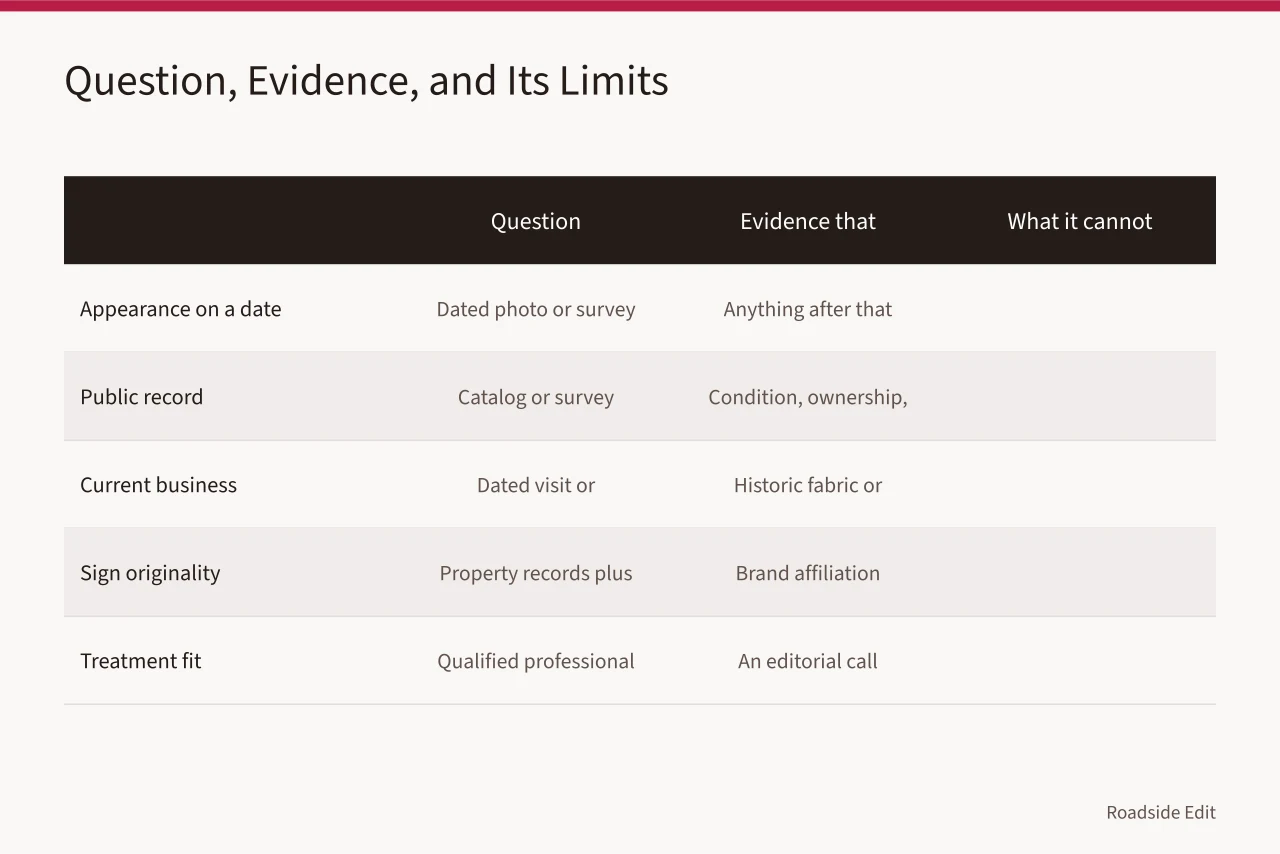
The Historic American Buildings Survey record for the Violet Ray Gasoline Station shows the habit this table rewards. It describes the surveyed complex and records condition as a separate matter. Keep those two apart and you will not turn an architectural description into a verdict about age or condition.
Five questions to ask before writing
- Which source names the property, and where does it place it?
- What is the date of the photograph, record, interview or site visit?
- Is the claim about appearance, documented history, current use, or opinion?
- Does the source use the same word as the draft, such as restored, original or intact?
- What would need a different source, or a licensed professional, to answer?
Question four catches the most errors. A 1950s porcelain-enamel station sign and a 1960s plastic-faced box sign are different objects with different repair paths, and a caption that calls both original signs misleads the reader who is trying to date a facade.
Read the source's limits out loud
An old photograph cannot inspect a present-day canopy soffit. A current visit cannot prove a 1930s construction detail. A business brochure can describe today's service, but it should not become a historic designation. Say which one you have.
The National Archives explains what makes a source primary, which comes down to who created a record, when, and why. A primary source can answer a narrow historical question and still leave later changes unknown.
Its records-management overview supports keeping a record that someone else can find and review. For research questions on sign fabrication and dating, hold the source, the date, the exact claim and the open question together, so an editor does not have to rebuild the decision from a draft.
The Federal Trade Commission's endorsement guidance covers disclosing a relationship that could change how a reader weighs a business-supplied statement. A label tells the reader where the claim came from. It does not confirm the claim.
Resolving conflicts between sources
When records disagree, write the scope of each one before you choose a sentence. One may describe a historic image, another current use. Both can be accurate while answering different questions, and the feature can say so plainly instead of forcing a resolution.
If a source identifies a former service bay but never dates it, ask for a property-specific record on the date. If an owner says the neon is original, ask what firsthand knowledge or dated source supports that. When no answer comes, publish the limited description or leave the detail out.
For anything touching canopy structure, neon transformers, or underground tanks, name the licensed engineer, electrician or environmental authority and refer to the authority having jurisdiction.
For easements, historic tax credits or cross-border import duties on salvaged booths and neon parts, name the attorney, accountant or customs broker.
Preservation compliance runs through the State Historic Preservation Office or the local landmarks commission and the adopted ordinance, not through an article.
Keep the question file after publication. A corrected caption, a better record or an owner update may answer it later. Until then, the article should carry the uncertainty rather than a generic label.
Common questions
Can a writer resolve a conflict by trusting the newer source?
Not automatically. Compare each source's purpose, date and direct connection to the claim. If the conflict changes the story, state it or keep researching.
Is a visible sign enough to identify an original brand affiliation?
No. A sign may be later, reproduced, relocated, or only loosely tied to the building. Use property-specific records before making that claim.
What is the best question for a station owner?
Ask what they know firsthand, when they learned it, and whether they can share a dated source. Attribute the answer rather than treating it as independent proof.