Reviews
Part of How to build a gas station preservation case study method with dated evidence
How to ask better case study questions about former gas stations in 2027
Ask better 2027 case-study questions about former gas stations by separating evidence, project stages, results, limitations, and meaningful comparisons.
A useful case study asks narrow questions and names the limits of the answer. That matters with former gas stations. Two properties can look similar in a photograph while their records, environmental history, proposed use, and stage of work differ sharply. This question set helps an editor describe one documented example without turning it into a promise about another property.
What to take away
- Start with the decision the example can actually inform.
- Separate a historical record, a current observation, and a sponsor statement.
- Compare work at the same stage before comparing outcomes.
- State what a cited result measures and what it leaves unresolved.
Decide what the case study is for
Before gathering images, write one sentence describing the question. For example: "What records explain the former use of this station?" or "What does the public project record say happened during this phase?"
A question about historic form differs from one about cleanup, occupancy, accessibility, financing, or structural condition. The article should not let one answer stand in for the others.
The National Archives explains that archival material can provide firsthand facts and evidence through letters, reports, notes, photographs, and other primary sources. See the National Archives explanation of an archives.
For an editorial case study, identify the record type. A scanned photograph may support a statement about what was visible on its date. It does not by itself prove what is inside a building now.
Questions for the project record
Use the questions below before drafting a comparison. The answers may be "not in the available record." That is a valid answer and usually more useful than a confident guess.
- What exact question does this example answer?
- What is the date and source of each historical, physical, and project claim?
- Does the source describe a proposal, an award, work in progress, or completed work?
- Who supplied any cost, benefit, or reuse statement, and what does it measure?
- What property-specific issue makes the comparison less direct?
The National Park Service advises setting an architectural investigation's purpose and scope before choosing an approach. Preservation Brief 35 describes historical research, documentation, inventory, and stabilization as preliminary parts of the process.
Consult NPS Preservation Brief 35 on architectural investigation.
The brief is not a substitute for a site investigation, but it supports keeping a case study's evidence categories separate.
Compare a second example without flattening it
Comparison works when the reader can see both the match and the difference. Do not compare only architectural style or a before-and-after image. Put the project stage and the record date beside the visible facts. A reader then has enough context to decide whether the example is relevant.
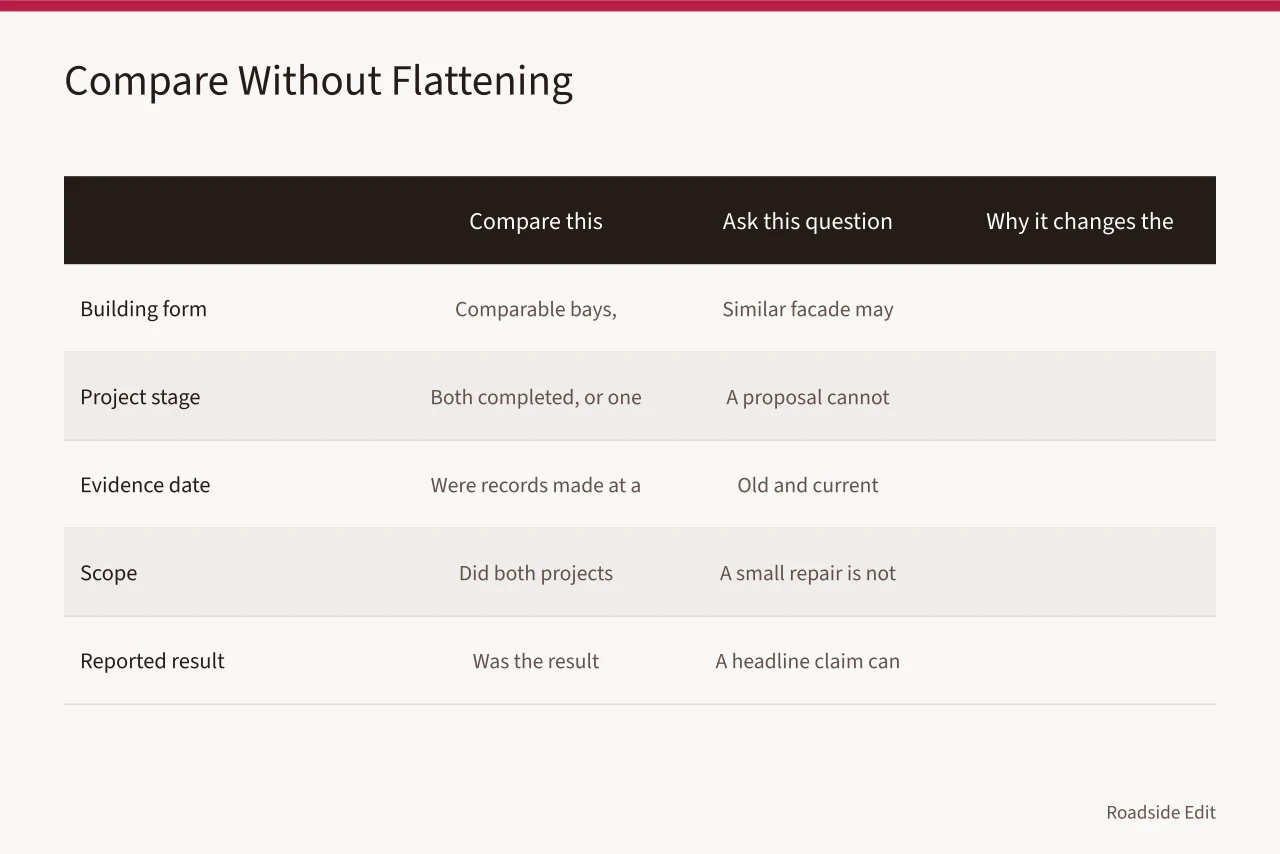
| Compare this | Ask this question | Why it changes the reading |
|---|---|---|
| Building form | Does the second station have comparable bays, materials, and site setting? | A similar facade may hide a different structure or use. |
| Project stage | Are both examples completed, or is one still proposed? | A proposal cannot prove a final result. |
| Evidence date | Were the records made at a similar time? | Old and current records answer different questions. |
| Scope | Did both projects address the same work? | A small repair is not the same as a full rehabilitation. |
| Reported result | Was the result measured in the same way? | A headline claim can omit the boundaries of its measure. |
The EPA Office of Inspector General evaluated 38 brownfield cleanup sites funded by the American Recovery and Reinvestment Act against a stated cleanup-and-reuse intent. Read the EPA OIG Brownfields evaluation.
The report separates sites that met that intent from those that had not as of the stated review period. It is not about one gas station, but it offers a sound editorial habit. Name the group, the measure, and the time frame before repeating a result.
Questions for claims, sponsors, and corrections
The last draft should make attribution visible. Write "the owner reported," "the agency stated," or "the project profile describes" when that is the basis for a statement. A case study does not need to judge whether a proposal is wise. It needs to avoid presenting a supplied claim as an independent finding.
Ask these final questions:
- Could a reader mistake this sentence for a safety finding, approval, or guarantee?
- Is the source close enough to the claim that the reader can see what it supports?
- Does an image receive an illustrative label instead of being used as proof of current condition?
- Has a sponsor, provider, paid placement, or supplied material been identified plainly?
The Federal Trade Commission says an endorsement must reflect the endorser's honest opinion. If an unexpected relationship could affect readers' evaluation, disclose it clearly and conspicuously. Read the FTC guidance on endorsement disclosures.
Those rules apply in their own legal context. For a case-study publisher, the parallel editorial practice is simple: label paid placement and keep editorial findings distinct from paid statements.
Common questions
Can two before-and-after photos make a useful comparison?
They can introduce a question, but they cannot carry the conclusion. Add dates, source, scope, and a meaningful property difference before drawing a comparison.
Is a reported project benefit a verified outcome?
It is a reported outcome unless the article identifies the source, measure, and relevant time period. The wording should preserve that limit.
Should a case study recommend a treatment or provider?
It can identify questions a reader should raise. It should not recommend a treatment or provider without the property-specific information needed for that decision.