Guides
Part of How to build a gas station preservation case study method with dated evidence
Gas station preservation case study records owners should keep for 2027
Use the U-Drop Inn in Shamrock, Texas, to see 2027 records owners should keep: source logs, image credits, timelines, project notes, corrections, and claim limits.
What to take away
- Use the U-Drop Inn in Shamrock, Texas, as a named case study.
- Keep a source log, image credits, and a timeline. Add project stage notes, a correction log, and claim limits.
- Record 2027 review dates for tax credit, grant, and permit files.
- Separate historic context from current project claims.
Good case studies are easier to update because their evidence is already organized. Keep a record that lets a future editor see where a claim came from, what it meant at the time, and whether it needs correction. This matters when a story includes a commercial contributor, a changing project timeline, or images from more than one date.
The U-Drop Inn case study
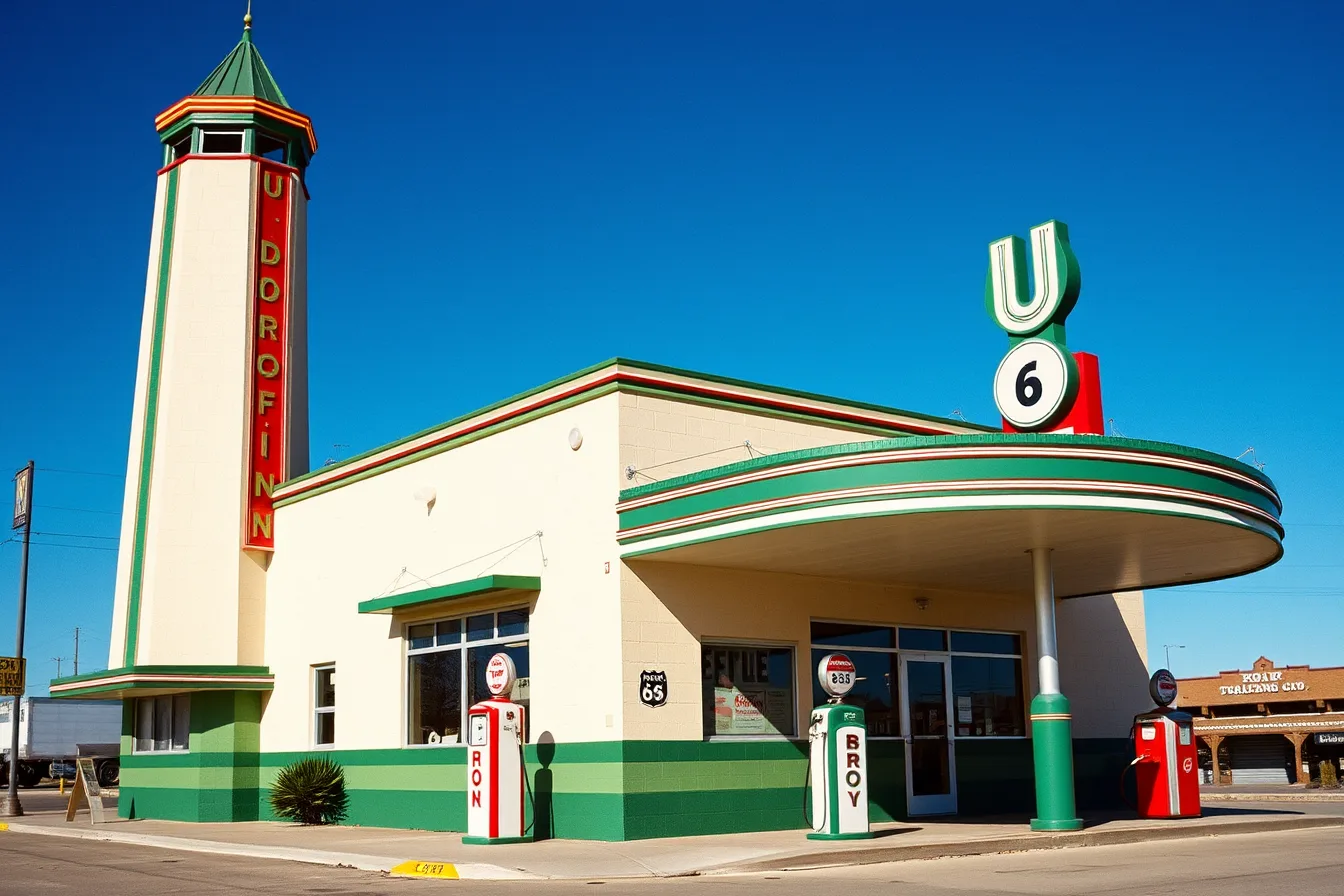
The U-Drop Inn in Shamrock, Texas, is a real 1936 Art Deco gas station and cafe. The City of Shamrock owns it and restored it in the early 2000s. Its file shows what owners should keep for 2027 preservation work. The Texas Historical Commission reviews state and federal preservation programs. The National Register of Historic Places listing file includes the nomination and photos. A 2027 owner should keep those records with new inspection reports and cost estimates.
For 2027, add current inspection reports, cost estimates, and grant correspondence. If work uses federal funds, keep the Section 106 review letters and the State Historic Preservation Office correspondence. The Texas Historical Commission is the state historic preservation office. It administers the Texas Historical Marker program.
Essential record set
- A research question and the reason the property was selected. For U-Drop Inn, note Route 66 tourism and Art Deco design.
- A source log with URL or archive reference, publisher, date, claim supported, and limit. Use Google Sheets or Microsoft Excel. Google Sheets is free with a Google account. Excel requires a Microsoft 365 subscription.
- A timeline that separates history, observation, and proposal. Add approval, work, and completion stages separately.
- Image files with license, credit, source page, date, and caption purpose. Wikimedia Commons stores freely licensed images with credit fields.
- A claim log for owner, provider, agency, and sponsor statements. The City of Shamrock and Texas Historical Commission are likely sources.
- A correction log showing what changed, when, and why.
Tools and providers for 2027
The National Park Service publishes Preservation Briefs and the National Register. Read the NPS Cambridge Apartments case study. It presents historical context and a defined scope of rehabilitation before describing the project.
The National Archives explains what makes a primary source. A source can be primary for one narrowly framed question and weak for another.
The Internet Archive Wayback Machine saves public web pages with timestamps. It is free to use. Save the Texas Historical Commission page and the City of Shamrock page before 2027 review.
The Library of Congress HABS/HAER/HALS collection offers measured drawings and photos. Access is public. It can document a station's exterior and site.
Keep commercial material in its own folder and disclose it on the public page. The Federal Trade Commission's endorsement guidance addresses material connections. If an operator funded a profile or supplied a photo, record the relationship, permission, and claim source beside the asset.
A simple record table
| Field | Example entry |
|---|---|
| Claim | 'The City of Shamrock restored the U-Drop Inn.' |
| Source | City page or Texas Historical Commission file with date |
| Status | Reported, verified, proposed, or completed as stated by source |
| Limit | Does not prove current access or another station's condition |
| Review date | Date the writer rechecked the statement for 2027 |
Label the evidence by what it can answer
The National Park Service describes historic documentation as information used by historians, researchers, preservationists, architects, and others in planning. In a U-Drop Inn file, note whether an item supports historical context, a project-stage statement, or a visible feature. Do not label it as current evidence when it was not created for that purpose.
A well-kept record makes an honest article more durable. It lets an editor update an opening date, project stage, or correction without changing the historical context. It also lets a reader see that an image credit establishes provenance, not a claim about another site.
Add a review cadence. Recheck time-sensitive statements such as proposed use, announced funding, operating information, and construction stage before the next publication date. Historical material may need less frequent review. When a source page changes, save the new date and compare the precise sentence.
For a multi-author article, give each material claim one editor of record. That person need not be the subject-matter decision maker. The editor confirms that the published sentence matches the identified source and contains the source's limitation when it matters.
The image is illustrative only and does not document another property's case-study record.
Common questions
Should source files be kept after publication?
Yes. Preserve the source log and permitted copies or references so later updates can be traced. For U-Drop Inn, keep the National Register file and city records.
Can an image credit be stored only in a spreadsheet?
No. Keep the credit in the article near the image as well as in the project record.
What should happen when a supplied claim changes?
Add a dated correction, revise the article, and retain enough of the record to explain the change.