Guides
Winter interior documentation of Upper Midwest diners in Illinois and Minnesota
Winter diner interior documentation in Illinois and Minnesota turns on low sun, building heat and tight access, and each one changes how you shoot and survey.
What to take away
- Low winter sun rakes through a diner's glass front at a shallow angle, so the usable light window is short and worth timing to the hour.
- A cold camera carried into a warm diner fogs inside the lens; let it acclimate in the bag for 20 to 30 minutes before the first frame.
- Working diners give access before opening or after closing, and a 90-minute to two-hour slot covers a small diner room by room.
- Survey floors, walls, ceilings, counters, seating, lighting, windows and interior signage, and log what you could not see.
- Minnesota's shorter, colder days and Illinois' freeze-thaw swings call for different kit, timing and travel plans.
What winter light does to a diner interior
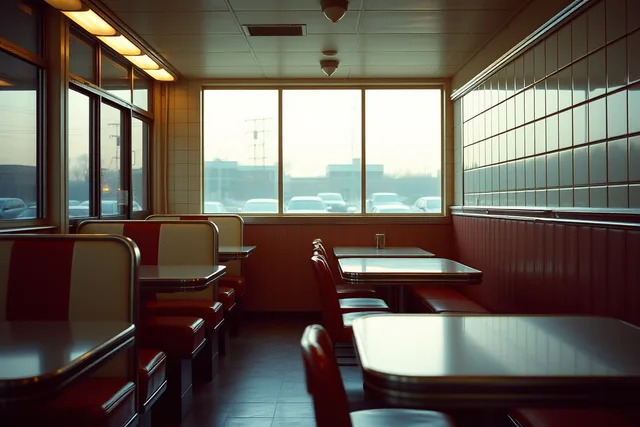
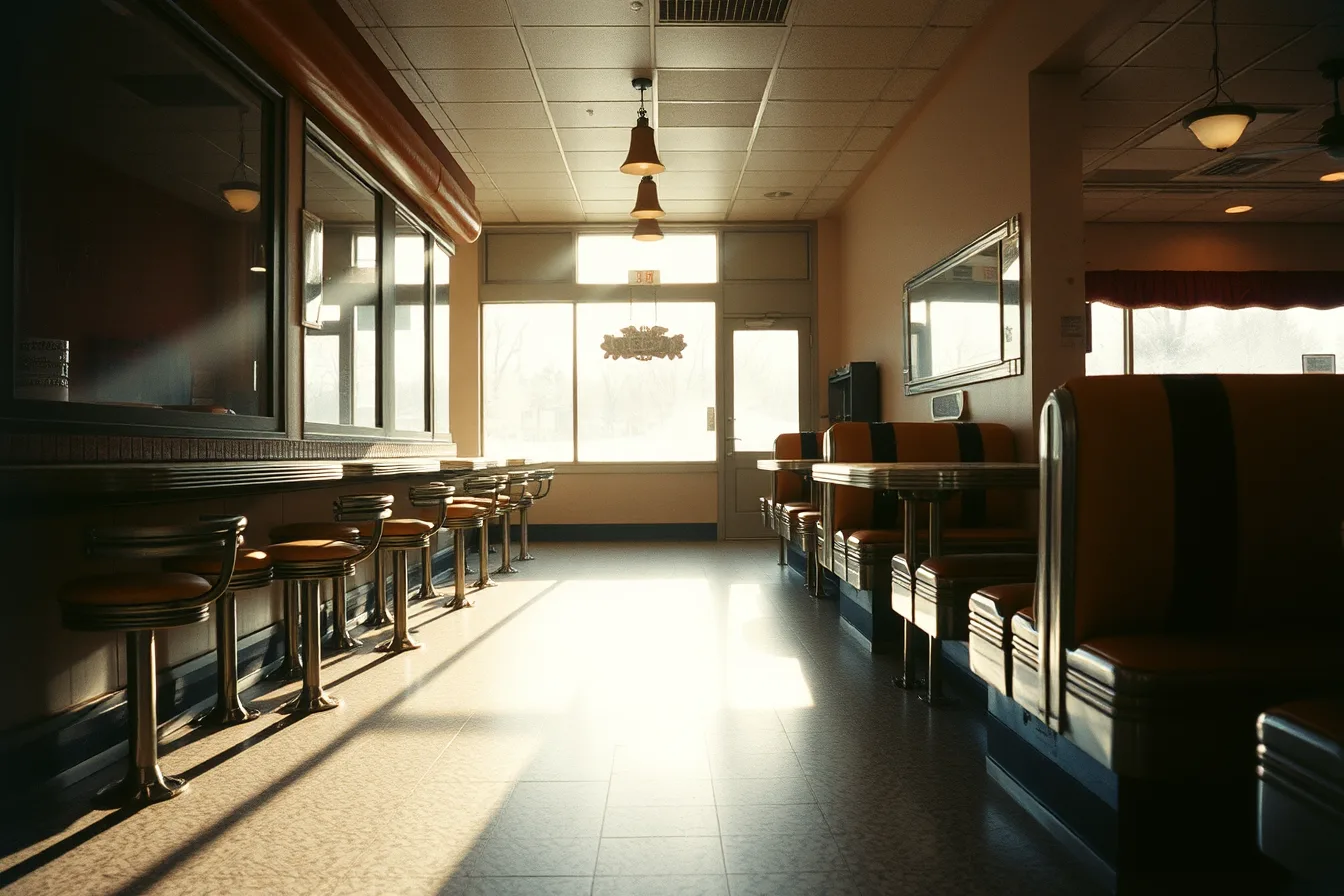
For most of a Midwest winter day the sun sits low. Through a diner's glass front it rakes across the counter, booth backs and floor in long strips instead of dropping flat from above.
That angle is the reason to work in this season. Raking light finds texture in terrazzo, ceramic tile and wood veneer that overhead fluorescents erase. It also throws hard shadows from stools, napkin dispensers and pendant lamps, which you manage by moving your own position, never the furniture.
The window is short. In northern Minnesota the sun may not clear neighboring rooflines for hours, and on an overcast day it never does. Central Illinois gets more direct sun and more cloud. Check sunrise and sunset for the site and put your interior work in the middle of the day.
Treat the glass front as your key light. Glass block, curved glass and plate glass each behave like a large softbox. When the sun turns harsh, a diffusion panel taped at the window tames it without killing the character.
Turn off the overheads when color accuracy matters and work from a tripod on a longer exposure. Mixing window light with fluorescents shifts color across the frame and is hard to correct later.
Shoot the wide view, then spend your remaining light on details: the way light crosses a counter edge, the grain of a booth back, the reflection in a chrome napkin holder. Those frames carry condition as well as character. A working frame list is in Twelve frames.
Winter also strips the room down. Summer signage comes off the glass, crowds thin, and the low light gives an interior a warmth that summer glare washes out. That is why winter is underrated for this work.
Heat, condensation and what it does to gear and fabric
A working diner is a wet, warm building. Grills, fryers, dishwashers and coffee makers push moist air into the room, and it meets cold glass. Condensation forms on windows, mirrors and chrome, and it is both a subject and a hazard to your equipment.
Bring a cold camera into that room and moisture condenses on the lens and inside the body. Leave the camera in its bag for 20 to 30 minutes before you shoot. Moving repeatedly between cold and warm, keep it sealed with a desiccant pack and wipe the lens only once it has reached room temperature.
Heat works on historic fabric the same way. Window frames rot and ferrous hardware corrodes where condensation repeats. Tile and terrazzo show efflorescence and staining. Dry heat pulls moisture from vinyl booth upholstery until it cracks. Record these conditions; do not clean or repair them on a documentation visit.
The National Park Service publishes material-specific guidance through Technical Preservation Services, covering windows, metals, wood and masonry, all of which turn up in a diner interior.
Cold changes your kit list. Battery capacity falls in low temperatures, so carry spares in an inside pocket and rotate them. Metal tripod legs pull heat from bare hands; foam pipe insulation on the upper sections fixes that. A microfiber cloth and a small blower clear dust and condensation without scratching a finish.
Map the room's microclimates before you start. A booth against a radiator or a counter seat over a floor vent runs warmer and drier than a corner table, and that difference shows in both the fabric and the people sitting there.
Scheduling around service hours
Access is the binding constraint. Almost every vintage diner in Illinois and Minnesota is a working business, and you cannot block the counter at breakfast or stop a cook mid-rush. Winter tightens it further: fewer daylight hours, more indoor seating, staff already stretched.
Ask the owner or manager for time before opening or after closing. Before the grill is lit you get clean surfaces and no customers. After the last table you get the same room under different light. Both demand that you arrive with a plan and work fast.
Know your ask before you make it. A condition survey of a small diner runs roughly 90 minutes to two hours. A photo shoot can be shorter if you carry a shot list.
Say plainly that you will not move fixtures, that you will stay out of the kitchen unless invited, and that the owner gets copies of your images and notes.
That is what earns a second visit.
Some diners close in winter or on set weekdays. A closed building may hold heat at a low setting, which changes condensation and comfort. An unheated one puts your gear, your hands and the historic materials at risk from freeze-thaw, so document quickly and record the conditions you found.
If interior access never comes, shoot the exterior. Bare trees open up sightlines to signage and rooflines that summer foliage hides. Keep the interior request alive with a polite call in January, once the holiday rush has passed. The permissions and timing side of this is set out in the field list.
A room-by-room condition survey
A condition survey records what exists and what is failing, in a form someone else can compare against a later visit. Work room by room: entry, counter, booth area, back counter, restrooms. Add the kitchen as a sixth space only if it is open to you, and label it as such.
Use one checklist across every site so the records line up.
- Floor: terrazzo, tile, vinyl or carpet. Note cracks, missing tiles, staining, unevenness.
- Walls: tile, laminate, wood panel or paint. Note cracks, water staining, loose tile, peeling paint.
- Ceiling: acoustic tile, plaster or metal. Note sagging, staining, missing tiles, water damage.
- Counter: laminate, stone or metal. Note chips, burns, open seams, support condition.
- Seating: booths, stools, chairs. Note upholstery tears, frame condition, missing feet.
- Lighting: fixtures, switches, outlets. Note original against replaced, working condition, missing parts.
- Windows: glass, frames, hardware. Note cracks, condensation damage, paint failure, operation.
- Signage and decor: interior signs, clocks, dispensers. Note condition, attachment, originality.
For each line, take a wide shot and a detail shot, and write the location in your notes. Where something is inaccessible, say so; a survey that admits its gaps is worth more than one that guesses.
The Secretary of the Interior's Standards for Rehabilitation define what counts as sensitive work on this fabric. Start with the preservation briefs index for material guidance, and the NPS technical notes for rehab practice.
Filing is part of the survey. Name files by site, date, room and subject, and keep one log of every frame. That structure is the backbone of a case study record and it is what makes a second visit comparable to the first.
Illinois and Minnesota are not the same winter
The two states share a season and not much else. Illinois runs milder in the south and colder in the north, with heavy freeze-thaw cycling through the middle. Minnesota is colder and darker, with deeper snow and shorter days.
Illinois holds more diners, spread further apart, so a day's drive can cover several sites. Its winter light swings between bright low sun that suits interiors and flat gray that does not. Freeze-thaw works on exterior masonry and window frames, and that moisture shows up inside. Build slack into the schedule and watch the forecast.
Minnesota's cold is steadier and its daylight shorter. The diner stock clusters in the Twin Cities with a few in outstate towns. Snow cover bounces light into interiors, brightening a room while flattening its contrast. Extreme cold makes plastics brittle and drains batteries faster, so plan shorter shoots with more warm-up breaks.
Both states have active State Historic Preservation Offices and local landmarks commissions. If a diner is listed on the National Register of Historic Places, or sits in a local historic district, your survey may feed a Section 106 review or a design review.
That raises the accuracy bar: original fabric and later alterations must be separated clearly in your notes.
Plan travel and light from data rather than memory. NOAA weather data publishes forecasts and climate normals that help you pick days with usable light and safe roads.
Budgeting a two-state run is its own exercise. The case study method works through the schedule and cost side of a multi-site winter survey.
Separating observation from inference
Write what you saw, where you stood, and under what conditions. If a corner was too dark to assess, say so. If a booth was occupied and you never photographed it, say so. A reader five years out needs to know the edges of your survey more than its middle.
Keep one note format. Site name, address, date and time, weather and indoor temperature if you have it. Then who granted access. Then the room-by-room list. Attach the photos under matching file names.
Keep a second log of what you could not see and why. That log is not an admission of a weak survey; it is the part that makes the rest trustworthy.
The window for this work is short, and low sun, building heat and tight access all push you to move. What you get in return is a record of diner interiors that is hard to assemble in any other season: quiet rooms, warm windows, and materials read under raking light.
Common questions
Why is winter the right season for diner interiors?
Low sun rakes through the glass front and shows texture that summer light flattens. Rooms are quieter, and before-opening or after-closing access is easier to arrange than in July.
How do I keep condensation off the camera in a warm diner?
Let it acclimate inside its bag for 20 to 30 minutes before the first frame. Moving between cold and warm, keep it sealed with a desiccant pack and wipe the lens only after it warms.
What belongs in a diner condition survey?
Floors, walls and ceilings first, then counters and seating.
Then lighting, windows and interior signage. For each, record the material, its condition, the location, and a wide plus a detail frame.
How do Illinois and Minnesota winters differ for this work?
Illinois brings more variable light and heavier freeze-thaw cycling; Minnesota is colder and darker with shorter days. Both need flexible scheduling and cold-weather care for batteries and tripods.