Guides
How federal Section 106 review affects US Route 66 motel owners
Section 106 review reaches Route 66 motel owners when federal money, permits or licenses touch the property, and the SHPO runs the consultation process.
What to take away
- Section 106 applies to federal undertakings: a Small Business Administration loan, a Route 66 Corridor Preservation Program grant, an Army Corps of Engineers permit, an FCC license on a rooftop antenna.
- Private money with no federal permit, license or funding stays outside the process, though state and local review may still apply.
- The State Historic Preservation Office is your working contact; the Advisory Council on Historic Preservation enters on disagreement, controversy or complex effects.
- The Area of Potential Effect must account for the sign, the court and the setting, not just the parcel line.
- Demolition is always an adverse effect, but it resolves through a memorandum of agreement with mitigation, not an automatic denial.
What actually triggers review on a Route 66 motel
Section 106 of the National Historic Preservation Act requires federal agencies to weigh their actions against historic properties. A plain-language introduction to the Section 106 process states the scope plainly: the law covers federal undertakings, not every renovation.
Three triggers reach motels most often.
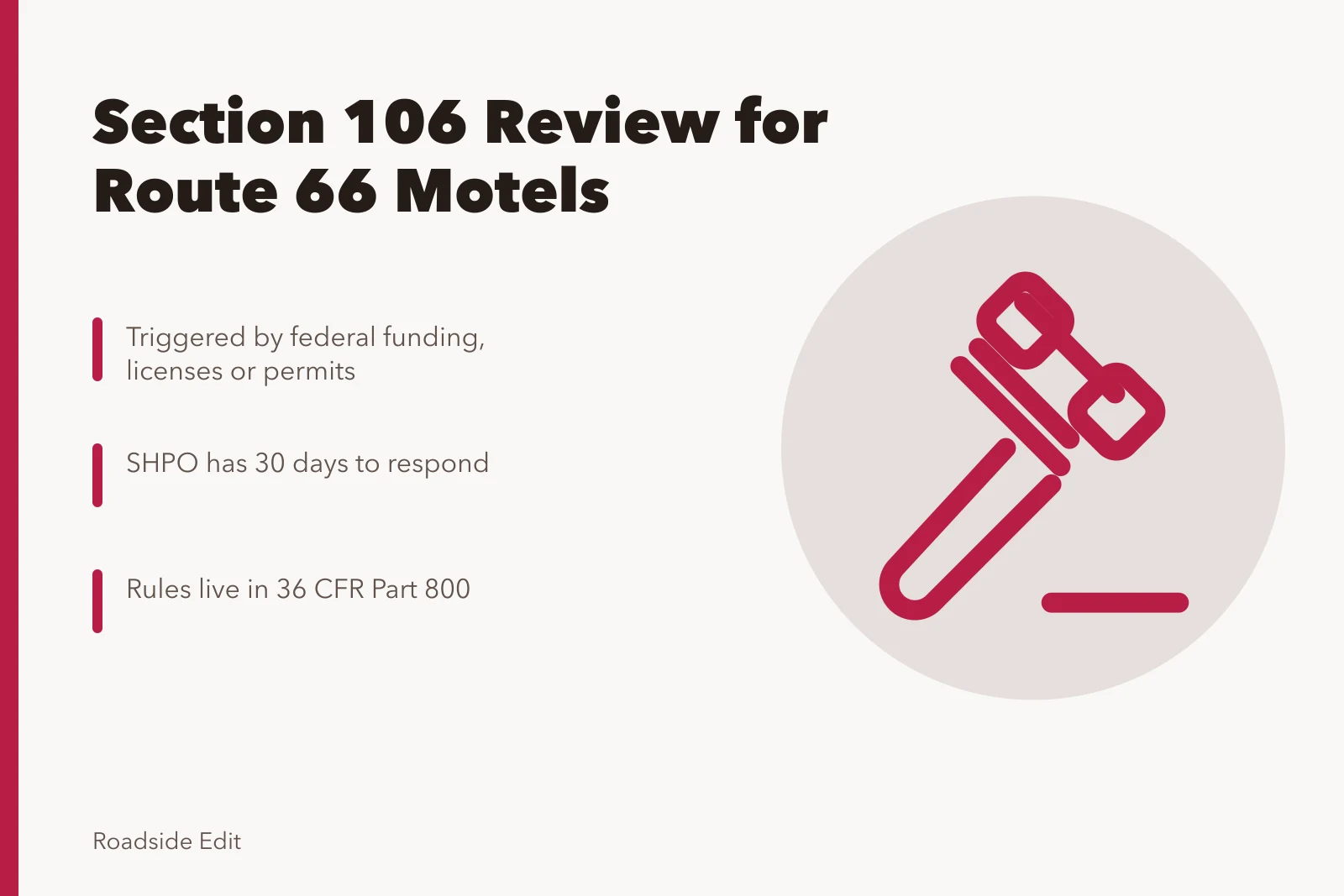
Federal funding is the direct one. An SBA loan to rebuild a burned wing, a National Park Service Route 66 Corridor Preservation Program grant for a sign, or federal disaster aid all count. The funding agency carries the Section 106 duty.
Federal licensing covers activities like broadcasting and energy. A cell antenna on the roof or an illuminated billboard under an FCC license is a federal undertaking, and the license holder's agency must consider effects on historic properties.
Federal permits include Clean Water Act permits from the Army Corps of Engineers and some Federal Highway Administration access permits. A new driveway cut or a sign near a federal highway can pull the project in. The permitting agency becomes the lead agency.
Age does most of the qualifying work. Most motels built between the 1920s and the 1960s clear the 50-year threshold for National Register eligibility, and a modest motor court with a porcelain-enamel or neon sign can qualify on association with the highway alone.
Eligibility does not freeze the property. It means an agency must consult before it acts. Owners who understand the sequence early shape the outcome instead of reacting to it. For period imagery that supports an eligibility argument, see Historic Motel Postcards.
Defining the Area of Potential Effect around the sign and court
The first formal step is the Area of Potential Effect, the geographic area where the project could affect a historic property. For a motel that means the office, the guest wings, the neon or enamel sign, the pump-island footprint if one survives, the parking court and the setting that carries the property's significance.
Direct effects are physical: demolishing a wing, removing a sign, over-painting original enamel. Indirect effects are changes in traffic, noise, lighting or visual setting. A taller building next door can alter the setting a Route 66 eligibility argument depends on.
The APE often runs past the property line. If the motel is eligible because of its highway association, the boundary may need to include contributing viewsheds. Photographs with dated field notes and a scaled site plan give the SHPO something to review rather than something to question.
A narrow APE that excludes a contributing sign or a dry-stand pipe will come back. A disciplined case study method organizes that evidence before submittal, which is cheaper than resubmitting.
Consultation: the SHPO, the ACHP and the 30-day clock
The lead federal agency consults the State Historic Preservation Office, the state's expert on historic properties. The SHPO generally has 30 days to respond to most submittals. If the SHPO concurs, the process moves; if not, the agency revises its work or gathers more information.
The Advisory Council on Historic Preservation is an independent federal agency that oversees the process. It enters on disagreement, controversy or complex effects. Most motel projects never reach it. The ACHP publishes official guidance and case examples for Section 106 review, including roadside properties handled in other states.
Consultation is not a public hearing, but the agency must make reasonable efforts to involve the public. A sign restoration may need a notice to local preservation groups. A demolition may need more.
The Section 106 regulations carry the timeframes, roles and resolution steps. Read them and you can follow the conversation and spot when an agency skips a step. The agency must consider SHPO comments; it does not have to agree with them.
Assessing adverse effect on a sign, a facade or a wing
Adverse effect finding means the project could diminish:
- integrity of location
- design
- setting
- materials
- workmanship
- feeling
- association Demolition is always adverse. So is an addition that overwhelms the original building.
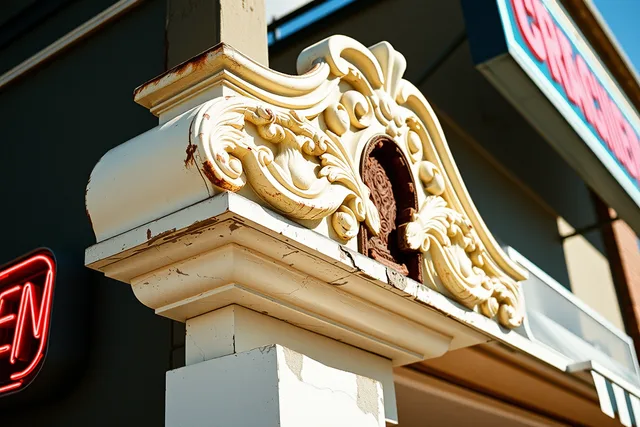
The sign is usually the most sensitive element. Removing a porcelain-enamel panel, replacing neon with LED, or repainting a sign in non-historic colors can each be adverse when the sign contributes to significance. The same test applies to brick veneer, curtain-wall glazing and butterfly roofs that date a motel exterior to a decade.
If the motel is listed, review is more rigorous. If it is eligible but unlisted, the same standards apply. The agency asks whether the project harms the characteristics that make the property eligible.
An adverse finding is not a denial. It moves the project into resolution, which can end in a memorandum of agreement with mitigation. If the agency finds no adverse effect and the SHPO concurs, the review closes there. Straight talk on restoration planning helps you prepare for both paths.
Avoid, minimize, mitigate: the order 36 CFR Part 800 requires
The binding Section 106 regulations and consultation steps rank the responses. Avoidance comes first. Keep the original sign and build the new wing behind the court, and the adverse effect may disappear.
Minimization comes second. Keep the sign but change the lighting to cut glare. Keep the facade and take out an interior wall. Minimization protects the features that carry significance while letting the project proceed.
Mitigation is the last resort, and it compensates rather than prevents. Historic American Buildings Survey documentation, oral histories, salvage of a sign to a local museum, or a preservation fund all appear in agreements.
A run of neon tubing formed to the wrong length is a return trip with a trailer, which is why salvage is planned before demolition, not during it.
The regulation also allows program alternatives such as programmatic agreements, which can set standard mitigation for routine work. A state may hold a programmatic agreement covering small motel renovations. Ask your SHPO what alternatives exist in your state.
Memoranda of agreement, program alternatives and e106
A memorandum of agreement is the document that records how adverse effects will be resolved. The agency, the SHPO and sometimes the ACHP sign it. It sets the mitigation measures and the schedule.
MOAs are negotiated, so owners should help draft them. A phased demolition with documentation first, an easement on the sign, or a maintenance plan for the neon can all be written in. Once signed, the MOA binds and becomes part of the federal approval.
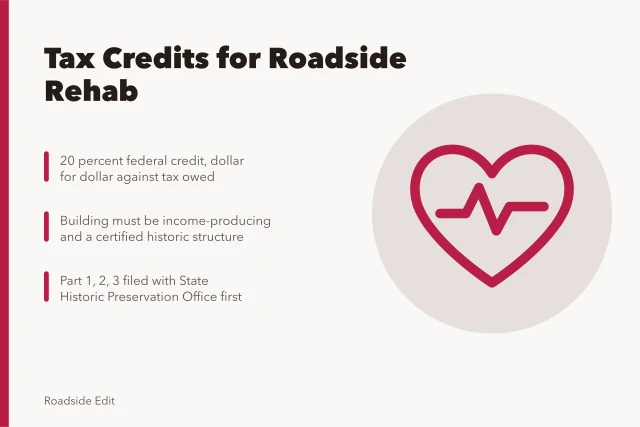
Program alternatives, including programmatic agreements, alternative procedures and exemptions, can cover a category of projects such as sign replacements along a corridor. If one fits your work, you may avoid a full review.
The e106 submittal system is where Section 106 documentation goes to the ACHP when the ACHP is involved. Owners rarely file directly; consultants and agency staff do. Knowing the system exists helps you ask where your paperwork sits.
Missing documents stall review for months. Keep every submittal, every agency determination letter and every SHPO concurrence in one file.
Documentation package to assemble before demolition or alteration
Build the package before you file, organized by category. The SHPO can request more on a complex project, but this covers the base.
- Dated photographs of all elevations, the sign faces and can, the office, the guest wings and the site.
- Historic photographs and postcards showing the property's original appearance.
- A written architectural description noting materials, design and alterations by decade.
- A site plan and an Area of Potential Effect map with boundaries and nearby historic resources.
- A project description stating what will be demolished, altered or added.
- A statement of significance tying the motel to Route 66 history and specific National Register criteria.
- Copies of permits, funding applications and correspondence with the lead federal agency.
Photographs should be dated and labeled. Maps should show north and scale. The statement of significance should cite facts, not praise.
Document the interior too. Lobby tile, diner booth laminate, chrome-edge trim and original counters are the details lost first and the ones that support mitigation or a salvage argument.
Phase by wing rather than all at once. A smaller scope can mean fewer effects, a faster review and time to raise mitigation funds. Where life safety work is part of the project, Fire Suppression Upgrades raise separate code questions worth documenting early.
Keep a log of calls, emails and meetings with the SHPO and the agency, with dates and names. It shows good faith and it settles disputes later.
Common questions
Does Section 106 apply if I use only private money?
No. Section 106 reaches federal undertakings, so private funds with no federal permit, license or funding stay outside it. State and local preservation ordinances may still apply, and your local landmarks commission or SHPO can say which. Ask before you sign a contract, not after.
What belongs in the Area of Potential Effect for a motel with a neon sign?
The office, wings, sign, parking court and any setting that contributes to significance, including viewsheds that may cross the property line. A scaled map with dated photographs supports the boundary. If the SHPO finds the area too narrow, expect a request to revise it.
How long does the review take?
A simple concurrence can close in about 30 days, the SHPO's usual response window. Complex projects with an adverse effect finding and a memorandum of agreement can run several months. Extensions and additional consultation add time, so build the schedule into your construction financing.
Can I demolish a historic motel after Section 106?
Demolition is always an adverse effect, but it is not automatically prohibited. It resolves through a memorandum of agreement that may require HABS documentation, salvage or another mitigation measure. The agreement, not the review, decides what you must do.