
Guides
Historic motel restoration case study method: how to document a project honestly
Historic motel case study method for 2027 explains how to document sources, conditions, decisions, changes, and limits without inventing project results.
A useful historic motel case study starts with a record, not a dramatic conclusion: what property, which time period the evidence covers, which source supports each statement, and what remains unknown.
That approach helps readers without pretending a photo, a project mention, or a sponsor statement proves more than it does.
This method is for editorial documentation. It does not assess a building, verify a project's historic status, approve a treatment, establish an incentive result, or endorse a business. A real project needs the right property-specific records and review for its location and scope.
What to take away
- Define the question before collecting material.
- Keep historical context, current observations, project decisions, and reported work in separate sections.
- Attach a source and date to every factual statement.
- Record changes and open questions instead of smoothing them out of the story.
- Label paid placements, supplied material, and media credits by their actual role.
Decide what the case study can answer
Before writing a headline, write a narrow research question. A case study might explain how a documented entry sequence changed over time, how a planning team handled an evidence gap, or how records were organized before considering a limited scope.
It should not answer questions its sources cannot support, such as whether a renovation was appropriate, compliant, profitable, or successful.
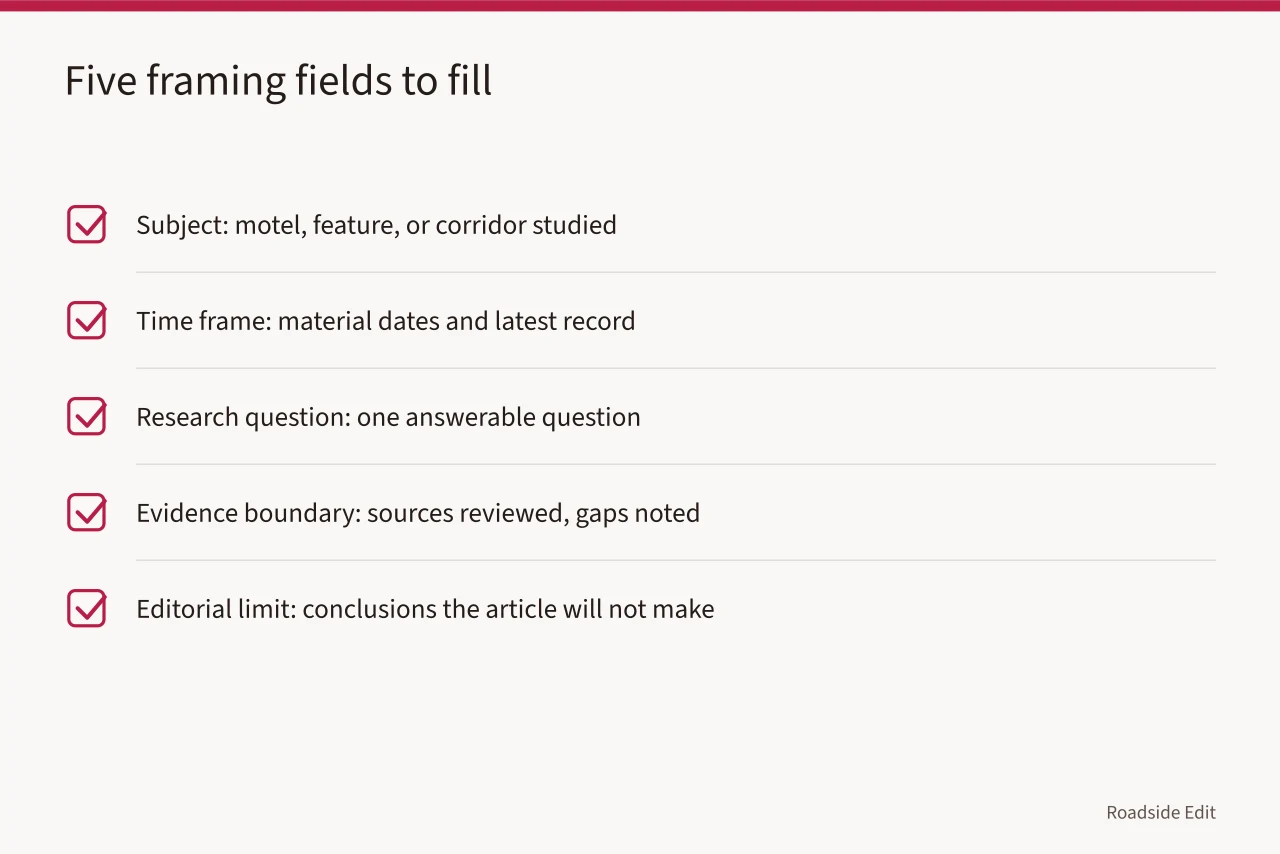
Start with five framing fields:
| Field | What to write |
|---|---|
| Subject | The motel, feature, route corridor, or documented project being studied |
| Time frame | Dates covered by the material and the date of the latest record |
| Research question | One answerable question, not a promotional goal |
| Evidence boundary | What sources were reviewed and what was not available |
| Editorial limit | The conclusions the article will not make |
An example question might be, "What records describe the motel sign in the selected time period?" A weaker question would be, "How did the sign restoration transform the business?"
It assumes a treatment, an outcome, and a business result, and requires evidence that many public records will not contain.
Build a source map before drafting
Collecting sources differs from giving every source the same job; a historic photograph may document an appearance on a particular date.
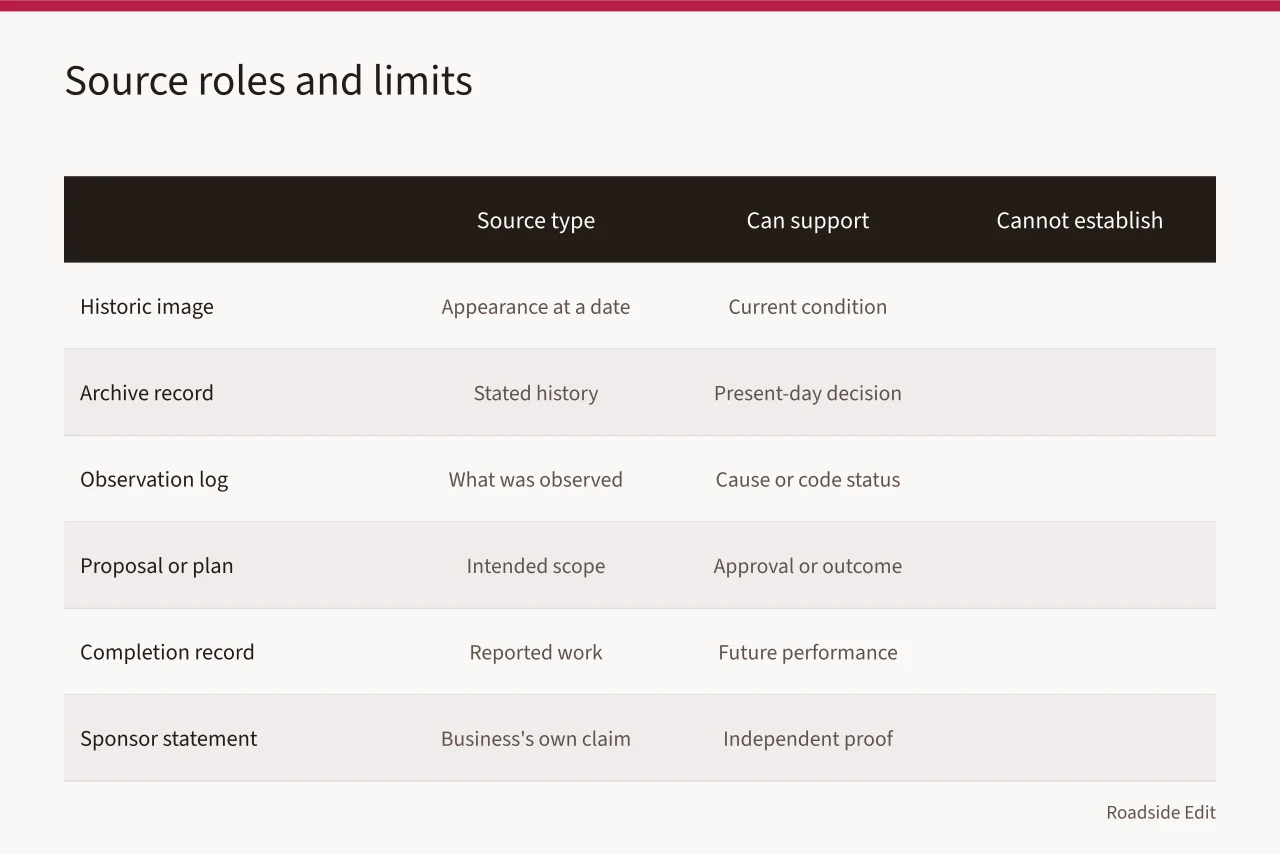
A planning record may document a proposed decision, and a scope document may list intended work. A completion record may report what was done, and a media credit identifies an image's origin. None of those roles automatically proves the next one.
| Source type | It can support | It cannot establish by itself |
|---|---|---|
| Historic image | Documented appearance at a date | Current condition or treatment quality |
| Archive or survey record | What the record states about history or description | A present-day project decision |
| Observation log | What was observed in a defined location and time | Cause, code status, or concealed conditions |
| Proposal or plan | A stated intended scope | Approval, completion, or outcome |
| Completion documentation | Reported work, materials, or changes | Future performance or financial impact |
| Sponsor statement | A business's own claim | Independent proof about a property |
The National Park Service describes its Historic Property Project Documentation tool as a flexible, collaborative way to collect and integrate resource-management information into planning and to document treatment decisions. Read the NPS HPPD overview.
That tool fits an NPS context. The transferable editorial lesson: keep the records behind a decision connected, rather than making one source carry the whole story.
Use a four-part case structure
The cleanest case study structure separates evidence from interpretation and proposed work from reported work. Readers should be able to stop at any section and see the status of the information.
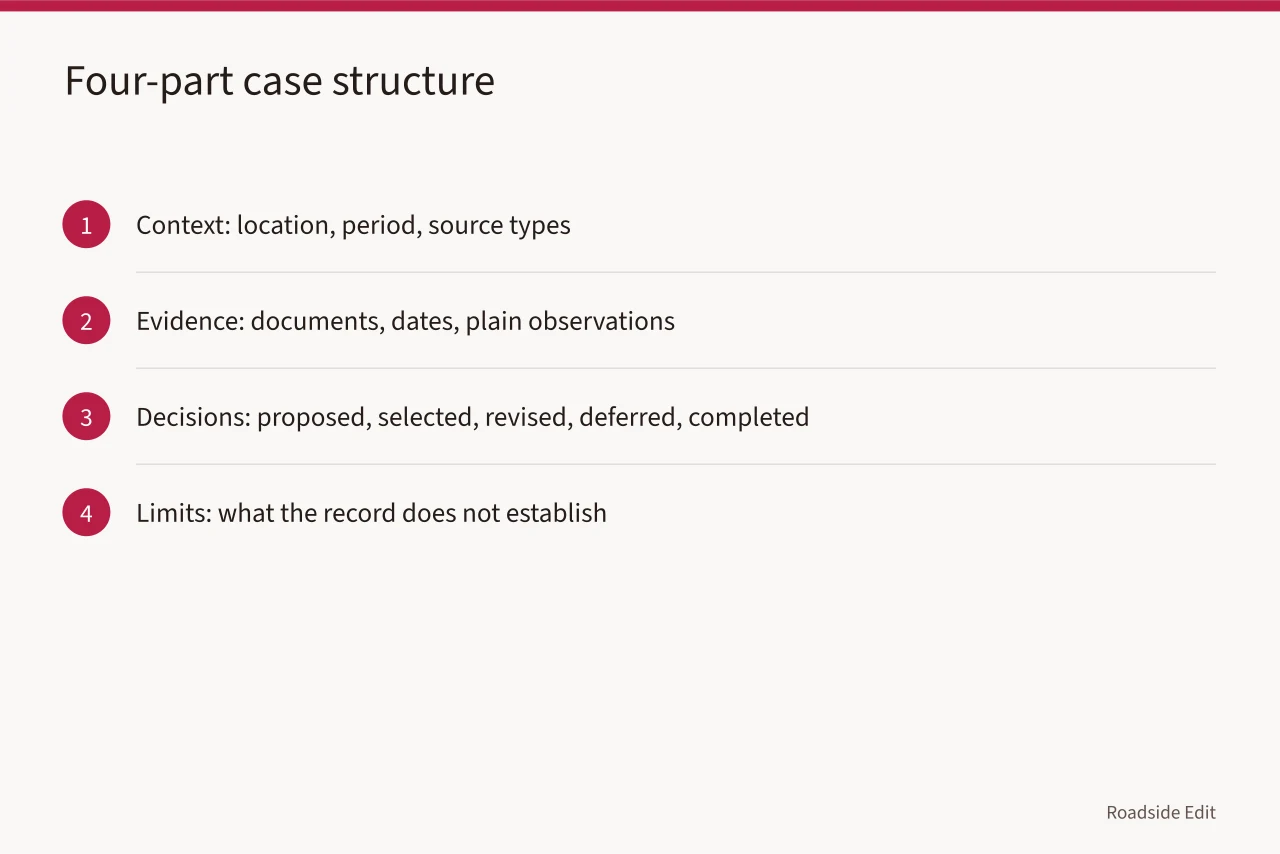
1. Context
State the location, the historical period being examined, and the available source types. Do not call a building historic, eligible, or protected unless a specific record supports that status. If a date comes from a secondary source, say so.
2. Evidence and observations
Describe the documents, images, interviews, or inspection notes reviewed. For each one, note its date, author or repository when known, and what it actually shows. Keep an observation in plain language. "The image shows a painted sign face" is an observation. "The sign has a moisture failure" is a diagnosis that needs different evidence.
3. Decisions and changes
Document what was proposed, selected, revised, deferred, or completed, along with the record that states it. Never write a proposal in the past tense as though it were finished. If a source shows a project change, explain the change without guessing at the reason unless the source names it.
4. Limits and next questions
End with what the record does not establish. This might include an unavailable date, incomplete access, missing plans, an unknown material, an unverified outcome, or a needed local review. A case study becomes more trustworthy when it leaves a precise question open.
Capture a timeline, not a polished legend
Case studies often become less accurate when all events are compressed into one smooth narrative. Use a dated timeline instead. It can hold uncertainty without making the article unreadable.
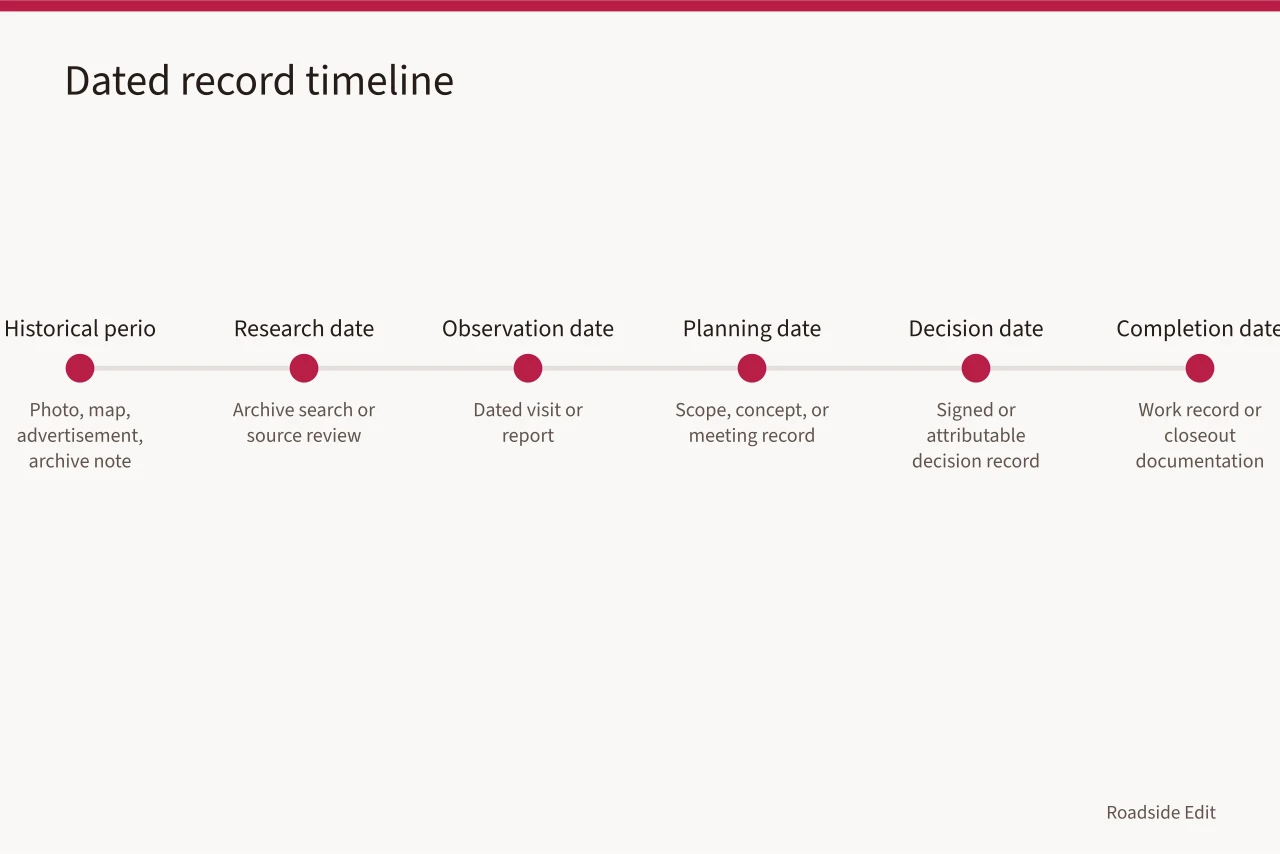
| Date or period | Record | Status | What the record supports |
|---|---|---|---|
| Historical period | Photo, map, advertisement, or archive note | Context | A documented past appearance or statement |
| Research date | Archive search or source review | In review | Sources located and gaps identified |
| Observation date | Dated visit or report | Observation | What was reported or visible then |
| Planning date | Scope, concept, or meeting record | Proposed | What was under consideration |
| Decision date | Signed or attributable decision record | Decided | The documented choice |
| Completion date | Work record or closeout documentation | Reported complete | The work described in the record |
If the date is unknown, say unknown. If a source uses a broad date range, preserve that range instead of inventing a precise day. Accuracy is more valuable than a tidy timeline.
Separate description from evaluation
Good writing still needs a point of view, but the point of view should be honest about its basis. Editorial analysis can explain why a record trail is strong or weak, why a source cannot answer a question, or why a public claim needs more documentation. It should not diagnose a building or predict commercial performance without appropriate evidence.
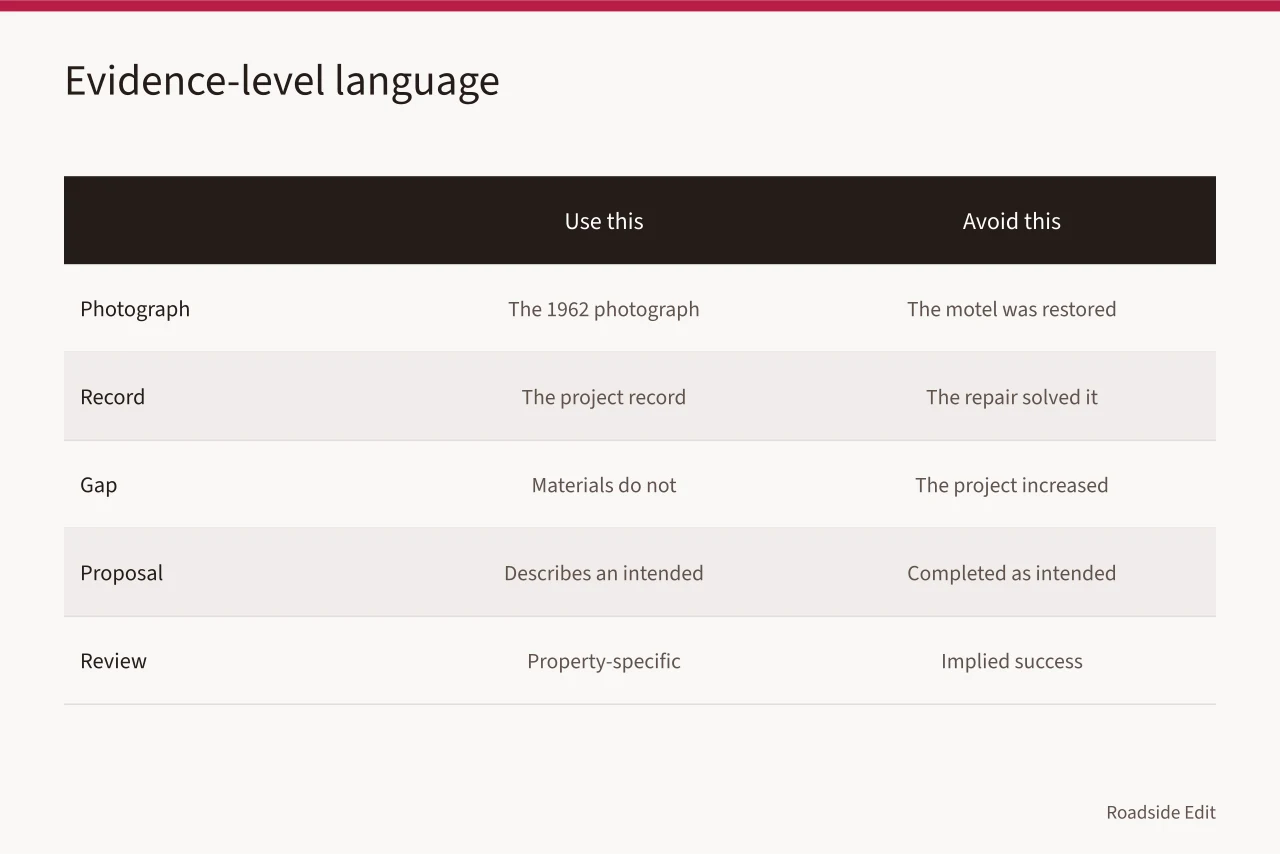
Use language that shows the evidence level:
- "The 1962 photograph shows..."
- "The project record states..."
- "The available materials do not establish..."
- "This proposal describes an intended scope..."
- "A property-specific review would be needed to determine..."
Avoid language that removes the source: "The motel was restored exactly as intended," "The repair solved the problem," or "The project increased demand." Those conclusions require direct, relevant documentation. If no such documentation is available, do not imply it through energetic wording.
Treat money and business claims with special care
Money is often the weakest part of a public case study. A grant award, a fee proposal, an invoice, an occupancy figure, and a tax-credit reference have different meanings. Do not add them together, treat them as a whole project cost, or use them to calculate a return unless the primary records support that calculation and permission to publish exists.
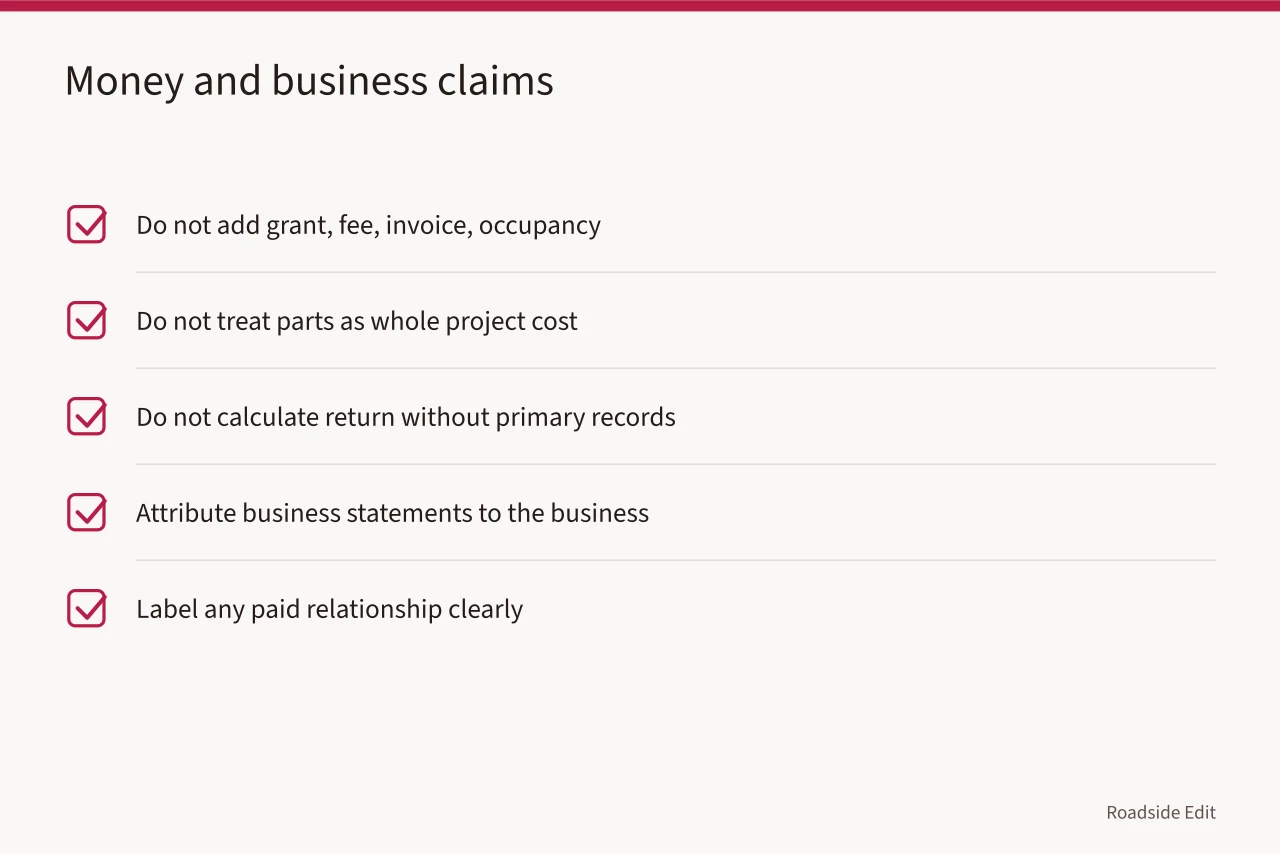
The same caution applies to businesses. A contractor, designer, consultant, or sponsor may provide useful context about its role. Attribute the statement to the business and label any paid relationship. Do not let a placement become proof that the business completed a project, holds a required credential, or produced a stated outcome.
Finish with a correction plan
Each case study needs an update path: name the record that would change the article, a newly located survey, a corrected date, a revised scope, a signed decision, or a completion report.
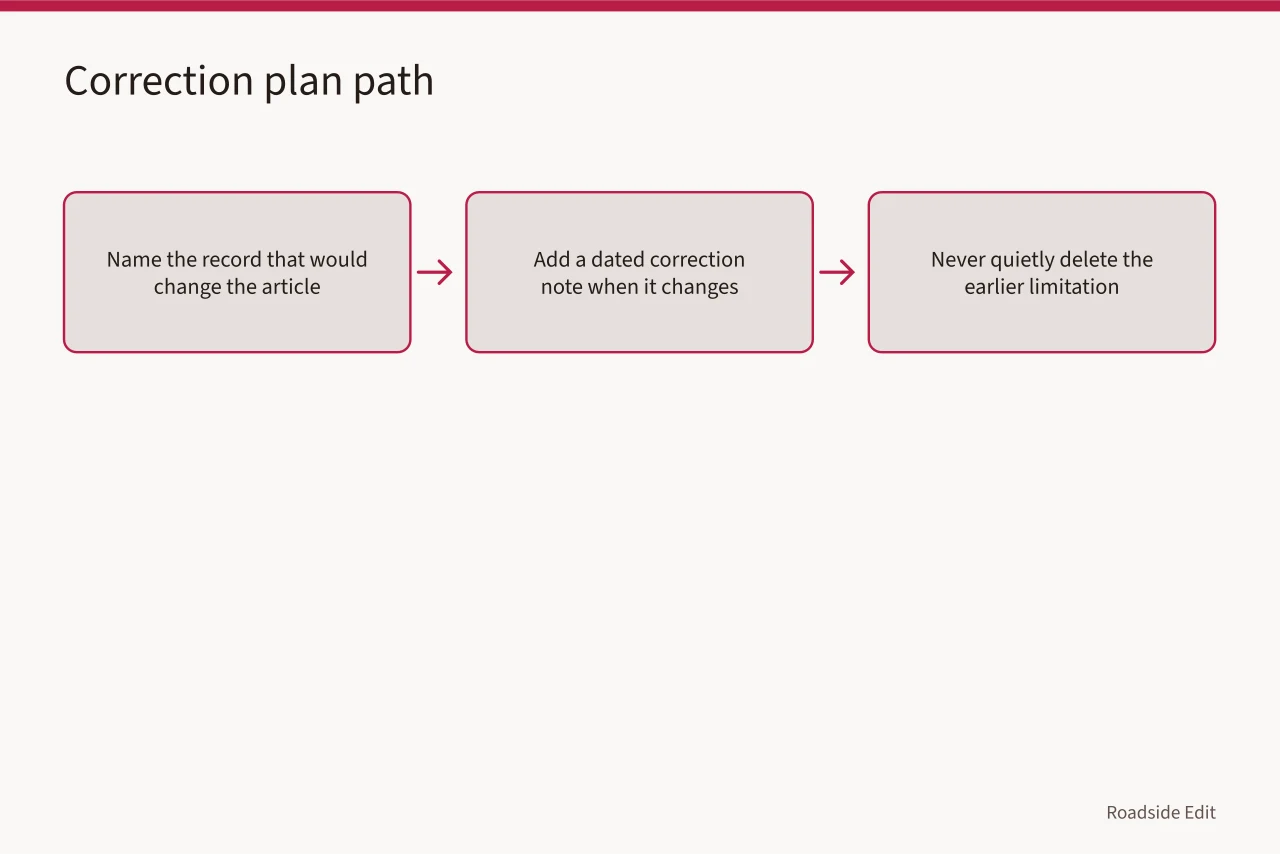
A copyright holder request counts; add a dated correction note when the article changes. Never quietly delete the earlier limitation to make the page always look complete.
That practice matters for long-running content. A historic motel article may be read by an owner, researcher, agency, advertiser, or traveler years after publication. They deserve to know whether a statement reflects a historic source, a current observation, a proposal, or a later correction.
Keep the article useful after publication
The NPS documentation standards require accurate records from reliable sources with limitations clear enough for independent verification. That standard gives a case study its structure. A historic image can document an appearance at a stated time. A proposed scope can document an intention. Neither should be rewritten as present condition or completed work.
The National Archives guidance for digital photographic records explains the role of identifiers and descriptive data in image management. Keep an image ID, original source page, date, subject, and caption in the editorial file. A media credit is not proof of a broader property claim.
The NPS historical documentation guidelines describe identifying sources and reporting results. A dated correction should identify what was changed, which new record prompted it, and which part of the earlier statement is no longer supported. That makes the next publication update easier to review.
Add a review date near the source register. Reconsider the article when material circumstances change.
A new archive record may clarify a date, a project note may show an idea was never carried out, and an owner's correction may require a different location label. Do not rewrite the original source to fit the update; preserve the new record and explain what it changes.
This is especially important for a directory or publication that later accepts paid placements. A commercial profile can be current while a historical case study remains unchanged. Readers need to see the difference between a dated research narrative and a current advertising relationship.
Common questions
Can a case study use a before-and-after photo pair?
Yes, if each image is credited and dated, the connection to the property is supported, and the article does not claim more than the images show.
Does a provider's project description verify the project?
No. Attribute it as a provider statement unless an independent record supports the same fact.
What should happen when evidence is missing?
State what was checked, what was not found, and what additional record or review would be needed.