Costs
Federal and state tax credits for rehabilitating US roadside architecture
Rehabilitation tax credit roadside architecture: how the 20 percent federal credit, state credits in four states, and Part 2 paperwork fit together.
What to take away
- The rehabilitation tax credit roadside architecture owners chase is usually two credits: a 20 percent federal credit and a state credit that may be larger.
- The federal credit is only for income-producing buildings that are certified historic structures, so a gas station or diner has to earn revenue before it qualifies.
- The National Park Service approves the work through a three part application, and the pass or fail line is the Secretary of the Interior's Standards for Rehabilitation.
- California, Texas, Illinois and Pennsylvania all run their own credit programs, with different caps, deadlines and review routes.
- State and federal credits can be stacked on one project, but the state review usually comes first and the federal award depends on the state certification.
- Budget the application work as a line item. Photography, architectural drawings and a preservation consultant are normal costs on a certified rehabilitation.
How the 20 percent federal rehabilitation tax credit works
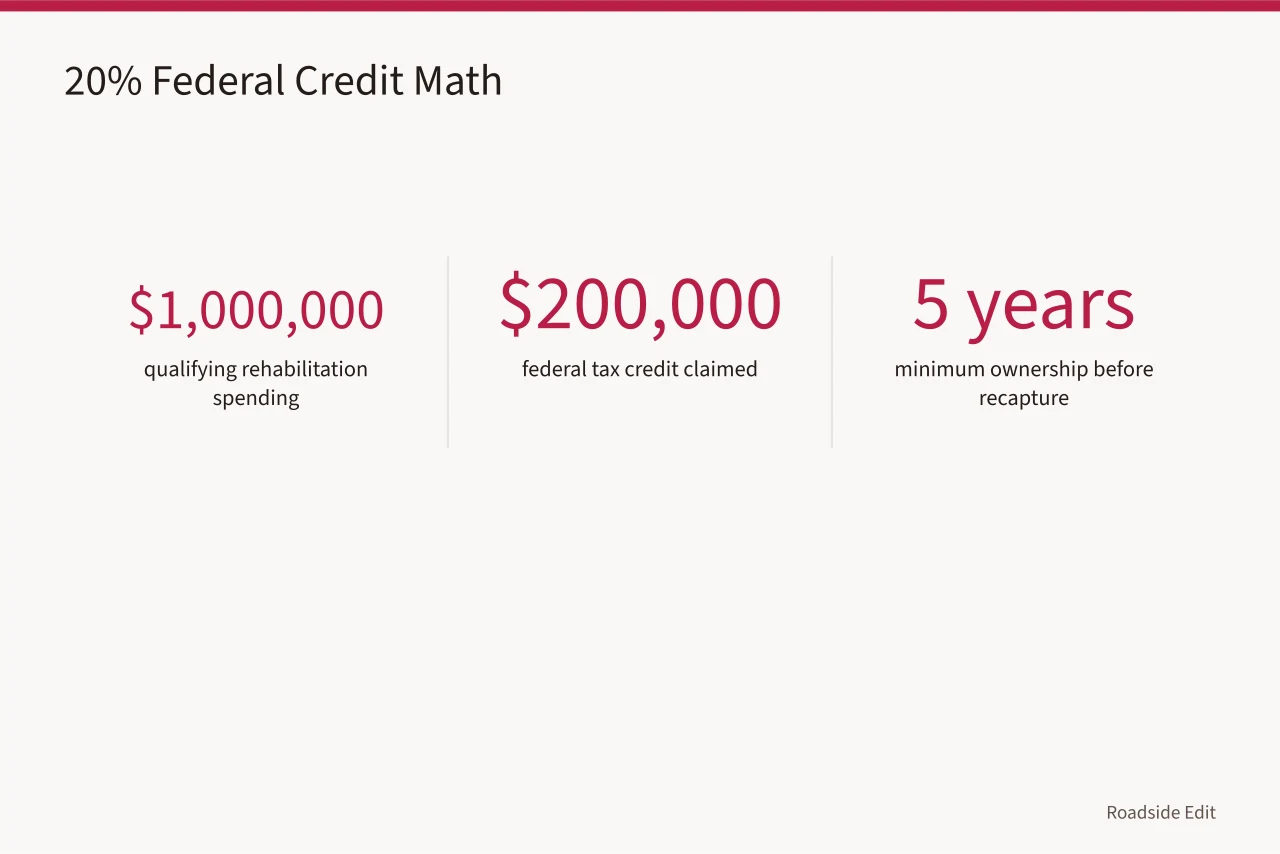
The 20 percent federal rehabilitation tax credit is a dollar for dollar reduction of federal income tax owed, not a deduction. A project that spends one million dollars on qualifying rehabilitation work can claim a credit of two hundred thousand dollars against its tax bill.
The credit is taken in the year the building is placed in service after the rehabilitation.
The program is run by the National Park Service with the Internal Revenue Service, and the state review is handled by the State Historic Preservation Office. The [Historic Preservation Tax Incentives (U.S.
National Park Service)](https://www.nps.gov/subjects/taxincentives/index.htm) program has produced tens of thousands of rehabilitated buildings since it began, and the credit has been a permanent part of the tax code since 1986.
Only the rehabilitation spending counts. Acquisition cost, furniture, equipment and most site work do not. The building must be depreciable and used in a trade or business or held for the production of income. A diner that still serves meals qualifies.
A gas station converted to a working shop or rented to a tenant qualifies. A building used only as a private residence does not.
The credit is claimed on the owner's tax return, and the owner must hold the building for at least five years or face recapture of part of the credit. That five year window shapes how owners structure a sale or a lease.
What counts as a substantial rehabilitation
The spending test is called the substantial rehabilitation test. Rehabilitation costs during a 24 month period must exceed the greater of five thousand dollars or the adjusted basis of the building.
Most roadside projects clear this easily because the purchase price of a derelict station is low compared with the cost of a new roof, new glazing and repointed masonry.
A phased project can use a 60 month measuring period if the owner gets approval in advance. That matters for a motel or a long diner where the work is done wing by wing. A phased schedule is also the reason a budget plan that separates phases is worth building before the application goes in.
What the credit is worth over time
The credit is not paid out in cash. It offsets tax owed, so an owner with little tax liability may not be able to use the full amount in one year. The rules allow a carryback of one year and a carryforward of twenty years, which is why syndication exists.
Syndicators buy the credit from owners who cannot use it, at a discount, so a nonprofit or a small operator can still finance the work.
For a roadside project, the practical question is whether the owner has enough tax liability to absorb the credit or needs a partner. Answer that before signing a construction contract, not after.
Eligibility tests: income-producing buildings and National Register status
Two tests decide whether a building can use the credit. The building must be income-producing, and it must be a certified historic structure. Both are pass or fail, and both are checked before any work begins.
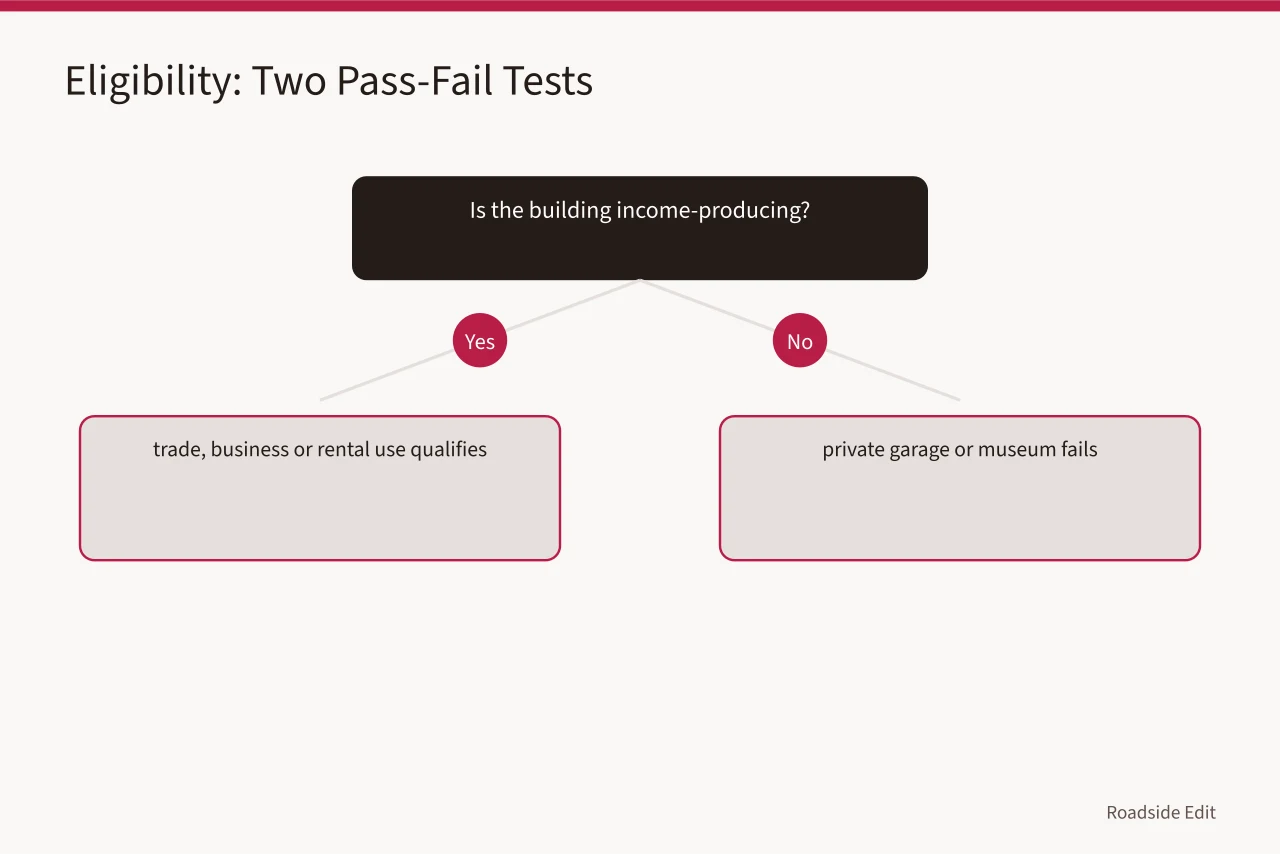
Income-producing means the building is used in a trade or business or held for the production of income. A restored gas station that operates as a coffee bar, a retail shop, an office or a rental property qualifies. A station kept as a private garage or a museum with no revenue does not.
The test looks at use, not at profit, so a building that loses money can still qualify.
Certified historic structure means the building is listed individually in the National Register of Historic Places, or it contributes to a registered historic district and the National Park Service approves it as contributing. A building inside a district does not need its own nomination.
A building outside a district needs a nomination, which is a separate process run through the State Historic Preservation Office.
Reading the building before you buy
Check the National Register status before closing. A station on a state highway may sit outside any district and outside any nomination, which adds months to the front end. A diner in a downtown commercial district is often already contributing, which shortens the path.
Age matters. A building generally must be at least fifty years old to be listed, though a younger building can qualify in some circumstances. Most roadside architecture from the 1920s through the 1970s is old enough now to be considered.
What disqualifies a building
A building moved from its original site can lose its listing and its eligibility. Demolition of a contributing structure in a district can affect the status of the rest. A building that has already been stripped of its historic character may fail the certification even if it is listed.
The National Park Service publishes guidance on eligibility, certification and application steps through Technical Preservation Services (U.S. National Park Service). Read that page before hiring anyone. It sets out the order of operations that reviewers expect.
The certified rehabilitation and Part 1, 2 and 3 paperwork
A certified rehabilitation is work the National Park Service has reviewed and approved as consistent with the historic character of the building. The approval is what makes the credit available. Without it, the building may be listed and the work may be beautiful, but the credit is not there.
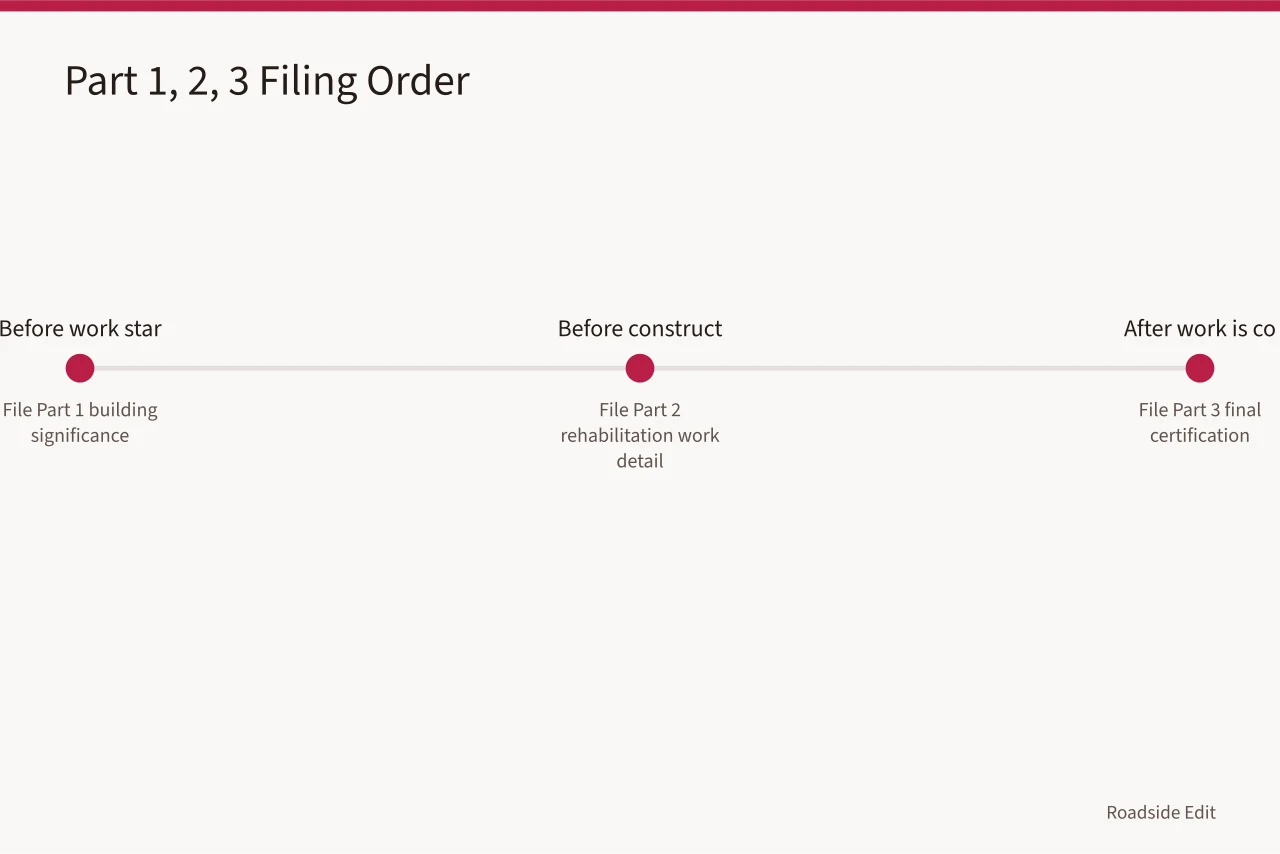
The application is filed in three parts, and the parts are filed at different points in the project. Each part goes to the State Historic Preservation Office first, which reviews it and forwards it to the National Park Service with a recommendation.
The three parts
- Part 1 establishes the building's significance. File it before work starts. It documents the listing or the contributing status and describes the building.
- Part 2 describes the rehabilitation work in detail, with drawings and photographs of existing conditions and proposed changes. File it before construction begins and wait for approval.
- Part 3 is filed after the work is complete. It confirms the work matched the approved plan and requests the final certification.
The order is not optional. Starting construction before Part 2 approval is the most common way projects lose the credit, and reviewers are not required to forgive it.
What the Part 2 submission contains
Photographs of every elevation and every interior space that will change. Floor plans and elevations for the proposed work. A written scope that describes what is being repaired, what is being replaced and what is being removed. Specifications for materials, including window and door profiles.
Reviewers compare the scope against the Secretary of the Interior's Standards. A scope that says replace all windows will draw a comment. A scope that says repair existing sash, replace glazing and add unobtrusive weatherstripping will move faster.
Review time and fees
The National Park Service charges a review fee based on the size of the project. Small projects pay a modest flat fee, and larger projects pay a percentage of the rehabilitation cost. State offices may charge their own fee on top of that.
Review time varies by state and by workload. A clean Part 2 in a state with an experienced office can move in a few months. A complicated one with missing drawings can sit for much longer. Build the review window into the construction schedule instead of treating it as a formality.
A restoration project of any size carries costs beyond construction. Consulting fees, photography and travel to meetings add up, and a cost checklist helps keep those soft costs visible before the estimate is compared.
State credits compared: California, Texas, Illinois and Pennsylvania
State historic tax credits are where the numbers get interesting. Several states offer credits that exceed the federal 20 percent, and some offer them to owners who do not qualify federally, including owner occupied residential projects.
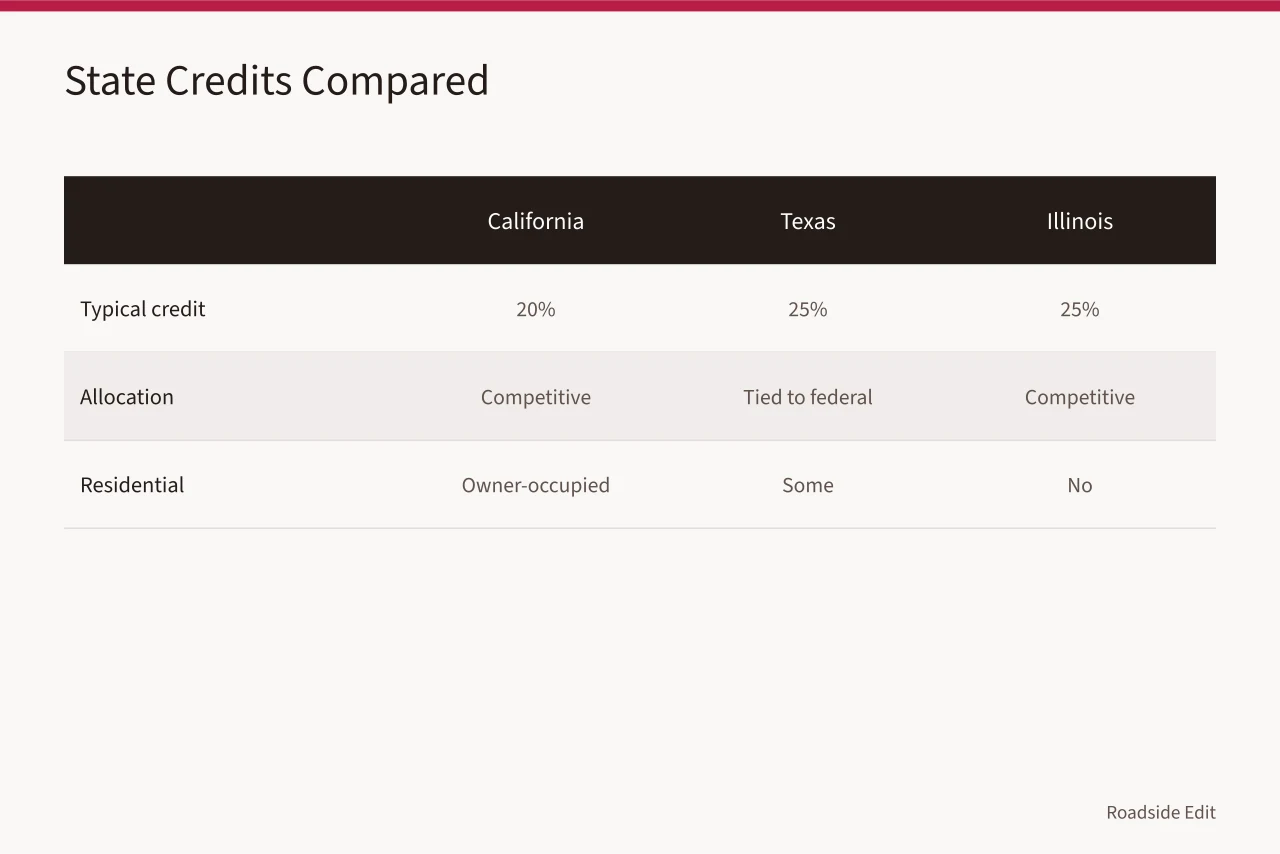
The National Park Service maintains a national directory of state historic preservation tax incentive programs and a more detailed list of state historic preservation tax incentives. Use both before assuming a state has nothing.
| State | Program shape | Typical credit | Notes for roadside projects |
|---|---|---|---|
| California | State credit with a certified historic structure requirement | 20 percent of qualified expenditures | Competitive allocation; small projects have a set aside; owner occupied residential can qualify |
| Texas | State credit tied to the federal certification | 25 percent of eligible costs | State review runs alongside the federal Part 2; commercial and some residential projects qualify |
| Illinois | State credit with an annual cap and a per project cap | 25 percent of qualified expenditures | River edge and downtown districts see heavy use; allocation is competitive |
| Pennsylvania | State credit with a cap and a phased allocation | Up to 25 percent of qualified expenditures | Often paired with a local credit; the state office reviews the same scope as the federal Part 2 |
California
California runs a state credit for certified historic structures, and it uses the same certification machinery as the federal program. The state sets aside a portion of the annual allocation for small projects, which matters for a single gas station or a small diner.
Demand has historically exceeded the allocation, so timing the application to the opening of a round is part of the strategy.
California also allows the credit for owner occupied residential rehabilitation in some cases, which the federal credit does not. That opens the door for a station converted to a residence if the local jurisdiction allows the use.
Texas
Texas ties its credit to the federal certification, so a project that fails the federal review usually fails the state one too. The state credit is a percentage of eligible costs and is claimed over several years in some cases. The Texas Historical Commission handles the review, and its staff work with applicants on scope before the formal filing.
For a Route 66 era station or a mid century diner, the Texas program is often the difference between a project that pencils and one that does not. The state credit can be syndicated in some structures, which brings outside capital into a small project.
Illinois
Illinois offers a state credit with an annual statewide cap and a per project cap. The credit applies to qualified rehabilitation expenditures on certified historic structures, and the review follows the federal standards. Downtown commercial districts and river edge corridors have absorbed much of the allocation in recent rounds.
Because the cap is competitive, an Illinois project benefits from a complete Part 2 filed early in the round. A thin scope with missing photographs is a disadvantage when the state is choosing among applications.
Pennsylvania
Pennsylvania offers a state credit that is often paired with a local credit in cities that run their own programs. The state credit has a cap and a phased allocation, and the review uses the same scope as the federal Part 2. That means one set of drawings can serve both filings if it is prepared correctly.
Pennsylvania also has a dense network of local preservation organizations and design review boards. A project in a historic district may need local approval in addition to state and federal review, and the local review can be the slowest step.
Stacking state and federal credits on one roadside project
Stacking is normal, not exotic. A single rehabilitation can generate a federal credit and a state credit on the same qualified expenditures, and the two are claimed separately. The federal credit does not shrink because a state credit exists, though the state credit may be taxable income for federal purposes in some cases.
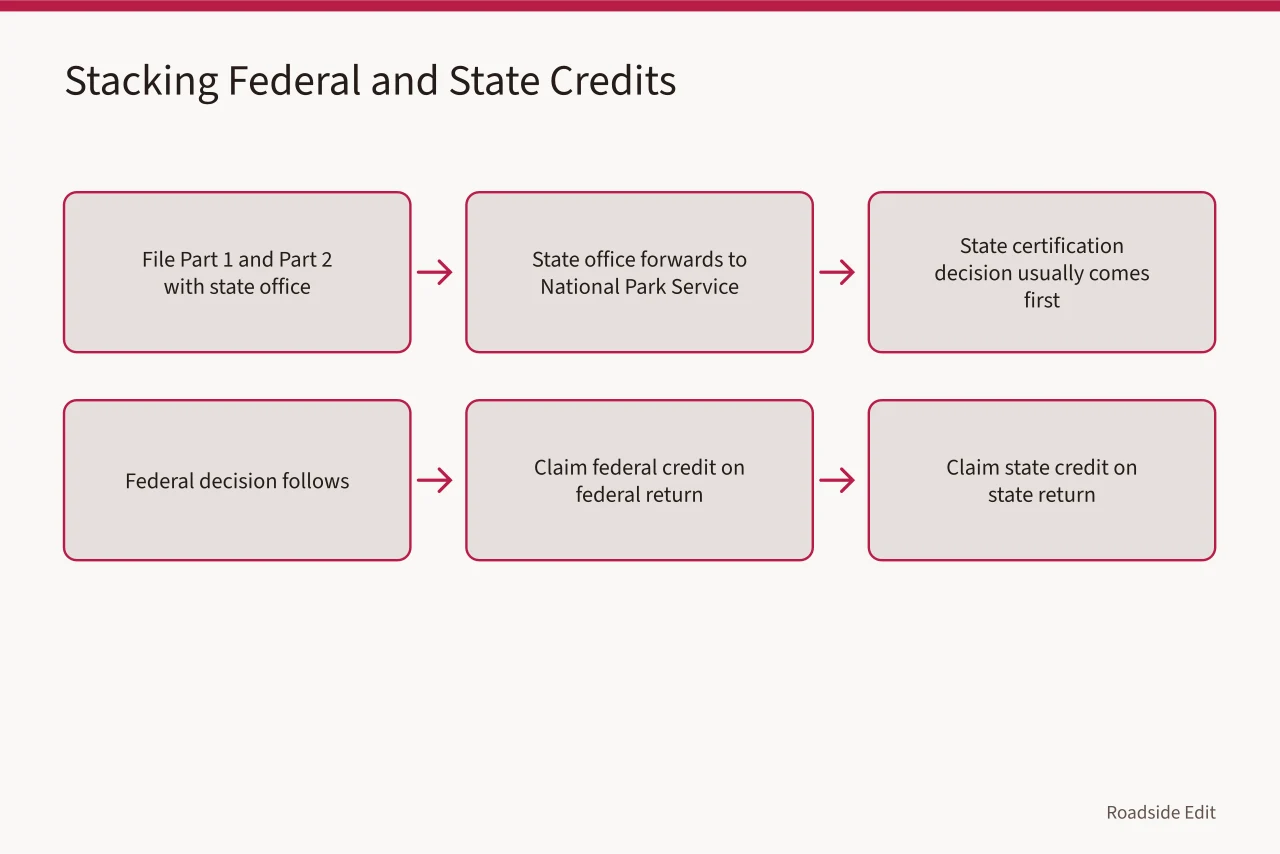
The order of review matters. Most states require the federal Part 1 and Part 2 to be filed with the state office, which then forwards them. The state certification decision usually comes first, and the federal decision follows. A state approval is not a federal approval, and a federal approval does not guarantee the state credit.
A worked example
Take a 1930s gas station in Texas that is contributing to a listed district. The owner buys it for a low price, restores the canopy, the office and the service bay, and leases the building to a coffee operator.
Qualified rehabilitation spending reaches the substantial rehabilitation threshold. The owner files Part 1 and Part 2 through the Texas Historical Commission. Both the state credit and the federal credit are approved on the same scope.
The owner claims the federal credit on the federal return and the state credit on the Texas return, and sells part of one credit to a partner to cover a gap in tax liability.
The project works because the building is income-producing, the scope respects the standards, and the paperwork was filed before construction. Remove any one of those and the credits disappear.
Where stacking goes wrong
Owners sometimes assume a state credit can be used by a nonprofit or a public agency. Many state programs restrict who can claim the credit, and pass through structures vary. Read the state statute, not a summary of it.
Owners also assume the credits can be claimed in any year. The federal credit is claimed when the building is placed in service, and the state credit may follow a different schedule. A three budgets approach, one for construction, one for soft costs and one for the credit timing, keeps the cash flow honest.
The Secretary of the Interior's Standards as the pass-fail line
The Secretary of the Interior's Standards for Rehabilitation are ten principles that guide how historic buildings are treated. Reviewers apply them to every Part 2. They are the reason a project can be listed, funded and well built, and still fail certification.
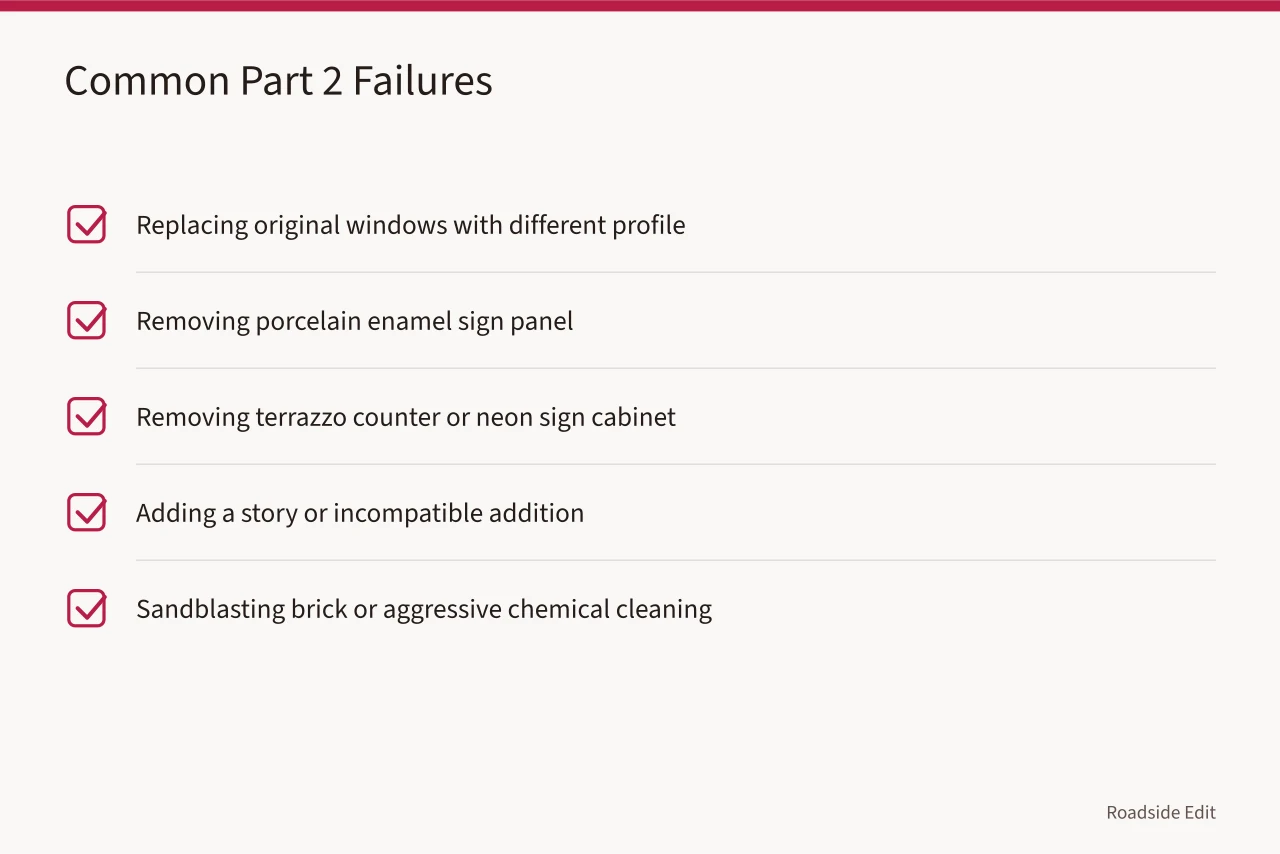
The standards do not require a building to be frozen in time. They require that the historic character of the property be retained and preserved, that distinctive features be preserved, and that new work be differentiated from old work. A new canopy that reads as new is acceptable. A new canopy that pretends to be original is not.
The standards that trip up roadside projects
How to stay on the right side of the line
Document existing conditions before touching anything. Photograph the building inside and out, including the parts that will be removed. Write a scope that repairs rather than replaces wherever the material allows it. Where replacement is necessary, specify a match in material, profile and finish.
Hire a preservation consultant for the Part 2 if the project is at all complicated. The fee is small compared with the credit at stake, and reviewers respond to submissions that speak their language.
The same discipline applies to provider selection for interior trades, where a contractor who has never worked on a certified project can cost more in revisions than they save in labor.
When a project cannot meet the standards
Some buildings are too far gone for certification on the full scope. In that case, an owner can sometimes certify a partial rehabilitation, or can pursue a different incentive such as a local property tax abatement. A facade easement or a local historic district designation may also carry benefits.
If the numbers only work with a scope that fails the standards, the project has a finance problem, not a preservation problem. Better to learn that at the Part 2 stage than after construction.
Where to find state incentive details and SHPO contacts
Every state has a State Historic Preservation Office, and every SHPO has a tax incentive contact. That person reviews Part 1, Part 2 and Part 3 submissions and forwards them to the National Park Service. Getting to know the reviewer early is the single most useful step in the process.
The National Park Service publishes the national directory of state programs and the detailed list of state incentives. Both are updated periodically, and both link to the administering agency in each state. Start there, then call the office directly.
What to ask the SHPO
Ask whether the building is listed individually or contributes to a district. Ask what the state credit rate is and whether the round is open. Ask what the office wants to see in a Part 2 for a project of this type. Ask how long review typically takes.
Ask about local overlays too. A city with a historic preservation commission may require design review before a building permit, and that review can add conditions that affect the scope.
Other programs worth knowing
The National Park Service Route 66 Corridor Preservation Program has funded work on roadside resources along the route. The National Trust for Historic Preservation and the Society for Commercial Archeology publish case studies on gas stations, diners and motels. Local preservation commissions and design review boards control much of what happens at the street level.
For a project that involves travel to inspect a property or meet a reviewer, it helps to know what a gas station preservation trip actually costs before the first site visit.
Keeping the file together
Keep one file with the listing documentation, the Part 1, the approved Part 2, the construction photographs and the Part 3. The owner will need it at sale, at refinancing and at audit. A certified rehabilitation is a durable asset, and the paper trail is part of it.
Common questions
Can a building that is not individually listed use the federal credit? Yes, if it contributes to a registered historic district and the National Park Service certifies it as contributing. The Part 1 establishes that status.
Does the credit cover the purchase price of the building? No. Only qualified rehabilitation expenditures count. Acquisition cost, furniture and equipment are excluded.
Can I start construction before the Part 2 is approved? You can, but you risk losing the credit. Reviewers expect approval before work begins, and starting early is the most common cause of failed certifications.
Do state credits work the same way in every state? No. Rates, caps, eligible owners and review routes differ. Check the state program directory and confirm with the State Historic Preservation Office.
Is the federal credit available for an owner occupied residence? No. The building must be income-producing. Some state programs allow owner occupied residential projects, so check the state rules.
How long does the certification take? It varies by state and by the completeness of the submission. A clean Part 2 in an experienced office can move in a few months, and a phased project can take longer.