Costs
Where to Buy Salvage Materials for Diner Booths in Canada
Buy salvage diner booths in Canada from named sources: Smash Salvage, The Door Store, MaxSold, Able Auctions, with CAD price ranges and freight tips.
What to take away
- Call named Canadian sellers such as Smash Salvage in Vancouver and The Door Store in Toronto before searching online.
- Asking prices run from about $200 to $6,000 per unit or matching set, as illustrative ranges rather than quotes.
- Freight is the line owners forget; a booth moved between provinces can cost as much as the booth.
- Inspect the frame, table top and back panel before paying, and price reupholstery as a separate job.
Why Canadian salvage lists read differently
US salvage directories dominate search results, but most stop at the border, and American yards seldom quote in Canadian dollars or arrange freight north.
Owners planning a whole room, not one booth, start with Budgeting Help for Diner Interiors. It sets seating against the rest of the spend. Canadian owners documenting each booth purchase should follow the same record habits described in the vintage diner interior records guide.
Canadian stock sits with three kinds of seller. Demolition and architectural salvage yards sell the booth as a design object. Restaurant equipment dealers and liquidators sell it as working furniture. Auction houses clear a closed diner in one lot on one day.
Each prices differently for the same reason. A yard charges for period character, a dealer for usability, an auction for whatever the room held.
Five named sources with current stock habits
- Smash Salvage, Vancouver, BC. Buy by appointment or through the shop's site. It often lists 1950s and 1960s booths, restored or as frames. Suits buyers who want a period piece.
- The Door Store, Toronto, ON. Architectural salvage with rotating stock of booth backs and frames. Call first, and ask for a photo of the underside before driving.
- MaxSold, online auctions Canada wide. Handles diner closures and restaurant liquidations. Local pickup is required, and a buyer's premium applies on winning bids.
- Able Auctions, Surrey, BC. Runs live and online commercial restaurant auctions. Lots sell as is, and matched booth sets appear in many sales.
- GCSurplus, online federal surplus. Lists institutional seating and some cafeteria booths. Bid online, then collect at the federal depot named in the listing.
- Dan's Used Restaurant Equipment, Burnaby, BC. Retail showroom for used commercial seating. You can walk in and check booth frames before paying.
Photograph a donor diner before anything is removed. Roadside Renovation Photography covers what to record while the room is still intact.
- Call the named yards and liquidators before searching online.
- Set alerts with auction platforms like MaxSold and Able Auctions.
- Watch GCSurplus for institutional seating.
- Post wanted notices where restoration owners gather.
What booths cost, in illustrative ranges
Figures below are illustrative ranges, not quotes. Completeness, upholstery and quantity move them more than province does.
Show the numbers
| Two-person booth, worn vinyl | $200–$600 |
|---|---|
| Four-person booth, usable | $600–$1,800 |
| Matched run of four booths | $1,500–$6,000 |
| Reupholstery, per booth | $300–$900 |
Completeness adds value fast, because a booth missing its back or feet costs more to finish than to buy. Original vinyl in usable condition lifts a price, then costs again when it fails. Quantity cuts unit price, and sellers prefer clearing a run to holding single units.
Track what you pay. Case Study Records shows how to log purchases, freight and rework.
Freight across Canada and the costs people forget
A booth is heavy, awkward and usually sold as part of a set. A carrier priced on pallet dimensions may quote a few hundred dollars within a province and over a thousand between Ontario and British Columbia.
- Crating or palletising, if the seller will not load loose
- Tail-lift or forklift access at both ends
- Upholstery once the booth arrives
- Storage while the rest of the room is finished
- Hardware: hinges, feet, table edging
If freight and crating together exceed half the booth price, look closer to home before you commit.
Ask for the freight quote in writing before paying a deposit.
Example: pricing a four-booth refit
A 1958 diner in southwestern Ontario needs four four-person booths. Two matched booths from a local liquidator at $900 each, two from a Toronto yard at $1,100 each. Freight within the province, $400. Reupholstery for four, $2,400. New table tops, $1,200. Total near $7,200 before structural work.
The same four from a US yard at a similar sticker price add cross-border freight and currency conversion. The apparent saving is usually imaginary.
Matching the booth to the building
Period matters less than colour and shape. The article on diners covers the exterior palettes and design trends that interiors echoed, which helps when choosing vinyl.
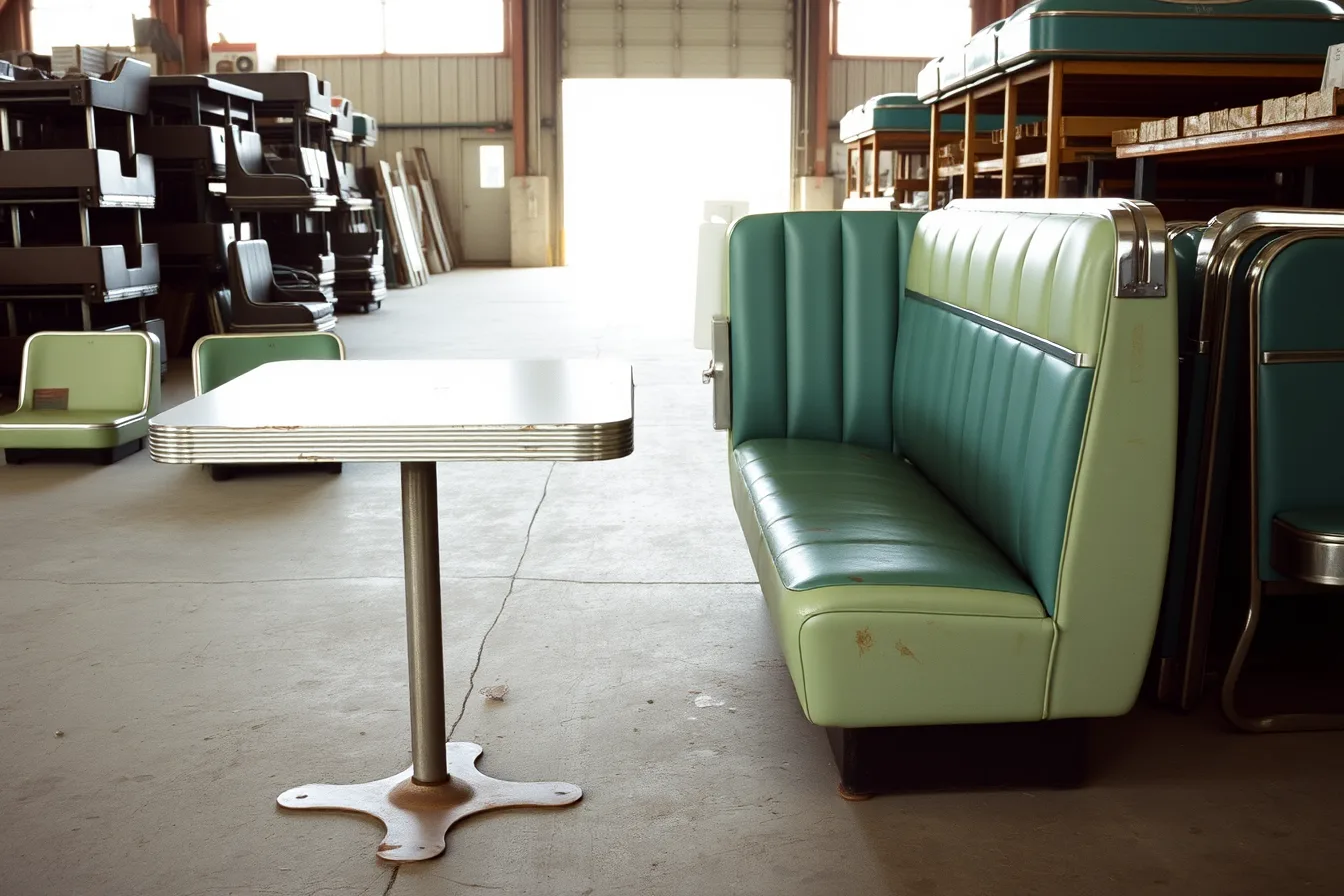
Frames are steel or wood. Steel from the 1940s to the 1960s survives surface rust. Wood warps and splits, so check the joints at seat and back. Table tops in porcelain enamel are repairable, but edge chips are common and enamel work is a specialist trade.
Booths rarely finish a room alone. Neon usually follows, and Neon Sign Restoration Help covers how to brief a tube bender. The Government of Canada heritage resources page lists preservation programs worth checking for a designated building.
Common questions
Can I buy a single booth rather than a run? Yes, but expect a higher unit price and slower sourcing. Yards prefer to clear four or six at once.
Do US salvage prices translate to Canada? Not directly. Add cross-border freight, currency conversion and brokerage, then compare with a local listing.
What should I inspect before paying? Frame joints, back panel, table top edges and upholstery. Ask for photographs of the underside.
Is original vinyl worth keeping? Rarely for a working diner. Keep it only if it is intact and the room is not open to the public.