Guides
Neon sign restoration provider selection: a 2027 reporting checklist
Choose neon sign restoration help in 2027 with a transparent reporting framework for scope, disclosures, provider facts, records, and paid placements.
Choosing neon sign restoration help in 2027 starts with provider selection. A more basic question comes first: what can a public article honestly say about a provider, a property, and a proposed project?
Roadside Edit does not inspect signs, certify companies, rank contractors, or give property-specific repair advice. Its useful job is a clear reporting framework: business-supplied facts kept apart from independently documented ones, paid placement labeled, and every statement dated and scoped.
What to take away
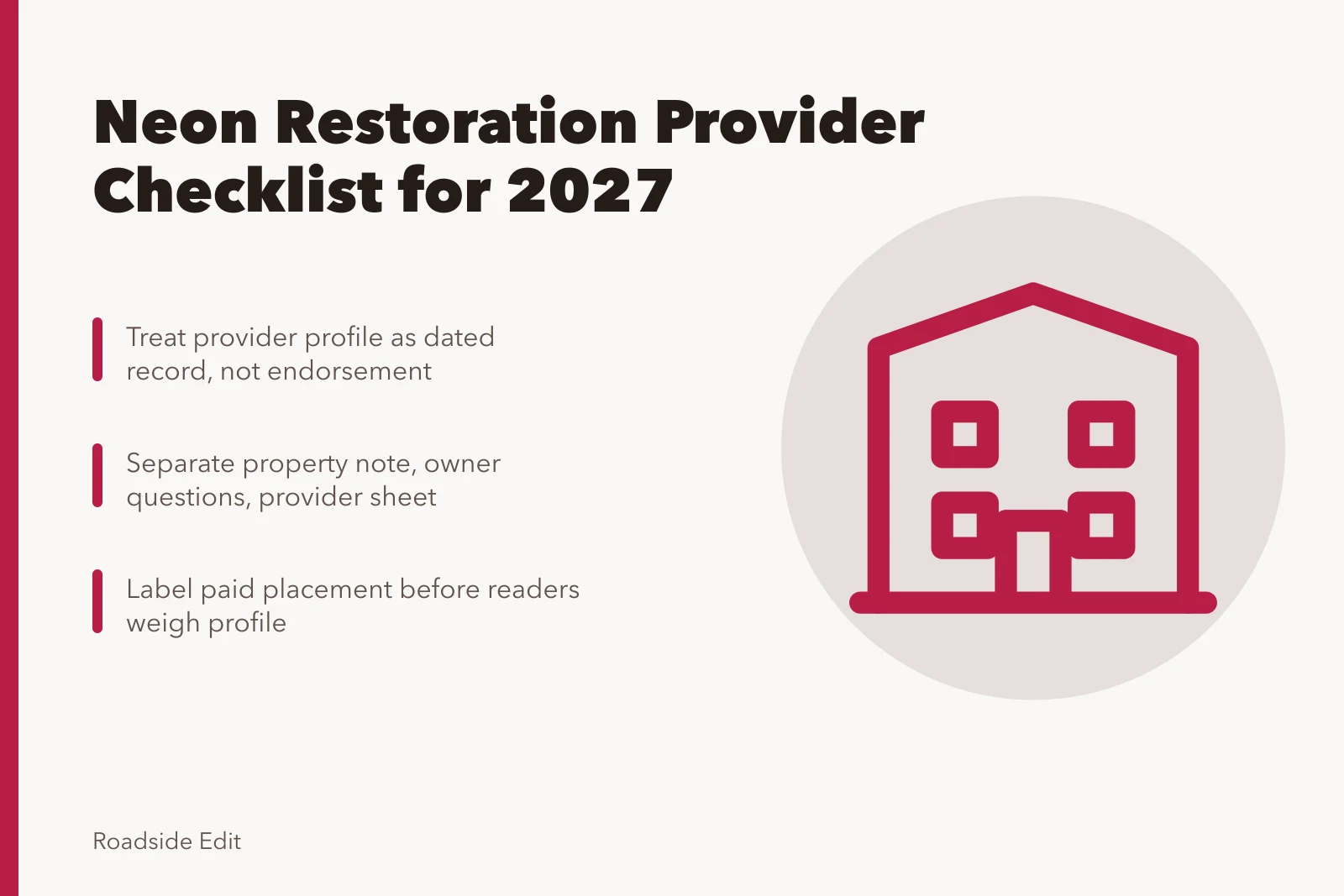
- Treat a provider profile as a dated information record, not an endorsement.
- Define the editorial inclusion standard before reviewing submissions.
- Keep a proposed scope, supplied materials, and unanswered questions separate.
- Label paid placement where a reader will see it before weighing the profile.
- Publish corrections, not silent rewrites, when a material fact changes.
Start with the limits of the article
An article helps a reader organize a search without pretending to make a technical decision for them.
A responsible provider profile may identify a business, its description of services, its service area, a contact route, and the date the information was supplied. It can also describe a public record or historical context when a specific source supports that narrow fact.
It should not convert a business statement into an award, an approval, a safety finding, a preservation qualification, or a promise of results. Those words carry a meaning that a directory-style article generally cannot establish.
The same restraint applies to an owner's description of a sign. A dated photograph may show what the photographer recorded from a certain viewpoint. It cannot establish a cause, operating condition, ownership, access rule, or repair outcome on its own.
Use a short scope statement at the top of every provider profile. For example: "This page organizes business-supplied information and public context. It is not a technical assessment, recommendation, or approval." That sentence makes the page's role clear before a reader reaches a name, logo, or paid listing.
Use a written inclusion standard
Inclusion can be modest and still be useful. A publication might include a provider only when the business supplies its public name, a contact method, a service-area statement, a dated description of what it offers, and a correction contact. A separate editorial note can explain whether the publication independently checked any public record and exactly what was checked.
The Federal Trade Commission's endorsement guidance says an unexpected material connection can affect the weight readers give an endorsement. It must be disclosed clearly. The guidance does not mean every listing must be rejected.
For this site, the point is narrower: a paid placement, free service, affiliate relationship, or other relevant connection cannot look like an independent recommendation.
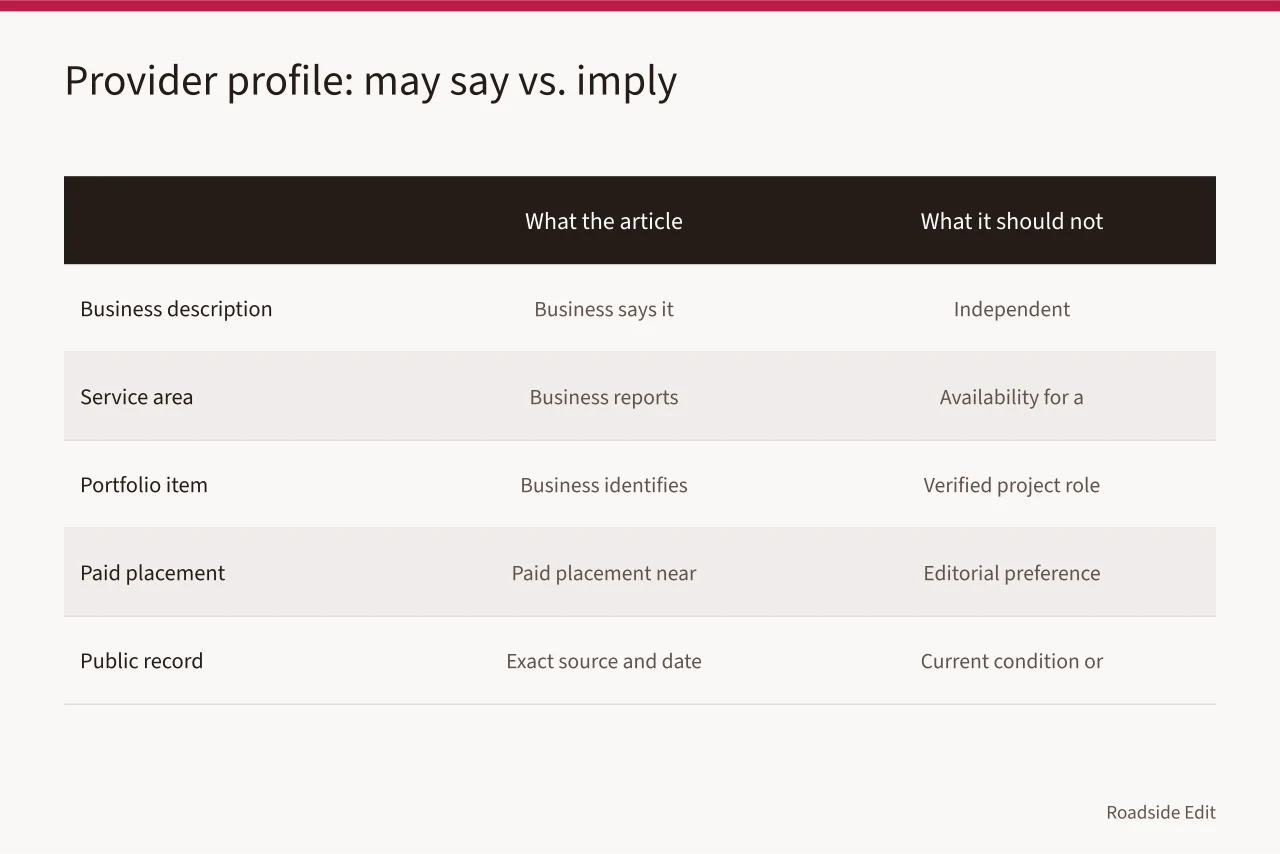
| Field | What the article may say | What it should not imply |
|---|---|---|
| Business description | "The business says it provides..." | Independent confirmation of competence |
| Service area | "The business reports serving..." | Availability for a specific project |
| Portfolio item | "The business identifies this project..." | Verified project role or quality finding |
| Paid placement | "Paid placement" near the profile | Editorial preference or ranking |
| Public record | Exact source and date | A current condition not stated by the record |
Consistency matters. Apply the same inclusion fields to every ordinary profile. If the site runs a sponsored feature, give it a visually clear paid label and keep its supplied copy in a designated section. The label should not depend on a reader reaching the last paragraph or opening a separate policy page.
The FTC native advertising guide explains that promotional material resembling editorial content may need clear identification. It does not rank providers. It supports placing paid-placement labels near the profile and repeated cards.
Separate the project brief from the provider profile
People often search for a provider before they have a defined project. The article can still help by separating three documents:
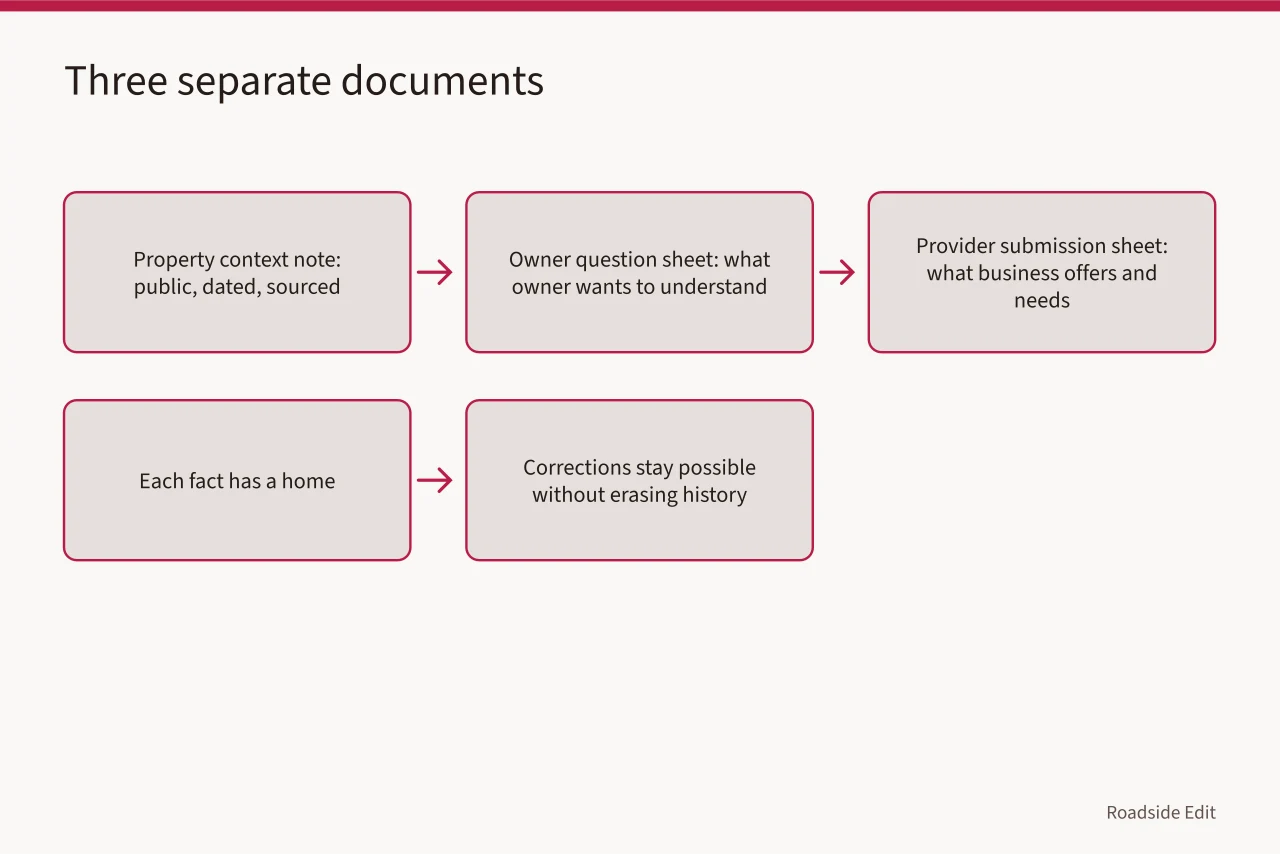
- A property context note: what is publicly known, dated, and sourced.
- An owner question sheet: what the owner wants to understand or preserve.
- A provider submission sheet: what the business says it can offer and what it needs to know.
This separation avoids a common mistake: treating an early conversation as a plan. A property context note may include an old photograph, a location reference, or a historic description. It should be clearly dated and should not be recast as current condition information.
An owner question sheet can list unknowns, such as access, permissions, schedule constraints, or the right contact for a current record. A provider submission sheet can request a written description of the approach, assumptions, exclusions, schedule window, and the information the provider still needs.
The benefit is practical. Each fact has a home, and a later editor can tell whether a sentence came from a public record, an owner, or the provider itself. Corrections stay possible without erasing the page's history.
The National Archives overview of records explains that records can take different forms, including photographs and electronic materials. It is not a provider-selection rule. It supports retaining dated source material for updates and corrections.
Ask comparable questions, not leading questions
An editorial list should not manufacture a winner. It can make comparison easier by asking each participating business the same nontechnical questions and presenting answers in the same order. Focus on clarity rather than claims of superiority.
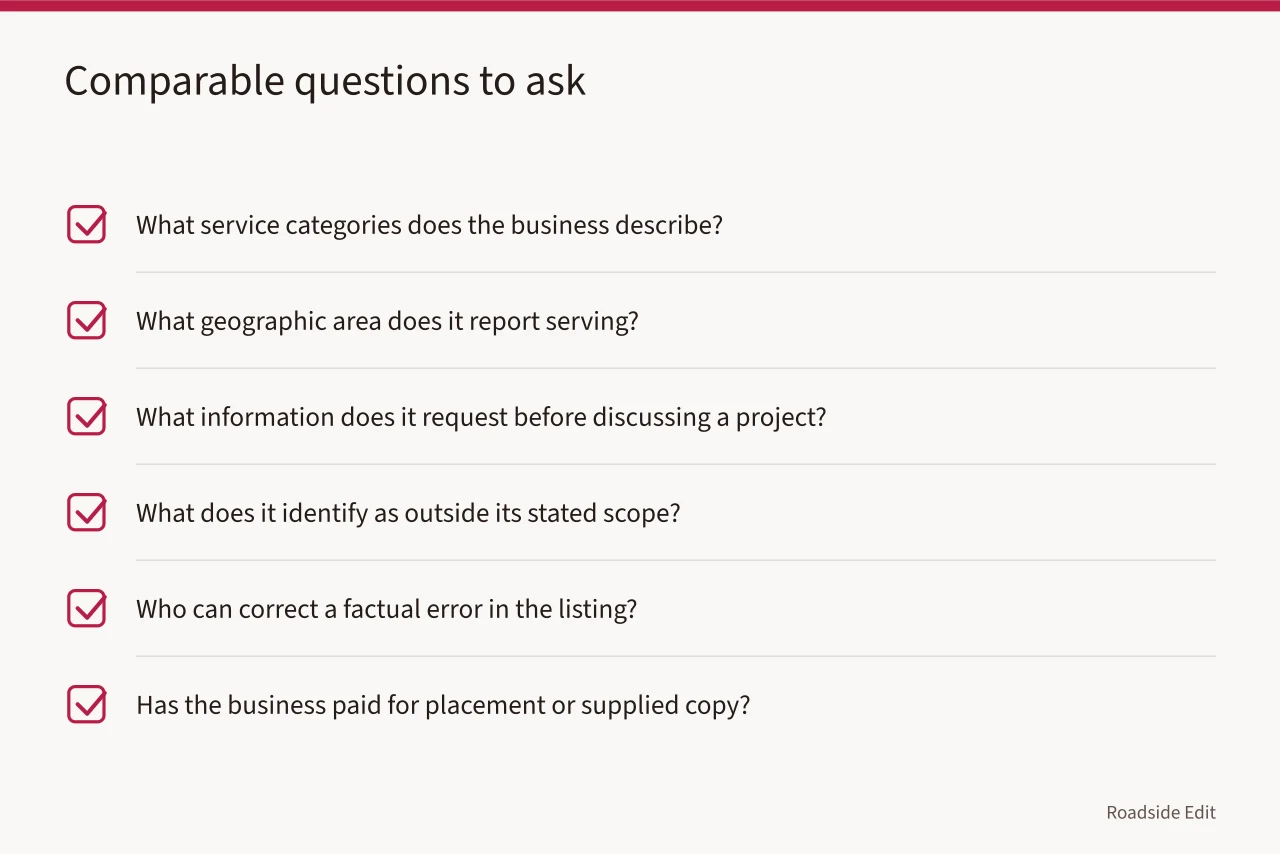
Suggested questions include:
- What service categories does the business describe in its own words?
- What geographic area does it report serving?
- What information does it request before discussing a project?
- What does it identify as outside its stated scope?
- Who can correct a factual error in the listing?
- Has the business paid for placement, supplied copy, or provided another material benefit to the publisher?
Do not ask a business to declare itself "the best," "approved," or "safe." Those answers are marketing claims, not useful comparison fields. If a business supplies a reference, present it as a reference supplied by that business. Do not summarize it as an independent performance conclusion unless the article has a specific, attributable source for that conclusion.
Make price reporting honest about uncertainty
A meaningful public page should not present a single number as a universal restoration price. Work can differ by sign type, condition, access, local requirements, and record needs. Materials, timing, and the defined deliverables matter too.
A transparent feature can report a provider-supplied estimate range only when it states what the range includes and excludes, the date it was supplied, and that it is not a quote for the reader's property.
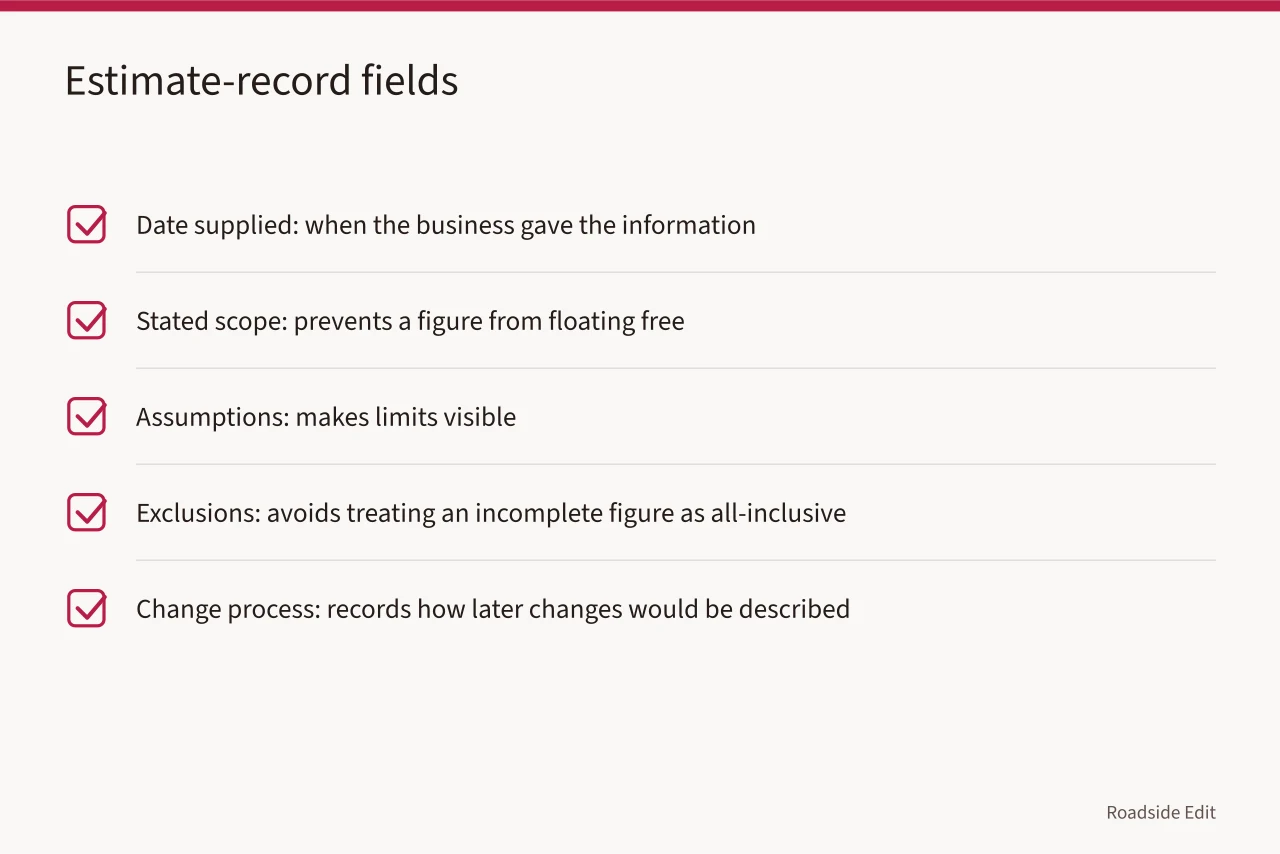
Better still, use an estimate-record table:
| Estimate field | Why it belongs in the record |
|---|---|
| Date supplied | Shows when the business gave the information |
| Stated scope | Prevents a figure from floating free of deliverables |
| Assumptions | Makes limits visible |
| Exclusions | Avoids treating an incomplete figure as all-inclusive |
| Change process | Records how later changes would be described |
This is a publishing standard, not repair advice. It gives a reader a way to recognize when numbers cannot be fairly compared.
Keep disclosure close to the claim
Disclosure belongs in the reading experience, not in paperwork at the bottom of the page. If an entry is paid, say so beside the entry title and again wherever the entry is repeated in a list or card.
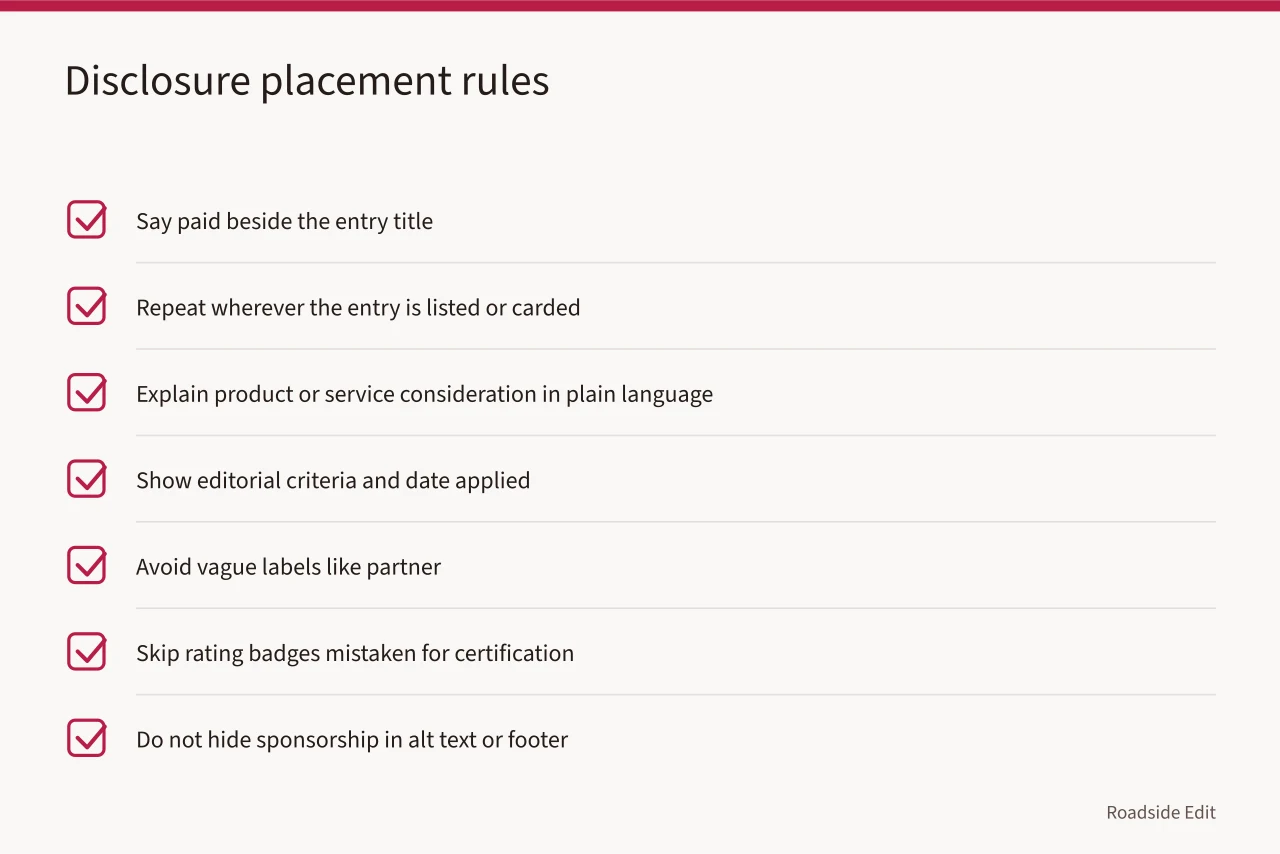
If a provider gave the publisher a product, service, or other consideration tied to a recommendation, explain the relationship in plain language. If a list is editorially selected under stated criteria, show the criteria and the date they were applied.
Avoid vague labels such as "partner" when the important fact is that an entry is a paid placement, and skip a rating badge a reader could mistake for independent certification.
Do not hide a sponsorship note in image alt text, hover treatment, or an isolated footer. Readers should not hunt for the relationship that changes how they read a claim.
Build a correction trail
Every provider page needs a correction path. Include a contact channel, a statement of the evidence needed for a factual correction, the date of the last review, and a short update note when a material fact changes.
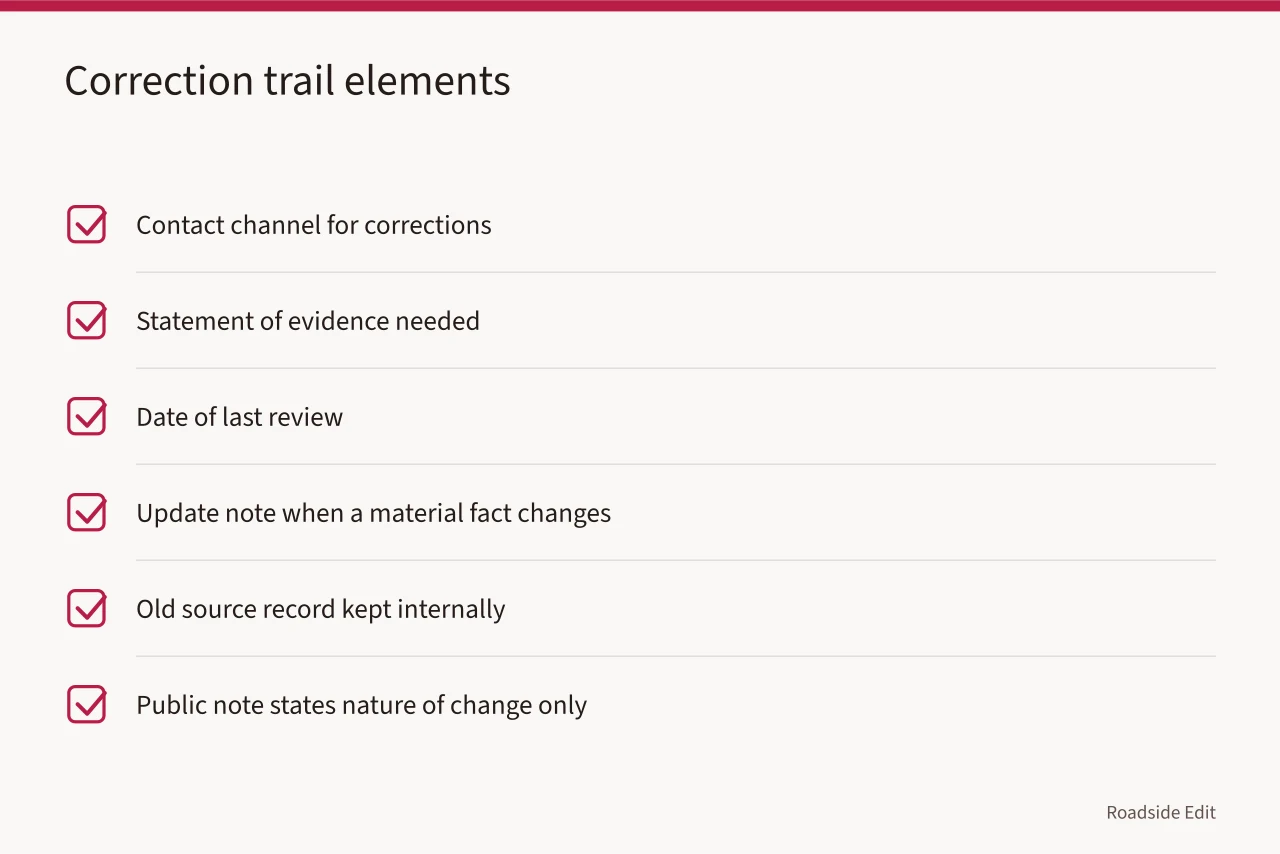
Keep the old source record internally. On the public page, state the nature of the change without making a new claim the evidence does not support.
A safe update note might read: "Updated October 2027 to revise the business-supplied service-area statement." The listed business requested that revision. The note should not claim the provider is now available, insured, licensed, qualified, or recommended unless the page has documented and cited that fact.
A publishing checklist for provider features
Before a provider profile or listicle goes live, confirm the following.
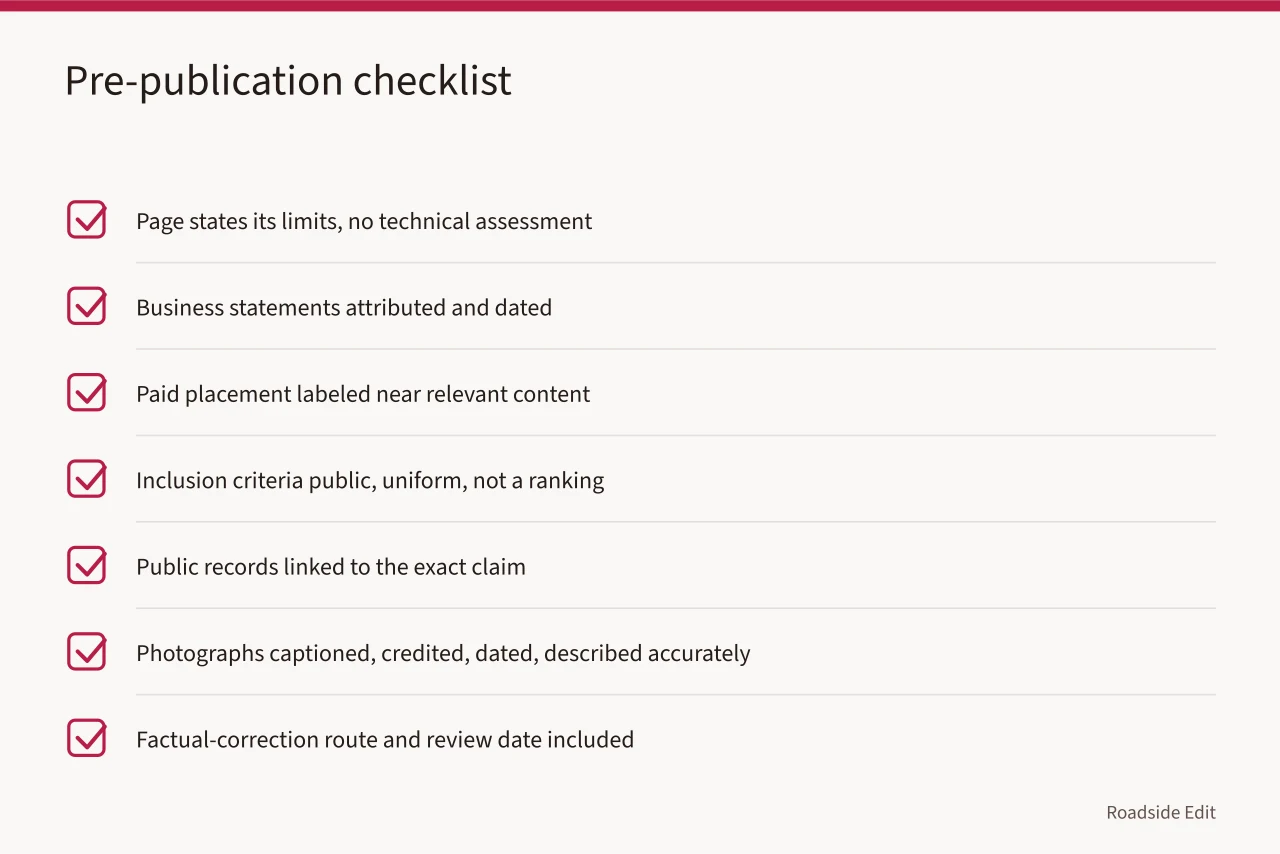
- The page states its limits and does not promise a technical assessment.
- Business-supplied statements are attributed and dated.
- Paid placement and material connections are labeled near the relevant content.
- Inclusion criteria are public, uniform, and not disguised as a ranking.
- Public records are linked to the exact claim they support.
- Photographs are captioned, credited, dated when known, and described as context or evidence accurately.
- The page includes a factual-correction route and review date.
This approach is less flashy than a top-ten score. It is more durable. It lets agencies and businesses contribute accurate details, gives readers a clear way to understand what they are seeing, and preserves the difference between a paid opportunity and an independent editorial conclusion.
The Library of Congress Prints and Photographs collections provide item records with descriptive and rights information. They do not establish a provider's project role. They support checking visual context before an image appears beside a commercial profile.
Common questions
Can a paid provider appear in a Roadside Edit list?
Yes, if the relationship is clearly labeled, the business-supplied material is attributed, and the placement is not presented as independent approval or a superior rank.
Does a profile prove that a provider is qualified?
No. A profile can organize documented and business-supplied information. It cannot replace property-specific review, licensing checks, or a professional decision process.
What should a provider submit for a factual correction?
Submit the exact statement that needs correction, the replacement wording, the source or responsible contact supporting it, and the date of the request.
Can an article publish a price range?
It can report a dated, business-supplied range only with its stated scope, assumptions, exclusions, and a clear note that it is not a quote for a reader's property.