Guides
How to plan neon sign restoration costs without guesswork
Neon sign restoration cost planning for 2027 helps U.S. owners organize budget categories, evidence, approvals, and disclosures without generic price claims.
Cost planning for a historic neon sign should clarify decisions, not manufacture a price. A reliable planning file shows the budget's scope and what information supports each category.
It notes what remains unknown and which authority or qualified review is needed before commitment and does not tell readers how to perform electrical, structural, lifting, access, or other site-specific work.
What to take away
- Start with categories and evidence, not a single average figure.
- Connect every proposed budget item to a defined project purpose.
- Separate research, documentation, professional review, communication, and physical work.
- Label provider estimates and sponsored content as such.
- Keep unknown conditions visible instead of hiding them in a confident total.
Define what the budget is for
The phrase "sign restoration budget" can describe very different assignments. One owner may need a public history, another may need an organized record for a preservation conversation, and another may be considering a property-specific professional assessment. Treating these as one scope produces bad comparisons.
Write a one-sentence purpose first. For example: "Organize historical sources and current photographs for an owner decision," or "Prepare a source-supported public profile with paid-placement disclosure." A sentence like this sets a boundary and lets a reader see whether a proposal actually answers the need.
The National Park Service's Historic Preservation Fund forms distinguish a complete project budget from a budget justification. That distinction is useful beyond a grant application. A number is easier to evaluate when the record explains why the category exists, what it includes, and what it excludes. It does not mean every private sign project follows federal forms or eligibility rules.
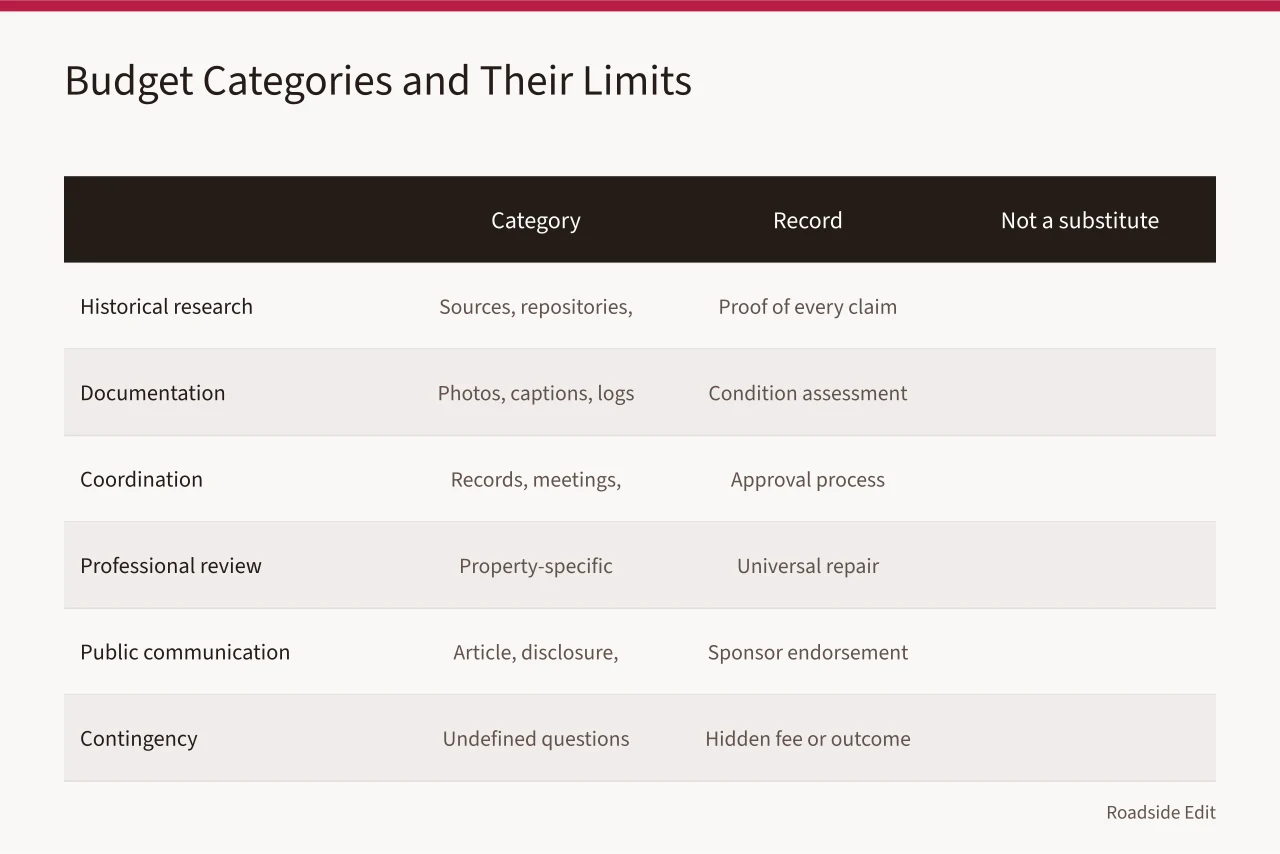
Use a category-based budget
| Category | Questions to record | Avoid treating it as |
|---|---|---|
| Historical research | Which sources, repositories, and dates need review? | Proof of every historical claim |
| Documentation | Which photos, captions, logs, and file records are needed? | A technical condition assessment |
| Coordination | Who gathers records, sets meetings, and records decisions? | An implied approval process |
| Professional review | What property-specific question needs qualified attention? | A universal repair recommendation |
| Public communication | What article, directory entry, disclosure, or grant narrative is needed? | Independent endorsement of a sponsor |
| Contingency | Which questions cannot be priced until they are better defined? | A hidden fee or predicted outcome |
This table gives owners a way to compare proposals without comparing unrelated work. A supplier quote, photographer's day rate, grant narrative, and professional review are not substitutes for one another. The useful question is whether each proposed deliverable has a clear purpose and a record that supports it.
Keep estimates tied to scope
An estimate becomes misleading when it is separated from its assumptions. If a provider gives a range, record the date, stated work, access assumptions, travel assumptions, exclusions, tax treatment, and whether the range is an initial conversation or a formal proposal. Do not publish it as a general market price.
The same rule applies to examples from other projects: an old grant worksheet may organize categories but cannot establish a different sign's cost.
Location, ownership, documented history, and current condition can change the work. Applicable requirements, access, and the project boundary can also change it. A transparent list of questions serves a reader better than a number with false precision.
The National Archives guidance on agency recordkeeping describes federal responsibilities for records documenting activities and decisions. It does not establish a private cost-planning file. It supports retaining the dated material that explains why a category, scope, or public statement changed.
Separate evidence from commercial language
A directory or listicle can help businesses reach readers if it explains its method. Say whether a company paid for placement, supplied its own description, or was selected from public information. Attribute prices, capabilities, and project examples to the source that provided them. Do not let an advertiser's preferred phrase become an editorial finding.
For an owner, this also makes comparison easier. A proposal can be compared by deliverables, documentation practices, review limits, schedule assumptions, and change process. It should not be ranked by a headline claim such as "best value" unless the publication can state and support a consistent method.
Make uncertainty visible
The most important cost-planning note is often the unresolved-question list. It might include unclear ownership, missing historical photos, uncertain access, a possible local review process, incomplete provider records, or a decision that the owner has not made. Put those questions in a separate section and name who can answer them.
This is not a delay tactic: it prevents a research assignment from becoming a promise to complete unrelated work and an article from drifting into unsafe instruction.
If the question involves energized components, structural support, or access to high-mounted features, document it. For permits, utilities, or a public right-of-way, document it; use the qualified process for the actual site.
The OSHA electrical eTool for Subpart S covers electrical-installation topics including qualified-person considerations. It is not a neon-sign estimate or planning scope. It supports the safety boundary in this article: published budget content should not be used as site-specific electrical direction.
Maintain a decision record
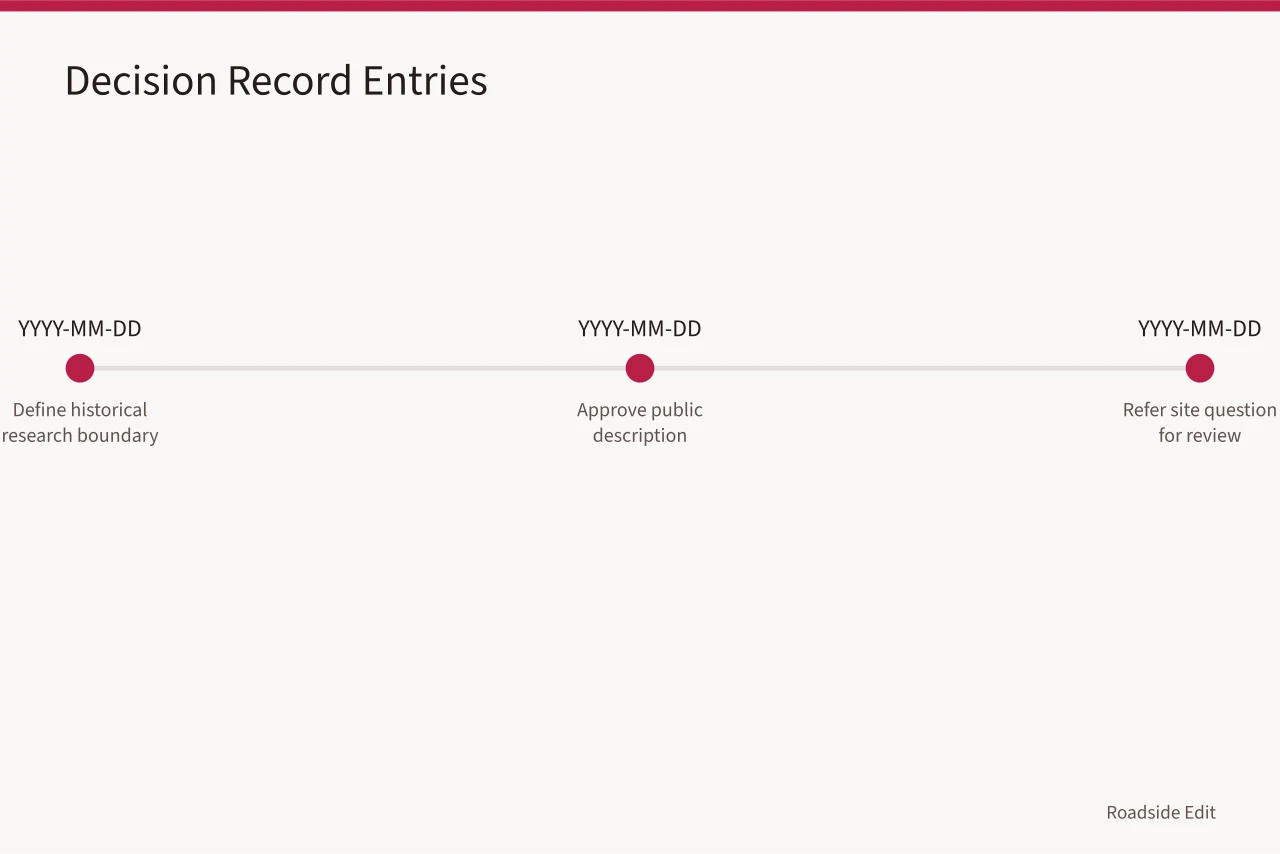
Use a simple table with the date, decision, evidence considered, responsible party, and next action. When a category changes, state why. A decision record can show that an owner chose more documentation before seeking a quote, that a sponsor's statement was labeled, or that a public article was delayed because a key claim was not confirmed.
| Date | Decision | Evidence used | Next action |
|---|
The record should not manufacture authority. Its purpose is to show what the team knew at the time and how the decision stayed within that information.
Compare proposals using the same questions
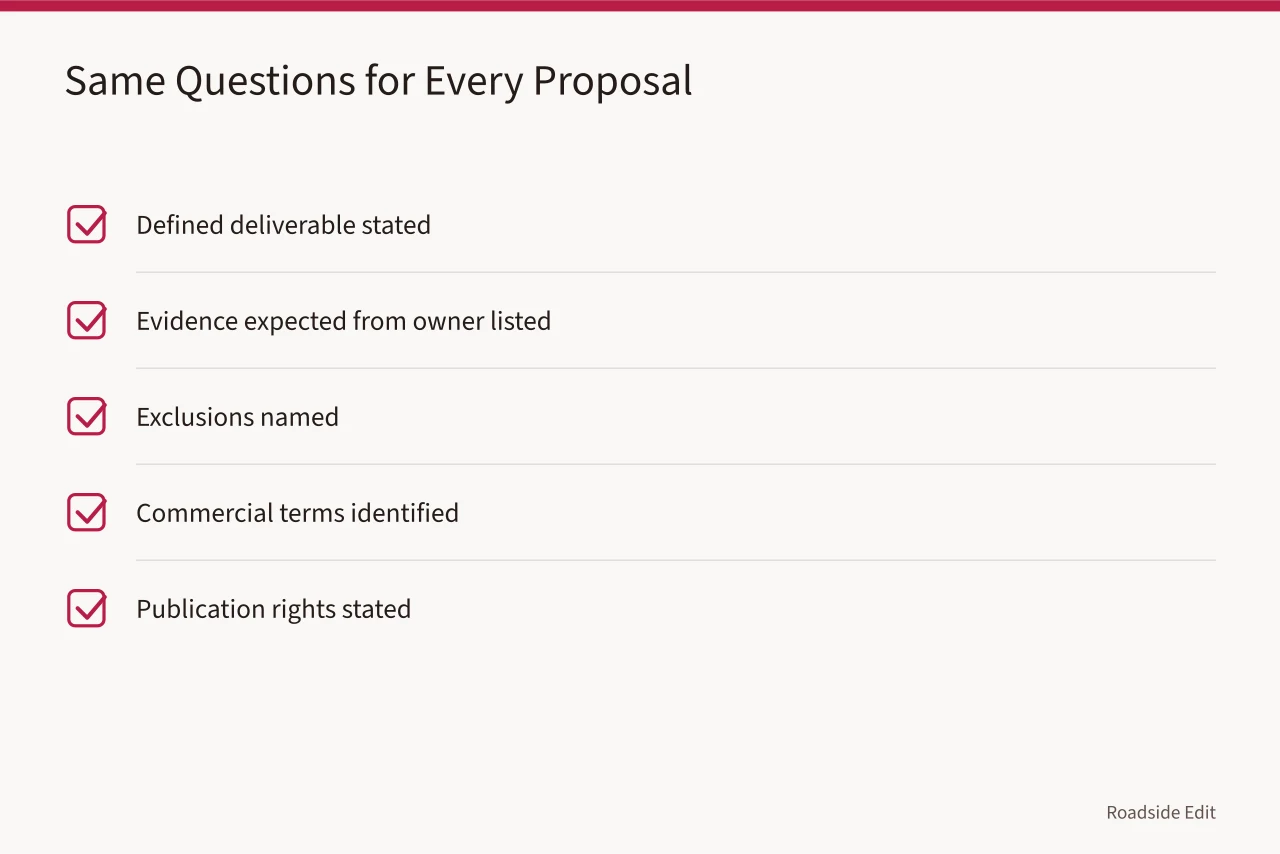
When considering several providers, researchers, or communications partners, ask each the same defined questions. What deliverable will be provided, and what records or access does the response assume?
Who will own the resulting report, photographs, or written copy, and what change process applies if the historical record or assignment changes? Which matters does the proposal explicitly leave for another qualified party or authority?
This method does not rank a company by an unsupported slogan. It builds a practical comparison table from stated deliverables.
An owner can see one response offers a historical source log, another a photographic record, and another a public-facing profile. Each may have value, but they are not interchangeable because they relate to the same sign.
| Comparison item | Provider or proposal response |
|---|---|
| Defined deliverable | State the report, record, or public material to be delivered |
| Evidence expected from owner | List records, photographs, access, or decisions needed before work begins |
| Exclusions | State work not included or questions left for separate review |
| Commercial terms | Identify fees, dates, sponsorship, and change process |
| Publication rights | State what may be used publicly and how attribution works |
Keep the comparison document with the decision record. If the selected option is later described in a sponsor profile or listicle, the publication should disclose the relationship and avoid creating a false impression that its editorial team independently certified every service or price.
Check the public budget narrative
Public copy should distinguish a budget category from money spent, a proposal from an approved commitment, and a grant award from a private endorsement.
A sentence like "the project includes a documentation category" differs from "the project is fully funded." Use the first only when the record supports it. Do not use the second unless a current source establishes it.
For businesses considering a paid placement, this discipline is an advantage. A clearly labeled listing can explain what information a company supplied, how readers can verify it, and what the publisher did not assess. That is more durable than copy that sounds impressive but blurs editorial and advertising roles.
The Federal Trade Commission's endorsement guides address endorsements and testimonials in advertising. They are not historic-preservation or cost-estimating guidance. They are relevant when a provider estimate, profile, or testimonial is linked to a paid relationship.
An owner can also use the same record when a project pauses. Preserve the last proposal, the scope version it addressed, and the open questions that prevented a decision.
When planning resumes, the next reviewer can start with evidence, not an old total detached from assumptions. This reduces repeated research and prevents a stale statement from becoming a public claim.
Prepare content that can be trusted
Before publishing a cost article, remove claims that imply a universal figure, a guaranteed outcome, or a technical recommendation. Review every link and photo credit. Make sure the claim source supports the sentence beside it, then label illustrations as illustrations. State commercial relationships in plain American English.
Common questions
Why not list a typical restoration price?
Typical figures can hide differences in scope, evidence, ownership, location, access, and required review. Category-based planning is more useful before a property-specific scope exists.
Can a provider's estimate be included in an article?
Yes, when it is attributed, dated, described with its stated scope and exclusions, and not presented as an independent market conclusion.
Is a contingency always necessary?
No. It is a way to identify questions that are not yet defined well enough for a responsible commitment.
Does this guide provide restoration instructions?
No. It concerns records, choices, budgets, and public communication. Physical and safety questions require the appropriate site-specific process.