Guides
Part of How modern roadside design cost planning works before you commit to a number
How to build a modern roadside design cost planning scope checklist
Modern roadside cost planning checklist for 2027 helps owners define scope, document assumptions, compare estimates, and track changes without price claims.
Modern roadside cost planning begins with the work, not a number copied from another property. A roadside building, sign, parking area, frontage, or service space can carry different access needs, existing conditions, local requirements, and operating limits. This checklist organizes questions for an owner. It does not estimate construction cost or set a fair price.
What to take away
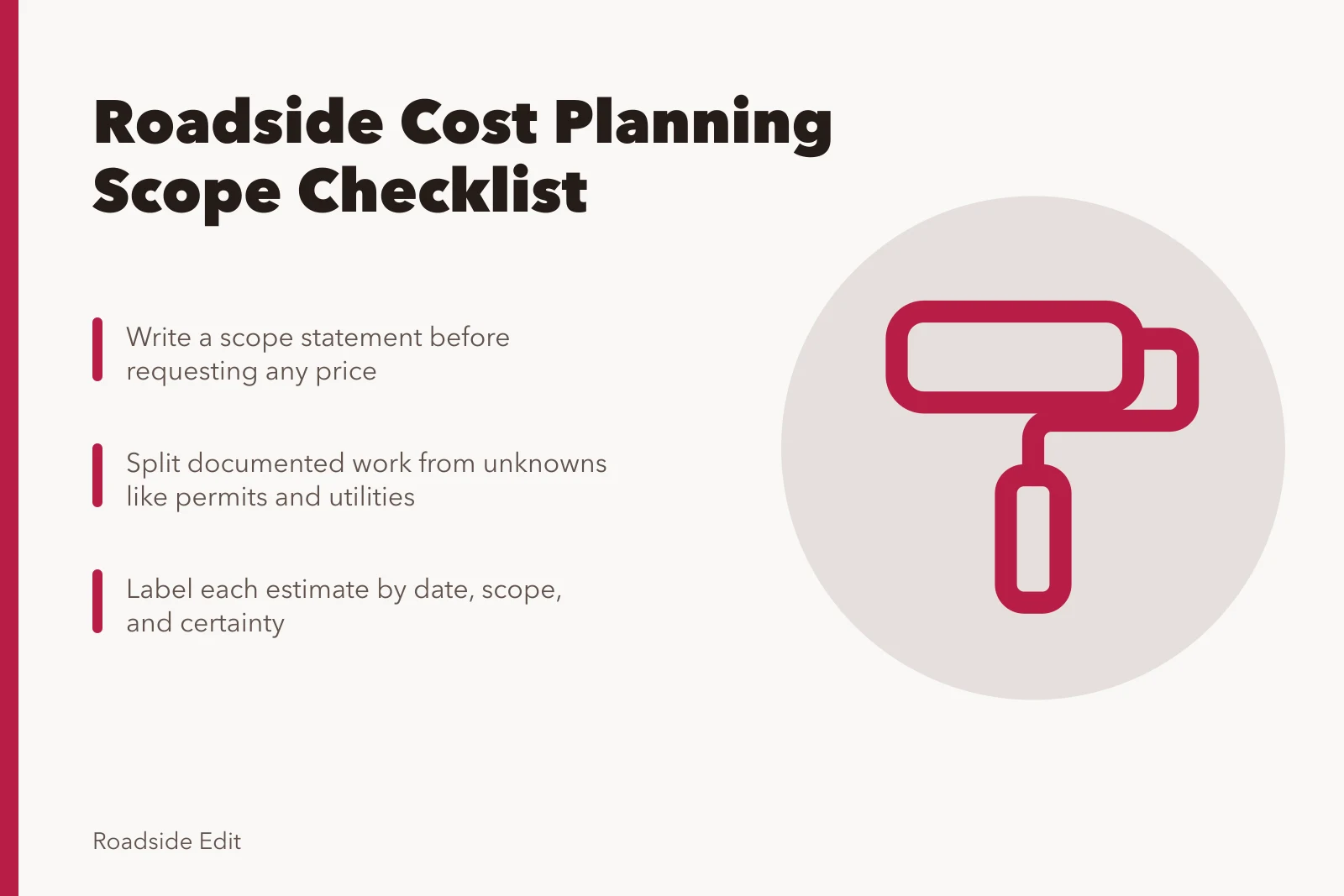
- Define the work boundary before requesting a price.
- Label every estimate by date, scope, and level of certainty.
- Keep known work separate from risks and unresolved questions.
- Record changes instead of treating an early figure as a final budget.
1. Write a usable scope statement
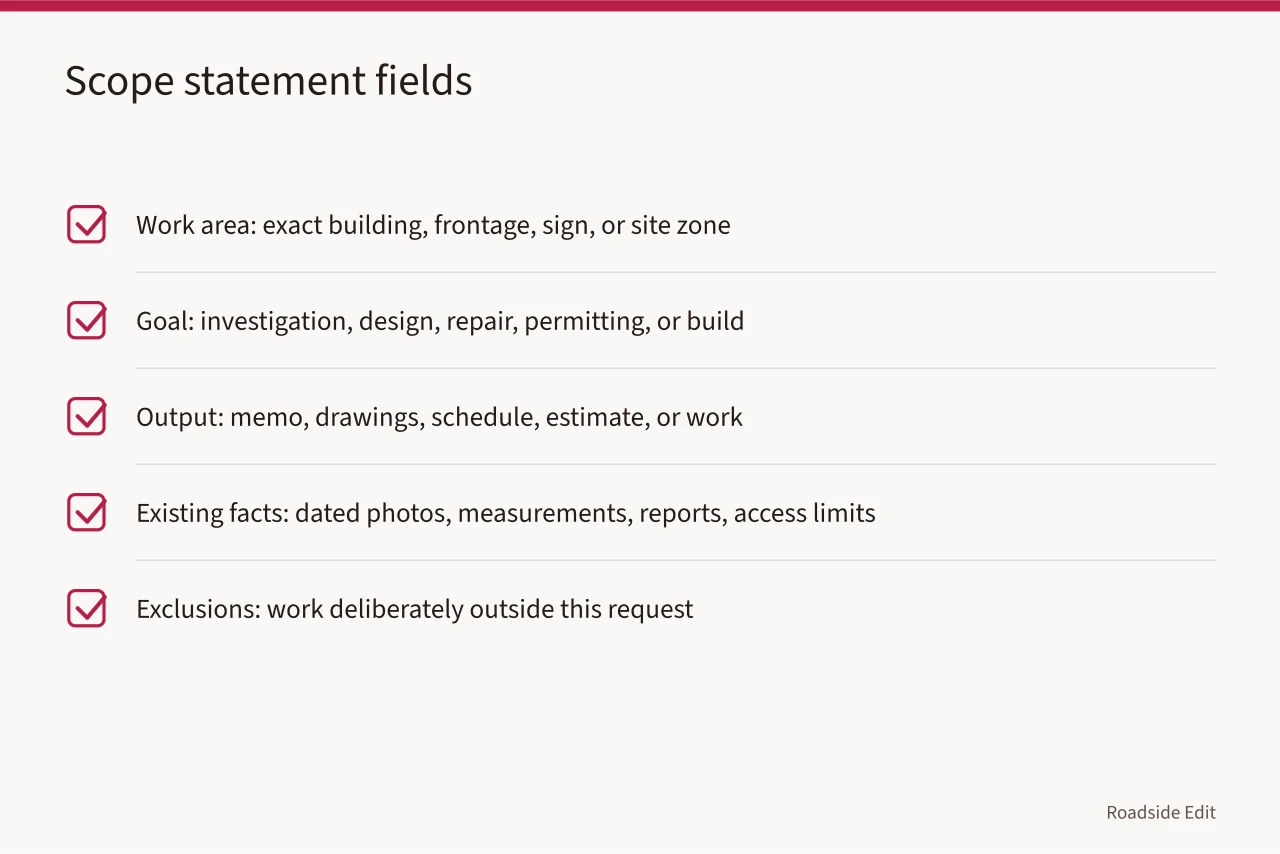
Start with a short description of the decision at hand. Name the property area, the goal, what is already known, and the output being requested. For a roadside property, the assignment might concern a sign, exterior lighting, a parking edge, a facade, a service counter, or a package of related repairs. Avoid a catch-all request such as "update the site."
GSA says that a scope of work is used to create a cost estimate and should be developed before the estimate. Read GSA's project-process guidance. The page describes a federal work authorization process, not a private design project. Its central sequence still applies: a cost conversation needs enough detail about the work to mean anything.
| Scope field | What to enter | What not to assume |
|---|---|---|
| Work area | Exact building, frontage, sign, or site zone | That the entire property is included |
| Goal | Investigation, design, repair, permitting, or build work | That one trade will solve every issue |
| Output | Memo, drawings, schedule, estimate, or completed work | That a proposal promises an outcome |
| Existing facts | Dated photos, measurements, reports, access limits | That an old image proves present condition |
| Exclusions | Work deliberately outside this request | That exclusions will be obvious from the fee |
If a supplier or consultant needs more information, add the question to the scope record. Do not resolve it in a private phone call and leave later readers with a proposal that appears more certain than it was.
2. Separate known items from unknowns
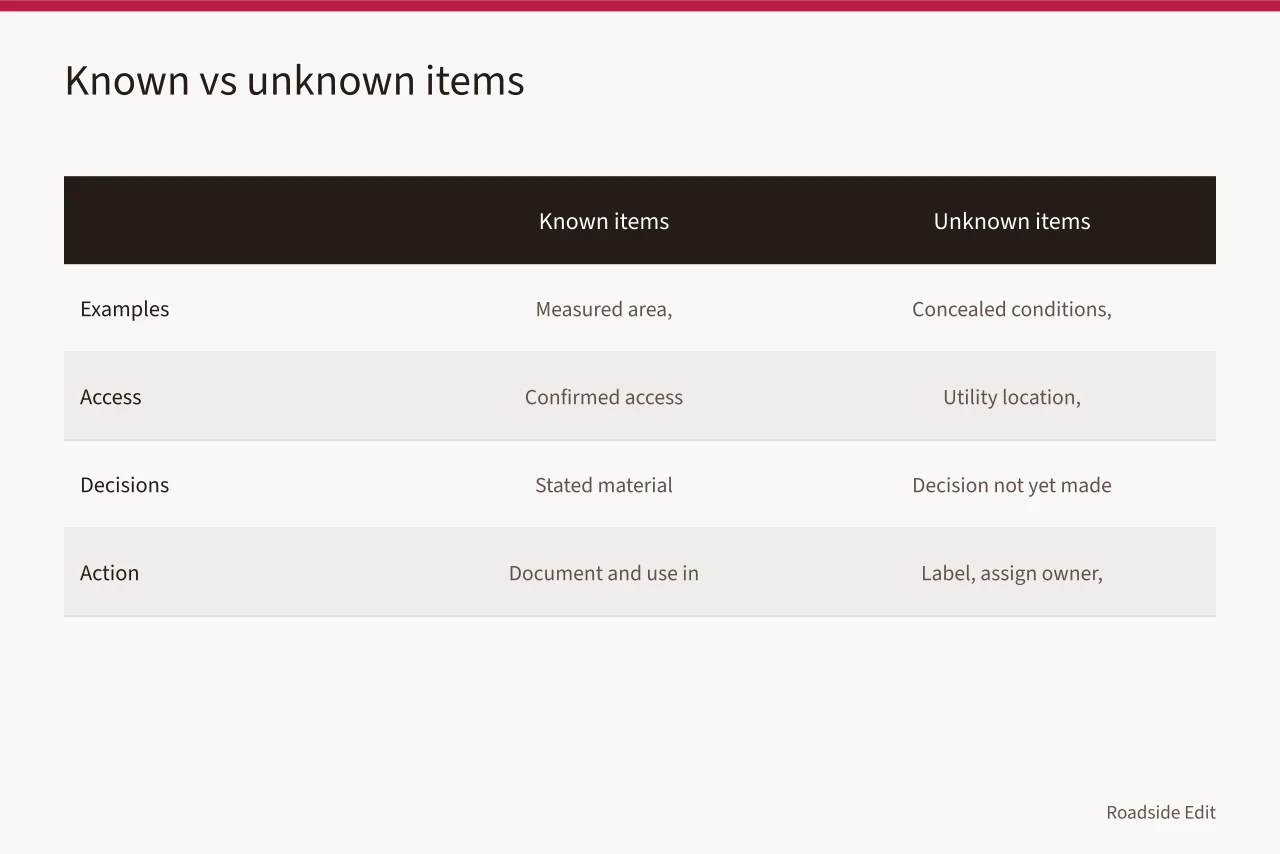
Create two lists. The first includes work that is documented: a measured area, a requested drawing, a confirmed access restriction, or a stated material requirement. The second includes unknowns: concealed conditions, permit questions, utility location, availability, or a decision that has not been made. This makes the next estimate more honest without requiring a prediction.
NPS preservation-planning standards state that the activity scope must be defined so work can be completed with the available budgeted resources. Read the NPS planning standards. The standards concern preservation planning, not a roadside price sheet. They support the practical need to match a stated task with the resources set aside for it.
Do not turn an unknown into a hidden allowance. Give it a label, an owner, and a next step. If it cannot be resolved before an estimate is requested, say so in the request.
3. Identify the estimate stage
Not every figure has the same job. An early planning amount, a design-stage estimate, a contractor response, and a change proposal should not share a single label. Put the date, author, scope version, and stated purpose beside each figure.
GSA explains that estimates evolve as scope and requirements become clearer through a project life cycle. Review GSA cost-management guidance. Its figures and stages are for GSA work, so they should not be republished as a private-project formula. The helpful point is to document what information supported an estimate at that stage.
| Estimate label | Use it for | Keep with the record |
|---|---|---|
| Early planning | Testing whether a concept fits available funds | Known limits and open questions |
| Design-stage | Checking a more defined approach | Drawings, specifications, and assumptions |
| Proposal | Evaluating a stated provider scope | Deliverables, exclusions, fee terms |
| Change note | Recording new work or conditions | Original scope and approval status |
4. Check the work description against the documents
Read the scope, site information, and estimate together. If the scope mentions salvaged materials, sequencing, protection, or a defined area, check whether the documents identify the detail needed to understand that task. A cost record cannot repair missing project information, but it can make the gap visible before a decision is made.
NPS's architectural-preservation quality-review checklist includes work scope, preservation intent, existing conditions, drawings, and specifications among the material checked for project work. See the NPS architectural-preservation QA checklist. It is a government review tool, not a rulebook for a commercial property. It provides a useful example of why a cost discussion belongs beside clear project documents.
5. Keep a change log
When the requested work changes, create a dated entry instead of replacing the first estimate. Note the scope item affected, the reason stated, the supporting document, the proposed cost effect if any, and the person who must approve the next step.
This record is not a substitute for a contract or legal review. It prevents an estimate from being quoted later without its context.
Before a public article, directory profile, or sponsored placement mentions a project, remove private cost terms and unsupported performance claims. Process information is safer and more useful: an owner can say that work was compared against a stated scope without saying who had the best price.
Common questions
Can this checklist give me a project budget?
No. It prepares the documents and questions needed for a responsible budget conversation.
Is an estimate the same as a bid?
No. Record the document's stated purpose and terms. A provider proposal, preliminary planning figure, and final contract price are different records.
What if the scope is still unclear?
List the unresolved issue and decide whether it needs research, a site visit, a professional opinion, or a narrower initial assignment.