Guides
Choosing help for roadside architecture: a 2027 guide to named providers and criteria
A 2027 guide to hiring help for roadside architecture, naming real firms and directories and the criteria that decide scope, evidence and fit.
What to take away
- Write the scope first. It names the property, the feature, the output and who signs it.
- Match the firm to the task: a porcelain-enamel sign face, a canopy soffit, a motel court survey and a Section 106 file need four different resumes.
- Verify licenses through NCARB and state boards, not through a provider's own web page.
- Compare written scope and assumptions before fees. A low fee usually describes a smaller job.
- Keep the selection file: proposals, source pages, dated notes and reference permissions.
Write the scope before you collect names
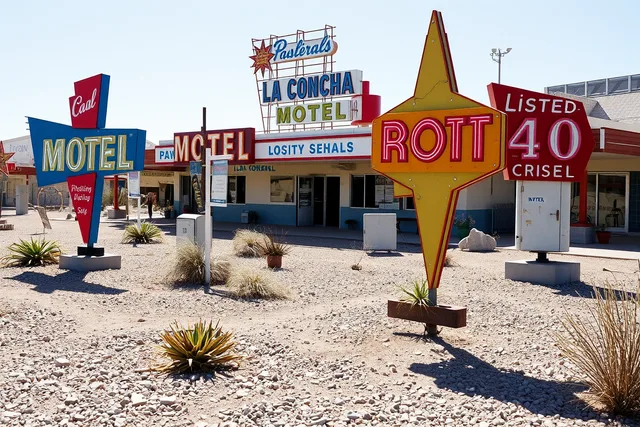
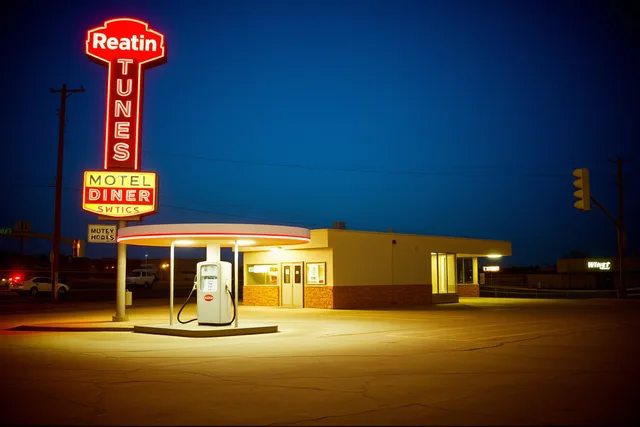
A roadside property carries several jobs at once. A 1950s porcelain-enamel station sign, a 1960s plastic-faced box sign, a motel court with brick veneer, and a forecourt with a dry-stand pipe each need a different hand. One scope, one deliverable, one signature.
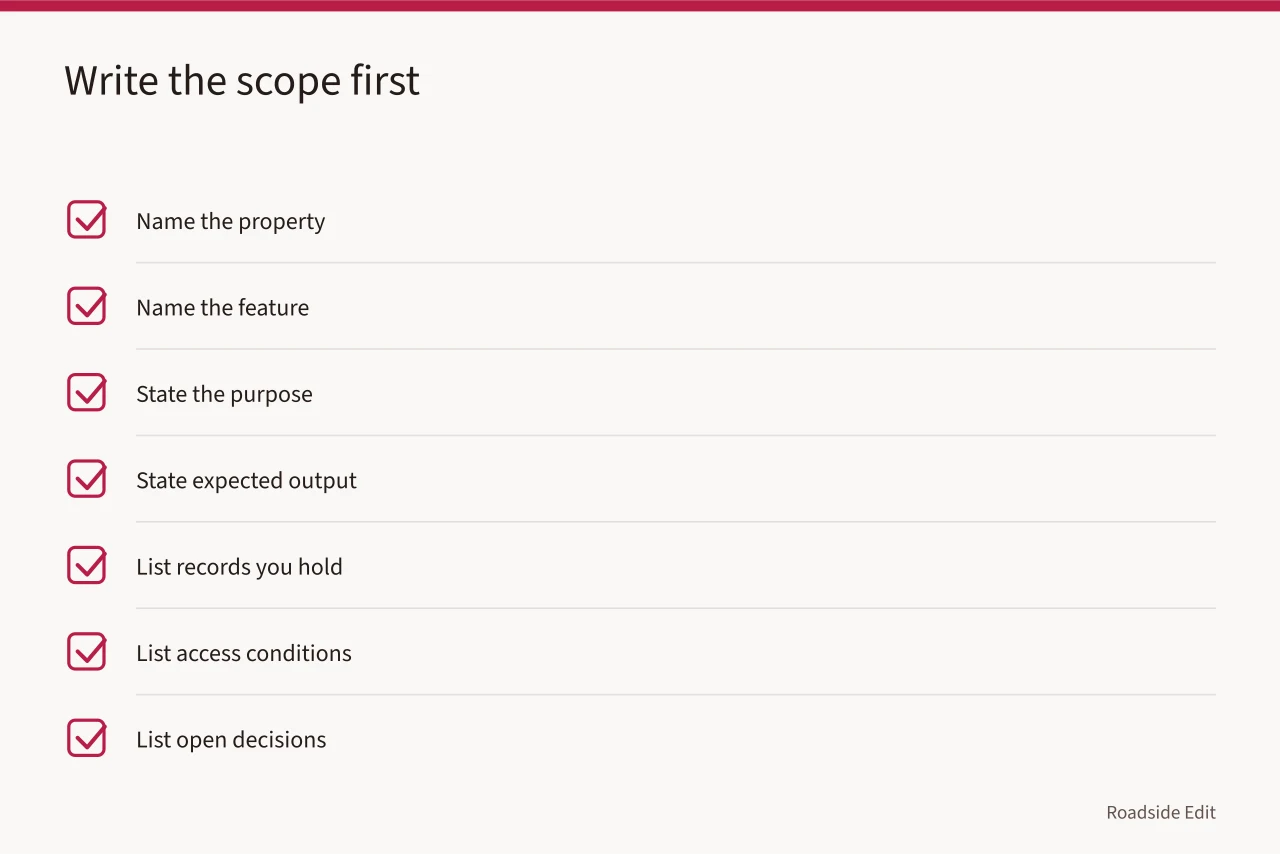
Put the scope in writing before you call anyone. Name the property, the feature, the purpose and the expected output. List the records you hold, the access conditions, and the decisions still open. A short, precise scope lets a historian, architect, engineer or conservator say what they would do without promising work outside their role.
The National Park Service inquiry guidance is built for National Historic Landmark nominations, not private roadside projects. Its screening logic still works: read the education, the prior work, and the quality of that work through the program or preservation office that holds the record. Use the NPS inquiry guidance as a screening model.
Named firms worth a short list
These are real practices with public records. This is not a ranking and nobody here tested them. Verify current licensing, capacity and scope yourself.
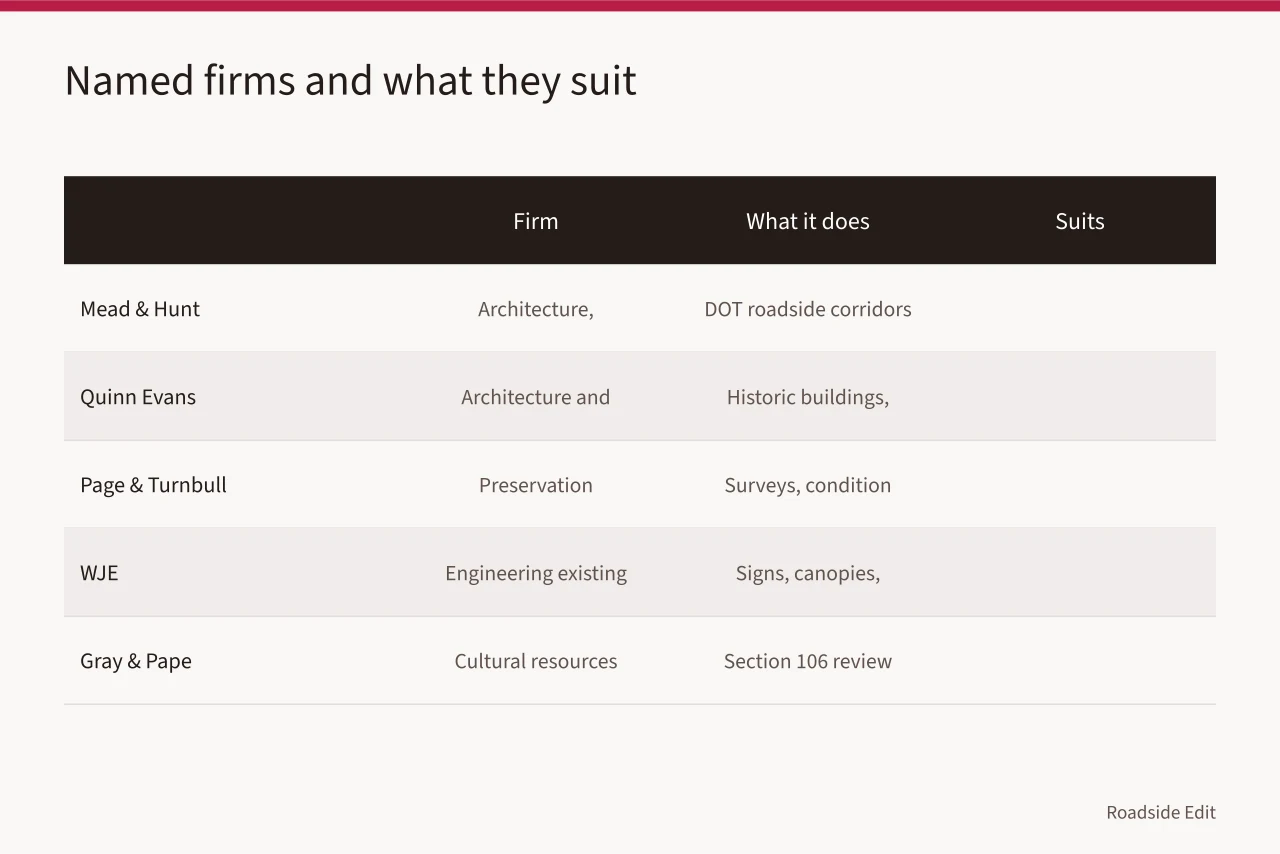
| Firm | What it does | Suits | Pricing model |
|---|---|---|---|
| Mead & Hunt | Architecture, engineering, planning, cultural resources | DOT and state roadside corridors, historic roads and bridges | Project-based, no public schedule |
| Quinn Evans | Architecture and preservation | Historic buildings, museums, Main Street blocks | Project-based |
| Page & Turnbull | Preservation architecture, planning, conservation; founded 1977 | Historic resource surveys, condition assessments, design | Project-based |
| Wiss, Janney, Elstner (WJE) | Engineering and architecture of existing structures | Signs, canopies and buildings that need engineering | Project-based |
| Architectural Resources Group | Preservation architecture and planning | Rehabilitation and preservation planning | Project-based |
| Beyer Blinder Belle | Architecture, planning, preservation | Large civic and historic projects | Project-based |
| Gray & Pape | Cultural resources management | Section 106 review and documentation | Project-based |
| SWCA Environmental Consultants | Environmental and cultural resources, employee-owned | Regulatory compliance and surveys | Project-based |
| R. Christopher Goodwin & Associates | Historic architecture, archaeology, preservation planning | Documentation and compliance | Project-based |
| EverGreene Architectural Arts | Conservation of decorative finishes, murals, plaster, stone | Historic interiors and materials | Project-based |
| Keast & Hood | Structural engineering, preservation practice, Philadelphia | Structural evaluation and repair | Project-based |
| Silman, a TYLin Company | Structural engineering with preservation expertise | Structural work on historic structures | Project-based |
Directories find the local names the table cannot. PreservationDirectory.com lists consultants, contractors and organizations, free to search, with some listings submitted or paid. The American Cultural Resources Association member directory lists cultural resources firms and is free. The AIA Firm Directory searches architects by location and specialty. NCARB license lookup verifies an architect's license at no cost.
Your State Historic Preservation Office is the free first call for review questions. On Route 66, the NPS Route 66 Corridor Preservation Program runs cost-share grants for corridor properties.
Read qualifications as a starting point, not a verdict
The NPS Professional Qualifications Standards set minimum education and experience for identification, evaluation, registration and treatment work. They also note that complex tasks or properties can require added areas or levels of expertise. Read the NPS qualifications standards.
That framework identifies a discipline. It does not certify a private provider, confirm availability, set a fee, or prove local experience with porcelain enamel, neon tube diameter or diner booth laminate. Describe only what the record establishes.
Separate the roles before you compare anyone
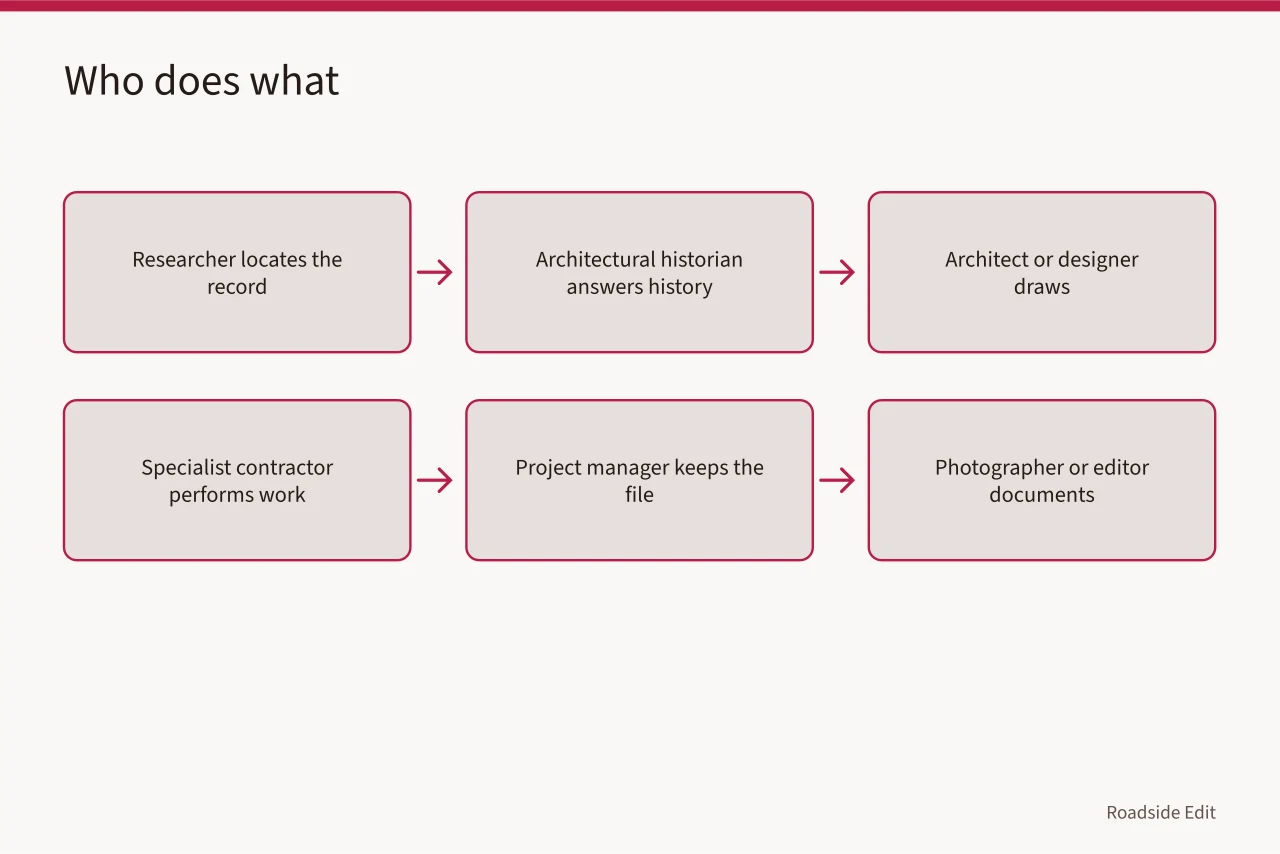
The Secretary of the Interior's Standards tie the treatment choice to significance, physical condition, available documentation and interpretive goals. See the NPS treatment standards overview. They do not tell a private owner whom to hire, and they are the reason a one-size answer fails when the property facts differ.
Ask for one bounded example
Ask for a single past job, not a slogan. Name the feature, their role, the output, the approximate date, and any limit on sharing details. If the evidence cannot be shared, write that limit into the file. Do not fill the gap with an assumption.
NPS contracting and procurement guidance describes written evaluation factors, proposal review, and experience with historic resources inside its own program. Read NPS contracting and procurement guidance. It is not a private procedure, but it supports one method applied to every comparable response.
Compare scope before fee
A fee means something only when the work matches. One proposal may carry travel, research days, meetings and draft review. Another may carry technical coordination, revisions and a final report. The lower number may simply describe the smaller job.
Where a figure matters and you do not have it, keep the arithmetic in named variables. Fabrication cost, survey days, travel and drafting hours are the usual lines. State which side of the line each one sits on before you compare totals.
Keep the selection file
Save the request, the responses, the source pages and dated notes. Save reference permissions, proposal versions, and the reason an entry was included or left out. The file supports public writing without becoming public itself: it may hold personal contact details, unpublished documents, pricing and site information.
When a fact changes, correct the article from the supporting record. A short correction note beats a silent mismatch between the page and the evidence. Provenance records for neon and signage work belong in the same file, and the source records guide shows what a complete set looks like.
Common questions
Does a credential prove a provider fits a roadside project?
No. It supports a narrow statement about education, experience or registration in one discipline. Fit also turns on the scope, the role, the evidence and current capacity.
Should a provider list rank firms by price?
Not unless the scopes match. A fee without a matching deliverable and assumption list tells a reader nothing about the work.
Can a publisher sell a placement in a provider list?
Only with clear disclosure and an inclusion method that never treats payment as proof of quality. A paid placement is a statement from the provider, not a finding.
Who signs off on a canopy, a neon transformer or an underground tank?
A licensed engineer, electrician or environmental authority, under the adopted local ordinance. Name the authority and let the AHJ rule.
In this guide
- Roadside architecture provider checklist: how to compare scope and evidenceRoadside architecture provider checklist for 2027 helps U.S. owners compare roles, written scope, evidence, and stated limits without false endorsements.
- Roadside architecture provider questions to ask before you compare feesRoadside architecture provider questions for 2027 give U.S. owners a neutral interview method for roles, comparable work, records, and deliverables.
- How to compare a roadside architecture provider budget before you signRoadside architecture provider budget notes for 2027 show U.S. owners how to compare written scope, fee assumptions, revisions, and exclusions responsibly.
- How to read roadside architecture provider warning signs before you hireRoadside architecture provider warning signs for 2027 help U.S. readers spot vague roles, unclear scope, and unsupported promises before work starts.
- How to keep roadside architecture provider records clean before publicationRoadside architecture provider records for 2027 give U.S. editors a clear file for scope notes, claims, proposals, evidence, and later corrections.