Guides
Part of Choosing help for roadside architecture: a 2027 guide to named providers and criteria
How to read roadside architecture provider warning signs before you hire
Roadside architecture provider warning signs for 2027 help U.S. readers spot vague roles, unclear scope, and unsupported promises before work starts.
What to take away
- A vague promise is a prompt for a written scope, not proof that a provider is unqualified.
- A general federal procedure cannot become a ready-made specification for a different building.
- Ask who will perform specialized work, what output they will provide, and what evidence supports their stated role.
- Treat a missing answer as an open question unless a reliable record supports a stronger conclusion.
Watch for borrowed certainty
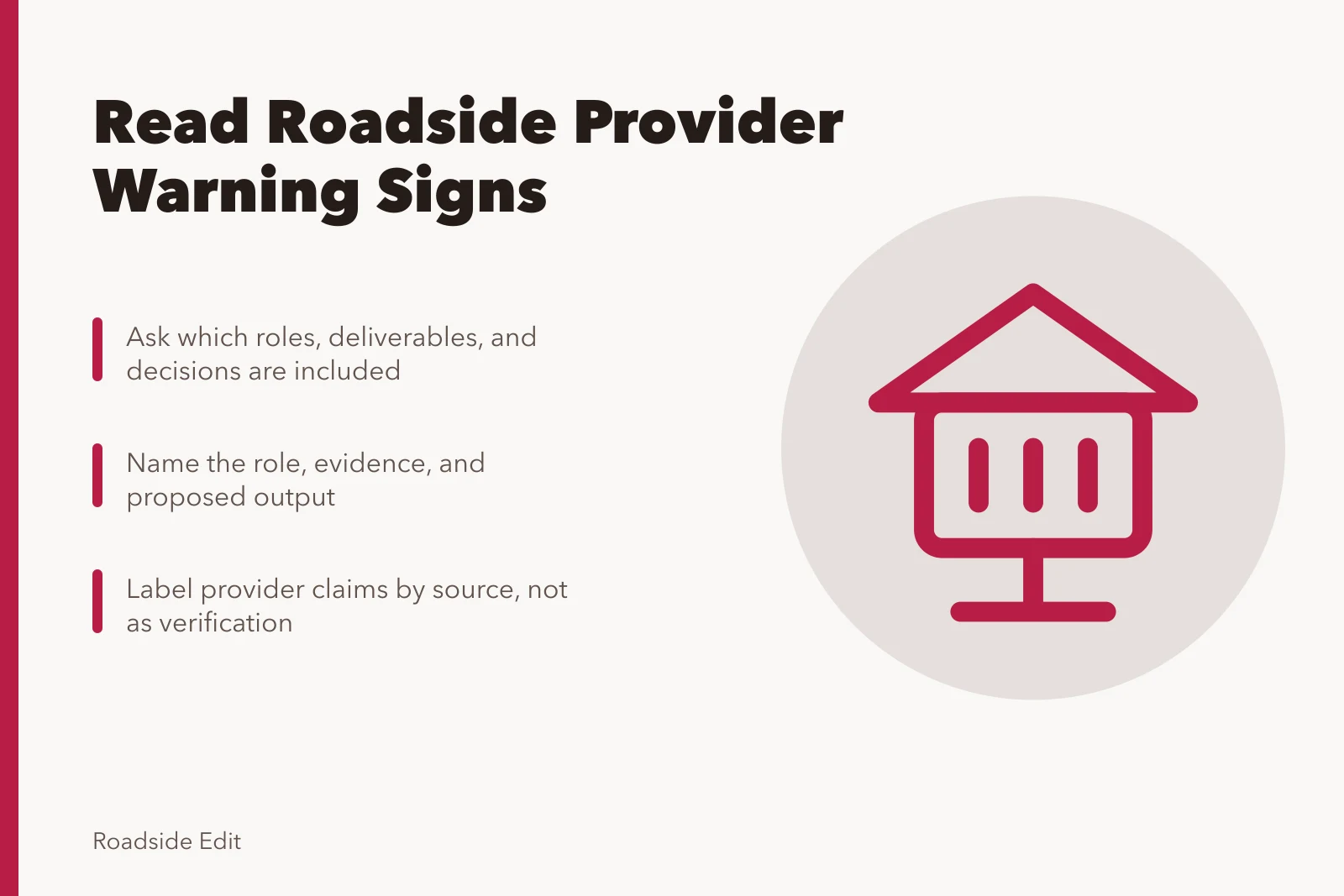
Provider language can sound more complete than the actual offer. "We handle everything," "standard fix," and "full service" are not descriptions of scope. They leave open who will do the work, what information they need, what deliverable is included, and what happens when new evidence appears.
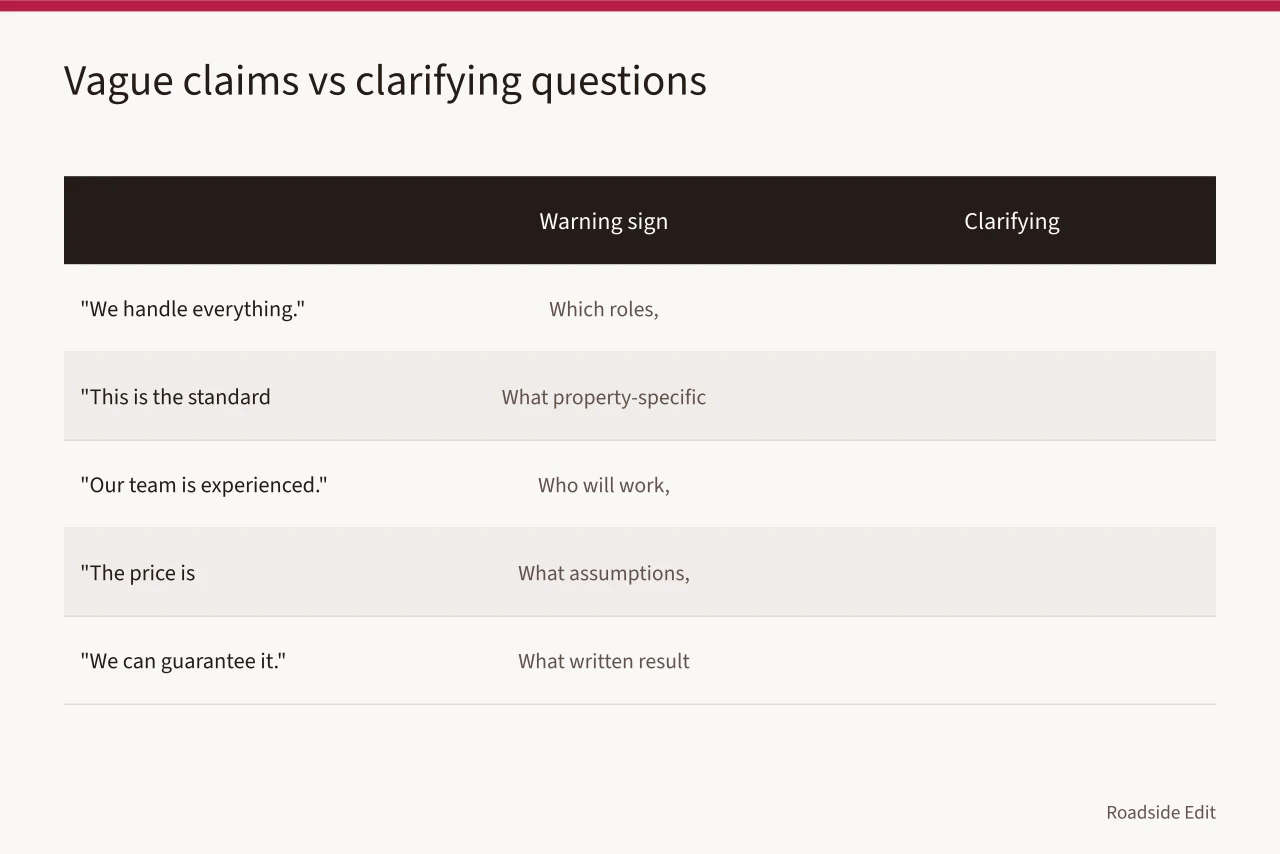
| Warning sign | Clarifying question |
|---|---|
| "We handle everything." | Which roles, deliverables, and decisions are included? |
| "This is the standard fix." | What property-specific record supports that statement? |
| "Our team is experienced." | Who will work on this scope and what comparable role can be shown? |
| "The price is all-inclusive." | What assumptions, exclusions, and change process apply? |
| "We can guarantee it." | What written result and limit does the scope actually state? |
GSA says its historic-masonry procedures require project-specific editing and professional judgment and are not substitutes for a qualified professional's specification development. Read GSA's technical-procedure disclaimer. That supports a basic editorial warning: a provider should not present a generic procedure as a full answer for a different roadside property.
Ask for a role, record, and deliverable
An answer becomes easier to assess when it names three things: the role offered, the evidence behind a claimed example, and the proposed output. A provider may be an excellent researcher but not offer design work. A contractor may offer a defined scope but not historical research. That distinction is useful information, not a criticism.
- What role would the provider perform?
- What document, drawing, report, or work record would they deliver?
- What comparable example do they claim, and what was their role in it?
- What existing records, access, or decisions must be available first?
- What work lies outside the offer?
The NPS Professional Qualifications Standards describe minimum criteria for certain preservation activities and note that complex work can need additional areas or levels of expertise. Review NPS qualification standards. The standards do not endorse a provider. They help readers understand why a broad title does not answer every project question.
Keep the response proportionate
Request missing information in writing. Record the date of the question and the answer, if one is provided. Compare the same missing item across candidates. Do not attach a negative label to a provider simply because an answer was incomplete at an early stage. The correct editorial response is usually to say what the record does and does not contain.
NPS procurement guidance describes written evaluation factors and experience with historic resources as part of an organized review process. Read NPS contracting and procurement guidance. It does not require private owners to use one particular system. It supports applying the same questions and documented criteria to comparable responses.
Keep marketing claims in their lane
A provider's portfolio, testimonial, award, and before-and-after image may be legitimate material supplied by that provider. Label it by source. Do not recast it as independent verification. If an article includes a commercial listing or paid placement, disclose that relationship plainly. Payment is not evidence of qualifications, performance, or fit for a reader's project.
| Claim source | Appropriate label |
|---|---|
| Provider website | "The provider states..." |
| Client reference | "The reference described..." |
| Public record | Identify the agency and document date |
| Paid listing | Identify the commercial relationship |
GSA's preservation checklist includes comparable experience, specialist competency, and reference checks in relevant project stages. Review the GSA preservation checklist. It does not make a testimonial independent evidence. It does show why a proper review keeps roles, qualifications, references, and scope visible.
Protect private and site-sensitive information
Do not publish a candidate's personal contact details, unpublished proposal, security information, or site access details unless there is a clear and appropriate basis to do so. A provider article can explain its research method without exposing a property or a person. When a claim cannot be attributed safely and accurately, remove it.
Use the warning table as a drafting check as well as a screening tool. If the article cannot answer the clarifying question with a source, it should present the issue as an open question or remove the claim. That keeps an article from copying a sales phrase into a factual caption, list entry, or review summary.
The result is fairer to readers and providers alike.
Common questions
Does an unclear proposal mean a provider is unqualified?
No. It means the information is incomplete for comparison. Ask a focused follow-up and record the response.
Can a provider use a federal guide on a private project?
A guide can be useful context. Its relevance and application still need property-specific professional judgment.
What is the most serious warning sign for an article?
An unsupported promise presented as a fact. Attach a reliable source or remove the claim.