Guides
Part of Choosing help for roadside architecture: a 2027 guide to named providers and criteria
How to keep roadside architecture provider records clean before publication
Roadside architecture provider records for 2027 give U.S. editors a clear file for scope notes, claims, proposals, evidence, and later corrections.
What to take away
- A provider file should preserve the request, each stated role, supporting evidence, scope, and decision limit.
- Keep qualifications, proposals, marketing material, and project records in separate folders or fields.
- Date every change to the role, deliverable, fee assumption, or review path.
- Public articles should use only information that is supported, relevant, and appropriate to disclose.
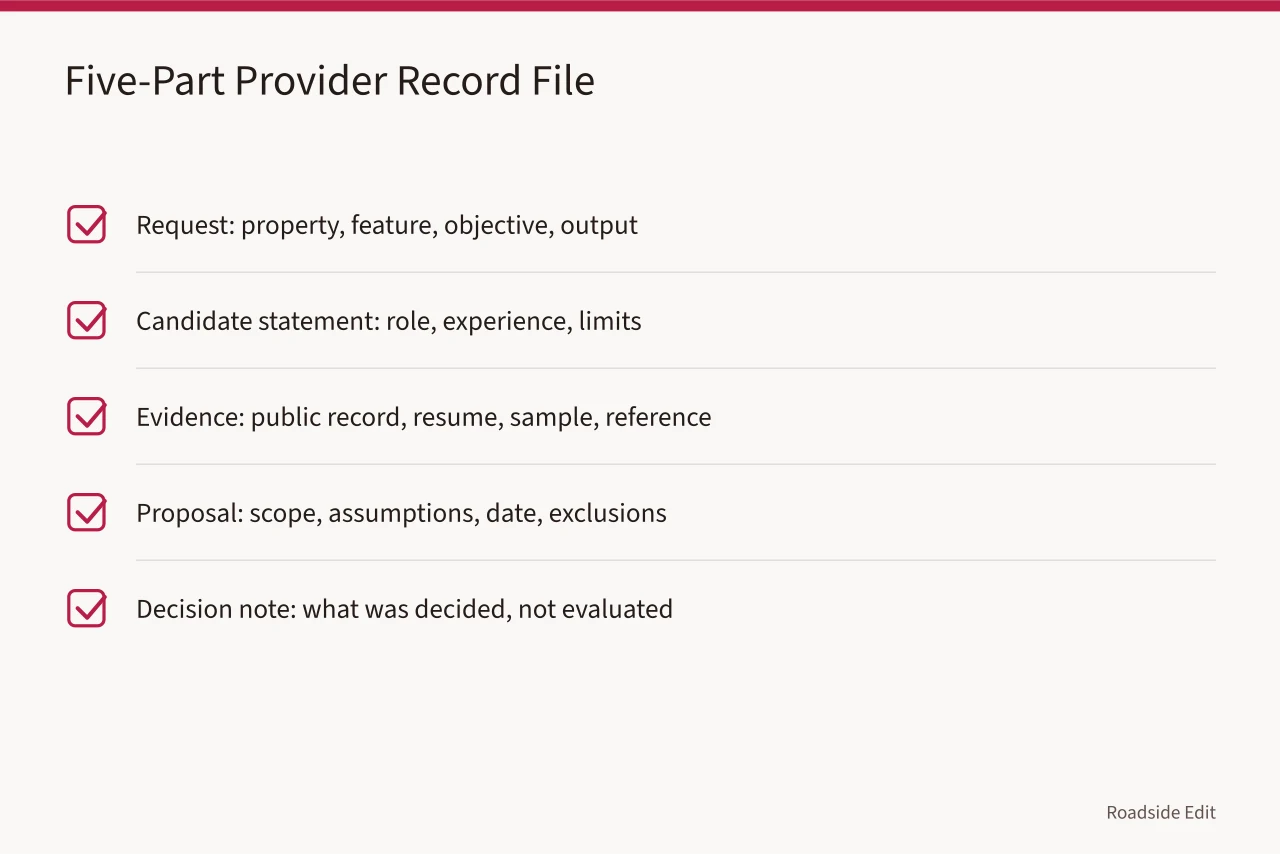
Set up a five-part file
Provider records give a later editor or project contact a way to understand what was asked and what was actually supplied. They are not a substitute for licensing checks, contracts, procurement policy, or professional judgment. Their purpose is narrower: prevent a candidate's claim, a scope, and a project decision from being mixed together.
| Record | What to keep |
|---|---|
| Request | Property, feature, objective, and desired output |
| Candidate statement | Claimed role, experience, and stated limits |
| Evidence | Public record, resume, sample, or reference note as appropriate |
| Proposal | Scope, assumptions, date, and exclusions |
| Decision note | What was decided and what was not evaluated |
NPS treatment standards say that choices depend on a property's significance, physical condition, available documentation, and interpretive goals where relevant. Review the NPS treatment standards overview. A selection file should therefore preserve the underlying project questions instead of reducing a candidate to a rating or a single fee.
Separate a claim from its source
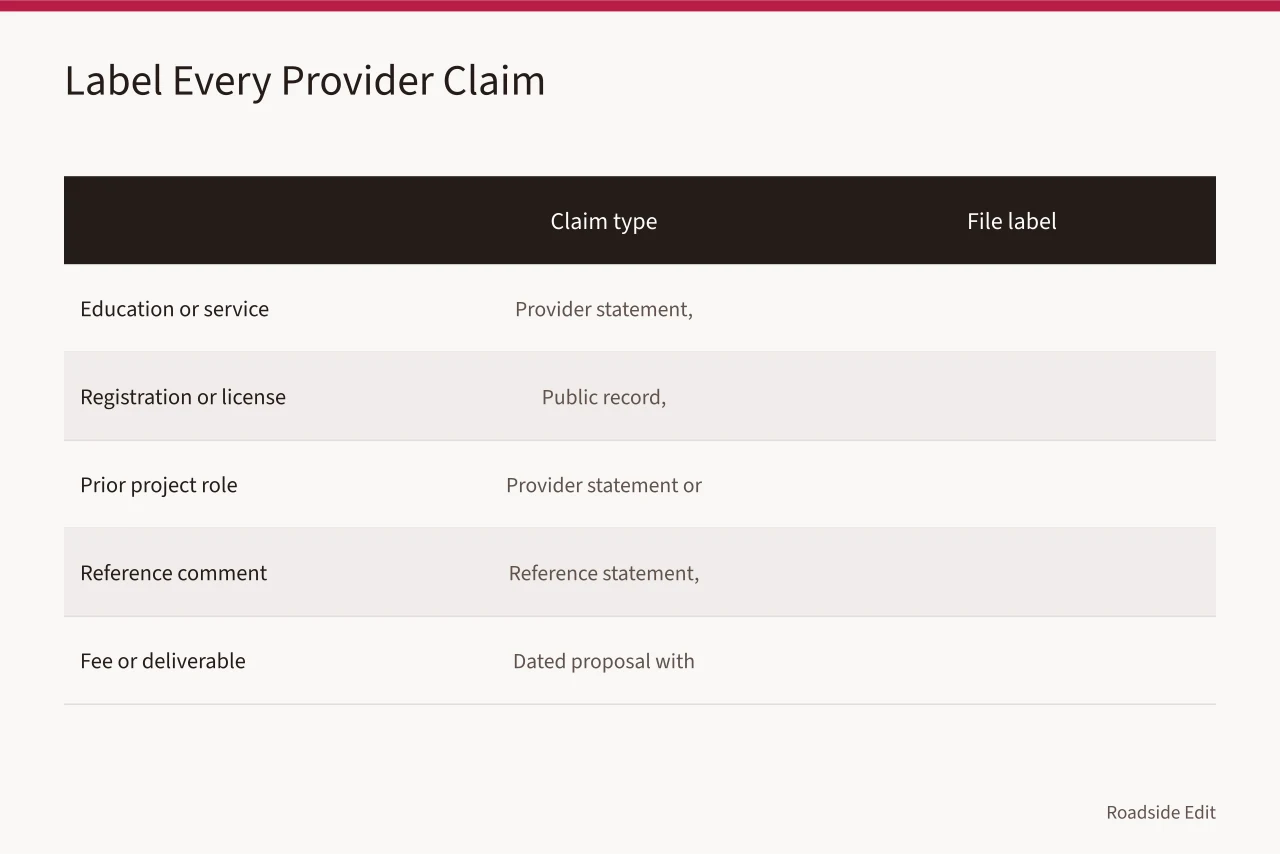
Every provider claim needs a label. A provider biography is a provider statement. A public registration entry is a public record. A client reference is a reference statement. A project page may identify an organization but not every person's role. Keep these differences visible in the file and in any article.
| Claim type | File label |
|---|---|
| Education or service claim | Provider statement, date checked |
| Registration or license status | Public record, jurisdiction, date checked |
| Prior project role | Provider statement or named project source |
| Reference comment | Reference statement, permission status |
| Fee or deliverable | Dated proposal with stated scope |
NPS documentation standards call for reliable sources and stated limitations that allow later verification. Use NPS documentation standards as a recordkeeping model. The practical rule is to store the source beside the claim, not in a separate folder where the connection will be lost.
Maintain a change trail
Scope changes are common. A newly found drawing, access limit, additional feature, revised publication plan, or new review requirement can change what a provider is being asked to do. Preserve the earlier version. Then record the added question and the provider's written response.
- Date each request and response.
- Keep versions of the written scope.
- Note when an image, record, access assumption, or feature changes.
- Record the source for any provider claim used in public copy.
- Remove outdated claims from the article rather than leaving them without a date.
The NPS procurement guidance describes evaluation factors and a written review method in its stated program context. Read NPS contracting and procurement guidance. A private file may be simpler, but it benefits from the same habit of retaining the basis for a comparison.
Keep private detail out of the public article
An internal file can hold fuller notes than a public page should show. Do not copy direct contacts, personal addresses, unpublished proposals, security information, or sensitive site details into an article. A page can state that a provider supplied a dated response or that a record was checked without publishing the record itself.
| Public article may state | Internal file may retain |
|---|---|
| A provider's stated service | Dated response and source link |
| A documented role in a named example | Supporting note and permission status |
| An unresolved question | Follow-up request and reply |
| A disclosed commercial placement | Agreement details and editorial review note |
Keep sensitive provider and property material out of public coverage. A record can preserve the fuller context internally while public copy uses only supported, relevant facts that are appropriate to disclose.
Review the file before publication
Before publishing, check the source, date, wording, and limit for every provider statement. Do not present a stated service as an endorsement. Do not call a portfolio image independent proof. Do not describe a proposal as an award, contract, or completed project unless the record says so.
GSA's preservation checklist includes review of relevant experience, specialist competency, and references. Review the GSA preservation checklist. That source supports a documented review process. It does not justify publishing private scoring notes or claiming that a candidate is the right choice for every reader.
When an article is revised, add a correction note to the internal file. Note the changed sentence, the source that required the change, and the date it was updated.
This builds an editorial trail without exposing the full selection record. It also keeps a removed provider claim from returning in a later update through an old draft or copied description.
Common questions
How long should a provider record be kept?
Follow the organization's record policy and any applicable agreement. Keep it long enough to support a published claim or later correction.
Should a provider list include personal contact details?
Use only information the provider has made public or authorized for that purpose. A research file can contain material that should not be published.
What should be revised when a provider's role changes?
Update the scope, decision note, article wording, and any caption or listing that describes the provider's participation.