Guides
Part of Choosing help for roadside architecture: a 2027 guide to named providers and criteria
How to compare a roadside architecture provider budget before you sign
Roadside architecture provider budget notes for 2027 show U.S. owners how to compare written scope, fee assumptions, revisions, and exclusions responsibly.
What to take away
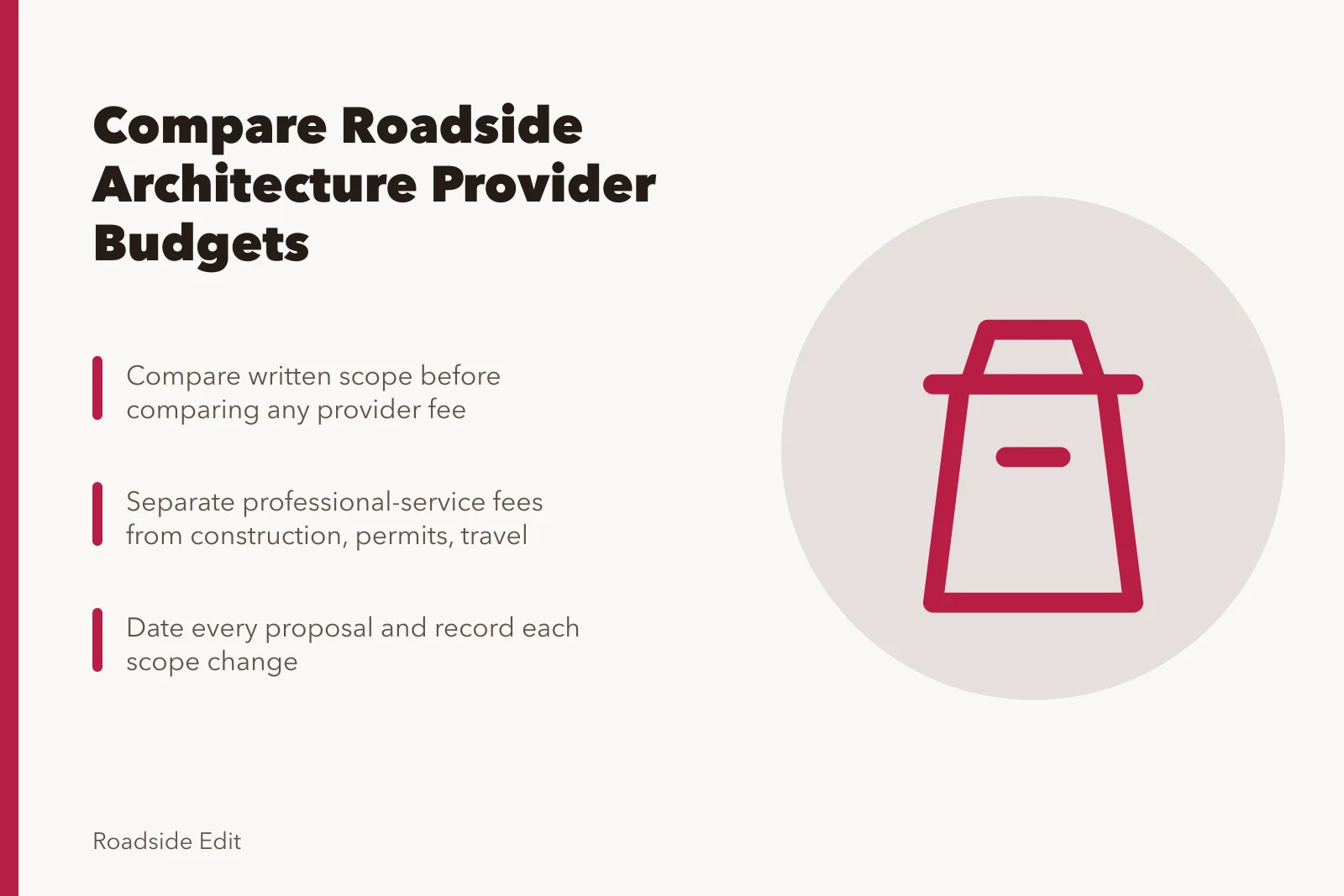
- Compare scope before comparing a fee, because similar labels can describe different work.
- Keep professional-service fees separate from construction, product, permit, and travel costs.
- Record assumptions that could change the work, then date every proposal or discussion.
- Do not turn a template, historic example, or preliminary conversation into a quote for another property.
List the fee inputs
Provider fees make sense only when the task is defined. A research memo, site documentation visit, design package, specialized review, and construction scope are different outputs. A low figure may cover less work. A high figure may include stages that another proposal excludes. The note should show the difference without ranking providers by price alone.
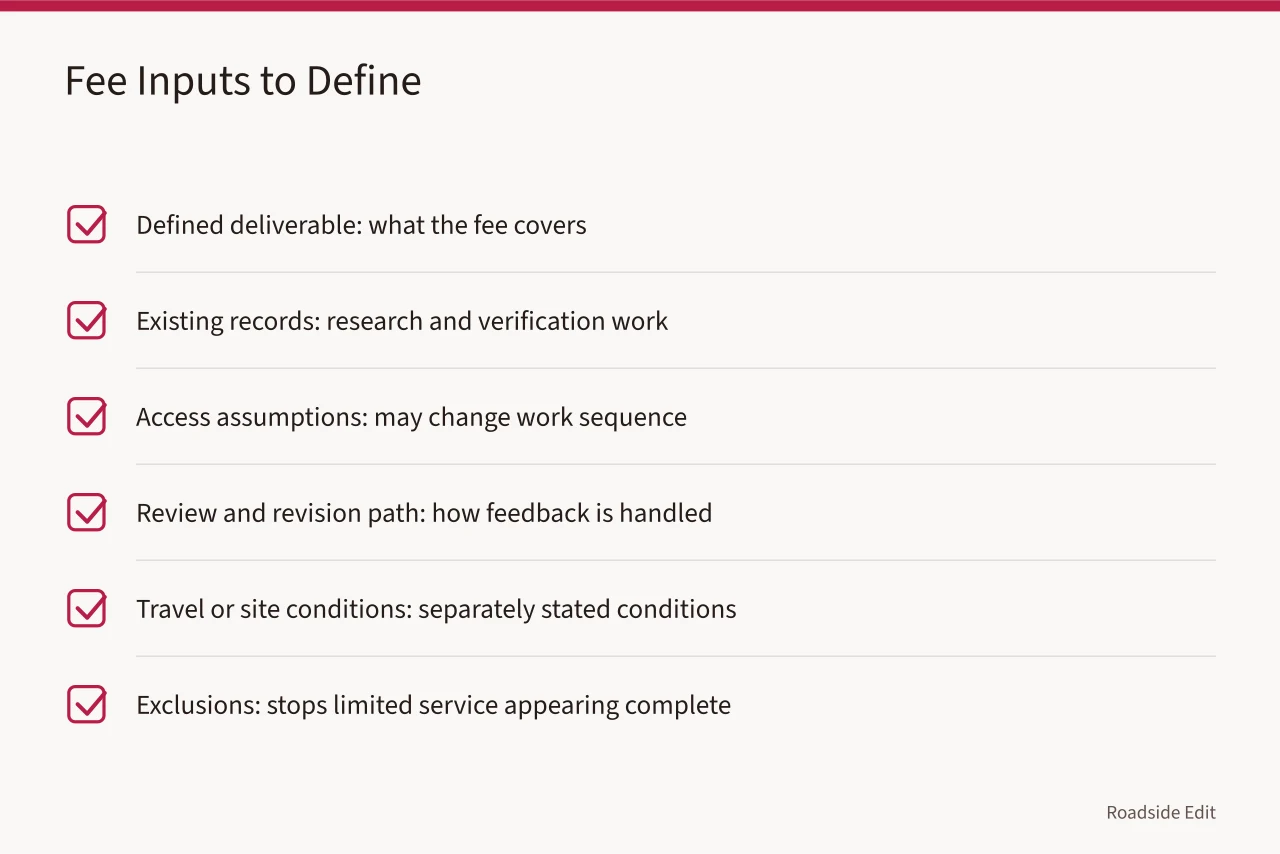
| Fee input | Why it belongs in a note |
|---|---|
| Defined deliverable | Shows what the fee is meant to cover |
| Existing records | Affects research and verification work |
| Access assumptions | May change the work sequence |
| Review and revision path | Clarifies how feedback is handled |
| Travel or site conditions | Identifies separately stated conditions |
| Exclusions | Stops a limited service from appearing complete |
GSA's preservation checklist calls for project-specific preservation design issues, comparable experience, specialist competency, and reference checks at relevant stages. Review the GSA preservation checklist. It is not a fee schedule. Its value here is that it treats the work as project-specific rather than a generic service label.
Compare line items, not labels
Ask a candidate to define broad terms. "Consulting," "field work," "design," and "project management" can mean very different tasks. A record should show the actual work proposed, the expected output, and the point where another scope would be needed.
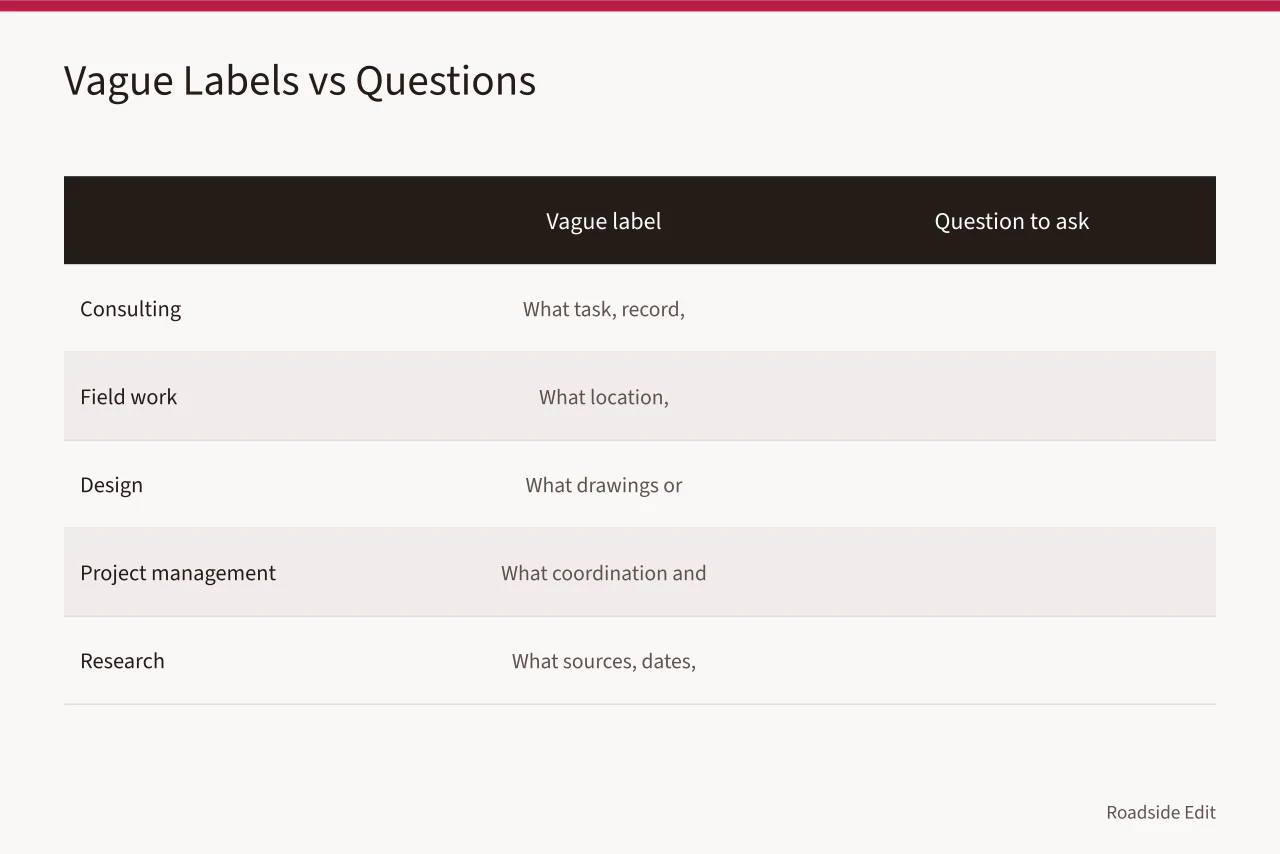
| Vague label | Question to ask |
|---|---|
| Consulting | What task, record, meeting, or review is included? |
| Field work | What location, duration, and output are proposed? |
| Design | What drawings or review stages are included? |
| Project management | What coordination and decision support are part of the role? |
| Research | What sources, dates, and written product are included? |
The NPS treatment standards say that choices depend on a property's significance, physical condition, available documentation, and interpretive goals where relevant. See the NPS treatment standards overview. The standards do not set a private fee. They support the narrower point that preservation work cannot be priced responsibly without knowing what property-specific work is in scope.
Keep changes visible
Create a change note whenever the property feature, deliverable, access, schedule, or review path changes. The note does not create a contract or decide a fee. It records why two proposals may no longer be comparable.
- Date the request and the candidate response.
- Name the item that changed.
- Preserve the earlier scope.
- Record the stated impact on time, work, or fee.
- Ask for written confirmation before publishing a claim about the change.
NPS procurement guidance describes written evaluation factors and a defined method for reviewing proposals in its program setting. Read NPS contracting and procurement guidance. Private work may follow a different process, but a written comparison still helps avoid a misleading article that treats altered scopes as identical offers.
Separate early research from later work
An initial research or documentation assignment can uncover facts that change a later design or construction discussion. Do not imply that an early fee covers later work that has not been described, priced, or accepted. A clear note can say that a separate request may be needed after the first deliverable is reviewed.
| Stage | Useful budget boundary |
|---|---|
| Research | Records, questions, and the stated research output |
| Documentation | Defined observation or image work and its limits |
| Design or review | Listed drawings, consultations, and revisions |
| Later project work | New written scope based on then-available information |
GSA says its technical procedures require project-specific editing and professional judgment and are not substitutes for specification development by a qualified preservation professional. Read GSA's technical-procedure overview. That source supports keeping general guidance separate from a provider's own written offer.
Preserve evidence, not private details
Keep the dated proposal, scope, assumptions, and clarification trail in the selection file. Before publishing anything, remove private contact details, account information, and portions of a proposal that were not supplied for public use. An article can explain its method without disclosing documents it cannot lawfully share.
In a budget note, the source, scope, date, and limit should stay together. That record makes the published explanation reviewable without exposing private provider documents.
If several versions of a fee arrive, keep every dated version and do not overwrite the first one.
The comparison may show a change came from a larger deliverable, added access requirement, revised review path, or new fact found during research. That history is more useful than a bare final number. It lets an editor explain why an old figure is no longer appropriate without speculating about a provider's motives.
Keep any acceptance decision separate from the comparison itself.
Common questions
Can a writer publish a provider's fee range?
Only with a stated scope, date, source, and limitation. Do not present it as a quote for another property.
Is the lowest fee the best value?
Not necessarily. It may reflect a smaller scope, different assumptions, or excluded work.
What should be kept after a fee discussion?
Keep the written scope, assumptions, exclusions, date, and any clarification that changed the requested work.