Guides
Part of How to build a roadside architecture safety checklist that stays useful
Roadside architecture safety questions writers should ask before publishing a claim
Roadside architecture safety questions for 2027 help writers separate what they saw, what a record supports, and what needs authorized review.
Safety questions are useful when they stop an article from guessing. The right question may be "what can this photograph establish?" rather than "what is wrong with this building?" Use these prompts to separate a public observation from a statement that needs a project record or authorized review.
What to take away
- Start with the exact feature and lawful viewpoint.
- Ask what evidence supports a claim before using it in a headline.
- Safety, ownership, and treatment questions usually need more than an exterior photo.
- Keep questions in a log until a reliable source answers them.
Ask the evidence questions
| Question | What it protects against |
|---|
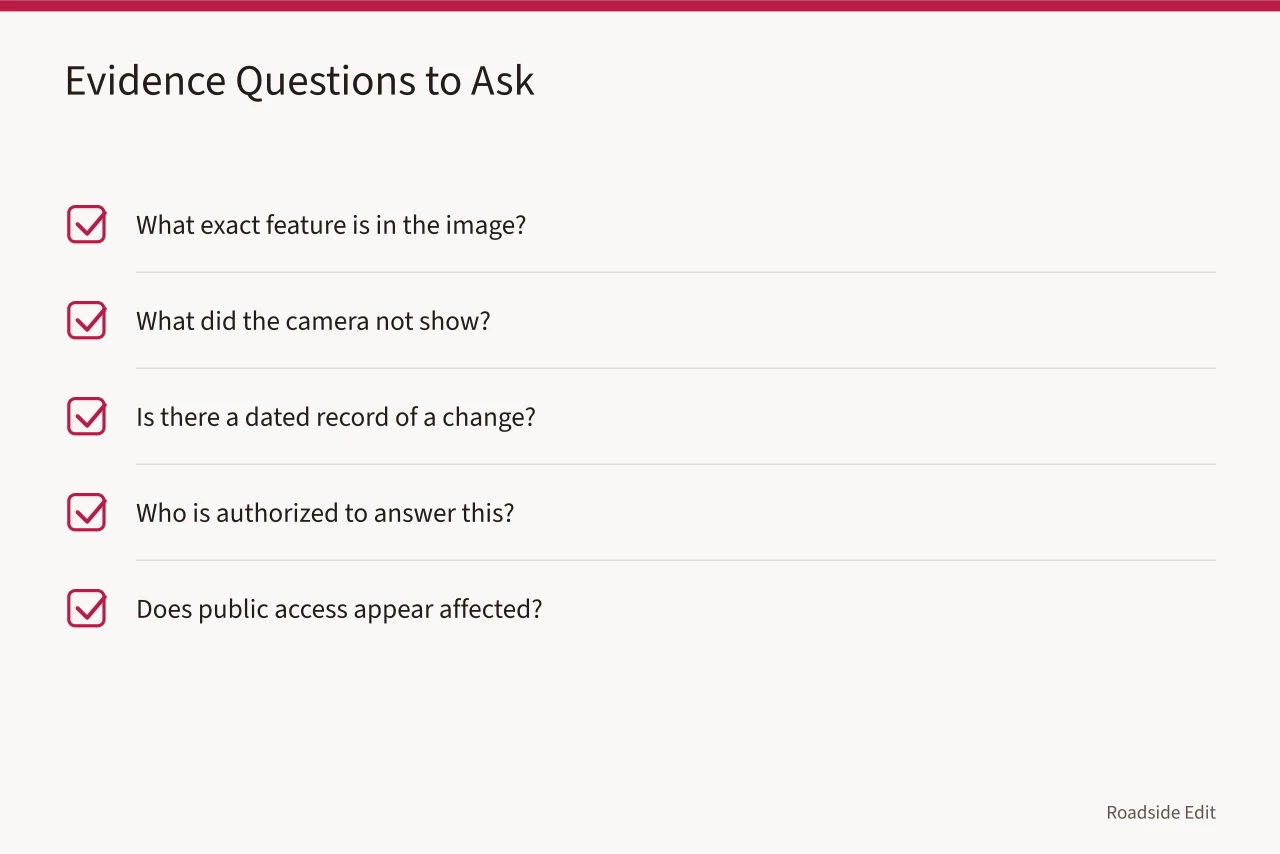
Ask the project questions
Before describing a repair, closure, treatment, or planned work, ask whether there is a dated project record. If the source is a sign on a door, state only what the sign says. If the source is an owner statement, identify it as an owner statement. If no source is available, keep the article narrower.
The National Park Service describes Historic Property Project Documentation as a collaborative tool that matches research, documentation, and treatment information to a proposed project. Read the NPS overview of Historic Property Project Documentation. It is a federal planning tool, not a requirement for a small roadside story, but it shows why a project question needs a documented scope.
When a project document is unavailable, record the gap instead of writing through it. A public notice may prove that a sidewalk is closed on the date shown. It does not prove why it is closed, who owns the site, or what repair will follow. This distinction keeps the article useful without assigning technical causes to a visual clue.
Match the question to the source
The most useful question often identifies a source limit. NPS documentation standards treat photographs and written data as complementary forms of record, not substitutes for every fact about a property. See the NPS documentation standards.
Apply that logic to ordinary editorial work: use an image for what it shows, and use a dated document for scope, history, or ownership statements.
| Question type | Source that may answer it | Source that usually cannot answer it alone |
|---|---|---|
| What was visible on a date? | Dated image with a stated viewpoint | An undated reposted image |
| What work is planned? | Dated project notice or public record | A comment below a photo |
| What feature existed earlier? | Dated historic image or record | A new replica or painted mural |
| Is a condition unsafe? | Authorized assessment or agency notice | A writer's exterior impression |
The Library of Congress primary-source guidance recommends examining a source for observations, reflections, and questions before drawing a conclusion. Use the Library of Congress primary-source analysis guide. For a roadside article, that means writing down what is visible first, then listing the unanswered question. It does not mean treating an unanswered question as proof of a problem.
Keep a question log
| Field | Example |
|---|---|
| Question | "Does the public record describe a planned sign repair?" |
| Evidence held | Dated exterior photo and public notice |
| Limit | No access to the sign mounting or work record |
| Responsible route | Owner, project contact, public agency, or qualified professional |
| Resolution | Link or document only after it has been verified |
Decide whether a question belongs in public copy
Some questions are useful for a private research note but inappropriate for publication. Do not publish personal contact details, access patterns, alarm information, or a claim that a place is vacant when that claim rests on appearance. Keep the public article on the feature, source, date, and known scope.
If a question concerns immediate danger, do not make the article a reporting channel. NPS HABS field guidance assigns safety responsibility to a project supervisor in formal documentation work; Review the NPS HABS field guidance.
A writer at a roadside location is not that supervisor, so from a safe location, use the emergency or non-emergency route suited to the situation. Avoid further investigation.
Common questions
Can a writer answer a safety question from a photo?
Usually not. A photo can identify a visible condition and a date, but it cannot show hidden conditions, authority, or a complete project scope.
What if no public record answers the question?
Say that the record was not located or remove the stronger claim. Do not fill the gap with a likely explanation.
Should a question log be published?
Publish only a resolved, supported answer when it is relevant. Keep personal details and security-related questions out of public records.