Guides
Part of How to build a roadside architecture safety checklist that stays useful
How to report roadside architecture safety warning signs without guessing
Roadside architecture safety warning signs for 2027 explain how to document a visible concern, keep distance, and use responsible reporting routes.
An apparent warning sign is a reason to slow down, not move closer. A roadside article should record a visible change from a safe and lawful place, state what the image cannot prove, and send an immediate concern through the right route.
What to take away
- Do not turn a visible change into a diagnosis.
- Keep distance from a loose-looking object, blocked route, or restricted area.
- A condition near public access may require a responsible report, not a better photograph.
- Avoid telling readers to visit a site that may be private or hazardous.
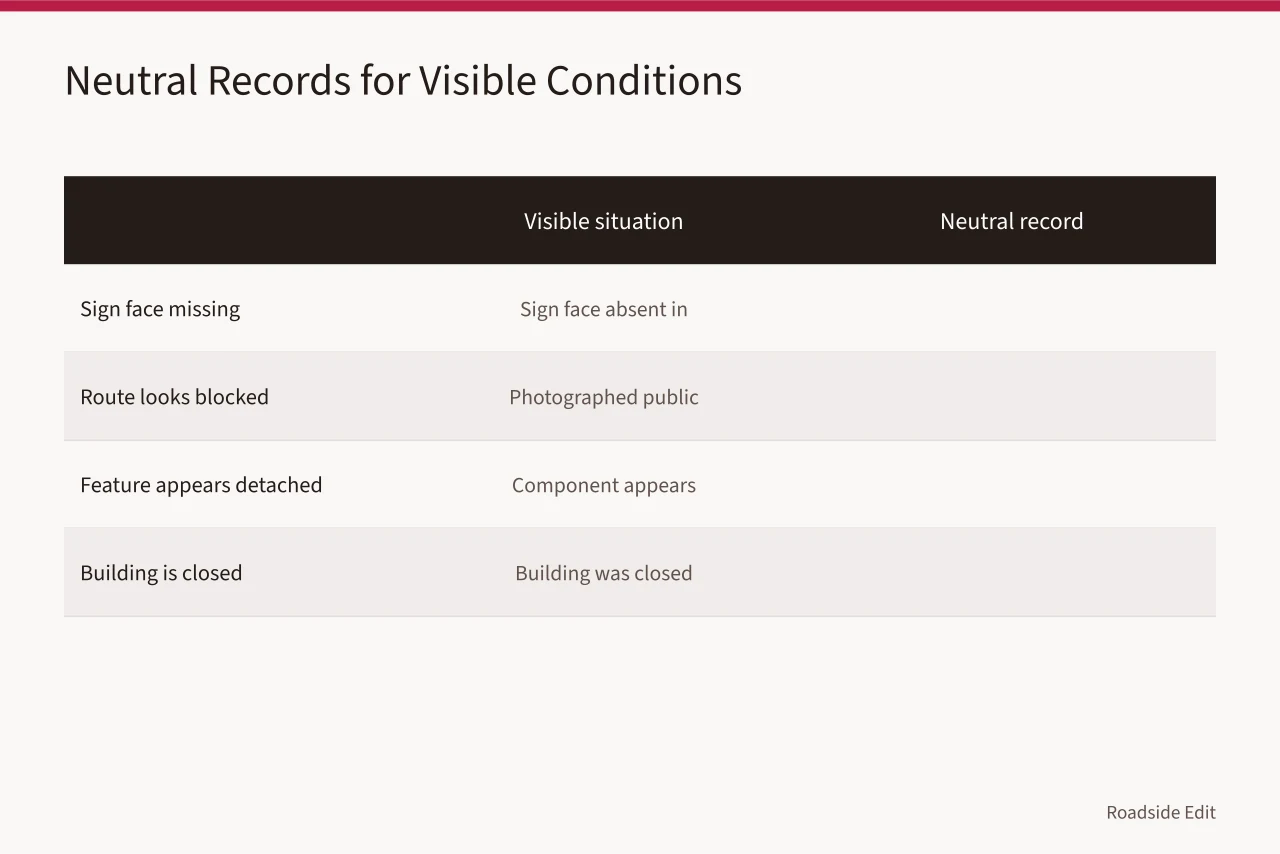
Use neutral descriptions
| Visible situation | Neutral record |
|---|---|
| A sign face is missing | "A sign face is absent in the current exterior image." |
| A route looks blocked | "The photographed public path appears obstructed." |
| A feature appears detached | "A component appears displaced from this viewpoint." |
| A building is closed | "The building was closed during the recorded visit." |
The FEMA post-disaster building-safety manual describes evaluations by trained teams to assess safety and habitability. It notes that an unsafe placard is not itself a demolition order. Read FEMA's post-disaster building-safety evaluation manual. A roadside reader should not attempt that evaluation process.
An article should also avoid treating a posted notice as more than it says. FEMA guidance on accelerated building reoccupancy distinguishes between advisory evaluators and the authority that makes final placarding decisions. Review FEMA's placard guidance. If a notice is visible, quote its wording and date when possible. Do not infer legal status, demolition plans, or an underlying diagnosis.
Choose the response, not the conclusion
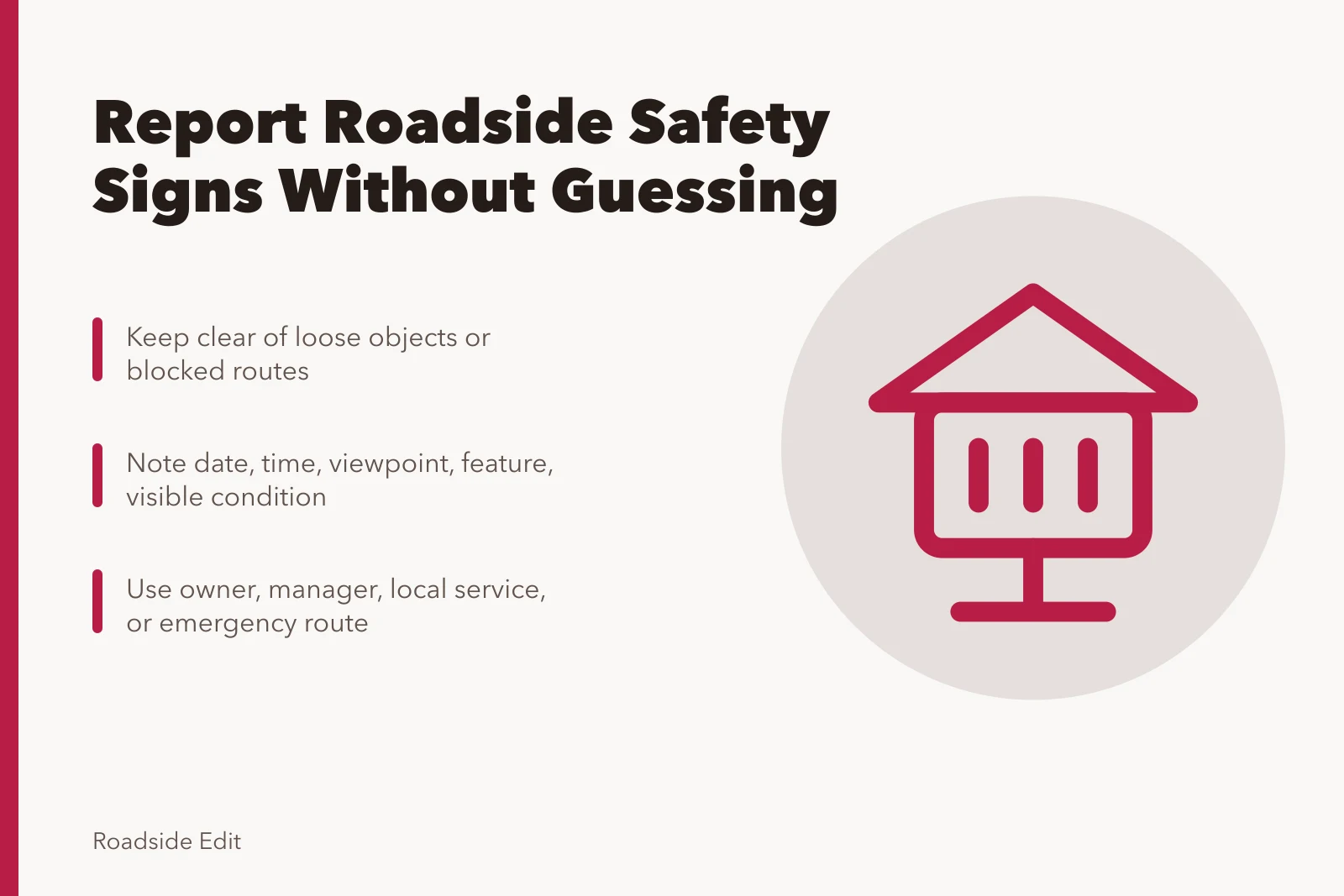
- Keep clear of a feature or route that appears to present an immediate concern.
- Note the time, feature, lawful viewpoint, and visible condition.
- Use a responsible owner, manager, local service, or emergency route as appropriate.
- Do not publish entry instructions, security details, or an invitation to investigate.
Keep distance without describing a diagnosis
Visible displacement, debris, a blocked route, or active work can all be reasons to choose another path. They do not tell a writer why a feature changed or whether a structure will fail.
OSHA's construction guidance identifies falling and flying objects as struck-by hazards and tells workers to keep clear during lifting and dumping operations. See OSHA's struck-by hazard guidance. That workplace guidance does not make a public observer a safety professional. It does reinforce the simple rule to stay out of an area where work, vehicles, or objects could create a hazard.
Use the word "appears" only for the visual fact, not for a conclusion. "A component appears displaced in the photograph" is a report of the image. "The component is unsafe" needs a source that makes that finding. This small difference keeps a published article from becoming an unqualified assessment.
Write a useful report note
When a public concern needs follow-up, a short note should give the date, time, lawful viewpoint, specific feature, and a brief description of what was visible. NPS documentation standards require a frank assessment of source reliability and limitations.
Read the NPS documentation standards. Note the limits: no entry, no roof view, no technical assessment, and no confirmation of ownership or cause.
If there is an apparent emergency, move to a safe location and use the appropriate emergency route. For a non-emergency concern, use the public contact channel of the responsible owner or local authority when one is available. Do not make the article a substitute for either route.
Protect the audience
Avoid words such as "dangerous," "condemned," or "about to collapse" unless a specific reliable source supports them. If there is no source, the article can state that a visible concern was recorded and routed for follow-up. The article does not need drama to be useful.
Do not publish a map pin for a vulnerable private site, detailed instructions for reaching a restricted area, or photos that expose security equipment. A reader does not need those details to understand that an exterior condition was observed. Keep the story focused on public information and the stated limits of the record.
Common questions
Does a warning sign mean the property is unsafe?
Not by itself. It may be a reason to document a visible condition and report a concern, but it does not establish a full safety finding.
Should I call emergency services for every deteriorated-looking building?
No. Use emergency services when there appears to be an immediate emergency. For non-emergency concerns, use a responsible local or owner reporting path if one is available.
Can an article show a restricted area?
Only from a lawful location and without revealing details that could encourage entry or compromise privacy or security.