Guides
How to build a roadside architecture safety checklist that stays useful
Roadside architecture safety checklist for 2027 helps U.S. readers document visible conditions, respect access limits, and route concerns responsibly.
A roadside architecture safety checklist should make the limits of an observation clear. It is not a building inspection, a safety rating, or a repair specification. Its practical purpose is to help people notice a visible change without putting themselves, a property owner, or a reader at risk. It also makes later corrections easier when better information becomes available.
Roadside sites are often easy to photograph and hard to understand. A diner may still be in business. A service station may be private. A sign may look weathered yet be stable, or look intact while having issues that cannot be seen from the road. A careful checklist keeps an article from treating appearance as proof.
What to take away
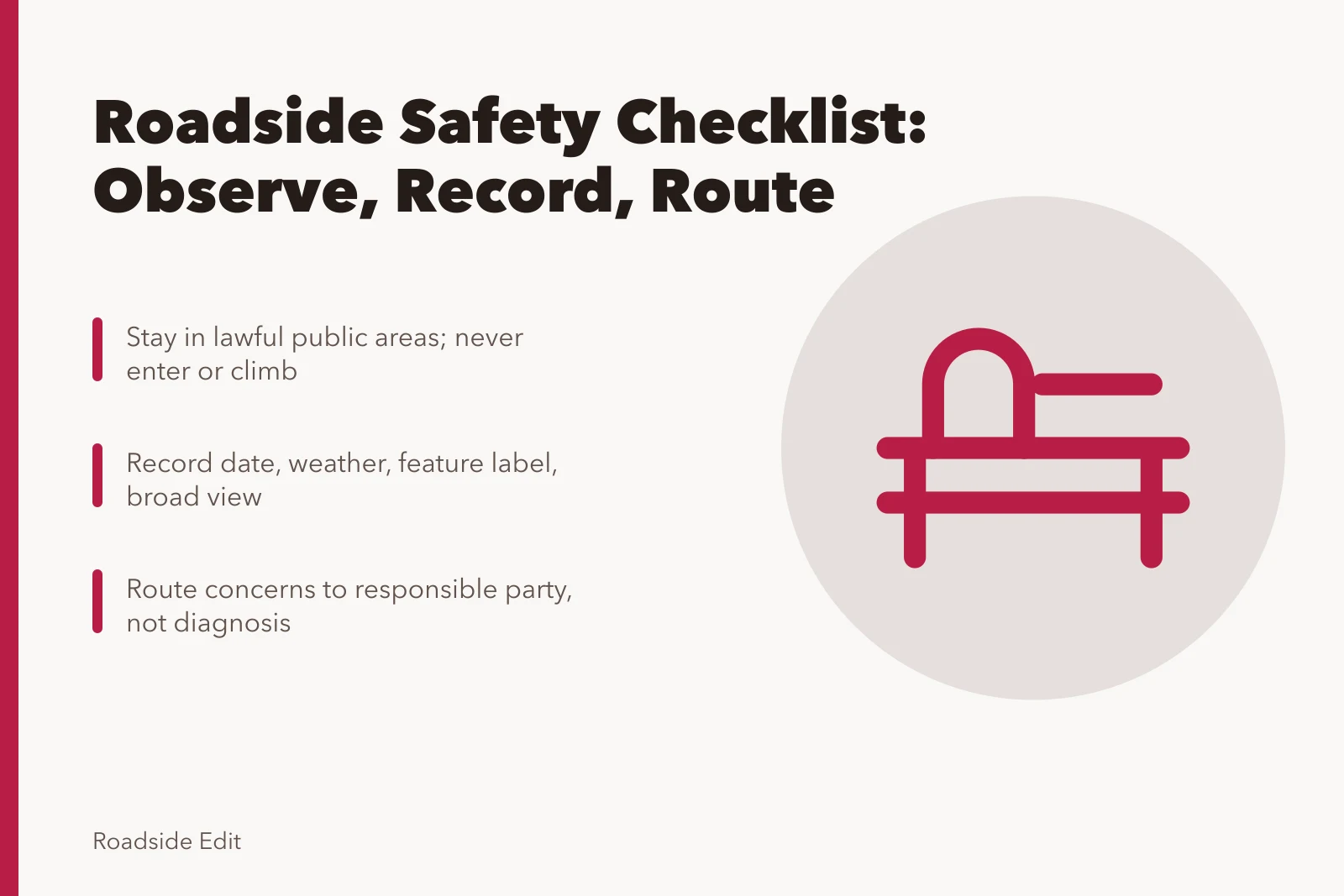
- Stay in lawful public areas unless an owner has clearly granted access.
- Record a visible condition with a date, feature label, viewpoint, and limit.
- Do not enter, climb, touch, test, or move material to improve an observation.
- Route a concern to the responsible party or an appropriate local channel instead of diagnosing it.
- Never use an article to direct readers toward a closed, restricted, or potentially hazardous place.
Define the checklist's boundary
Before using a form, decide who will use it and where. A public reader can make a note from a sidewalk, road shoulder where stopping is lawful and safe, or another public place. A site manager can work within an authorized access plan. A preservation or building professional can have a different scope. Those roles should not be blurred.
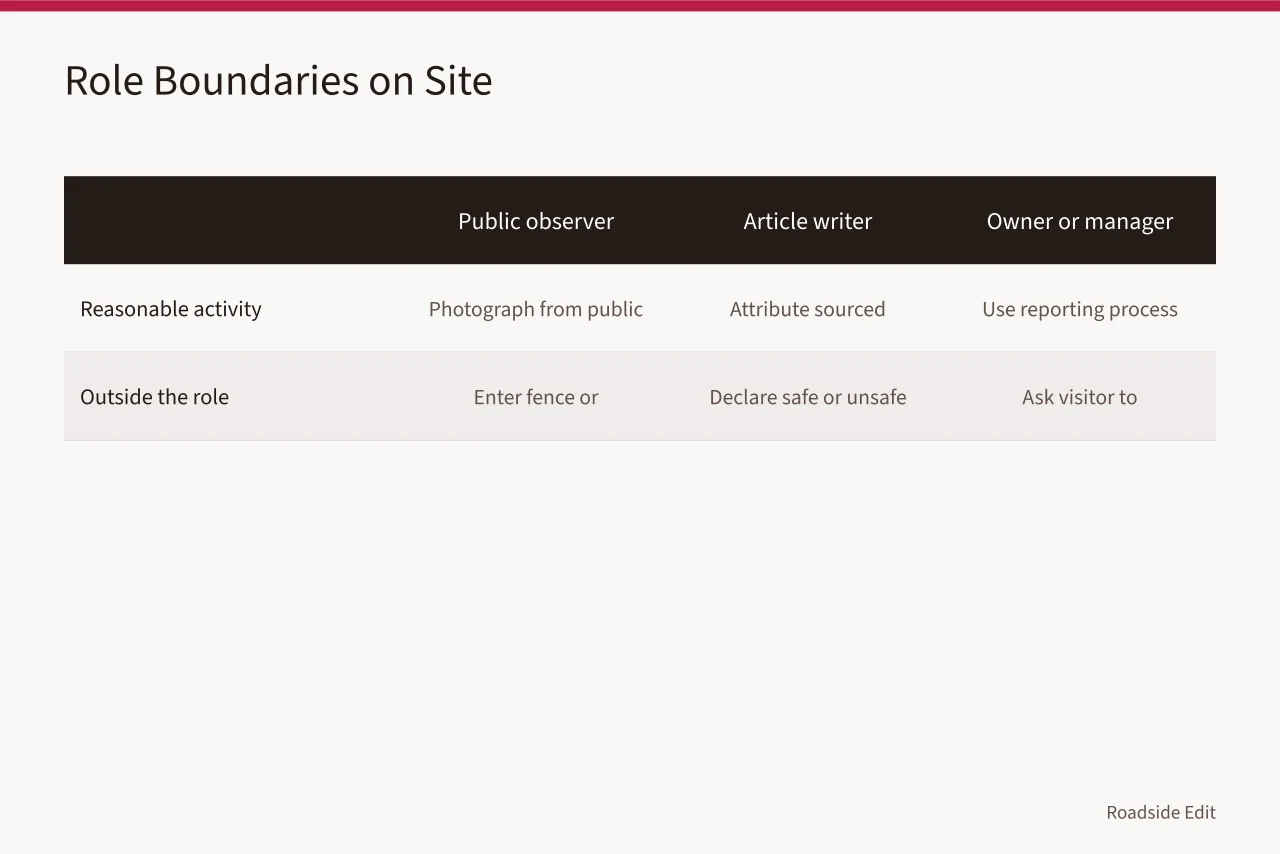
| Role | A reasonable activity | Outside the role |
|---|---|---|
| Public observer | Photograph a feature from a lawful, safe public location | Enter a fence, roof, interior, utility area, or closed structure |
| Article writer | Attribute a documented public claim and state its source limit | Declare a property safe, unsafe, original, or structurally sound |
| Owner or manager | Use an established reporting and work-order process | Ask a visitor to investigate a hazard |
| Qualified professional | Assess within the scope of engagement and applicable requirements | Provide an informal conclusion from a distant image |
The National Park Service says that when deterioration may affect structural integrity, a report from a structural engineer or other qualified professional should be requested in its tax-incentive guidance. Read NPS guidance on deteriorated or damaged historic buildings. The document concerns a specific federal review context. It does not diagnose a roadside property from a photograph.
For editorial purposes, the practical line is clear: write down what is visible, identify what is unknown, and do not convert an image into a technical conclusion. NPS documentation standards require reliable sources and a clear statement of limits so information can be independently checked. See the NPS documentation quality standard. A road-facing photograph has a useful but narrow job.
Use a safe observation sequence
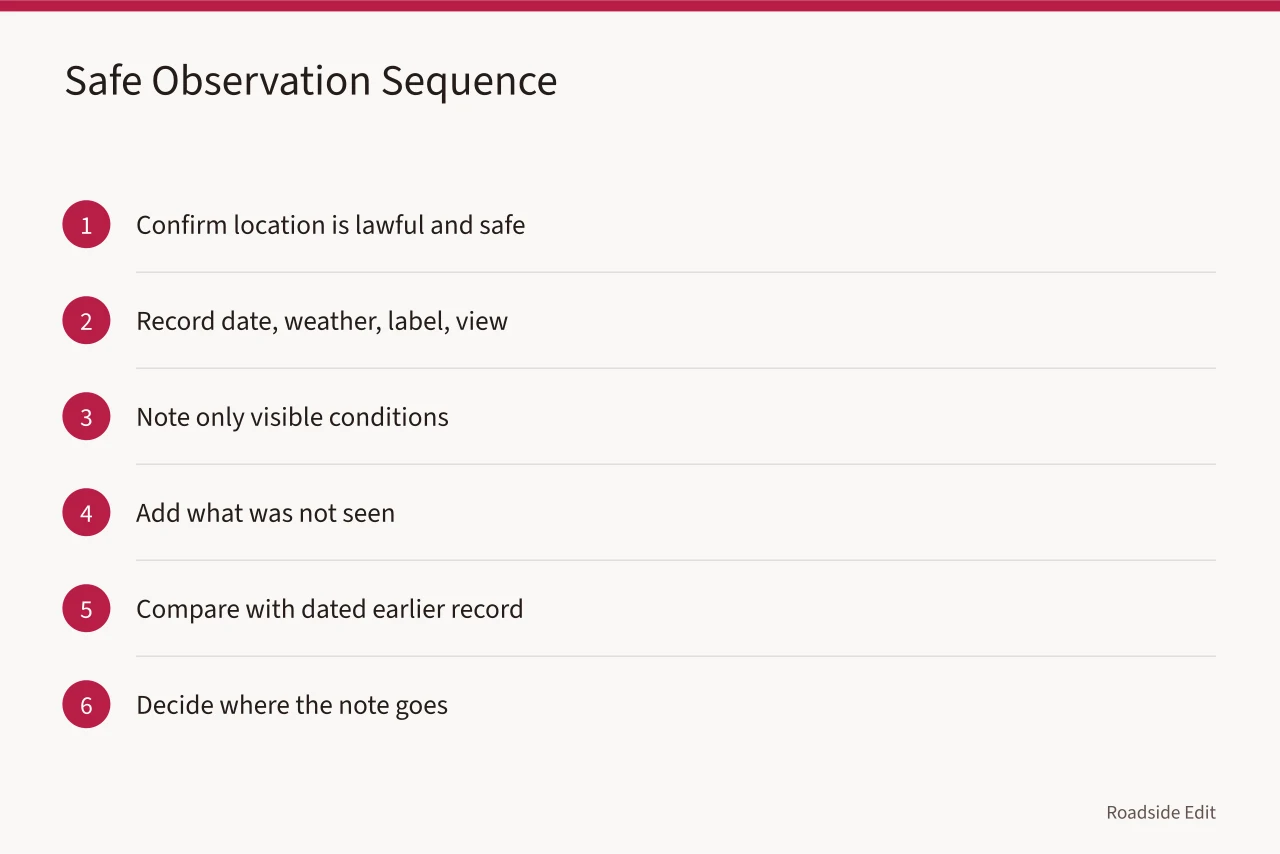
The safest checklist is simple enough to use under ordinary conditions. Start with your own position. Do not stand in traffic, cross an active work area, block a driveway, or rely on a shoulder that does not provide a safe stopping location. If the view cannot be obtained safely, do not obtain it.
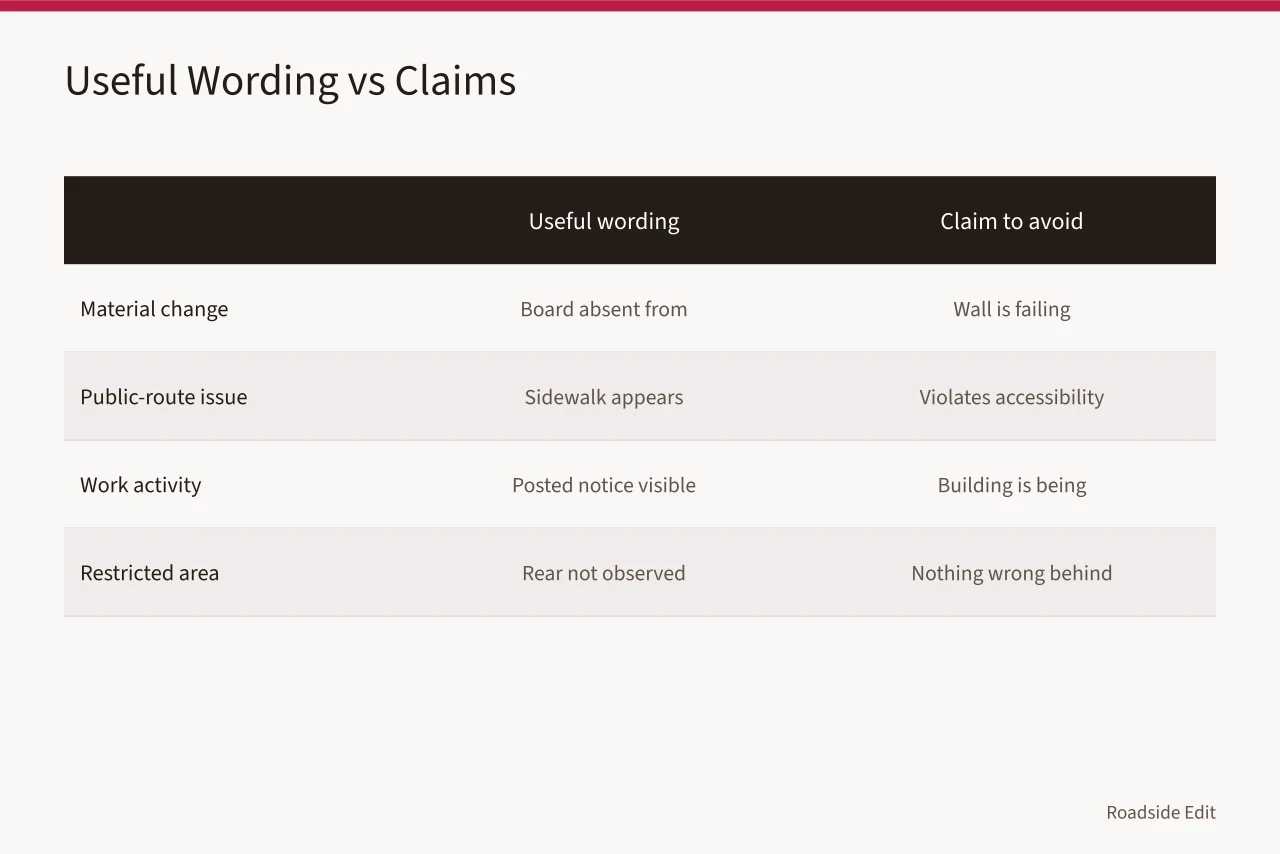
| Record | Useful wording | Claim to avoid |
|---|---|---|
| A material change | "A board is absent from the visible facade in the 2029 image." | "The wall is failing." |
| A public-route issue | "The sidewalk appears blocked in the current view." | "The property violates accessibility law." |
| A work activity | "A posted notice is visible at the site entrance." | "The building is being restored." |
| A restricted area | "The rear of the property was not observed." | "Nothing is wrong behind the building." |
If vehicles, active work, or loose material are part of the scene, choose distance over detail. OSHA identifies falling or flying objects and vehicle activity as struck-by hazards in construction settings.
The page, Read OSHA's struck-by hazard guidance, is written for workers, not roadside writers. It supports the common-sense choice to stay clear and avoid turning a photo request into a hazard.
Keep people out of the story unless needed
A safety-conscious article does not turn an occupied, vacant, or visibly deteriorated place into a spectacle. Do not identify a person's routine, publish security details, describe entry methods, or encourage a reader to explore. If a business is open, treat it as a business. If a property is private, respect that fact even when it is visible from the road.
Photography needs the same restraint. Use a public viewpoint or permission. Avoid close-ups that could reveal access controls or personal information. Do not include minors, license plates, or people in a way that is unnecessary to the article's purpose.
Separate safety from preservation language
Historic interest does not give a writer authority to make safety statements. It can be tempting to describe an old neon sign, unoccupied motel, or weathered facade as fragile, dangerous, abandoned, or at risk. Each word says more than a casual observation can establish.
Use a two-column note before publishing a strong phrase.
| Phrase considered | Evidence needed |
|---|---|
| "Unsafe" | A relevant, authoritative assessment or official notice |
| "Abandoned" | A source that establishes status, not a closed door or empty parking lot |
| "Original" | A dated historical or project source that supports provenance |
| "Restored" | A work record that describes the actual treatment and scope |
| "Damaged by storm" | A reliable dated source connecting the event and condition |
If the evidence is not available, write the observation instead. "The building was closed during the visit" is narrower than "abandoned." "Paint loss is visible in the photo" is narrower than "storm-damaged." Precision is safer for readers and fairer to owners.
Use a clear escalation path
A record should say where it goes next. A minor change with no public-access issue may need only a dated observation log. If a business or owner has a public contact route, use it politely and describe the visible condition without demanding a conclusion.
If an immediate emergency appears present, use the appropriate local emergency channel from a safe location. Do not wait for an article editor to decide what to do.
| Situation | Appropriate response |
|---|---|
| A difference from a prior photo | Preserve both images and update the observation log |
| A question about ownership or operating status | Seek a reliable public record or leave the claim out |
| A visible condition near public access | Keep distance and use the responsible party's reporting route if known |
| An apparent immediate emergency | Call the relevant emergency service from a safe place |
| A planned article about a restricted site | Reframe it around public records and lawful exterior views |
The person writing the note is not responsible for solving a property problem. The writer is responsible for not making it worse through unsafe conduct, unsupported claims, or a public invitation to trespass.
Prepare an article-safe field kit
An article field kit needs records, not inspection equipment. Bring a phone, camera, notebook, charging cable, and weather-appropriate clothing, and add a way to save the location of a lawful viewpoint; if conditions are poor, leave and return later.
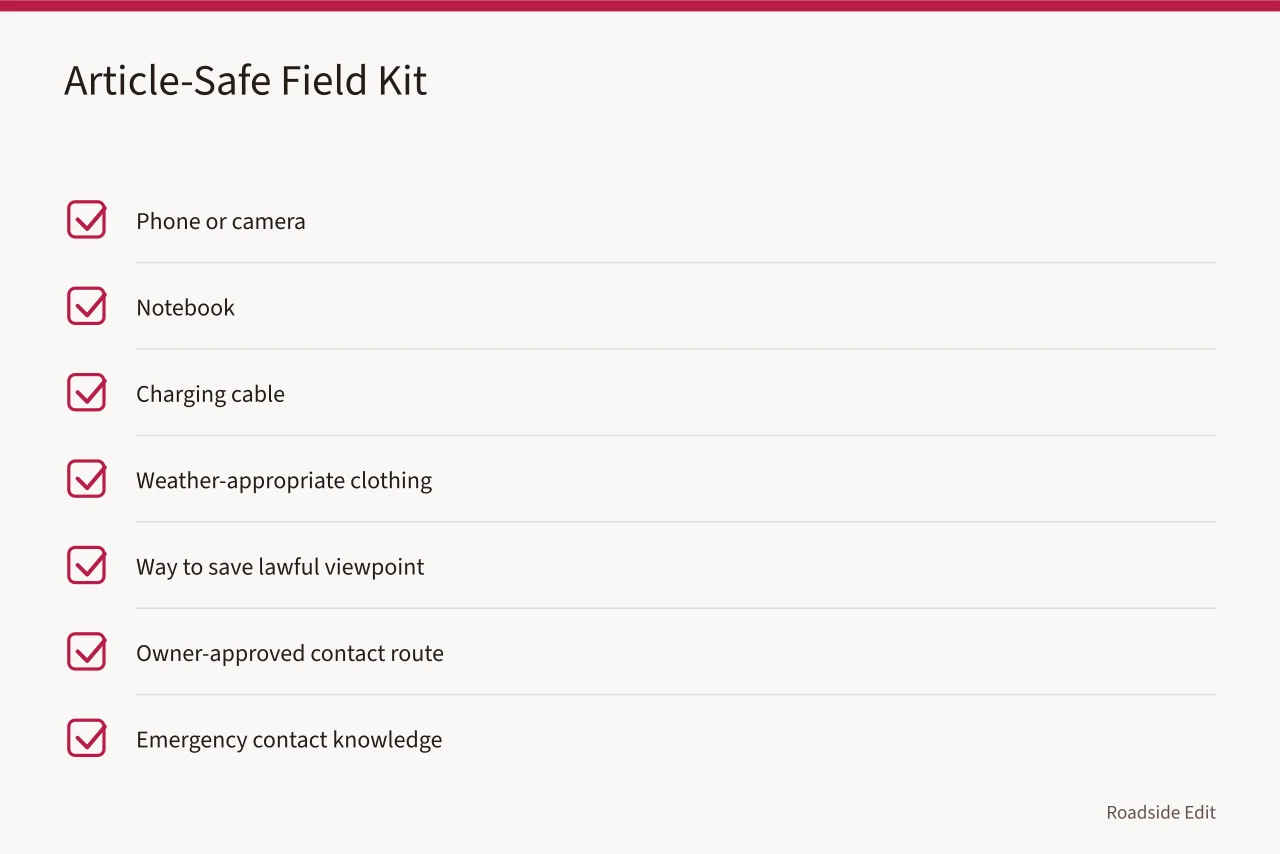
Do not add a ladder, flashlight, pry bar, meter, or other tool implying inspection work without clear authorization and proper competence.
| Item | Why it belongs | Why it has a limit |
|---|---|---|
| Camera or phone | Makes a dated visual record | A photo cannot show hidden conditions |
| Notebook | Captures viewpoint and observation limits | It should not become a diagnosis log |
| Prior record | Helps compare like with like | It may not show every side or detail |
| Owner-approved contact route | Allows a respectful question | It does not require an owner to respond |
| Emergency contact knowledge | Supports a response to an apparent emergency | It should never be used to create drama |
Treat a drone as a separate aviation activity, not a better camera angle. The FAA requires recreational flyers to keep visual line of sight and follow their operation's rules. Check the FAA's recreational flyer requirements.
Those rules do not grant access to private property or let a writer bypass a closed area. If you cannot document an exterior from a lawful, safe public viewpoint, the article should say so.
Review public language before release
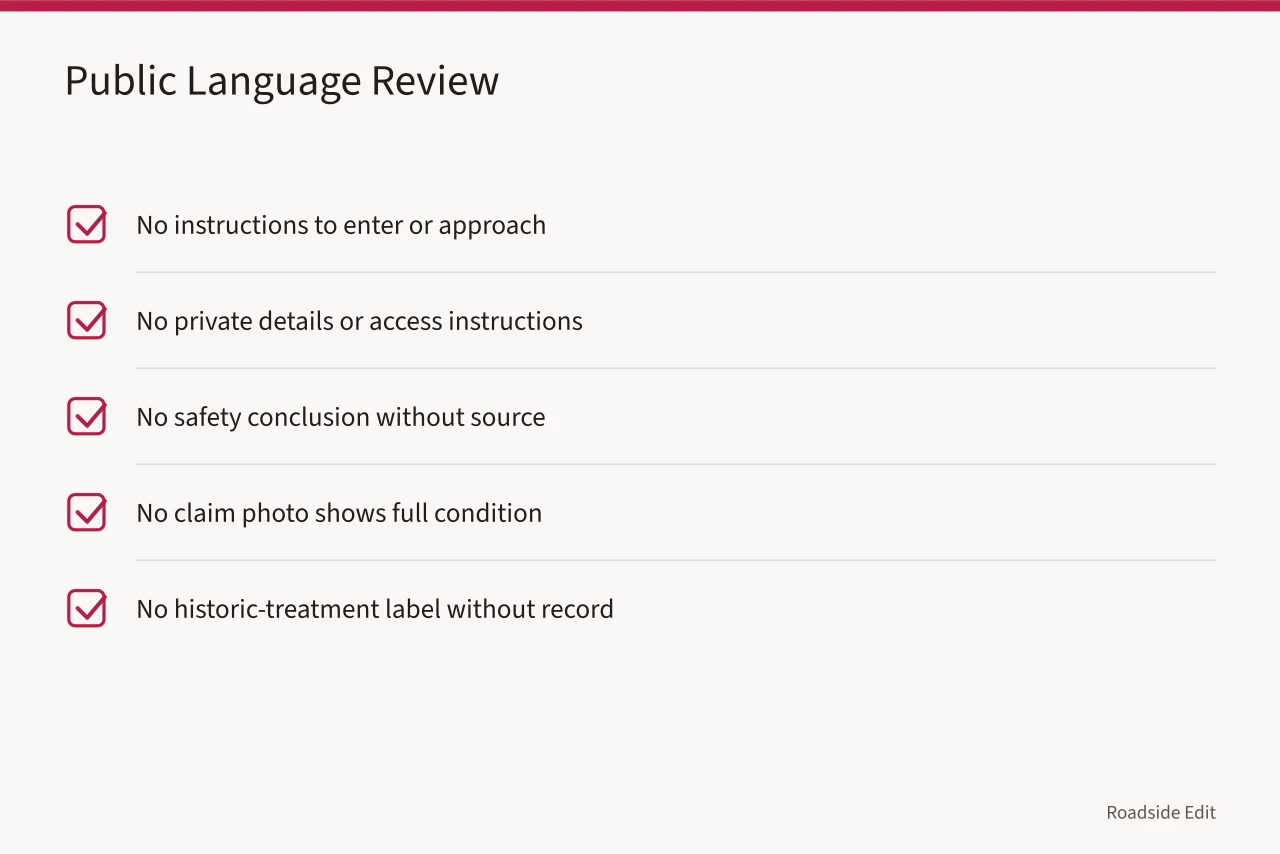
Read every headline, caption, and social teaser as if you were the owner. Remove language that implies blame, danger, access, or legal status without support. A dramatic phrase may attract clicks, but it can expose readers to risk and make a maintenance record less credible.
Check the publication draft for these limits:
Keep the checklist current
Review it after a site visit that did not go as expected. Did the form ask a public visitor to record something they could not safely see? Did the article wording create a stronger claim than the note supported? Did an owner correct a public detail? Adjust the template, preserve the older record, and document the reason for the change.
Common questions
Can a roadside article say that a building is unsafe?
Only when a relevant, reliable source supports that statement. A public photo or a closed gate does not establish a safety conclusion. Attribute the statement to the specific record, give its date, and avoid extending it to features the record did not cover. If the source is unavailable, describe only the visible condition and the limits of the view.
What should I do if I cannot photograph a feature safely?
Do not force the shot. Record the access limit or return at a time and place that permits a lawful, safe view. A missing image is better than a risky roadside stop, an entry onto private property, or a photo that creates an incorrect impression of the site.
Is a safety checklist the same as an inspection?
No. This checklist supports careful observation and responsible reporting. An inspection has a different scope, authority, and professional standard. Keep the checklist in the article file as editorial evidence, not as a substitute for an owner's inspection, official finding, or professional report.
In this guide
- Roadside architecture safety observation checklist: what to shoot and when to stopRoadside architecture safety observation checklist for 2027 sets clear limits for lawful exterior notes, photos, and responsible follow-up later.
- Roadside architecture safety questions writers should ask before publishing a claimRoadside architecture safety questions for 2027 help writers separate what they saw, what a record supports, and what needs authorized review.
- How to write roadside architecture safety budget notes without quoting a priceRoadside architecture safety budget notes for 2027 show how to document access, scope, timing, and safety conditions without publishing a project price.
- How to report roadside architecture safety warning signs without guessingRoadside architecture safety warning signs for 2027 explain how to document a visible concern, keep distance, and use responsible reporting routes.
- How to keep roadside architecture safety records clean before reviewRoadside architecture safety records for 2027 give editors a practical way to keep observations, reports, photos, and limits ready for review.