Guides
Part of How to build a roadside architecture safety checklist that stays useful
How to keep roadside architecture safety records clean before review
Roadside architecture safety records for 2027 give editors a practical way to keep observations, reports, photos, and limits ready for review.
A safety record should help a later reviewer understand what was seen, when it was seen, and what happened next. It should not become a private dossier, an unverified incident report, or a substitute for a qualified assessment.
What to take away
- Keep observations, reports, photos, and follow-up actions in separate fields.
- State a lawful viewpoint and a clear limit for each photo.
- Preserve original files and label edits made for publication.
- Remove private and security-sensitive details before publishing.
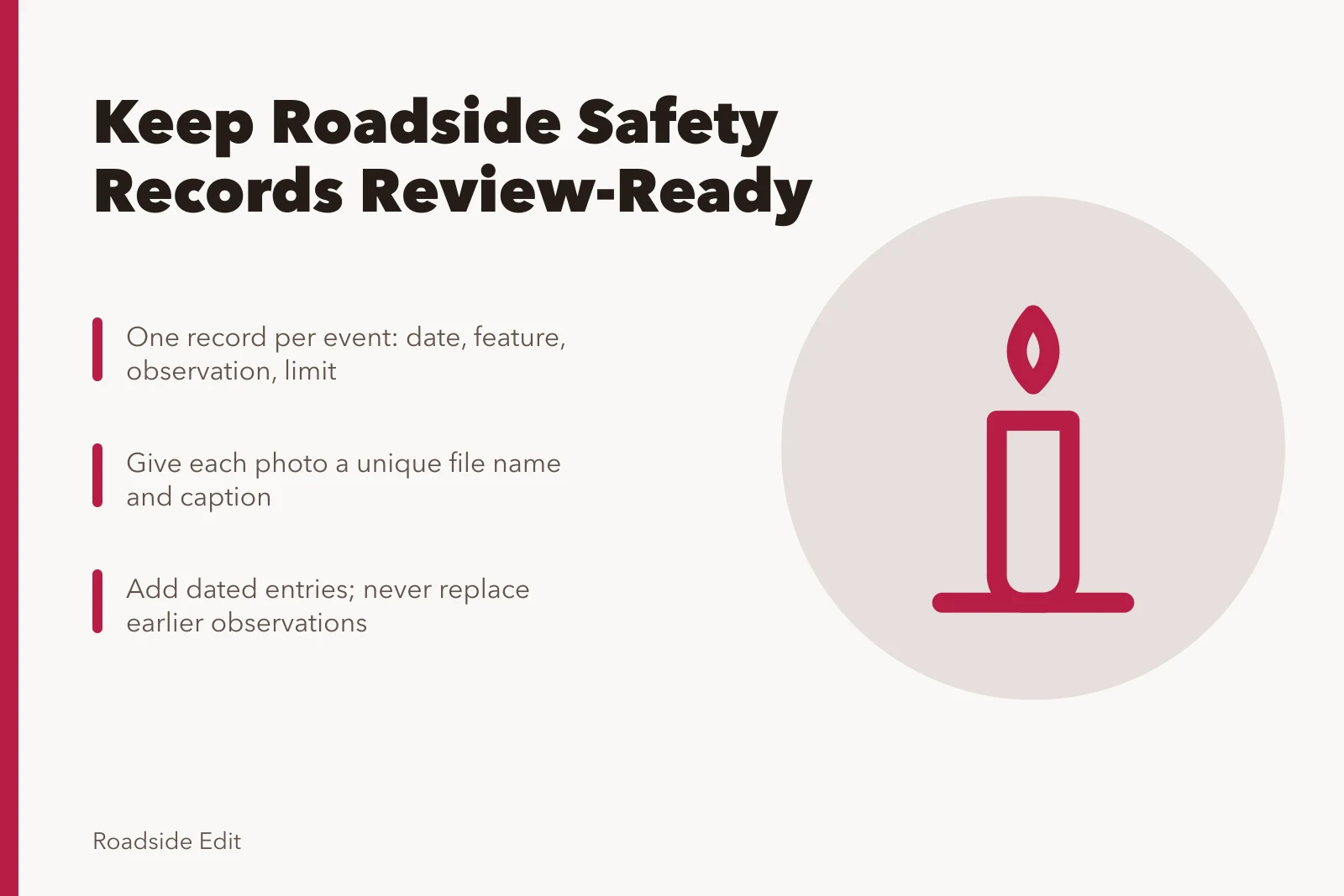
Use one short record per event
| Field | Minimum entry |
|---|---|
| Date and time | When the observation or report occurred |
| Feature | A stable label for the visible sign, route, facade, or object |
| Observation | What was visible from the stated viewpoint |
| Limit | What was not observed or confirmed |
| Action | Filed, sent to a responsible contact, or referred to emergency services |
| Source | Original photo file or reliable document identifier |
Keep pre-work and post-work records distinct
Do not combine a historic image, a current photo, and a work claim in one unlabeled folder. Give each item a date, feature label, and source. If a project supplies before-and-after images, keep the supplied context with them rather than assuming the images establish the full scope.
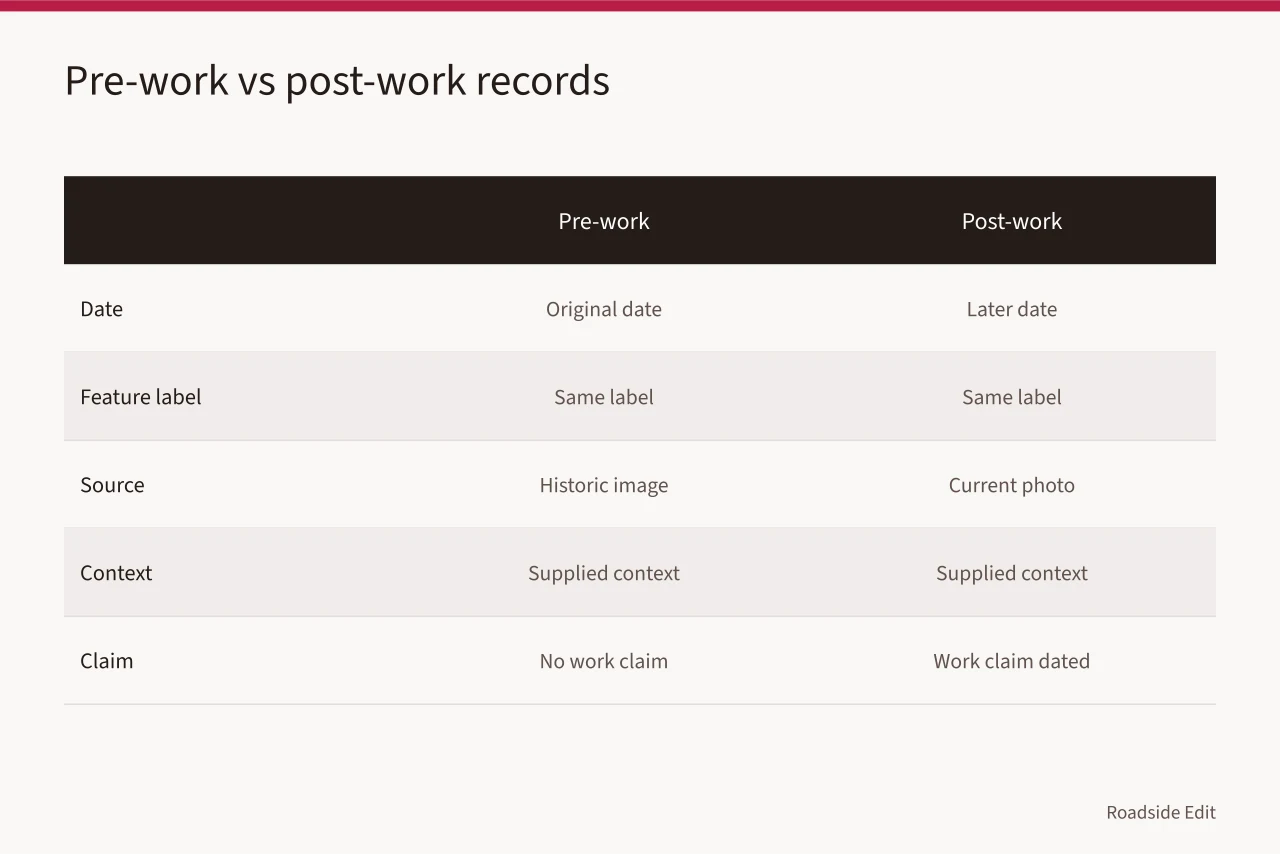
The National Park Service requires photographs that document the appearance and condition of historic building exteriors, interiors, sites, and environments before and after rehabilitation in its certification-application guidance. Review NPS documentation requirements for certification applications. That requirement applies to a federal application process, but it illustrates why dates and context matter in a safety-related record.
Keep a source chain for every image
Give each original file a unique name or identifier, keep the caption and any later publication edit beside it. National Archives guidance for digital photographic records calls for unique identification, descriptive metadata, and a caption that makes an image understandable and retrievable. Read National Archives guidance for digital photo records.
A small editorial log can use the same common-sense structure without claiming to be an archival system.
| Item | Record it this way |
|---|---|
| Original image | Retain the original file and its identifier. |
| Published crop | Label it as an edited version and note the edit date. |
| Caption | State the visible feature, location at an appropriate level, and image date. |
| Claim in article | Link it to the image or document that supports it. |
| Limitation | State what the image does not show or confirm. |
The goal is traceability, not volume. If an image was supplied by an organization, record the source and the exact wording that came with it. If a date is an estimate, label it as an estimate. Do not replace a missing source with a confident caption.
Record changes without rewriting the past
When new work, a repair, or a later finding changes the story, add a dated entry, not replace the earlier observation. NPS project-completion guidance calls for photographs, sketches, and written descriptions to record work, discoveries, and changes as they occur. See NPS project-completion record guidance.
The federal process is more formal than a newsroom file, but the principle carries over: keep the earlier record and explain what later evidence changed.
For example, a 2027 exterior photo might show a covered sign; a 2028 project notice might identify repair work.
The publication file should keep both items, date them, and avoid revising the older caption to imply prior repair knowledge. This gives a later editor a clear path to correct the article without losing the record of what was originally visible.
Remove sensitive material before publication
Do not publish personal phone numbers, private access instructions, security systems, unverified allegations, or images that unnecessarily identify people. A public article can state that a concern was recorded or referred without exposing information that could create a new risk.
NPS documentation standards require reliable sources, clear limitations, and information that permits independent verification. See the NPS documentation quality standard. Apply that rule before publishing: separate the original file from an edited illustration, name the source, and remove a claim that cannot be checked.
Use a simple review handoff
Before an editor publishes a safety-related note, another reviewer should be able to answer four questions: What is the source? When was it created? What does it show? What does it not establish? If the file cannot answer those questions, keep it out of the article until its context improves.
This review is not a condition assessment. It is a check that the public statement stays within the evidence. That boundary protects the writer, the reader, and the people connected to the site.
Common questions
Should a safety record include a formal incident number?
Include it only when a responsible organization has provided one and it is appropriate to retain. Do not invent a report number or expose private case information.
Can I edit a photo to make a condition easier to see?
Keep the original. Label any crop, annotation, or brightness adjustment as an edited publication version.
How long should safety records be kept?
Follow the responsible organization's policy and applicable legal requirements. For an editorial log, retain enough context to support or correct published statements.