Costs
Neon sign restoration costs in the US: glass, gas, transformers and labor
Neon sign restoration costs break down by glass bending, gas fill, transformers and licensed electrician labor, with regional price levels varying widely.
What to take away
- Neon sign restoration costs in the US typically run from about $2,500 for a small single-sided wall sign to more than $40,000 for a large rooftop or projecting sign, depending on tube count, transformer condition and access.
- Glass bending and tube replacement is usually the largest line item, followed by transformers and licensed electrician labor.
- Neon gas fill, electrodes and pumping are priced by the number of tubes and the gas mix, not by the sign's age.
- Regional price levels for sign shops serving historic properties differ by 20 to 40 percent between high-cost coastal markets and interior states.
- A useful quote separates glass, gas, electrical and access, so you can compare scope rather than a single lump sum.
- Safety rules for neon gas and shop work fall under OSHA hazard communication and personal protective equipment requirements.
What a neon sign restoration estimate actually covers
A neon sign restoration estimate is not one price. It is a stack of trades: glass bending, neon gas fill, transformers, licensed electrician labor, and the rigging or bucket truck time to reach the sign. Each has its own unit of measure.
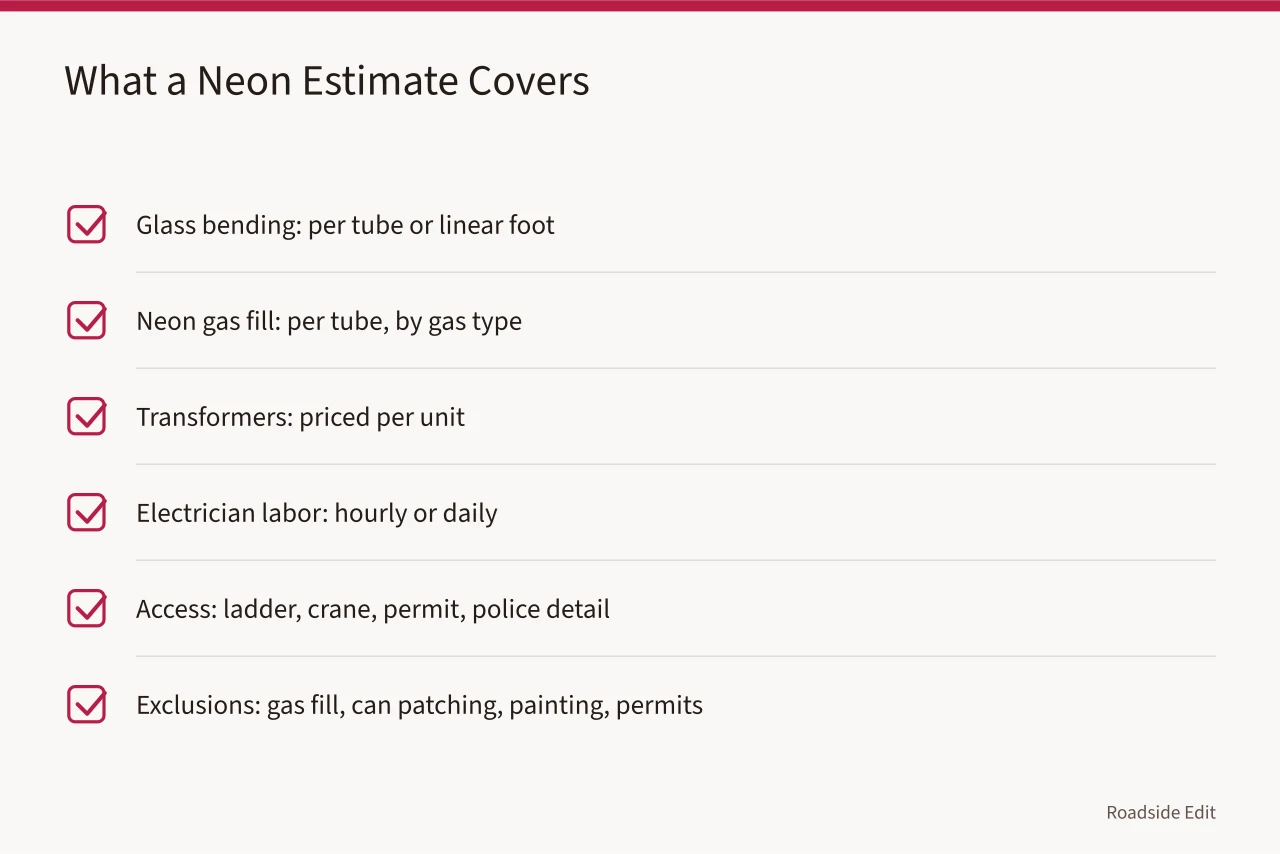
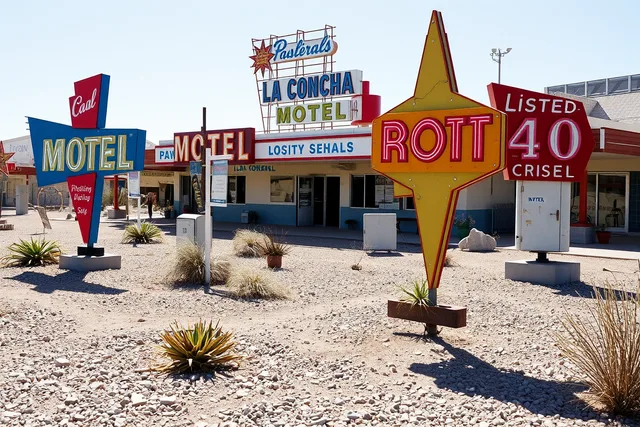
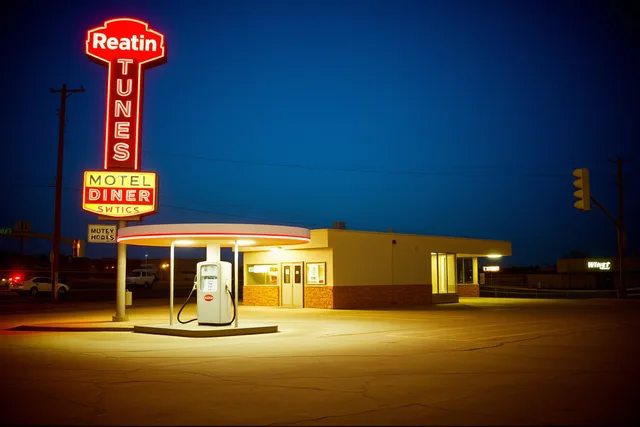
Access is the hidden variable. A flat wall sign at 12 feet is a ladder job. A rooftop sign over a 1950s motel on Route 66 may need a crane, a permit and a police detail. That single line can exceed the glass budget.
NPS preservation briefs cover preserving neon signs and materials, and they help owners define scope before calling a shop. Read them before you ask for numbers.
A complete estimate also names what is excluded: neon gas fill for tubes that test fine, patching of the can, painting, and permit fees. Ask for exclusions in writing.
If you are documenting condition before work starts, our neon sign restoration field notes cover the shots that make later scope disputes easier to settle.
Glass bending and tube replacement costs
Glass bending is the craft of heating glass tubing over a ribbon burner and shaping it to match the original letterform. A bender works from a pattern, often traced from the existing tube or from historic photographs.
Neon glass bending cost is usually quoted per tube. Small letters may run $25 to $60 each in a mid-cost market. Large script or border tubes can run $75 to $150 each. A 20-letter sign with borders can pass 40 tubes.
Tube replacement is not always full replacement. A shop may reuse sound tubing and re-bend only broken segments. That saves money but can leave color and diameter mismatches that show at night.
Color matters to price. Clear tubes with phosphor coatings, and rare colors such as gold or certain blues, cost more because the glass stock is less common. Standard red and clear are cheapest.
Diameter matters too. Most historic sign tubing is 12mm or 13mm. Some shops now bend 10mm or 15mm. Matching original diameter keeps the sign looking right but may raise the per-tube price.
A worked example: a 1950s projecting sign with 32 tubes, half broken. Re-bending 16 tubes at $55 each is $880. New electrodes and gas add more. The glass line alone is under $1,000, but the electrical and access lines will dominate the job.
Ask the shop whether the quote assumes new patterns or reuse of existing ones. New patterns add drafting time, often billed hourly.
Neon gas fill, electrodes and pumping
Neon gas fill is the process of evacuating a finished tube, adding electrodes, and backfilling with neon, argon, or a neon-argon mix. The gas type sets the color: neon gives red-orange, argon with mercury gives blue.
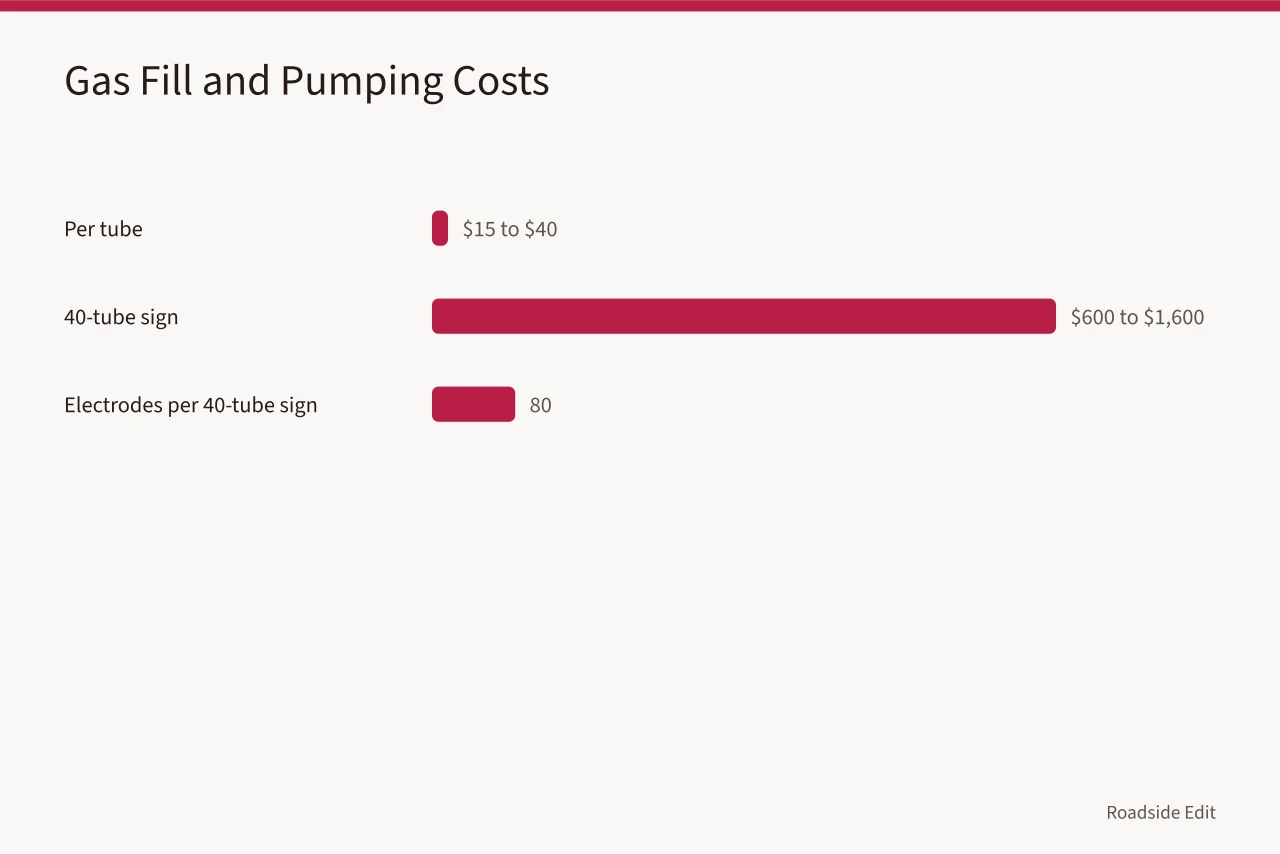
Pumping is priced per tube. A typical range is $15 to $40 per tube in a mid-cost market, higher in coastal cities. A 40-tube sign can add $600 to $1,600 on this line alone.
Electrodes are consumable. Each tube end needs one. They are inexpensive individually, often a few dollars, but a 40-tube sign needs 80 of them. Ask whether electrodes are included in the per-tube price.
Gas fill and pumping are usually done in the shop, not on site. That means tubes must be removed, transported and reinstalled. Transport and reinstallation are separate line items and are often underestimated.
Some shops now offer LED neon replacement instead of glass. It is cheaper to run and lasts longer, but it changes the sign's appearance and can conflict with preservation standards. If the sign is in a historic district, check with your local design review board first.
For signs on historic roadside properties, Technical Preservation Services (U.S. National Park Service) offers practical rehab guidance that addresses tube, gas and mounting decisions.
Transformers, wiring and licensed electrician labor
Neon transformer replacement is a common line item because old transformers fail, run hot, or are no longer code compliant. A modern magnetic transformer for a neon sign typically runs $75 to $250 per unit, depending on load.
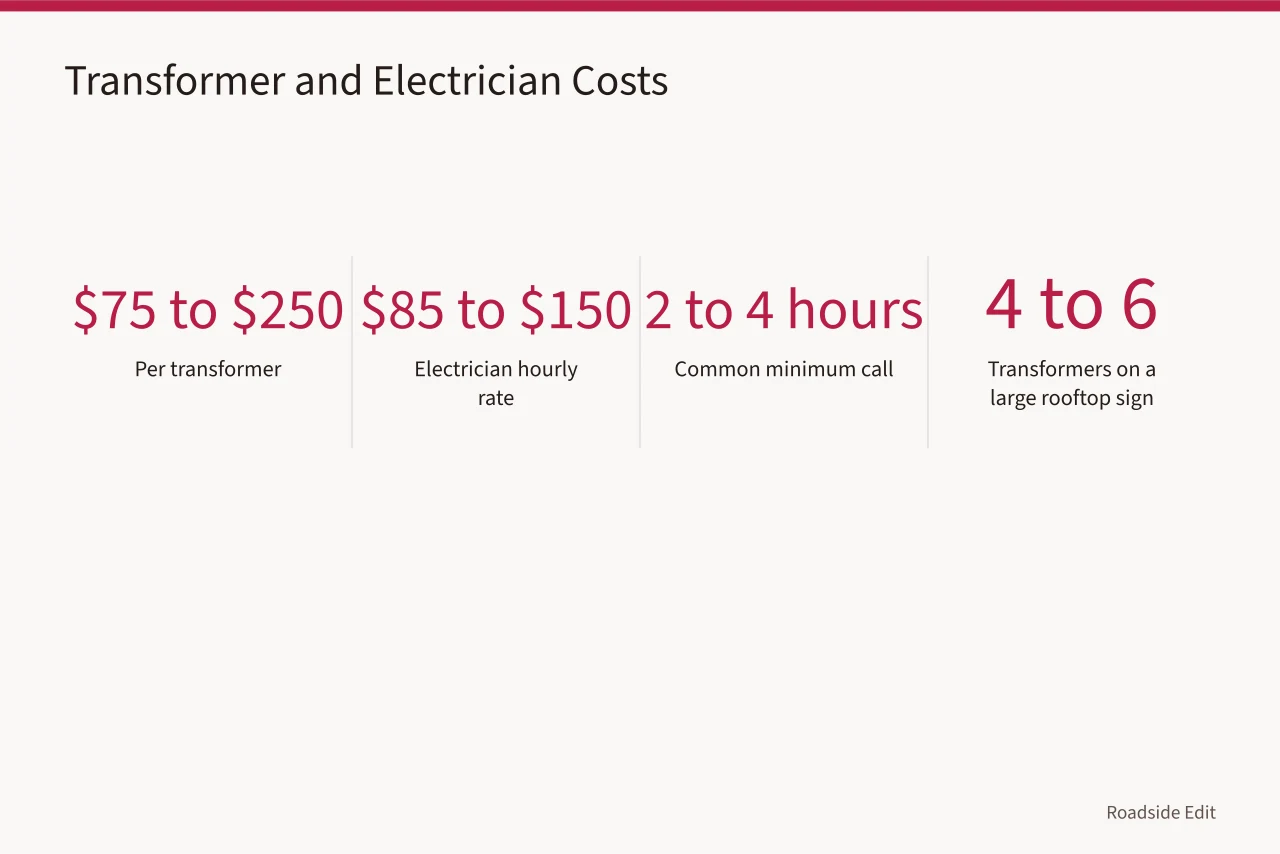
Many signs need more than one transformer. A large rooftop sign may have four or six. That multiplies the parts cost quickly, and each unit needs mounting and wiring.
Wiring is where licensed electrician labor enters. A licensed electrician must make the final connection to the building's power, and in most jurisdictions must pull the permit. Rates vary widely.
Expect $85 to $150 per hour in many markets, with higher rates in California, Illinois and the Northeast. Minimum call charges of two to four hours are common. A simple reconnect may be a half-day job.
Electricity - U.S. Energy Information Administration (EIA) publishes state-by-state electricity data that helps owners estimate operating cost after restoration. A restored neon sign left on nightly is not free to run.
Some shops have an electrician on staff; others subcontract. Ask which, because it affects scheduling and markup. A subcontractor adds a layer of coordination.
If the sign sits on a gas station canopy, the electrical scope can overlap with canopy structure and lighting. Our guide on What to Inspect Before You Hire covers the checks that keep the electrical quote honest.
Regional price levels for sign shops serving historic properties
Regional price levels for sign shops serving historic properties vary by labor market, travel distance and demand. A shop in a major metro charges more per hour than one in a smaller interior city.
California, Illinois and the Northeast tend to sit at the top. Texas, Arizona, New Mexico, Pennsylvania, Florida and Nevada vary, with tourist-heavy areas such as Las Vegas and parts of Florida running higher than their state averages.
Travel matters. If the nearest qualified neon shop is 300 miles away, you pay for travel, lodging and per diem. That can add thousands to a job before any glass is bent.
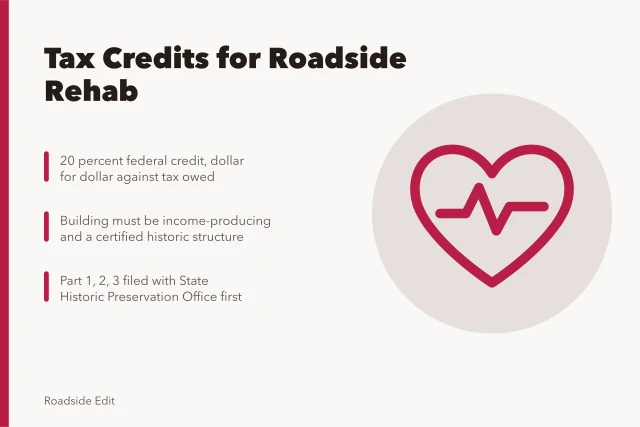
Museum and preservation projects often attract shops with historic sign experience. Those shops may charge a premium, but they also know how to document work for tax credit and grant purposes.
The National Park Service Route 66 Corridor Preservation Program and State Historic Preservation Offices (SHPOs) sometimes fund work on eligible signs. Funding does not lower the price, but it changes what you pay out of pocket.
For a fuller picture of travel and staging economics, see our breakdown of what a gas station preservation trip actually costs.
| Region | Typical glass bending per tube | Typical electrician hourly | Notes |
|---|---|---|---|
| California | $65 to $150 | $110 to $180 | High demand, strict permitting |
| Texas | $45 to $95 | $85 to $140 | Large metro vs. rural gap |
| Illinois | $55 to $120 | $95 to $160 | Chicago premium |
| Arizona | $45 to $100 | $80 to $135 | Phoenix and Tucson lead |
| New Mexico | $40 to $90 | $70 to $120 | Limited shop count |
| Pennsylvania | $50 to $110 | $85 to $150 | Philadelphia and Pittsburgh |
| Florida | $50 to $115 | $80 to $145 | Coastal storm premiums |
| Nevada | $55 to $125 | $90 to $155 | Las Vegas travel costs |
These are planning ranges, not quotes. Get at least three local quotes before you set a budget.
Safety rules for neon gas and restoration shop work
Neon gas itself is inert, but the work around it is not. Glass dust, mercury in some argon tubes, lead in old solder and electrical hazards all require controls.
Hazard Communication - Overview | Occupational Safety and Health Administration sets the rules for labeling and informing workers about hazardous chemicals in the shop, including mercury and solvents.
Personal Protective Equipment - Overview | Occupational Safety and Health Administration covers eye, hand and respiratory protection for sign restoration labor. Bending glass and handling old tubes both call for eye protection.
Mercury is the one to watch. Argon tubes often contain a small amount of mercury. Broken tubes release vapor. Shops should have ventilation and spill procedures, and owners should not sweep up broken tubes themselves.
Lead is the other. Old sign cans and solder may contain lead. Repainting or scraping without protection can expose workers. Ask the shop how it handles lead paint.
Electrical safety applies to the owner too. Do not energize a sign with damaged wiring to "test" it. Let the licensed electrician make that call.
If your project involves a museum or public site, add a written safety plan to the scope. It protects workers and gives your insurer a document to review.
How to compare quotes without mixing scope and price
Quotes are hard to compare because shops bundle differently. One quote may include gas fill; another may list it separately. One may include the permit; another may not.
The fix is a scope sheet. Ask every shop to price the same line items, even if they normally bundle. Then compare line by line.
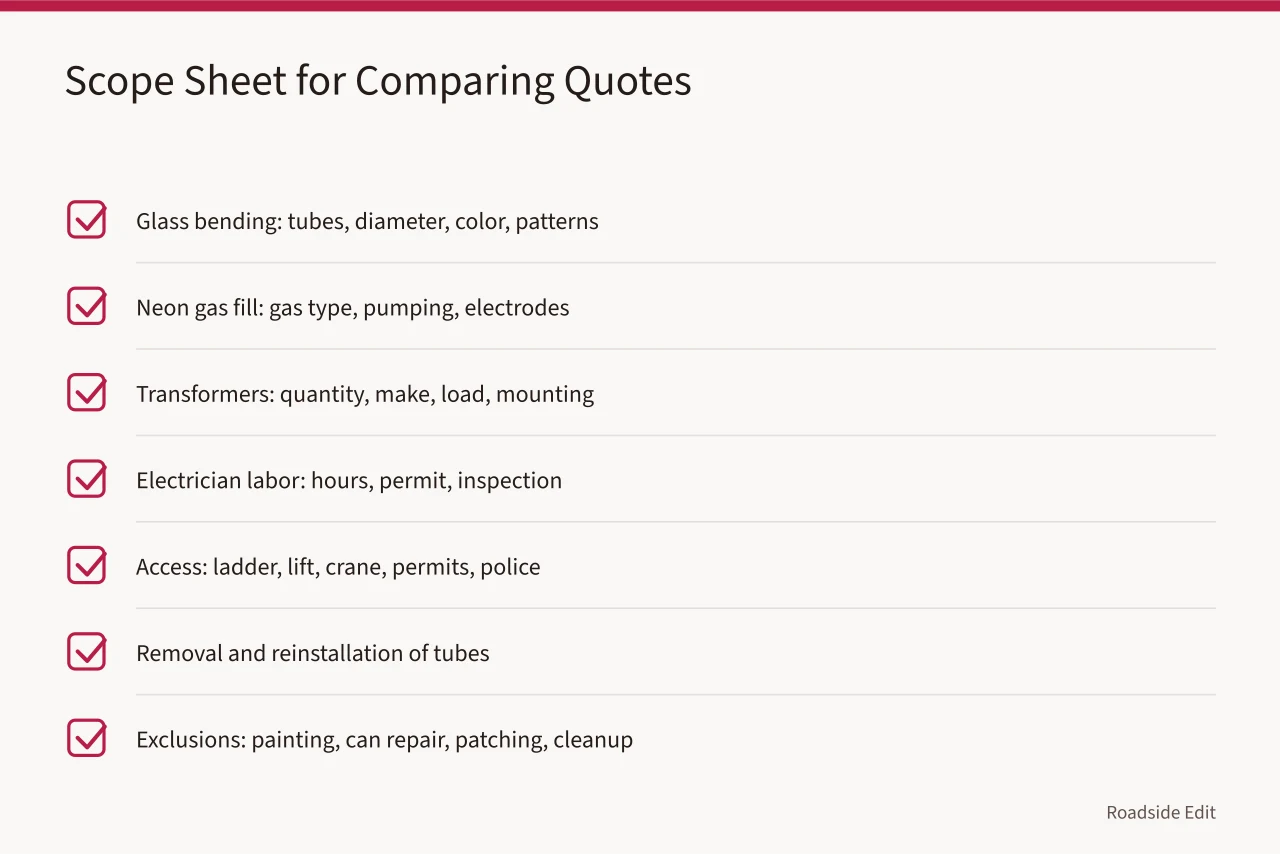
Once the scope sheet is filled, you can see whether the low bid is low because it left something out. That is the most common trap in neon sign restoration costs.
For a structured way to vet shops before you ask for numbers, our provider selection checklist walks through credentials, insurance and references.
If your sign sits on a diner or commercial interior, the budget logic differs because interior lighting and finishes are in play. Our guide on how to build a 2027 budget covers that case.
Finally, decide what you are buying. A working sign that lights is not the same as a restored sign that matches its historic appearance. Both are valid goals. They have different prices.
Common questions
How much does neon sign restoration cost in the US? For a small single-sided wall sign, plan on $2,500 to $8,000. Large rooftop or projecting signs on historic properties often run $15,000 to $40,000 or more, driven by tube count, transformer condition and access.
Is glass bending or electrical labor the bigger cost? Glass bending is usually the largest single line for signs with many broken tubes. Electrical labor dominates when the sign needs new service, permits or a long wire run.
Can I replace neon with LED to save money? Yes, and it is often cheaper to buy and run. But it changes the sign's appearance and may conflict with preservation standards or local design review rules for historic districts.
Do I need a licensed electrician for a neon sign? In most jurisdictions, yes, for the final connection and permit. Some sign shops have one on staff. Ask before you sign a contract.
How long does a restoration take? Small jobs can finish in two to four weeks. Large historic signs with custom glass and permitting often take three to six months, depending on shop backlog and weather.
Are there grants for historic neon signs? Sometimes. The National Park Service Route 66 Corridor Preservation Program and State Historic Preservation Offices (SHPOs) have funded eligible sign work. Check with your SHPO before work begins.