Guides
Part of Neon sign restoration safety checklist: what to document before anyone visits
How to build a neon sign safety record owners can trust
Neon sign safety records for 2027 help U.S. owners organize dated observations, visitor notices, role assignments, sources, and corrections responsibly.
Safety records for a historic neon sign should help an owner and publisher find the original evidence, current visitor instruction, and unanswered question. They should not imitate an electrical inspection report or imply that the file establishes a technical conclusion.
What to take away
- Keep observations, sources, public notices, and decisions in separate dated sections.
- Record the person or role that supplied each instruction.
- Preserve corrections rather than silently replacing prior wording.
- Use a handoff log to show what question is awaiting an appropriate response.
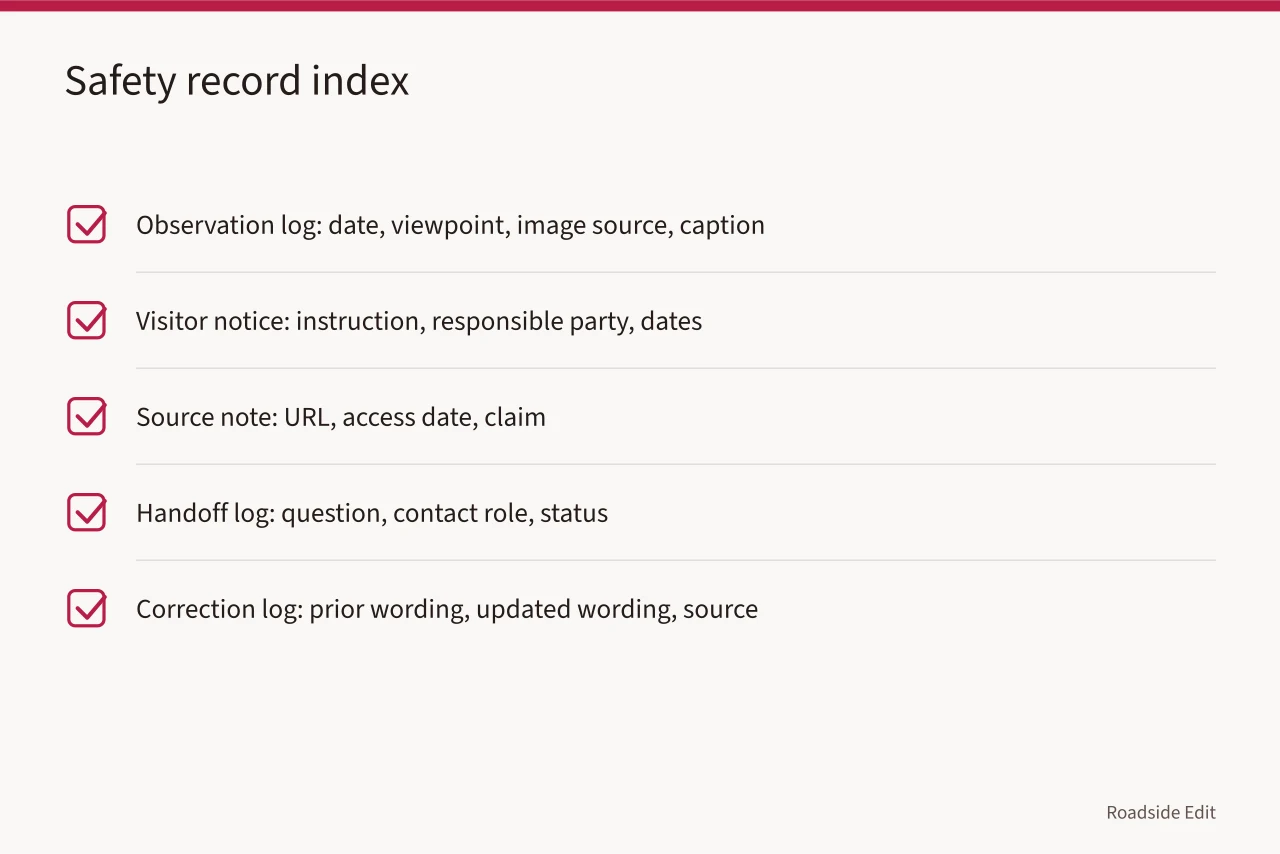
Create a simple safety record index
| Record | Minimum contents | Publication use |
|---|---|---|
| Observation log | Date, viewpoint, image source, factual caption | Supports a limited description of what was seen |
| Visitor notice | Exact instruction, responsible party, start date, review date | Supports current access wording |
| Source note | Specific URL or record, access date, claim supported | Supports a traceable factual statement |
| Handoff log | Question, contact role, date sent, response status | Explains that review is pending without guessing |
| Correction log | Prior wording, updated wording, source, date | Keeps material updates clear |
OSHA's training requirements material describes training concepts connected with electrical safety-related work practices. It does not turn a site visitor or writer into a qualified worker. The useful recordkeeping lesson is to identify roles and training boundaries rather than assume that everyone contributing to a file can answer a technical question.
Capture the source of each public claim
For every sentence that could affect a visitor's decision, preserve the underlying source. That source may be an owner-approved access instruction, a dated image, a public historical record, or a qualified response the responsible party authorized for publication.
A social-media comment or remembered story can be kept as a lead, but it should not carry the same weight as a confirmed source.
Make corrections visible to the next editor
If public copy changes from "open" to "access update pending," do not erase the reason. Record the date, the source of the update, and the person who approved the wording. If the owner later supplies a new instruction, add it as a new entry rather than rewriting the earlier one out of existence.
Transfer the record responsibly
When a staff member, volunteer, or writer leaves, transfer the index and source log with the images and public-copy archive. The recipient should be able to locate the current instruction and understand which questions are still unresolved. Keep private contact information out of the public article unless the responsible party has explicitly authorized it.
Keep each image tied to its source record
Store an image's source page, access date, caption, author when known, and known date. Record location when established and any crop or adjustment for publication; a file name is not enough.
If an image only provides visual context, label it illustrative. If it is evidence of a public change, retain the full record and limit the caption to what the image can show.
The Library of Congress Prints and Photographs collections provide item records with descriptive and rights information. They do not determine the present condition of a sign. They support checking image context before it is used to support a historic statement or visitor update.
Separate a public notice from a private contact log
The article record may name an owner-approved contact channel or public instruction. The internal handoff record can list that instruction's source and the date supplied.
Do not publish private phone numbers, email addresses, or internal discussion just because they are in the file. A public notice should give only what the reader needs for the next step. Review it when it goes stale.
The National Archives personal digital archiving guidance concerns preserving digital records and their context. It is not a privacy policy. It supports organizing source material so the next custodian can distinguish a public copy from supporting files.
Record commercial claims in a separate field
If a provider submits a directory profile, quote, testimonial, or sponsored placement, retain the submitted text, date, disclosure decision, and published version. Mark it as provider-supplied. Do not allow commercial wording to replace an owner instruction or a sourced historical statement. This division lets a reader see the relationship without treating paid information as a site finding.
The Federal Trade Commission's endorsement guides address endorsements and testimonials in advertising. They do not set technical safety requirements. They support preserving clear disclosure choices when commercial text appears in an editorial publication.
Common questions
Is a safety record the same as an inspection report?
No. It is an editorial and ownership record of observations, sources, notices, and handoffs. It does not make technical findings.
How often should the record be reviewed?
Set a date appropriate to the owner and publication schedule, then review the accuracy of contacts, notices, source links, and open questions.
Can the record include a contractor statement?
Yes, when it is dated and attributed to the contractor. Do not convert it into an independent assessment without separate support.