Guides
Part of Neon sign restoration safety checklist: what to document before anyone visits
Neon sign restoration safety checklist: how to flag warning signs in your records
A neon sign restoration safety checklist helps U.S. owners record flickering, buzzing, exposed wiring, cracked glass, and transformer issues for qualified review.
This neon sign safety warning-signs guide is about communication and records, not diagnosis. A visible change may call for a dated photograph, a temporary visitor instruction, or a qualified handoff. It does not give an unqualified person a reason to approach equipment or make a technical finding.
What to take away
- Describe what is visible, not what you think caused it.
- Record flickering, buzzing, exposed wiring, cracked glass, and transformer issues as warnings.
- Do not use a photograph to declare a sign safe or unsafe.
- Record the handoff and response date before changing a public statement.
- Keep visitor instructions separate from editorial conclusions.
Safety checklist for neon sign records
Use this checklist to flag visible warning signs and route them to qualified review. Do not touch equipment.
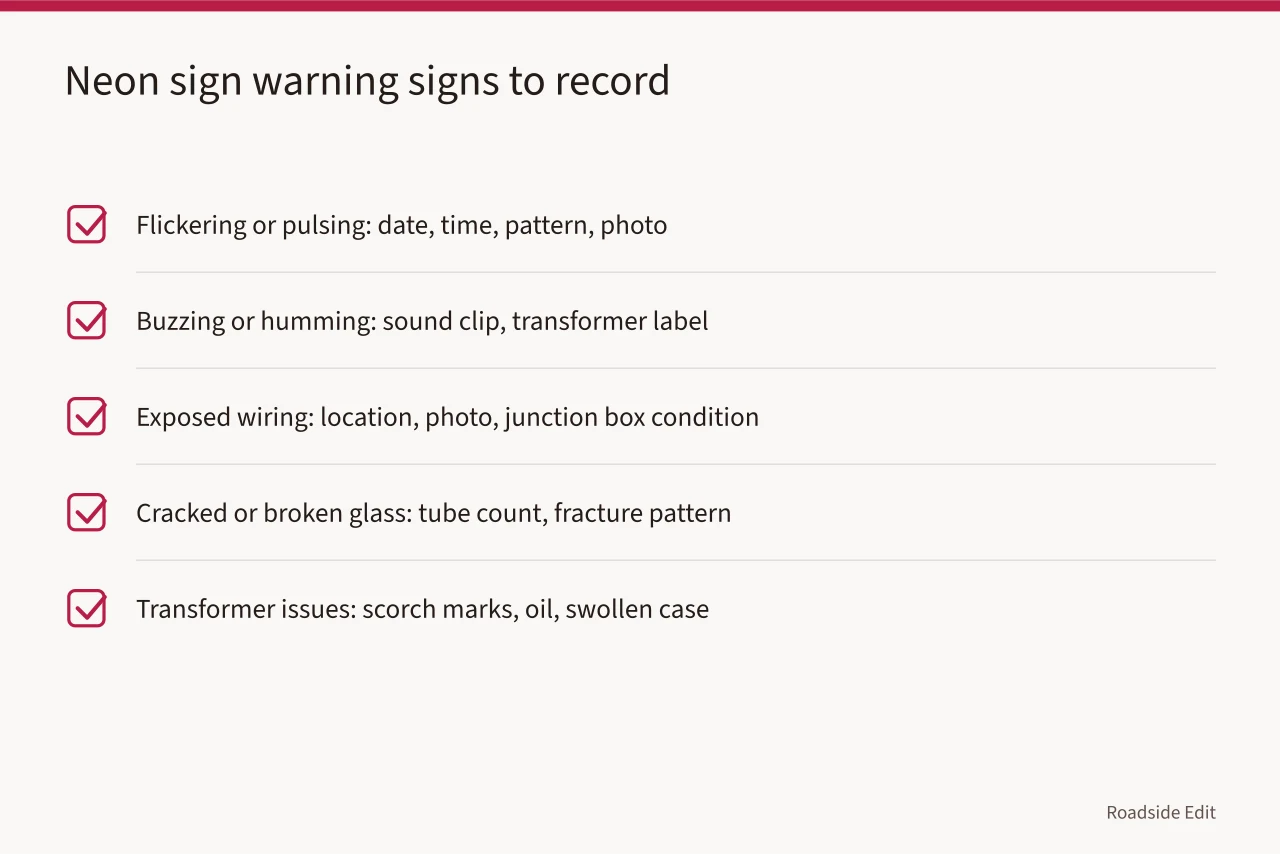
| Warning sign | What to record | Record flag |
|---|---|---|
| Flickering or pulsing | Date, time, pattern, photo or video, sign ID | Note if new or recurring; route to qualified electrician |
| Buzzing or humming | Sound clip, transformer label, model and serial number | Flag loud or new hum for neon sign company review |
| Exposed wiring | Location, photo without touching, junction box condition | Restrict area; call licensed electrician |
| Cracked or broken glass | Tube count, fracture pattern, missing pieces, location | Do not handle; contact a neon glass bender |
| Transformer issues | Scorch marks, oil, swollen case, input and output label | Record label and compare with UL 2161 listing |
For each row, save the original photo, date, author, and source. Add a one-line note that says whether the item is an observation or a qualified finding. If a visitor must avoid an area, publish a plain-language notice with a date and update contact.
Tools and standards to name in the record
- Fluke 1AC II VoltAlert: a non-contact voltage tester from Fluke Corporation. It detects AC voltage from 90 to 1000 V. It suits qualified electricians, not untrained staff.
- Klein Tools NCVT-3P: a dual-range non-contact voltage tester. It detects 12 to 1000 V AC and carries a CAT IV 1000 V rating. Sold at hardware stores.
- Megger MIT230: an insulation resistance tester. It tests at 250 V, 500 V, and 1000 V. Qualified electricians use it on wiring and transformers.
- Franceformer and Allanson International: two neon transformer makers. Both supply transformers for sign shops. Record the model and UL listing.
- Tecnolux: a neon tubing and electrode supplier. It serves glass benders and restoration shops. Record tube type and diameter.
- UL 2161: the standard for neon transformers and power supplies. It helps verify a replacement transformer listing.
- NFPA 70E: the electrical safety standard for workplaces. It covers arc flash risk and PPE. The 2024 edition is current.
- SafetyCulture iAuditor: an inspection app with digital checklists and photo capture. It offers a free tier and paid plans. Suits owners who need dated records.
- Internet Archive Wayback Machine: a free tool that saves dated snapshots of public web pages. Suits editors preserving source pages.
- ExifTool: a free open-source metadata tool by Phil Harvey. It reads and writes photo dates and camera data. Suits archivists checking image records.
- Preservica: digital preservation software with cloud and on-premise options. Pricing is quote-based. Suits archives keeping source files.
Keep visitor messaging narrow
If an owner asks visitors to avoid a clearly identified area, publish that instruction in plain language with the date and a way to find updated information. Do not enlarge the message into a claim about cause, repair timing, or regulatory status unless an appropriate specific source supports it.
Preserve a correction trail
When a warning-related sentence changes, retain the former wording, source, and date in the editorial archive. This protects the reader from mixed messages and helps a future editor see whether the update came from a new owner instruction, a corrected source, or a qualified response.
OSHA's typical minimal lockout procedure is a sample for employer-developed hazardous-energy procedures. It is not a public-facing instruction for a historic-sign article. The relevant communication lesson is that formal procedures belong to responsible programs and roles, not improvised directions in a blog post or visitor notice.
The Library of Congress Prints and Photographs collections show how image items can include descriptive and rights information. They do not assess safety conditions. They support checking an image record before treating a photograph as support for a historical or public-status statement.
The Federal Trade Commission's endorsement guides address endorsements and testimonials in advertising. They do not provide a safety finding. They support clear disclosure when commercial copy appears near editorial warnings or site-status information.
The National Archives personal digital archiving guidance concerns preserving digital files and their context. It is not a visitor-safety protocol. It supports keeping source copies and descriptive notes so an editorial correction can be traced to the information that changed.
Common questions
Is a changed appearance a warning sign of a specific fault?
Not on its own. Describe the observation and obtain the appropriate property-specific review rather than diagnosing it in the article.
Should a writer publish a dramatic warning for attention?
No. Use factual, owner-approved instructions that serve a clear public purpose and avoid unsupported alarm.
Can a public notice mention a pending review?
Yes, when it identifies the source of the instruction and does not imply a conclusion that the review has not reached.
What should I do first if I see exposed wiring?
Keep people away, do not touch it, and call a licensed electrician. Record the date, location, and a photo from a safe distance.