Guides
Neon sign restoration safety checklist: what to document before anyone visits
Neon sign restoration safety checklist for 2027 helps U.S. owners document concerns, protect visitors, set boundaries, and make qualified handoffs.
A neon sign restoration safety checklist helps owners, writers, or site stewards set safe editorial and visitor-facing boundaries around a historic sign. It is not a repair manual; it does not authorize anyone to test, touch, clean, or energize sign equipment.
It does not authorize opening, moving, or altering it. Its purpose: record observations, limit unqualified access, and route property-specific questions to the person or process that can properly answer.
What to take away
- Treat a visible change as an observation until an appropriate qualified party evaluates it.
- Keep visitors and unassigned staff away from areas the responsible party has restricted.
- Record dates, locations, photos, and the source of each statement before updating public copy.
- Separate a business's report from an independently verified fact.
- Use a named handoff question instead of broad or improvised technical advice.
Set the scope before anyone visits the site
Begin by stating what the checklist covers. For a publication or owner record, that may include public access, dated photographs, historical claims, contact information, temporary notices, and the status of a request for qualified review. It does not include diagnosing electrical equipment or deciding whether a sign is safe to operate.
This boundary matters because general descriptions can be mistaken for site-specific guidance. OSHA's electrical safety-related work-practices rule addresses work performed on or near equipment or circuits that are or may be energized. It also distinguishes qualified persons for work on circuit parts that have not been deenergized.
Those are employment requirements, not a reader checklist for a particular sign. The limited editorial lesson is clear: a publisher or unqualified visitor should document and hand off a safety question rather than attempt the work.
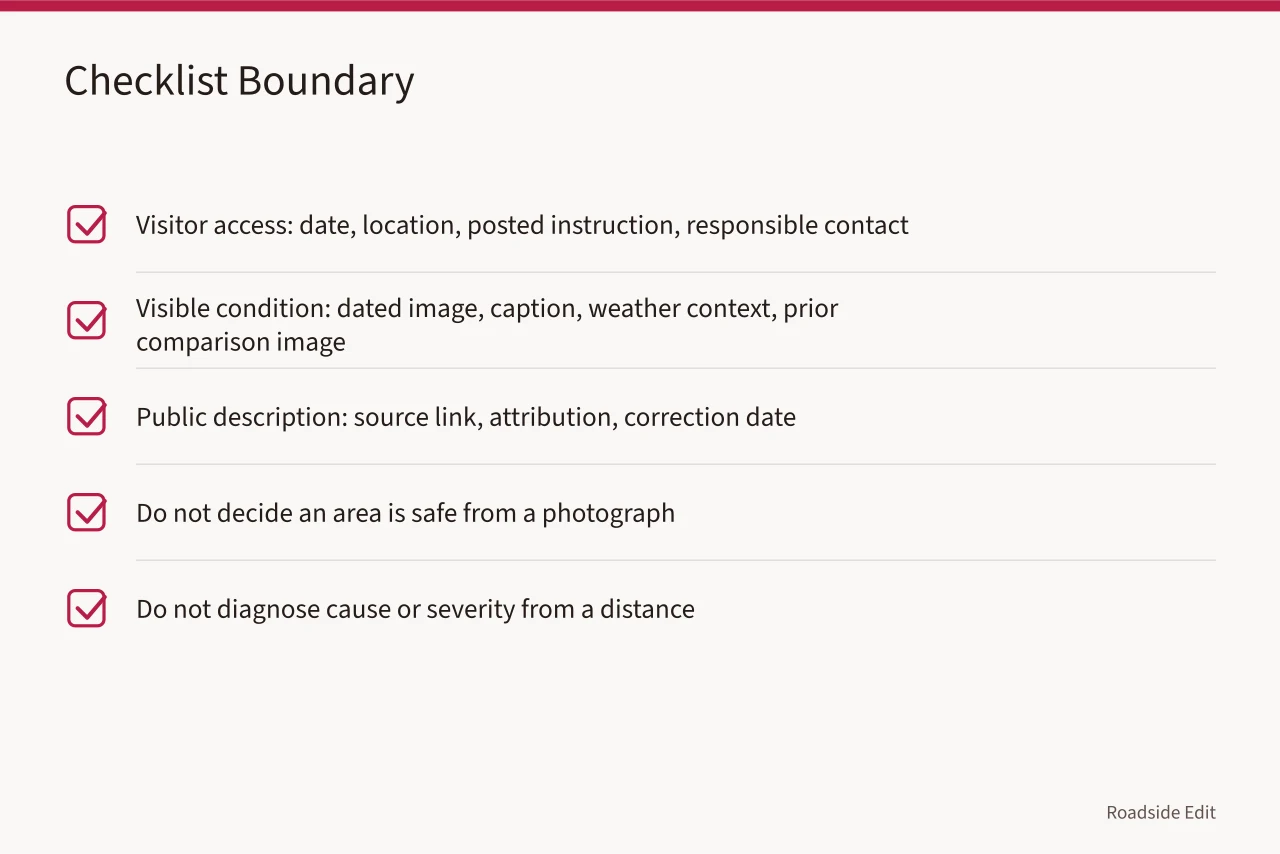
| Checklist boundary | Useful record | Do not do |
|---|---|---|
| Visitor access | Date, location, posted instruction, responsible contact | Decide that an area is safe based on a photograph |
| Visible condition | Dated image, caption, weather context, prior comparison image | Diagnose the cause or severity from a distance |
| Public description | Source link, attribution, correction date | Turn an owner statement into independent certification |
| Handoff | Question, contact role, date sent, response status | Give physical-work instructions to staff or readers |
Start with observable facts
Write down what was seen, where it was seen, and when the observation was made. A note can say a panel appears different in a dated photo, a public walkway is close to a sign, or an owner asked for a review.
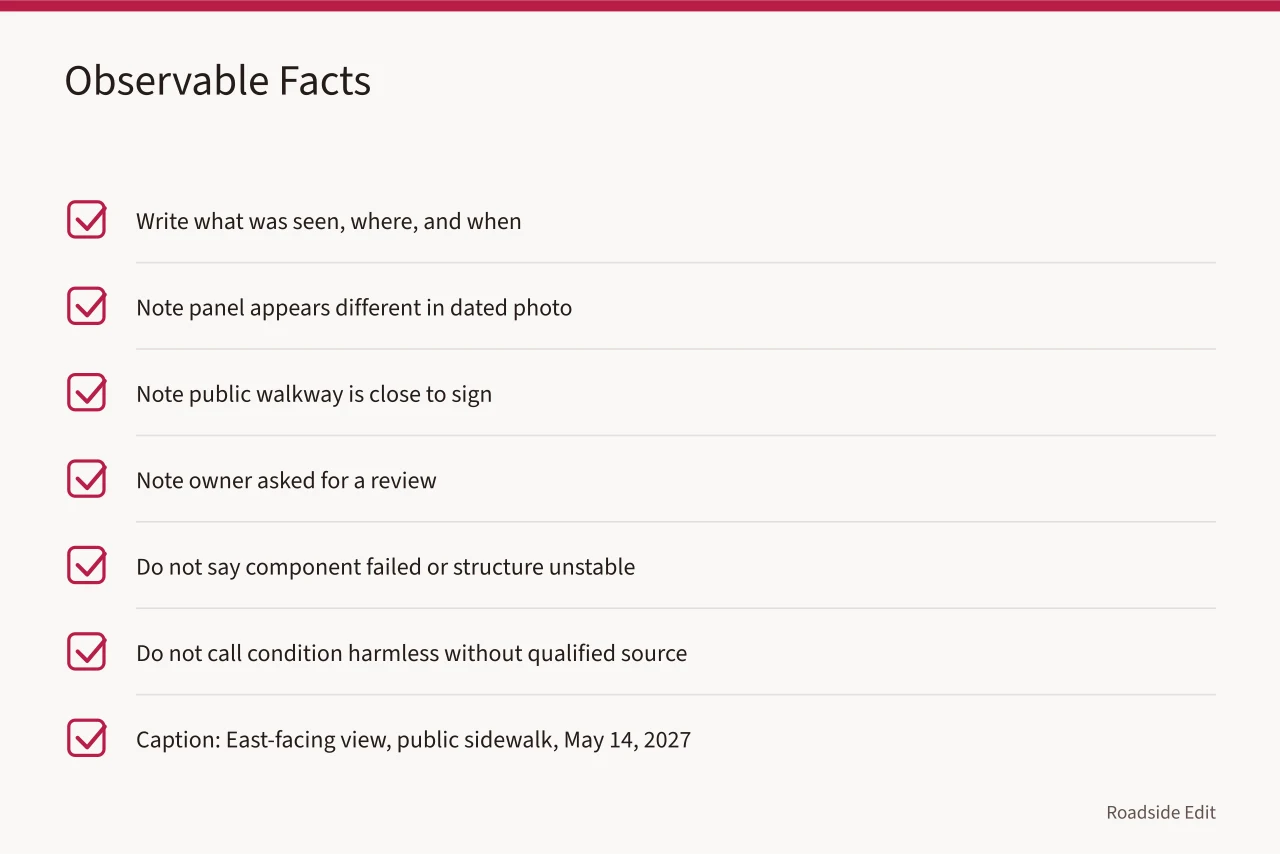
It should not say a component failed or a structure is unstable. It should not call a condition harmless unless a qualified, documented source supports the statement.
Write captions that tell a later reader what the photo shows. "East-facing view, taken from the public sidewalk on May 14, 2027" beats "damage." Keep the original image, filename, author or source, and permission note.
If an article uses another image as an illustration, label it as illustrative. Do not present it as evidence about the specific site.
The National Park Service documentation standards and guidelines concern recording historic properties. They do not determine the current condition or treatment of an individual neon sign. They support retaining dated visual evidence and its descriptive context before drawing a broader conclusion from an image.
Use access language that is simple and factual
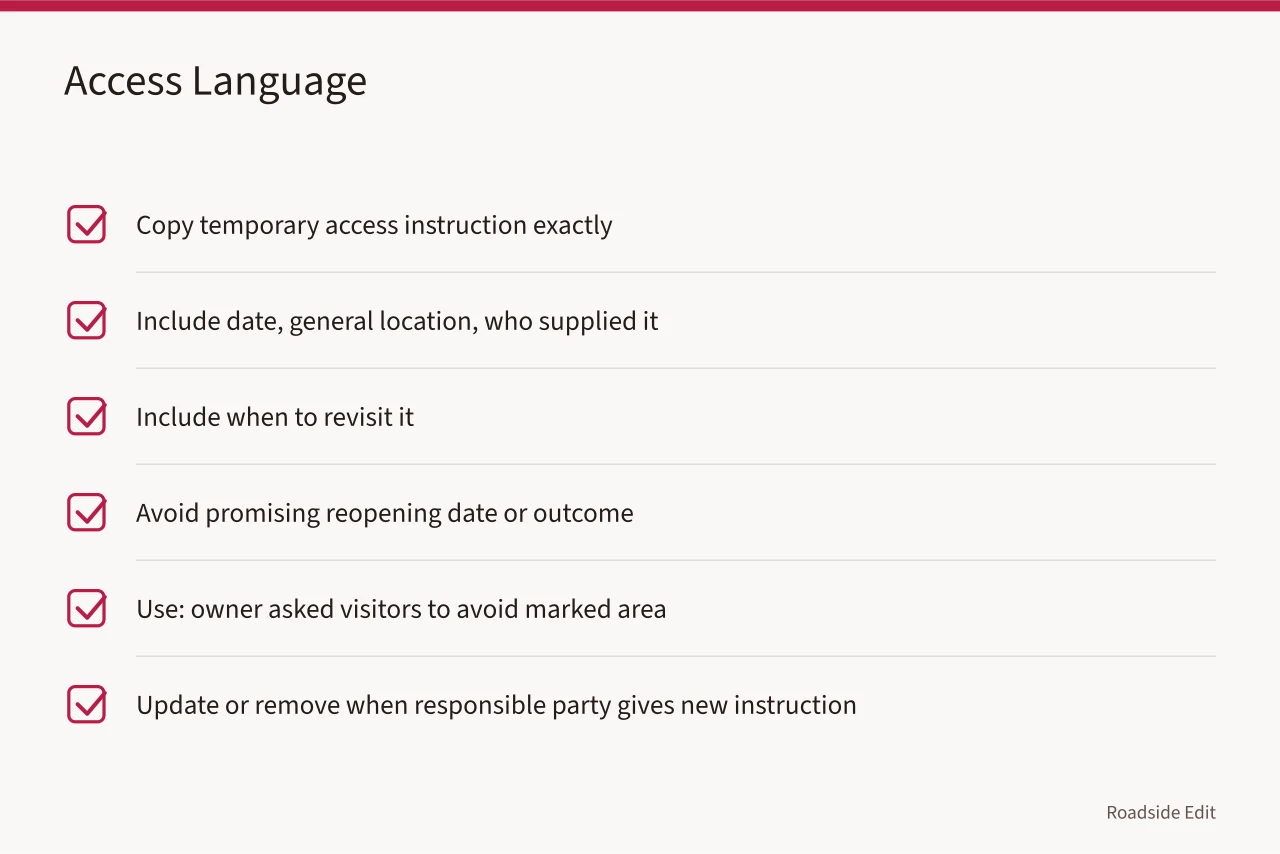
Temporary access instruction: when an owner or responsible party sets one, copy it exactly into the record and include the date, general location, who supplied it, and when to revisit it.
Readers may need to know if a visitor area, sidewalk edge, doorway, or business entrance has a current restriction. They do not need a dramatic account of unverified danger.
Avoid language that promises a reopening date or outcome. A useful notice can say: "The owner has asked visitors to avoid the marked area while a property-specific question is being reviewed." That sentence identifies the source and purpose without claiming a technical conclusion. Update or remove it when the responsible party provides a new instruction.
Create a practical handoff record
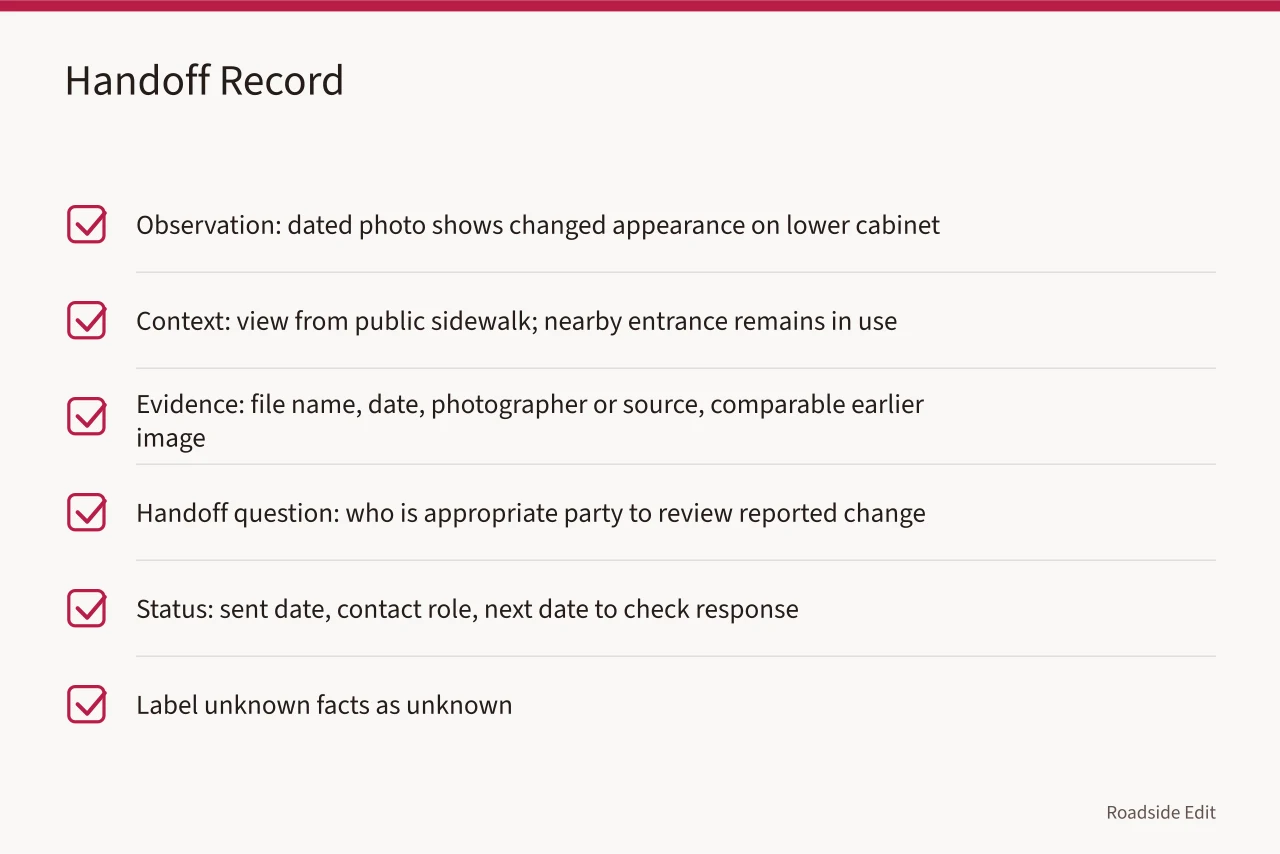
A handoff is a concise question for a person or organization with the right responsibility. The record should say what was observed, attach the relevant photo or source, identify the access context, and ask one answerable question. It is not a request for a generic internet opinion.
| Field | Example of a useful entry |
|---|---|
| Observation | "Dated photo shows a changed appearance on the lower cabinet." |
| Context | "View is from the public sidewalk; nearby entrance remains in use." |
| Evidence | File name, date, photographer or source, and comparable earlier image if available |
| Handoff question | "Who is the appropriate party to review this reported change before public copy is updated?" |
| Status | Sent date, contact role, and the next date to check for a response |
Do not crowd the record with guesses. If a relevant fact is unknown, label it as unknown. That gives an owner, editor, or qualified reviewer a clean starting point and reduces the risk that an assumption becomes part of the public record.
Keep historic interest separate from condition claims
Historic neon signs invite good stories, old photographs, and local memories. These can make an article valuable, but do not use them to infer current operation, ownership, access conditions, or safety.
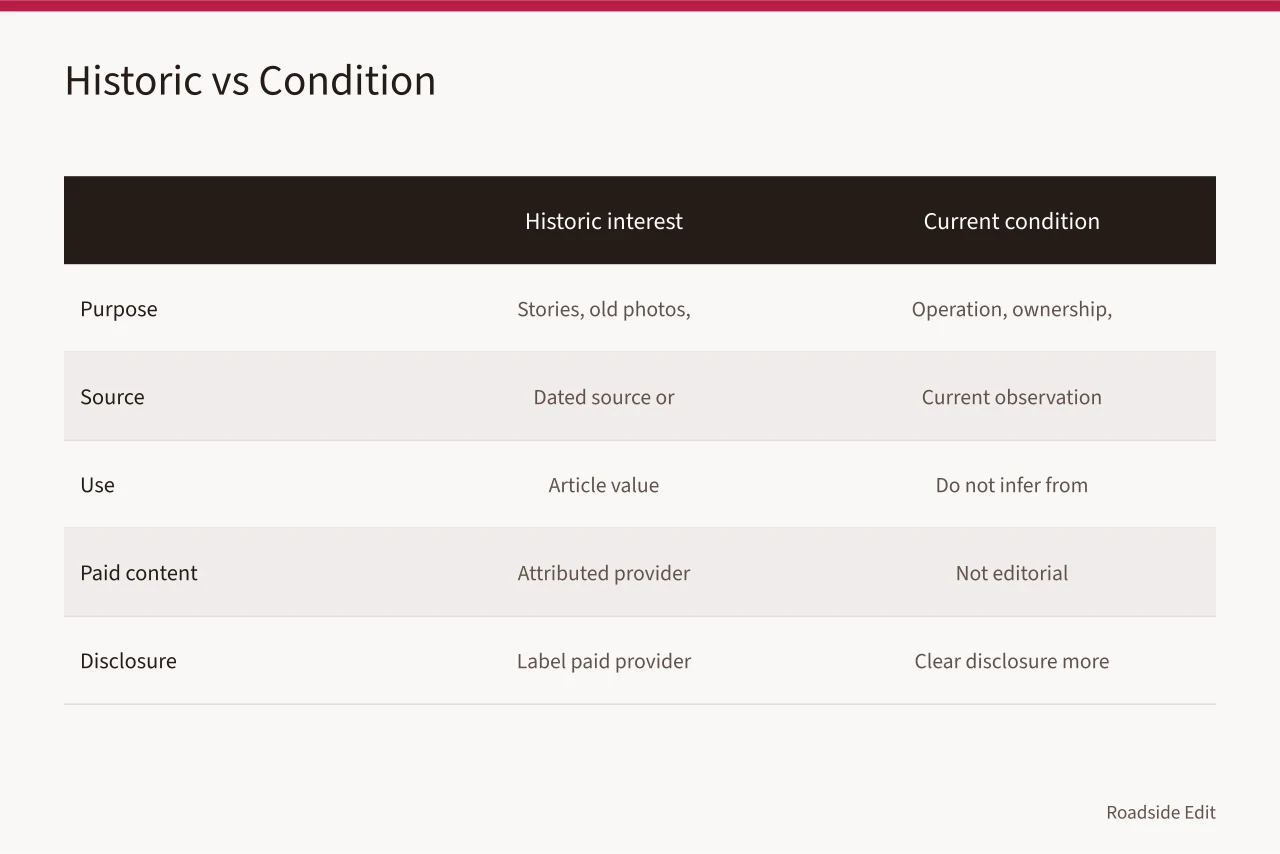
Keep historical sources in one section and current observations in another. If a community member remembers a prior restoration, call it a recollection unless a dated source confirms the details.
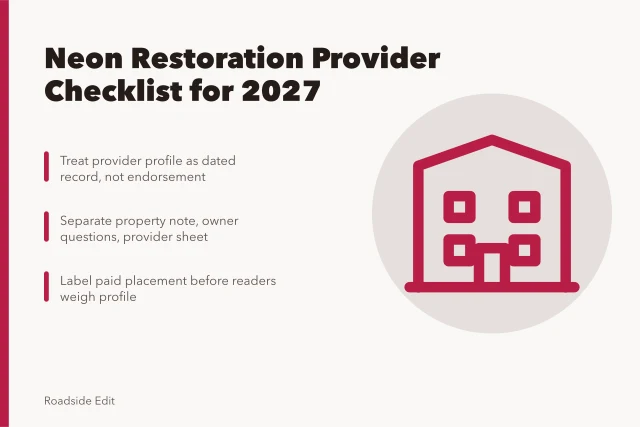
The same separation helps with paid placements. A business may describe its services, current hours, or a project it reports completing. Preserve that as attributed provider information. Do not transform it into an editorial assessment of a specific sign. A clear disclosure is more useful to a reader than an unsupported superlative.
The Federal Trade Commission's endorsement guides address endorsements and testimonials in advertising. They do not establish a sign's safety or history. They support labeling a paid provider profile so commercial information is not mistaken for an independent finding.
Review public content after each material change
When a new record changes a public statement, update it in controlled order. First verify source and date, next adjust the factual sentence only as far as the record supports.
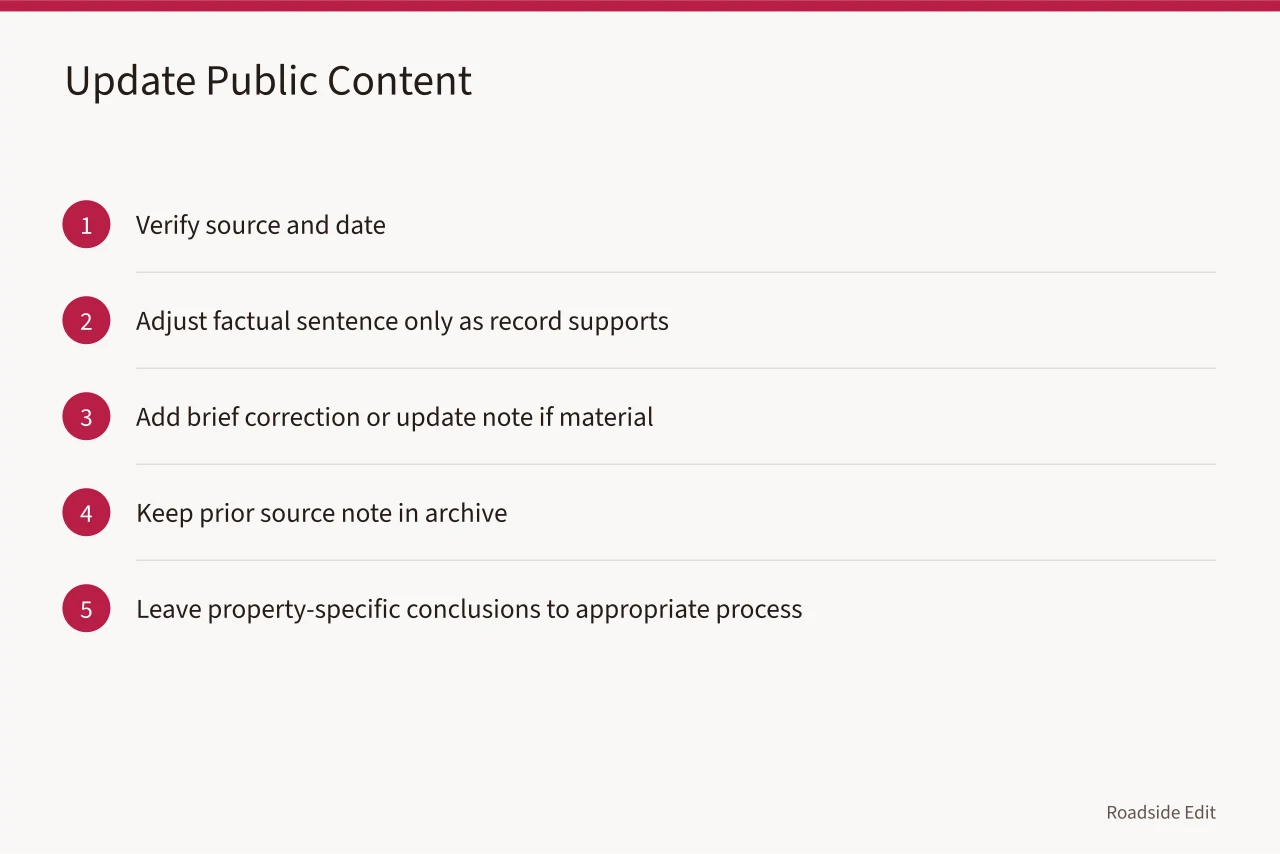
Then add a brief correction or update note when earlier wording was material; keep the prior source note in the archive so a later editor sees why the language changed.
This process supports accuracy without requiring a writer to become a technical reviewer. The writer's job is to state what a source says, identify the limits of that source, and leave property-specific conclusions to the appropriate process.
Maintain a short safety-review schedule
Set dates to review the records, not instructions to perform physical work. At each review, confirm that the owner or site contact is current, temporary visitor messaging still reflects the responsible party's instruction, source links still work, and open questions are either answered or escalated again. Note the reviewer and date.
Keep emergency contact details private unless the responsible party has approved publication. A public article can offer an official business contact or a municipal reporting channel when one is provided. It should not publish a private number, tell a reader to approach equipment, or present a generic guide as emergency advice.
The National Archives personal digital archiving guidance concerns preserving digital files and their context. It is not a safety procedure. It supports retaining the dated source copies, contact-authority notes, and prior public wording needed to make a later correction understandable.
Preserve the limits of the checklist
A checklist should clarify the next responsible step, not make a writer appear more certain than the evidence permits.
Keep a final note of who supplied each instruction, whether it applies to public communication or site work, and next review date. Later staff can update a notice without turning a short-term access message into a permanent claim about the sign.
If the information comes from a sponsor, provider, owner, or community contributor, label the source. This is especially important when a local story is compelling. A reader can appreciate a historic place and still be told honestly what has been confirmed, what is attributed, and what remains unresolved.
Use a calm correction process
Sometimes the record will contain an overstatement. A caption may have implied a cause, an old profile may have treated a provider claim as independent verification, or a temporary access notice may have outlived its purpose. Correct the specific statement, preserve the source that prompted the correction, and date the update. Do not try to cover uncertainty with stronger language.
This approach is useful for a publisher and for an owner. It keeps the page readable while giving a later reviewer enough context to understand the change. It also reduces the chance that an old, attention-grabbing phrase will be copied into a new listicle without its limitations.
Common questions
Is this checklist a substitute for a qualified safety review?
No. It organizes observations, visitor-facing information, and responsible handoffs. It does not evaluate equipment or authorize physical work.
What should a writer do after receiving a concerning photograph?
Keep the original, record its date and source, describe only what is visible, and send a focused question to the appropriate responsible party. Do not diagnose the sign in public copy.
Can an owner publish a temporary visitor instruction?
Yes. Attribute it to the owner or responsible party, state the date, keep the wording narrow, and update it when the instruction changes.
Should a sponsored business profile make safety claims?
Only when a specific, supportable source warrants the exact statement. Provider-supplied information should remain clearly attributed and disclosed.