
Guides
How to research a vintage diner on the National Register of Historic Places
National Register diner research runs through the NPS database, SHPO inventory files and the nomination itself, which settles name, date and boundary.
What to take away
- Three sources settle most diner questions: the NPS database, the State Historic Preservation Office inventory, and the nomination file itself.
- Listing triggers Section 106 review on federal projects and can open federal rehabilitation tax credit eligibility. It does not stop a private owner from repainting enamel or swapping a sign.
- A diner is either individually listed or a contributing resource in a district, and the district nomination may name it in a single paragraph.
- The reference number is the one identifier that survives every operator and franchise name change. Record it.
- A determination of eligibility is not a listing. Say which one you are holding.
What listing actually does to a diner
The National Register of Historic Places is the federal inventory of districts, sites, buildings, structures and objects worth preserving. A diner gets on it through a nomination reviewed by a State Historic Preservation Office and the National Park Service.
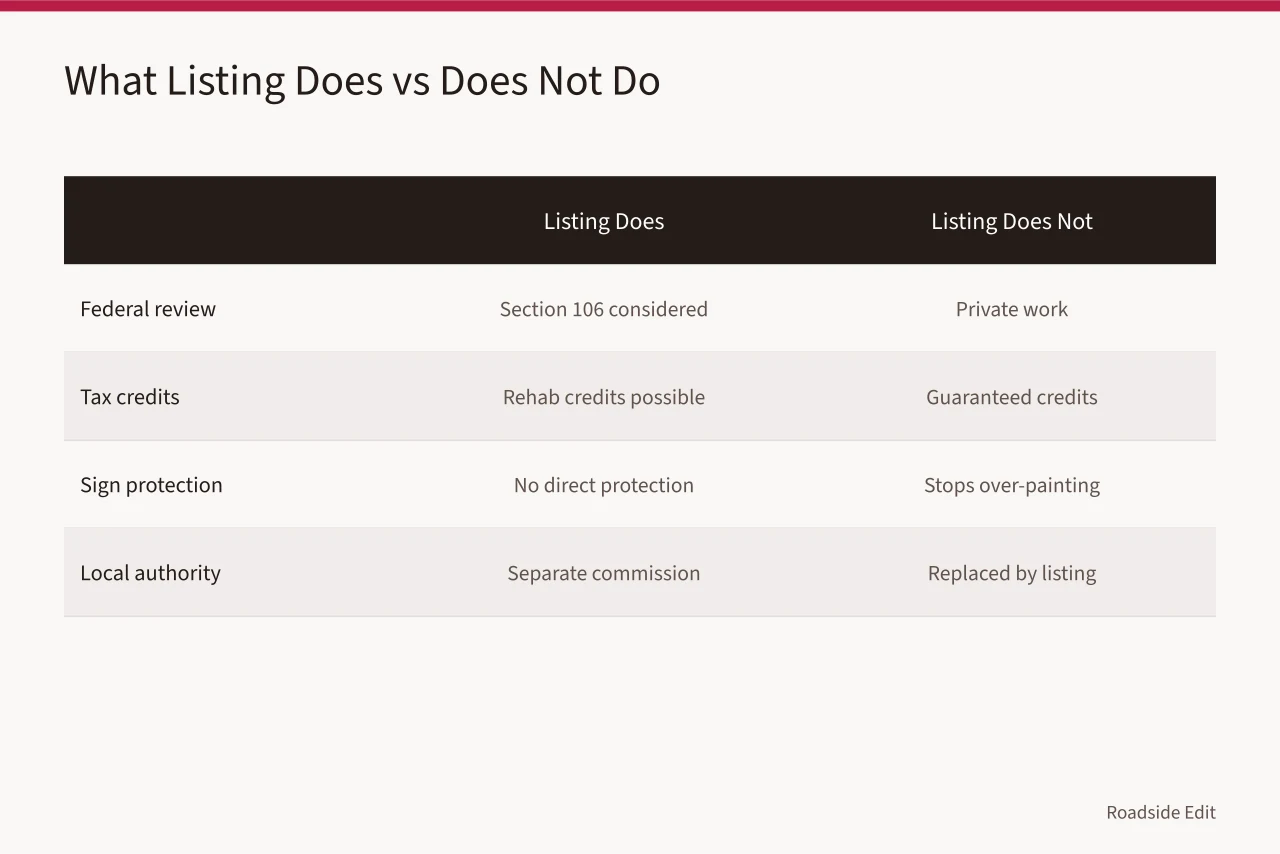
Listing is an honor roll with consequences. Under Section 106 of the National Historic Preservation Act, federal agencies must consider the effects of federally funded, permitted or licensed projects on a listed property. An income-producing diner may also qualify for federal rehabilitation tax credits if the work meets the Secretary of the Interior's Standards for Rehabilitation.
What listing does not do is control private work. Nothing in it stops an owner from over-painting original porcelain enamel, replacing neon with LED, or selling the building. Local historic preservation commissions and design review boards hold that authority, and some towns have no such board at all.
That gap is where most bad diner research starts. A reader finds a listing, assumes the sign is protected, and writes it up that way. Check the local commission as a separate question, and check the adopted ordinance rather than a plaque.
Listing also comes in two shapes. An individually listed diner is named on its own. A diner inside a historic district is a contributing resource, and the district nomination may give it one paragraph or none. Search both ways before you conclude anything.
Searching the NPS database
The National Register database is the fastest starting point. It searches by property name, state, county, city and reference number, and links to nomination documents and photographs for many entries. Begin with the National Register Database and Research pages.
Expect gaps. Older listings were digitized unevenly, and some records carry only a summary. If the diner changed names over the decades, search every version: original operator, later franchise, street address, and the nickname locals actually use.
Here is the order that saves the most time:
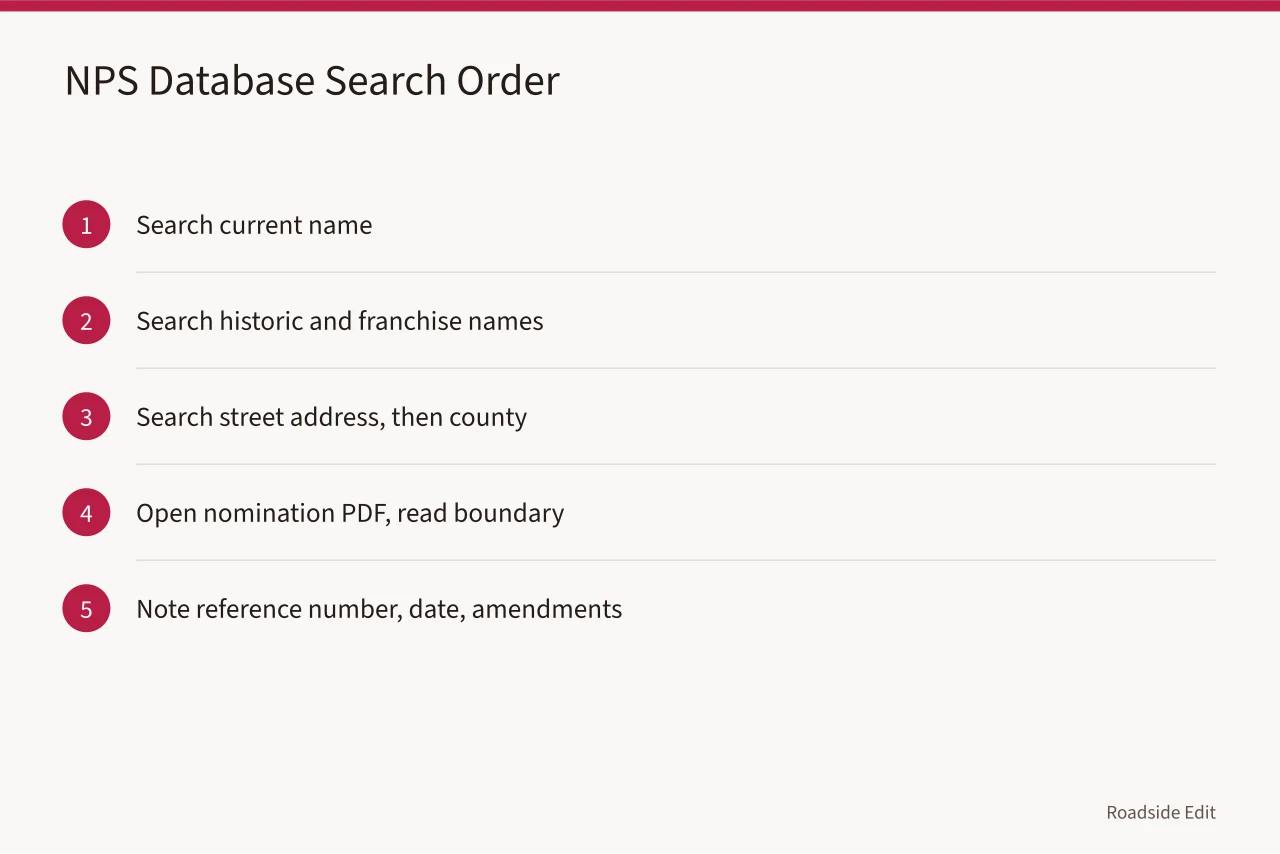
A worked example. You are chasing a 1949 barrel-roof diner in Albuquerque that now trades under a different name. The current name returns nothing. The original operator's surname returns nothing. The street address returns a district nomination listing the building as a contributing resource, with a 1980s survey photograph attached.
That photograph becomes your baseline for sign placement and door configuration. The reference number becomes your citation. It is the one identifier that survives every name change, and it is what a reviewer will check.
If the database returns nothing, do not stop there. Absence from the online database is not proof that a property was never listed, because some records sit only in the state office. The same discipline of dating a building from an old image runs through our guide to Historic Motel Postcards.
Reading a nomination like a researcher
A nomination follows a standard form:
- location
- classification
- description
- history
- significance
- bibliography The description tells you what the diner looked like on listing day. The significance section tells you why it qualified, whether for architecture, commerce, transportation history or association with a person.
The boundary description is the section most people skip. It defines what is actually listed, down to the parcel line or the facade. A canopy added later and sitting outside that line is not covered, no matter what the sign says.
The bibliography is a reading list. It usually names the local newspaper, the county history and the survey that produced the nomination. Follow those leads before you trust a secondary source.
Working the SHPO inventory
Every state runs a historic preservation office, and most keep inventory files on surveyed buildings that were never nominated. The NPS explains how SHPO inventories relate to the National Register. These files are the deep end of diner research.
Inventory records vary wildly by state. California and Texas hold large survey archives with photographs and architectural descriptions. Arizona, New Mexico and Illinois keep county-level files, sometimes on paper only. Pennsylvania and Florida run strong statewide survey programs with online portals. Nevada files thin out outside the big cities.
What to ask the office for:
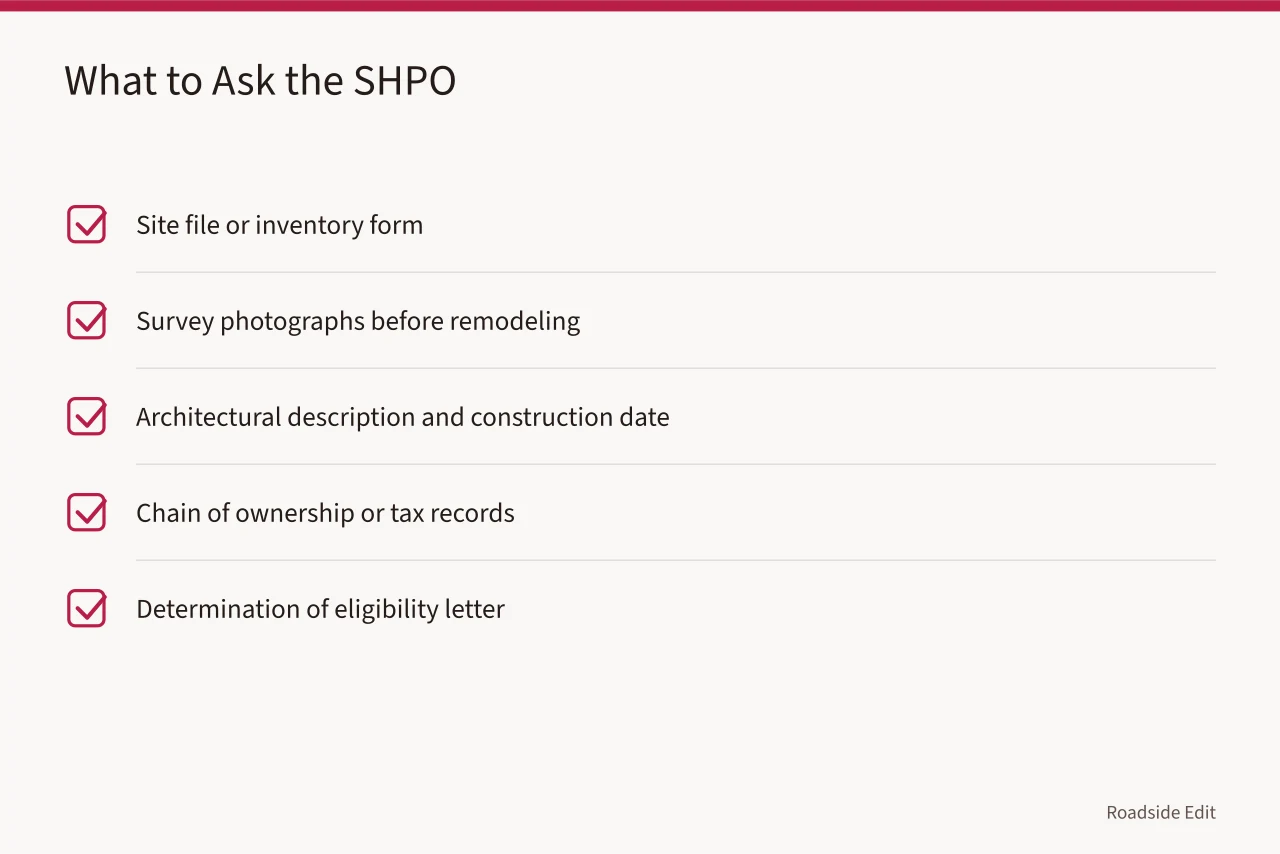
A determination of eligibility is the quiet prize. It means the property was assessed as National Register eligible without ever being listed. That status can trigger Section 106 review on a federal project, and it is worth citing as long as you label it a determination and not a listing.
Call the SHPO rather than relying on email. Staff turnover is high, and the person who knows the county files is often the survey coordinator. Ask whether the office holds a context study on roadside commercial architecture, because those documents frequently date diners by manufacturer and model.
State survey files also carry the vocabulary a nomination needs later. If you write one, the survey file is your evidence base. Treat it with the same care you would give interior documentation, the kind of planning covered in our notes on vintage diner interiors.
What the SHPO file will not settle
It rarely resolves paint colors or sign details. Exterior finishes are a materials question, not a designation question, and we cover period palettes in the guide to Diner Exterior Paint Colors.
Route 66 Corridor Preservation Program files
The NPS Route 66 Corridor Preservation Program covers the old highway's alignment through eight states, Illinois west to California. It awards cost-share grants for planning, preservation and rehabilitation along the route, and diners appear in its project lists regularly.
Program files describe condition and intent. A grant application or final report usually carries a condition assessment, a scope of work and photographs, which is more detail than a nomination form gives you.
How to work the records:
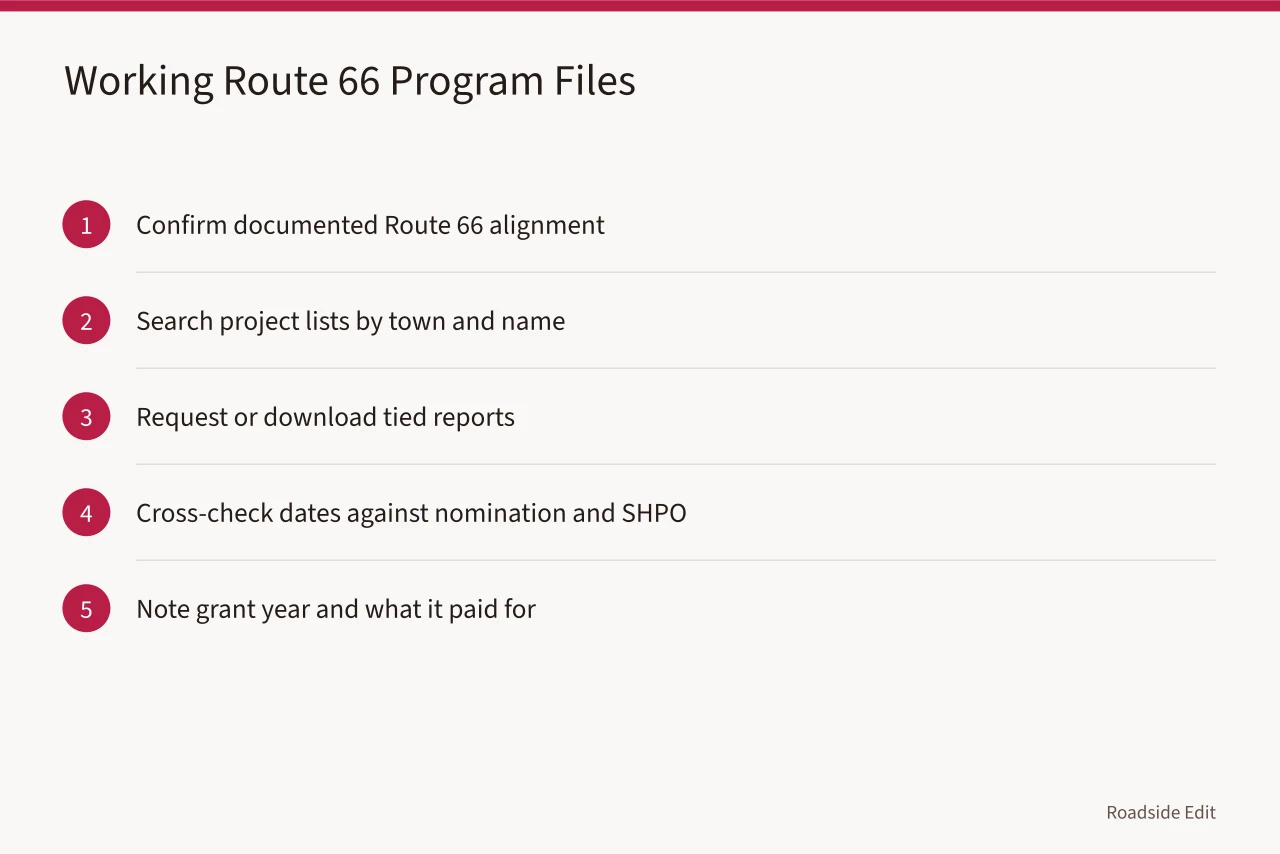
A grant is not a designation. A diner can take Route 66 program money without being listed, and a listed diner may never have touched the program. Keep those two facts apart in your notes.
The program also funds planning documents, interpretive signs and corridor studies. Those studies often name diners that have since closed or been demolished, which makes them the only surviving record of some buildings.
Nomination forms, samples and the weekly list
If you plan to nominate a diner, start with the current National Register Forms. The NPS publishes the nomination form and its documentation standards for photographs and maps. Download the current version rather than working from a photocopy.
Sample Nominations teach faster than any guidance document. The NPS posts successful forms showing how description, significance and boundaries are handled. Find a diner or roadside commercial building and copy its structure, never its wording.
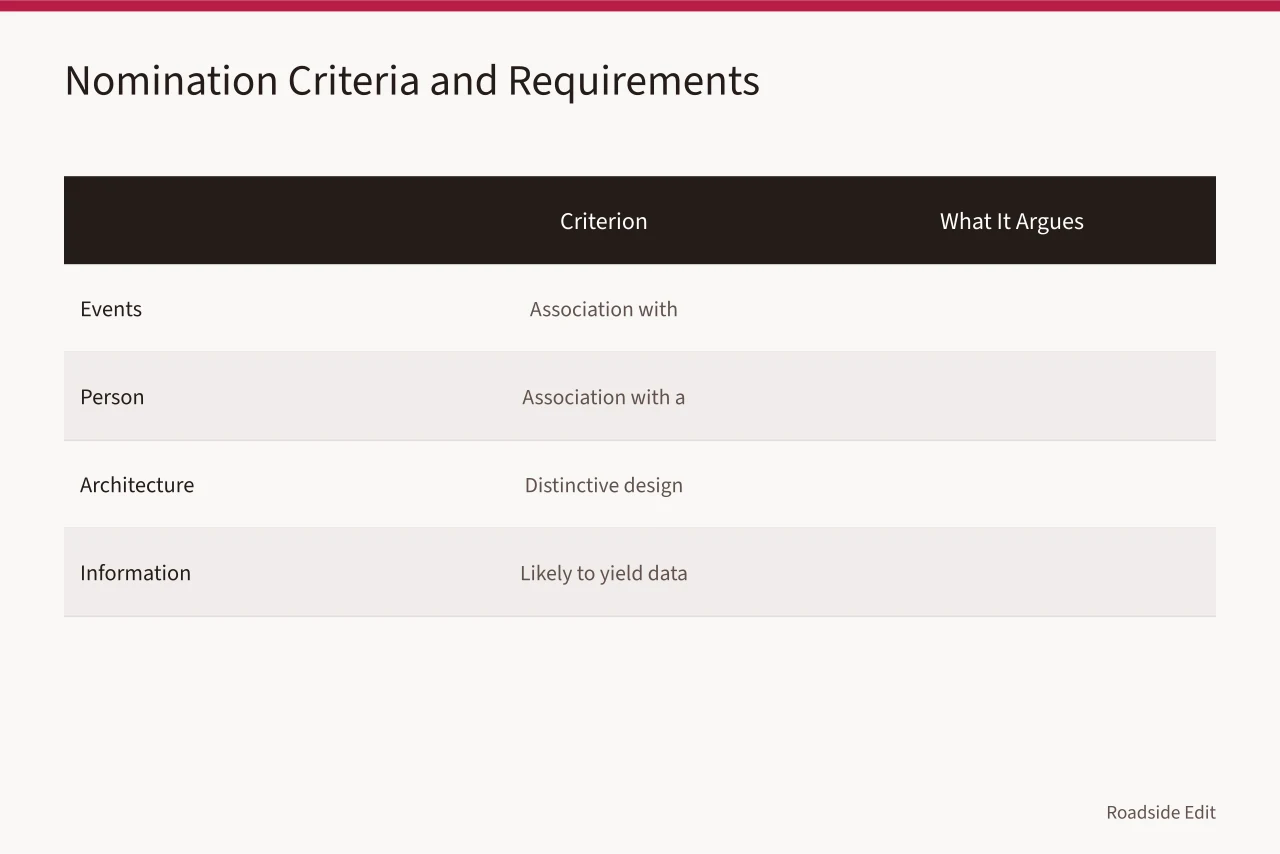
A diner nomination usually argues significance under one or more criteria: association with events, association with a person, distinctive architecture, or the likelihood of yielding information. Most diners qualify under architecture, and many also qualify under commerce or transportation history.
Registration requirements decide close calls. When a diner is nominated as part of a multiple property submission on roadside architecture, that submission sets out what the building must retain. A missing stainless counter can matter more than a replaced roof.
The Weekly List is the current awareness tool, published weekly with state, county and reference number for newly listed properties and eligibility determinations. Skim it for diner, cafe, lunchroom, drive-in and restaurant entries. Read the town names too, because the categories are inconsistent.
Building a citation file
Keep one folder per property: reference number, listing date, nomination PDF, SHPO file notes, weekly list entry. Date every note. This is the discipline of a case study record, and it prevents the common error of citing a listing date from memory.
If you are budgeting research or rehabilitation, treat the archival work as a line item rather than an afterthought. Our notes on the case study method cover how to scope that work before spending on it.
Confirming the history before you cite it
Confirmation means agreement across sources. The nomination, the SHPO inventory and the weekly list should tell the same story about name, date and boundary. When they disagree, the nomination usually wins, but check for amendments first.
A short checklist before you publish or file:
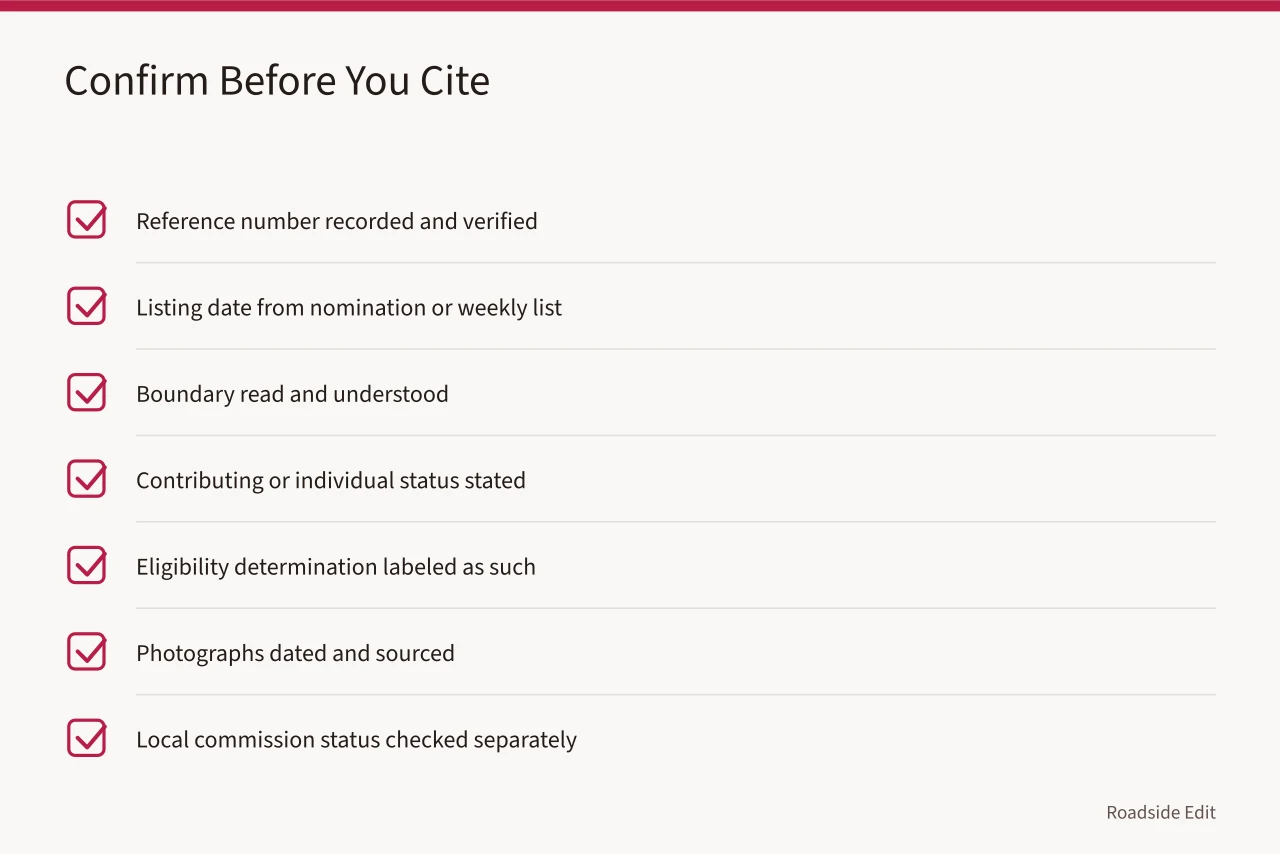
Common traps. A plaque may say "historic" with no designation behind it. A local landmark may be confused with a National Register listing. A district name may appear in an address without the building being contributing. A demolished diner can sit on the register until it is formally removed.
Respect the line between a research finding and a legal conclusion. You can report what the file says. You cannot promise an owner that listing protects the sign. Send that question to the SHPO and the local commission, and let the adopted ordinance answer it.
Common questions
Can I search the National Register database for free?
Yes. The NPS database and its linked nomination documents are open to anyone, with no account needed. Some state files still require a call to the SHPO.
Does listing protect a diner from demolition?
No. Listing triggers review on federal projects and can open tax credit eligibility, but private demolition is governed by state and local law. Confirm the local rules with the commission that adopted them.
What if the diner is part of a historic district?
Then it is a contributing resource rather than an individually listed property. Read the district nomination to see whether your building is named and whether it falls inside the boundary.
Where do I get the nomination form to write one myself?
The NPS publishes the current form and its documentation guidance. Pair it with a sample nomination for a roadside building before you draft anything.