Guides
How to Research Historic Motel Postcards for Restoration Clues
How to research historic motel postcards for restoration clues, from library archives to dealer listings, plus how to date a card and turn it into a brief.
What to take away
- A printed postcard is dated evidence for original signage, paint and rooflines, and it costs nothing to consult.
- Public libraries, state historical societies and university archives hold the deepest runs for Route 66 corridors.
- The printing era of a card, from white border to linen to chrome, narrows a construction date.
- Dealer listings show a sign fast but rarely confirm that it was original.
- Two to three hours per property is enough to match a card against a photograph and an assessor record.
Start with the card, not the building. Most motel projects begin with a site visit and a guess about what the sign once said. Postcards reverse that order. They were printed as advertising, often within two or three years of opening.
What actually differs between the archives
Four kinds of source turn up in this work, and they are not interchangeable. They differ in coverage, in scan quality, and in what they let you do with an image. A general history of the motel building type helps you judge whether a court predates or postdates the card.
Coverage decides the search. Publishers worked town by town, and a local drugstore often paid for the run. That is why the county library, not a national database, frequently holds the best view of a small court.
Filling stations next door sit in the same boxes, and Gas Station Preservation Basics lists which canopy and pump island details one photograph can settle.
The criteria matrix
Build this table before you plan a research trip, because it decides where the first afternoon goes.
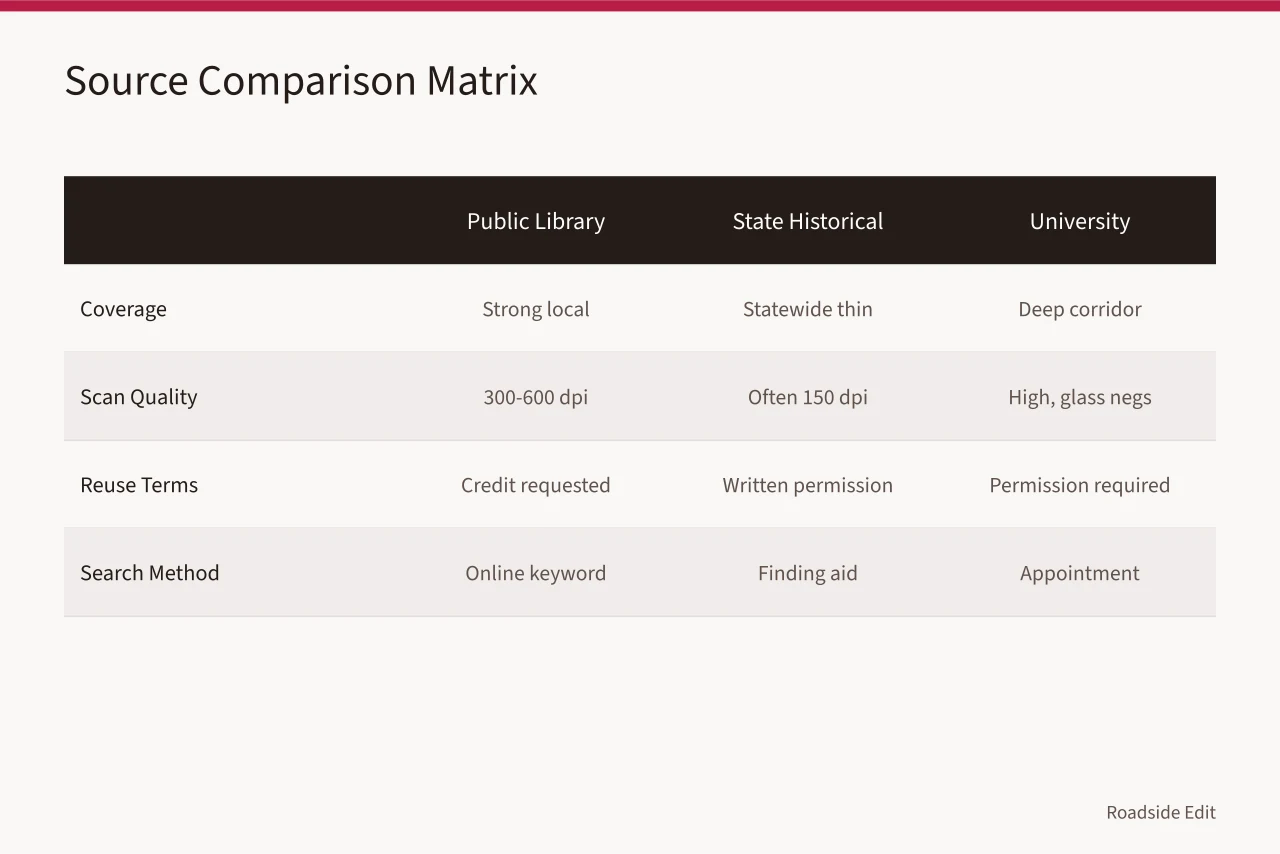
| Source | Coverage of small courts | Scan quality | Reuse terms | How you search it |
|---|---|---|---|---|
| Public library digital collection | Strong for one city or county | 300 to 600 dpi scans | Credit line requested | Online keyword search |
| State historical society | Statewide, thin on rural highways | Mixed, often 150 dpi | Written permission | Finding aid plus archivist |
| University special collection | Deep for one corridor or one photographer | High, some glass negatives | Permission required | Appointment with staff |
| Dealer and auction listing | Random, seller driven | Whatever the seller posts | Unclear | Browsing only |
Where each source is the right answer
A city library is the right answer when the motel stood inside a town limit and you need a first image today. A state historical society wins when you trace one owner across several counties. A university collection is right when you need a sharp scan of a sign face.
Dealer listings suit the day you only need a sign's shape confirmed.
What a card can and cannot show
All four sources share one limitation. Every postcard is a promotional image, and publishers retouched skies, removed power lines and sometimes painted out a rival court next door. A card shows what an owner wanted in 1954. It cannot show what a later owner added in 1972.
Signs are where the gaps bite. When the sign in the card is gone entirely, Neon Sign Restoration Help compares fabricators on tube matching and pattern records.
The dating sequence that works
- Read the back first. A postmark gives you a date, a town and sometimes a publisher code.
- Identify the era from paper and finish, using the overview of postcard production eras to separate linen from chrome stock.
- Compare the roofline and sign to the standing building, and write down every element that has changed.
- Pull the county assessor record and the Sanborn map for the same decade.
- Repeat the check on a second card from a different decade, which catches remodels the first card missed.
Reproducing the view you found
Matching the original camera position turns a card into a comparison tool. Stand where the photographer stood, keep the same height above the road, and frame the sign at the same size. Take one wide shot and three details.
Name the files after the property number, because roadside renovation photography sets out framing and naming that contractors can work from.
Turning the card into a scope of work
Line up the evidence before you brief anyone. Mark the card, the assessor date, the current photograph and the map extract with the same property number. A contractor who receives four dated documents will price the work against the original design, not against the last repaint.
Where the card shows fabric that no longer exists, the National Park Service brief on restoring historic signs covers documentation and compatible replacements.
Common questions
Do I need permission to publish a postcard image? Sometimes. The card may be yours while the image is not. Ask the holding institution for its reuse terms in writing, and keep the reply with the project file.
What if no library holds a card for my motel? Search the nearest larger town and the highway corridor. Small courts were often photographed as part of a strip, so a neighboring property card can still date your building.
Can I date a motel from a card alone? No. Use the card for design evidence and the assessor or Sanborn record for the date, then bring both to the work, as Historic Motel Restoration Help sets out.