Features
Route 66 preservation in eight states compared by climate and state law
Route 66 preservation eight states compared by climate and state law, from desert material survival to freeze-thaw damage and design review rules.
What to take away
- Route 66 preservation eight states compares two decay clocks: desert exposure in Arizona and New Mexico, freeze-thaw cycles in Illinois and Texas.
- Each State Historic Preservation Office sets its own survey, tax credit and review rhythm, so the same repair can take weeks in one state and months in another.
- Design review rules, not climate alone, decide which replacement materials, roof profiles and signs are allowed on a listed building.
- NOAA climate records and National Register data downloads are the two free tools that make a corridor-wide comparison possible.
- Program alternatives under Section 106 can move routine work faster in some states, but only when the state agrees to run them.
Eight states, two very different decay clocks
The Route 66 corridor states span California, Arizona, New Mexico, Texas and Illinois, plus the historic alignments through Kansas, Oklahoma and Missouri. Pennsylvania, Florida and Nevada hold related roadside material, but they sit outside the corridor proper. Each state's climate decides how fast a building fails, and its law decides who gets to say what happens next.
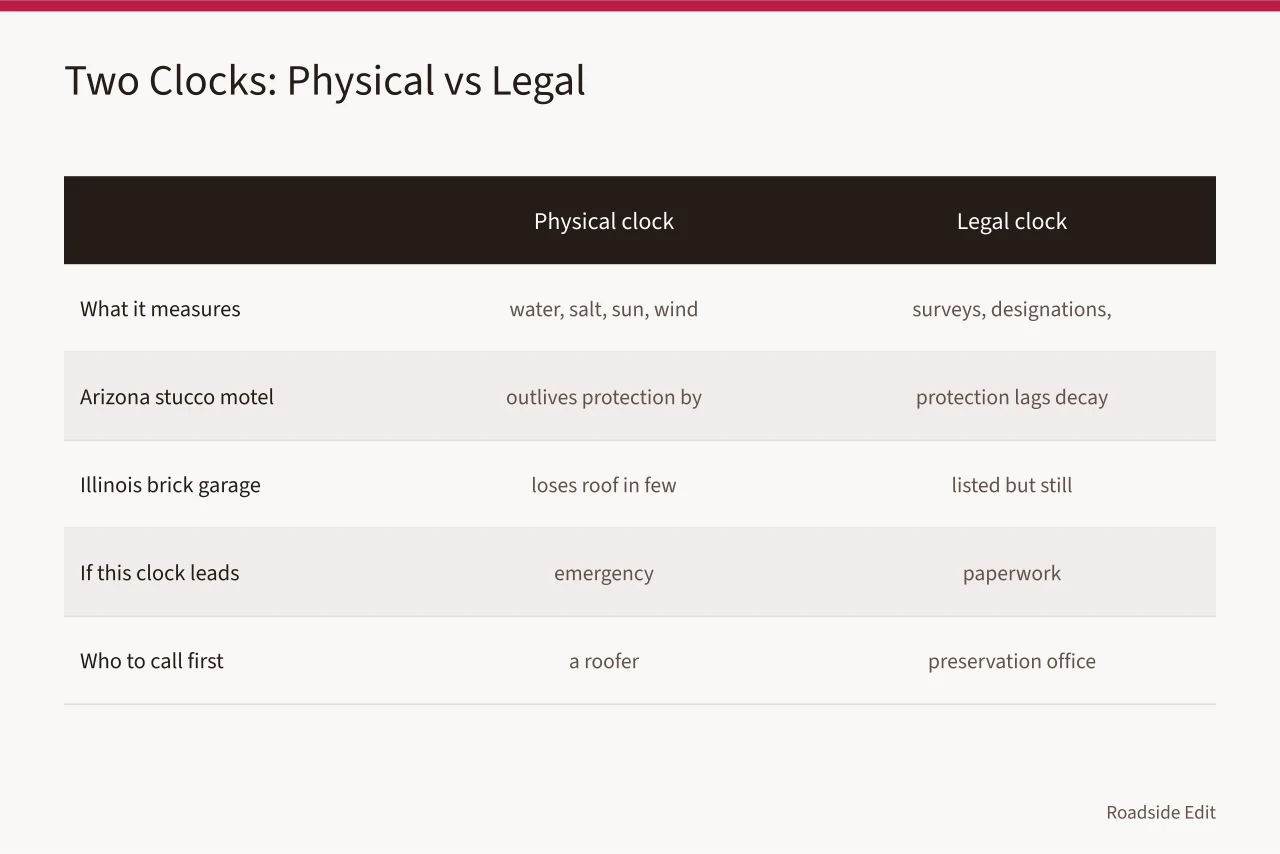
Two clocks run at once. The physical clock measures water, salt, sun and wind. The legal clock measures survey schedules, designations and permits. A stucco motel in Arizona can outlive its legal protection by decades, while a brick garage in Illinois can be listed and still lose its roof within a few winters.
For crews, the practical question is which clock is ahead. If the legal clock is ahead, the work is paperwork. If the physical clock is ahead, the work is emergency stabilization, and every state handles emergency work differently. Knowing which clock leads tells you whether to call a preservation office first or a roofer.
A single corridor strategy rarely survives contact with state lines. Documentation photographers learn to shoot the same building type twice: once for the record, once for the review board. Advocates learn to read state statutes before they read the Secretary of the Interior's Standards.
The Route 66 corridor also crosses tribal lands and several climate zones, which is why a corridor-wide condition survey has to be assembled town by town rather than state by state.
Desert material survival in Arizona and New Mexico
Arizona and New Mexico share a dry regime with wide daily temperature swings. Stucco, adobe, stone and terracotta survive well when water stays out. The same materials fail quickly once a roof leaks, because evaporation pulls salts to the surface and spalls the finish.
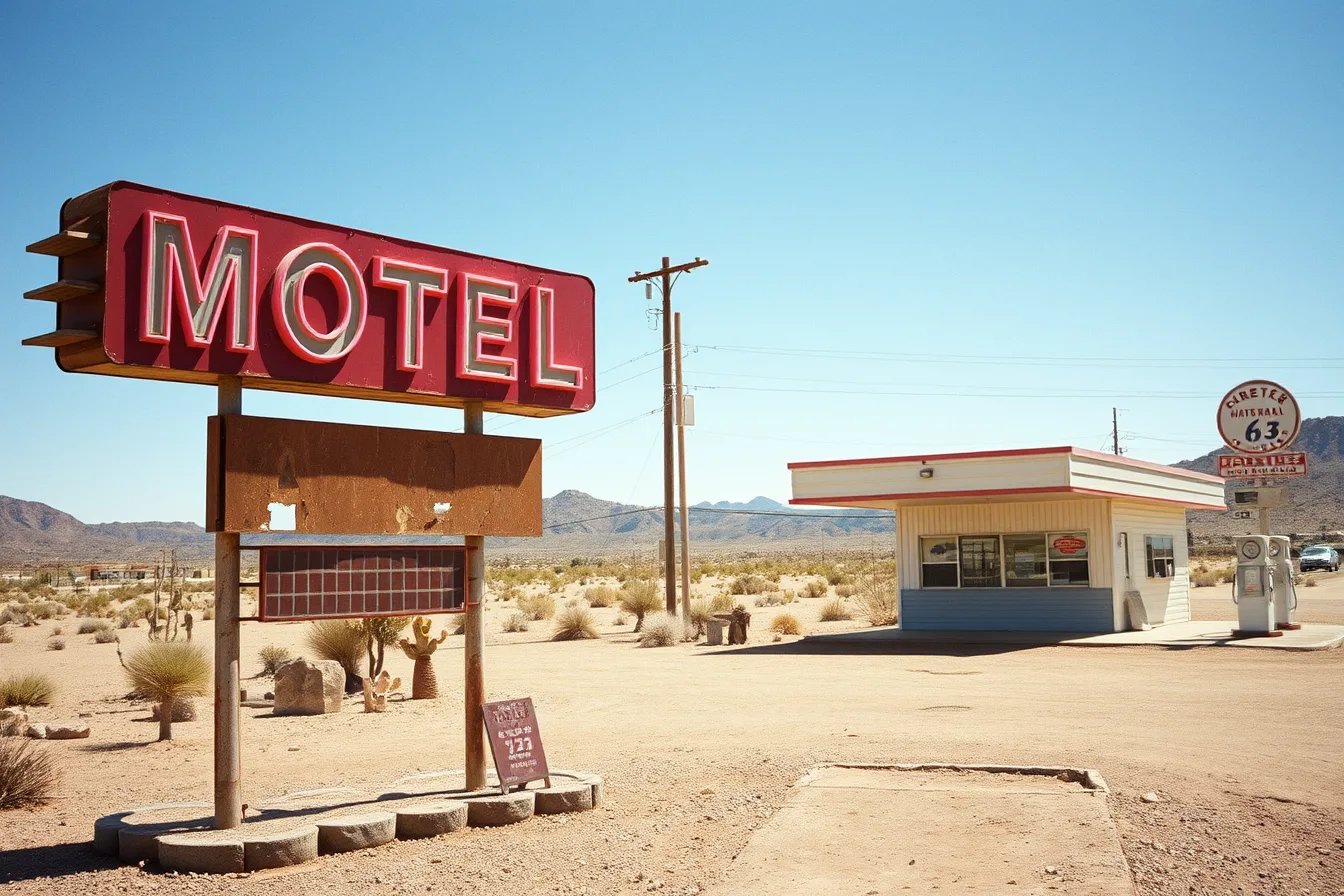
Sun is the quiet destroyer. Ultraviolet light breaks down asphalt shingles, paint films and rubber seals on windows. Metal signs fade from the top edge down. Neon tubing holds up better than its transformers, which cook in unvented cans.
Dust and sandblast abrasion strip protective coatings from concrete and stone. At the same time, low humidity slows rot and corrosion, so steel trusses and wood framing often outlast their desert finishes. A 1930s motor court can keep its original wood structure while losing three roofs.
Adobe needs a sacrificial coating renewed on a cycle, not a permanent seal. Cement stucco over adobe traps moisture and accelerates failure. Preservation crews in both states usually return to mud plaster or lime, and they time the work to the dry season.
Because rain arrives in short, intense events, drainage matters more than total rainfall. A single monsoon can undercut a foundation that survived years of sun. Roof scuppers, parapets and site grading are the highest-value interventions in this climate.
Material choices here echo the regional adaptation questions that gas station owners face when a canopy and a small office building age at different rates.
Freeze-thaw damage in Illinois and Texas
Illinois and Texas both deliver freeze-thaw damage, but on different schedules. Northern Illinois sees many cycles in a single winter. The Texas Panhandle and north Texas see fewer cycles, often with rapid warming, which can be worse for saturated masonry.
Water enters brick, stone and concrete, freezes, expands and pushes the surface off. Repeated cycles open joints, crack lintels and heave flatwork. Salt used on sidewalks and parking aprons adds a second attack through crystallization.
Illinois roadside buildings often carry clay brick, limestone and concrete block. Each has a different tolerance. Soft historic brick spalls fast when a hard modern mortar traps moisture. Lime mortar lets the wall breathe and is usually the correct repair.
Texas adds expansive clay soils, which move foundations with moisture changes. A building can survive freeze-thaw and still crack from soil movement. Foundation repairs and masonry repairs must be sequenced, or the new mortar cracks with the next wet season.
The practical rule in both states is to stop water first. Gutters, downspouts, flashing and roof membranes do more for a historic building than any surface treatment. Only after drainage is corrected does repointing make sense.
A two-day Illinois Route 66 loop shows how quickly these conditions change along a short stretch of the corridor.
How each State Historic Preservation Office shapes the work
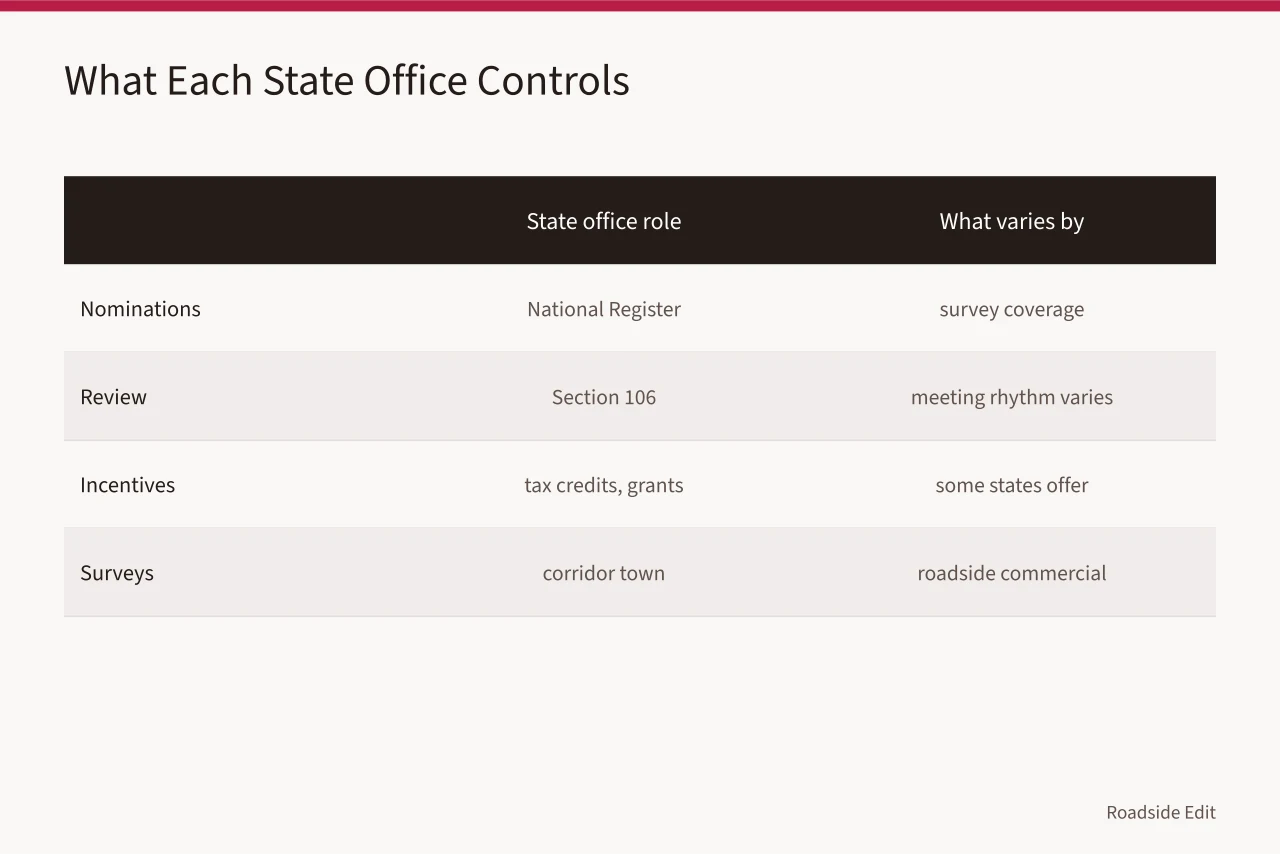
Every state runs a State Historic Preservation Office, usually inside a state historical society, department of natural resources or state historic preservation agency. These offices nominate properties to the National Register, administer survey programs and review federal undertakings under Section 106.
The National Park Service publishes a current list of State Historic Preservation Offices - National Register of Historic Places (U.S. National Park Service) for all fifty states, which is the fastest way to confirm contacts before a corridor project begins.
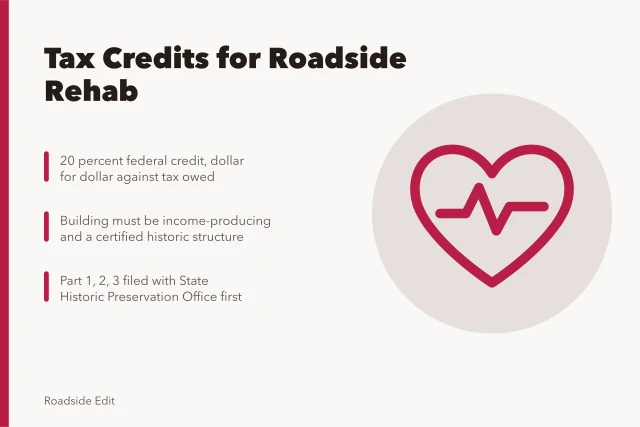
State rules differ in ways that change schedules. Some states offer state historic tax credits that require a certified rehabilitation and a state review. Others offer grants tied to preservation easements. A few offer neither, leaving federal programs and local commissions as the only tools.
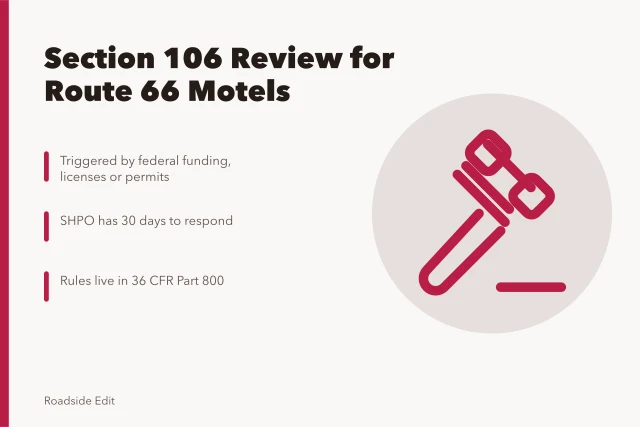
Section 106 applies when federal money, permits or licenses are involved, including some transportation projects along Route 66 alignments. The review process follows federal rules, but the state office runs the consultation and sets the meeting rhythm.
Survey coverage also varies. Some states have detailed historic resource surveys for corridor towns. Others have broad inventories that miss roadside commercial buildings entirely. Where survey data is thin, documentation photographers fill the gap before a demolition permit appears.
Design review boards and local commission rules
Local historic preservation commissions and design review boards decide most visible changes on designated buildings. Their authority comes from state enabling legislation and local ordinances, not from the National Register listing itself.
The Advisory Council on Historic Preservation advises on this division of power and maintains guidance on Advising on State and Local Legislation | Advisory Council on Historic Preservation for communities writing or revising their rules.
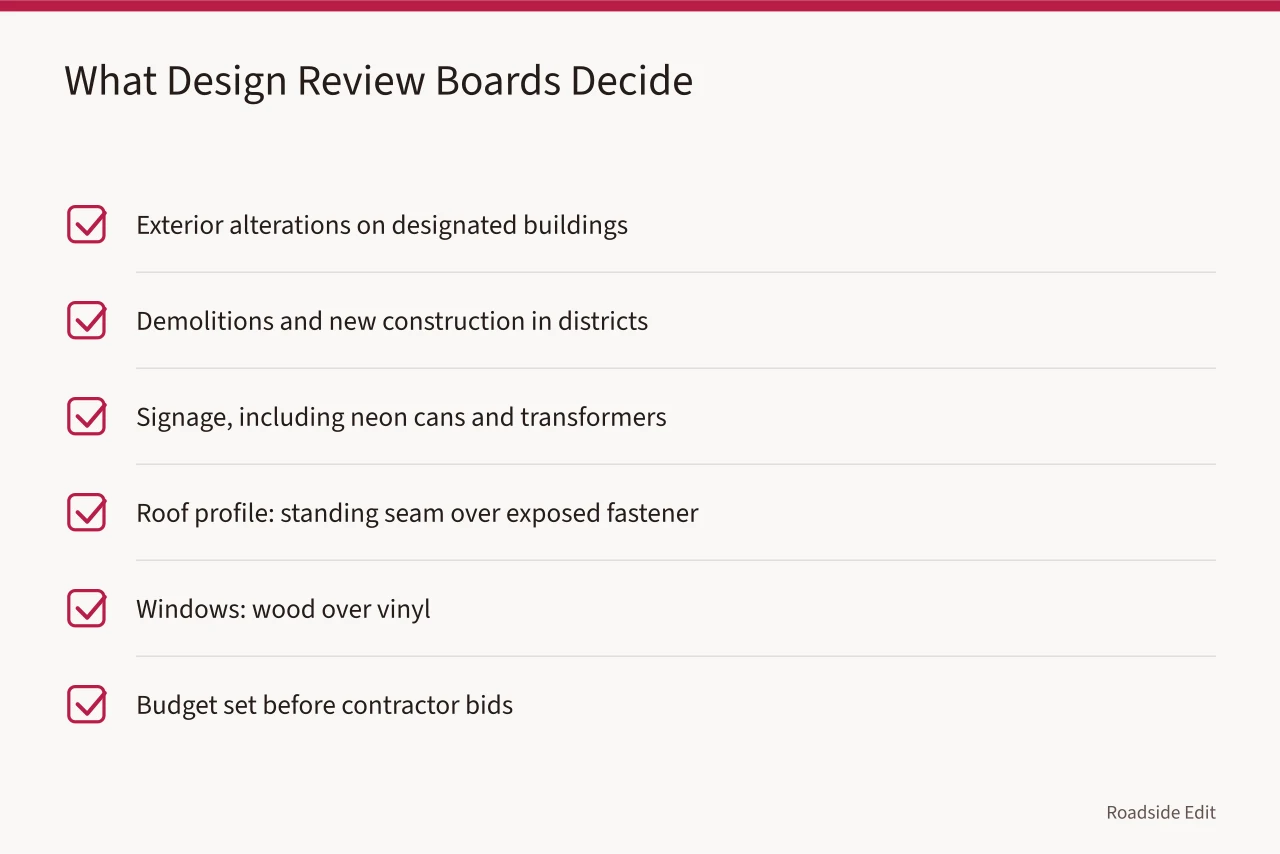
A design review board typically reviews exterior alterations, demolitions, new construction in a district, and sometimes signage. Standards vary from strict to advisory. Some boards apply the Secretary of the Interior's Standards directly. Others use local design guidelines written for a specific district.
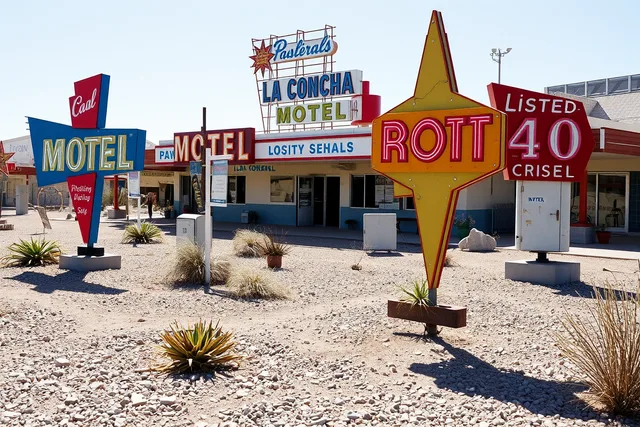
Signs are a common flashpoint. A neon sign may be protected as a contributing feature, while a modern replacement panel is not. Boards often approve repair of original cans and transformers while rejecting new plastic faces.
Roofs, windows and awnings come next. A board may require a standing-seam metal roof profile instead of exposed-fastener panels. It may require wood windows over vinyl. These decisions set the budget before a contractor bids.
For projects that span several towns, the regional scope of each commission's rules needs to be mapped before design begins. A single sign package can pass in one town and fail in the next.
Climate data sources for comparing corridor conditions
The National Oceanic and Atmospheric Administration publishes climate data, normals and outlooks that let crews compare conditions across states. Use Climate | National Oceanic and Atmospheric Administration to pull temperature, precipitation and freeze data for specific corridor locations.
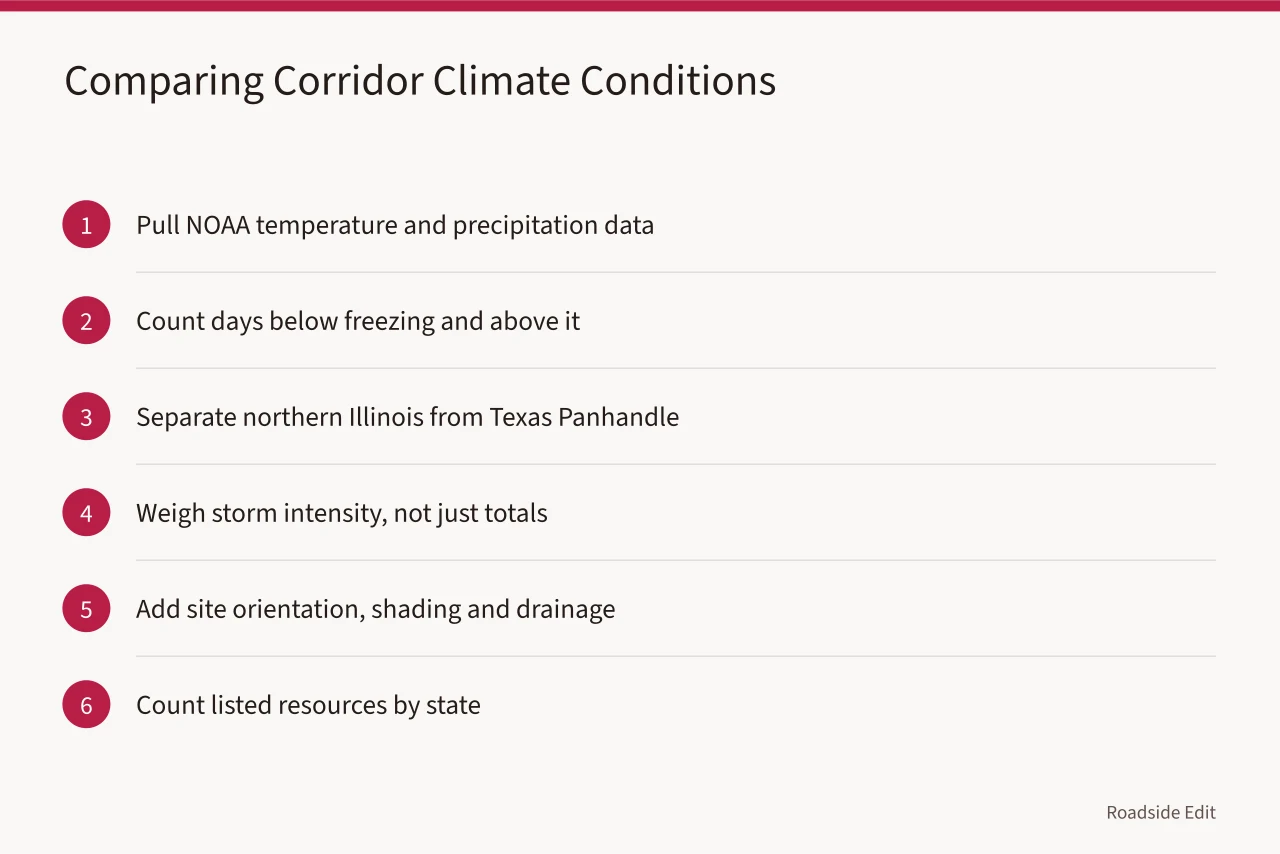
Freeze-thaw cycles are not always published directly. A workable proxy is counting days when the minimum temperature falls below freezing and the maximum rises above it. That count, run for several winters, separates northern Illinois from the Texas Panhandle.
Precipitation intensity matters as much as totals. Short, intense storms drive water into masonry in Arizona and New Mexico. Long, repeated wet and freeze periods drive it in Illinois. Texas can see both patterns in the same year.
Sun exposure and wind add variables that climate summaries rarely capture at building scale. Site-level observations, photographs and simple sensors fill the gap. Documentation photographers can record orientation, shading and drainage in the same visit as the building survey.
Listing data is the other half of the comparison. The National Park Service provides Data Downloads - National Register of Historic Places (U.S. National Park Service) so advocates can count listed resources by state and by resource type.
What changes when a state runs a program alternative
Section 106 usually requires case-by-case consultation. A program alternative replaces that with an agreed process, such as a programmatic agreement, a standard treatment or a state-specific protocol.
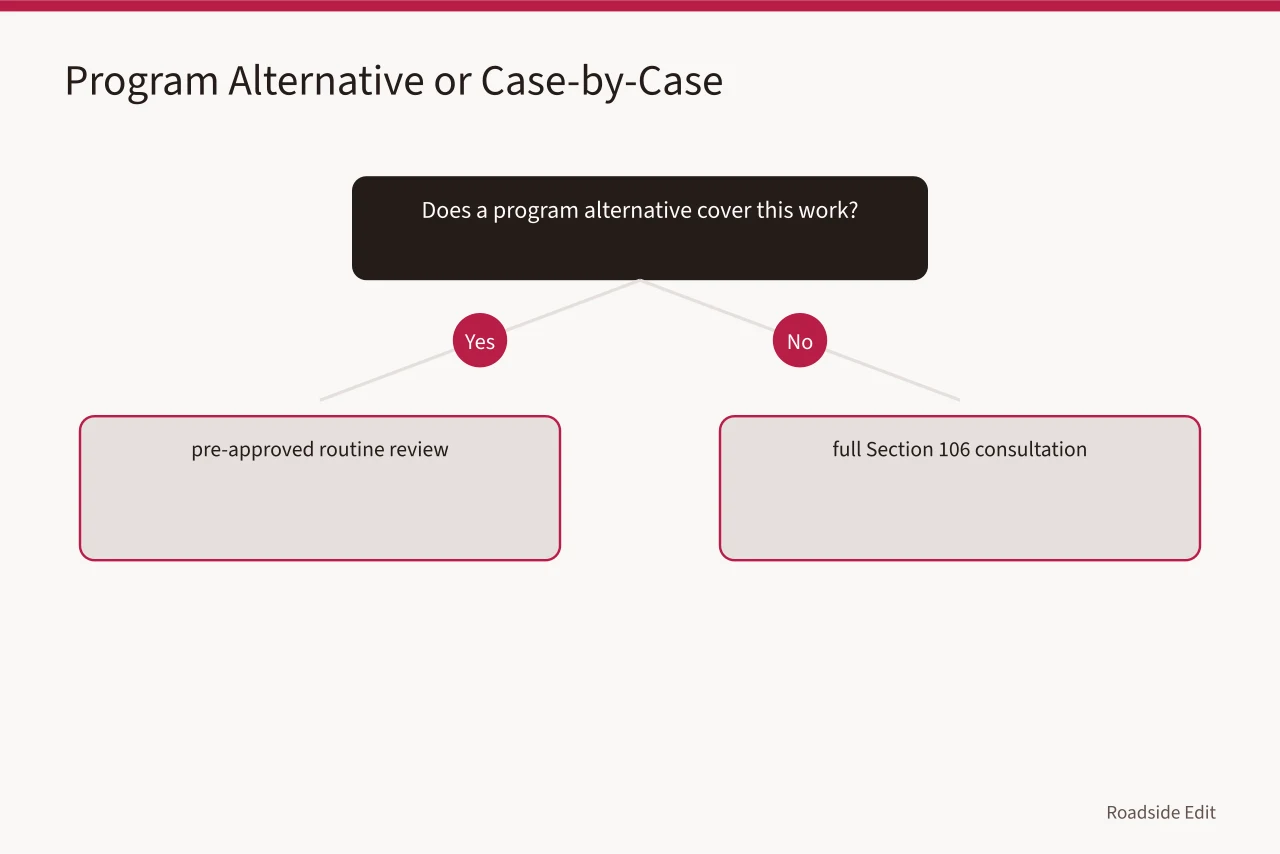
The Advisory Council on Historic Preservation explains these tools in Program Alternatives | Advisory Council on Historic Preservation. For corridor work, the payoff is predictable review for routine projects like sign replacement, roof repair or small additions.
Not every state uses them. Where a program alternative exists, a repeated repair can move through a pre-approved process. Where it does not, each project starts from scratch, which slows crews and raises costs.
Program alternatives also shift authority to the state office, which must have the staff to run them. A state with a strong office and clear protocols can approve routine work quickly. A state with a thin office may prefer case-by-case review.
For multi-state owners, this is the single biggest legal variable. The same repair can be routine in one state and a full consultation in another. Mapping that difference before design starts is cheaper than discovering it at bid time.
A worked example: one 1950s motor court, three states
Consider a 1950s motor court with a brick office, wood-frame cabins, a flat roof and a neon sign. The same building faces three different futures depending on where it stands.
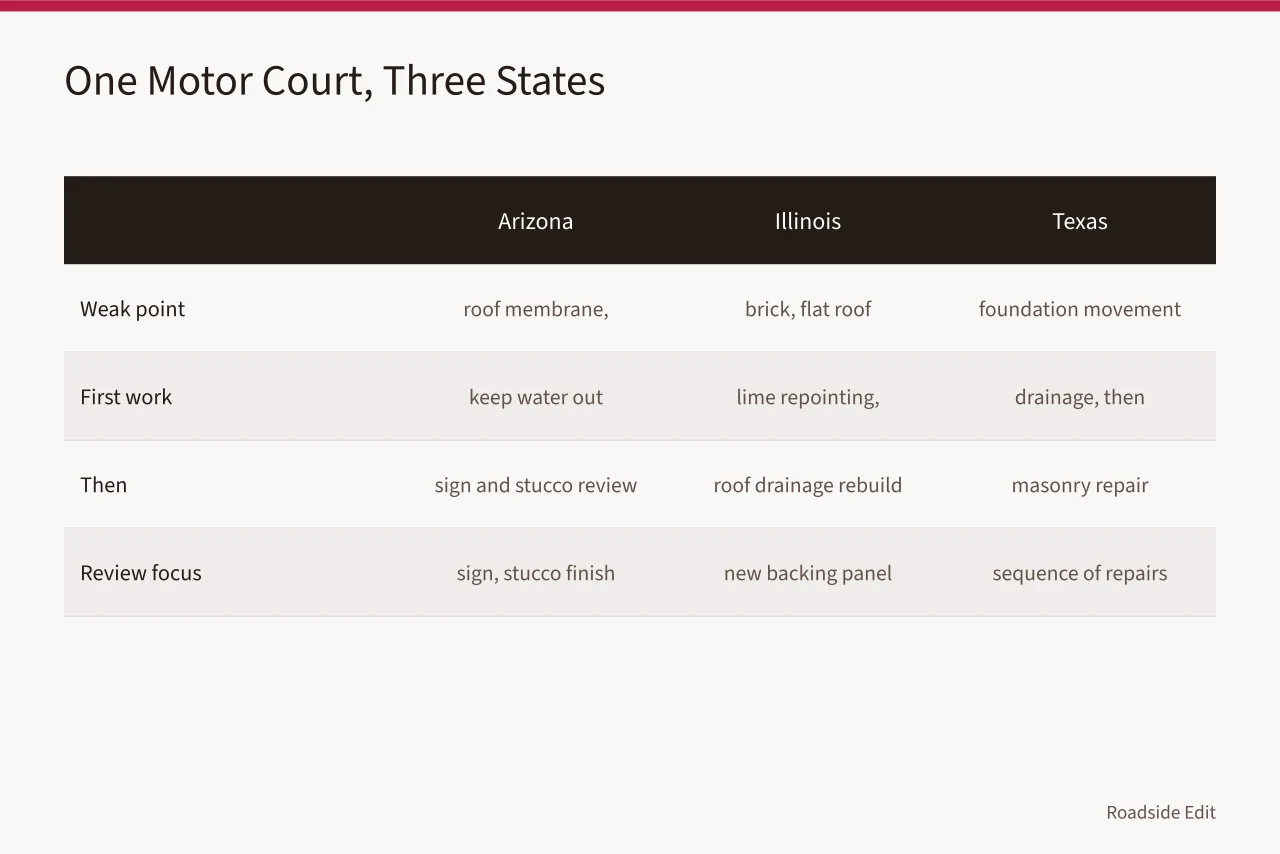
In Arizona, the roof membrane and the sign transformer are the weak points. The brick and wood survive if water stays out. Design review focuses on the sign and the stucco finish.
In Illinois, the freeze-thaw cycle attacks the brick and the flat roof. Repointing with lime mortar and rebuilding the roof drainage come first. The sign may be protected, but the board will review any new backing panel.
In Texas, foundation movement may precede masonry repair. The sequence is drainage, foundation, then masonry. Skipping a step wastes money, because the next wet season reopens the cracks.
Across these states, the legal steps differ as much as the physical ones. A survey may exist in one town and not the next. A tax credit may cover part of the work in one state and none in another.
Planning a historic motel restoration across regions means building this comparison into the schedule, not treating it as an afterthought.
A short checklist before you start
- Confirm the State Historic Preservation Office contact and current nomination status.
- Pull NOAA climate data for the specific town, not the state average.
- Check whether a local design review board has jurisdiction over the property.
- Identify whether a program alternative covers the type of work planned.
- Document existing conditions with photographs before any repair begins.
- Confirm mortar, roof and window specifications against the Secretary of the Interior's Standards.
- Sequence drainage and structural work before cosmetic finishes.
Common questions
Which states does the Route 66 corridor actually cross? The historic corridor runs through Illinois, Missouri, Kansas, Oklahoma and Texas. Its western half continues through New Mexico, Arizona and California. Related roadside material also survives in states outside the corridor, including Pennsylvania, Florida and Nevada.
Why compare Arizona and New Mexico with Illinois and Texas? They represent the two dominant decay regimes on the corridor. Desert exposure preserves structure while destroying finishes. Freeze-thaw cycles attack masonry and roofs directly.
Do State Historic Preservation Offices all work the same way? No. Their authority comes from state law, so survey schedules, tax credits, review timelines and staffing differ. The National Park Service maintains the current contact list for all states.
Can a design review board block a repair that the state office approves? Yes, if the property sits in a local historic district. Local ordinances can be stricter than state or federal review, and they often cover signs, roofs and windows.
What is a program alternative under Section 106? It is an agreement that replaces case-by-case consultation with a defined process, such as a programmatic agreement or standard treatment. It can speed routine work where a state has adopted one.
Where can I get data to compare listings across states? The National Park Service publishes National Register data downloads that can be sorted by state and resource type. NOAA provides the climate side of the comparison.