Guides
How to plan a historic motel restoration across regions in 2027
Historic motel regional planning guidance for 2027 helps teams organize climate evidence, property records, decision limits, and locally qualified review.
Regional planning gives a historic motel a way to organize what may differ by place: climate patterns, local infrastructure, jurisdictional rules, available records, and community context. It does not turn a map, a weather summary, or a national source into a conclusion about one property.
This guide is about building an evidence trail. It helps owners and editors identify what is known about a region, what needs local confirmation, and who should answer a property-specific question.
What to take away
- Start with a defined region and a stated reason for using it.
- Keep regional context separate from property evidence.
- Record uncertainty about climate, use, code, and infrastructure instead of smoothing it over.
- Pair historic-character documentation with any discussion of possible adaptation.
- Give every regional claim a date, source role, and limitation.
Define the regional question
Do not begin with "What should this motel do?" but instead ask a narrower question: "What regional information is relevant to future planning for this defined property?"
Possible topics include precipitation, heat, wind, coastal exposure, and wildfire. They may also include water, utility access, local regulation, or none; record the topic before selecting a source.
The National Park Service says resilience planning for historic buildings should evaluate actual risk, document the property, consider historic character, and balance technical and economic feasibility. Review NPS guidance on natural-hazard resilience. This supports a planning framework. It does not identify an actual risk or approve an adaptation for a particular motel.
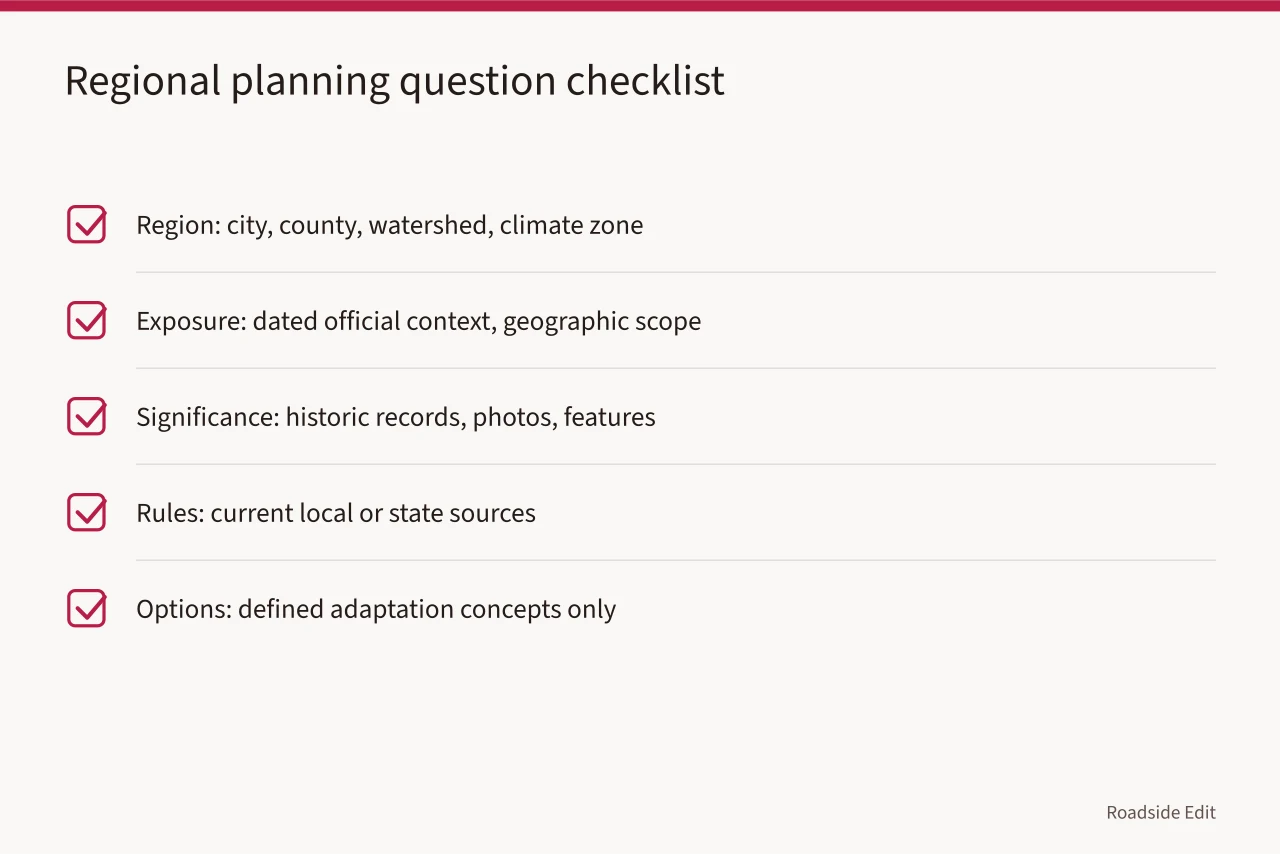
| Planning question | Evidence to collect | Do not infer |
|---|---|---|
| What region is relevant? | City, county, watershed, climate zone, or service area source | A property condition |
| What exposure is described? | Dated official context and geographic scope | A future loss at the motel |
| What makes the motel significant? | Historic records, photos, and feature descriptions | A treatment choice |
| What rules may apply? | Current local or state sources and qualified review | Compliance from a general guide |
| What could be considered? | Defined alternatives and their source limits | A recommended project |
Build two separate evidence files
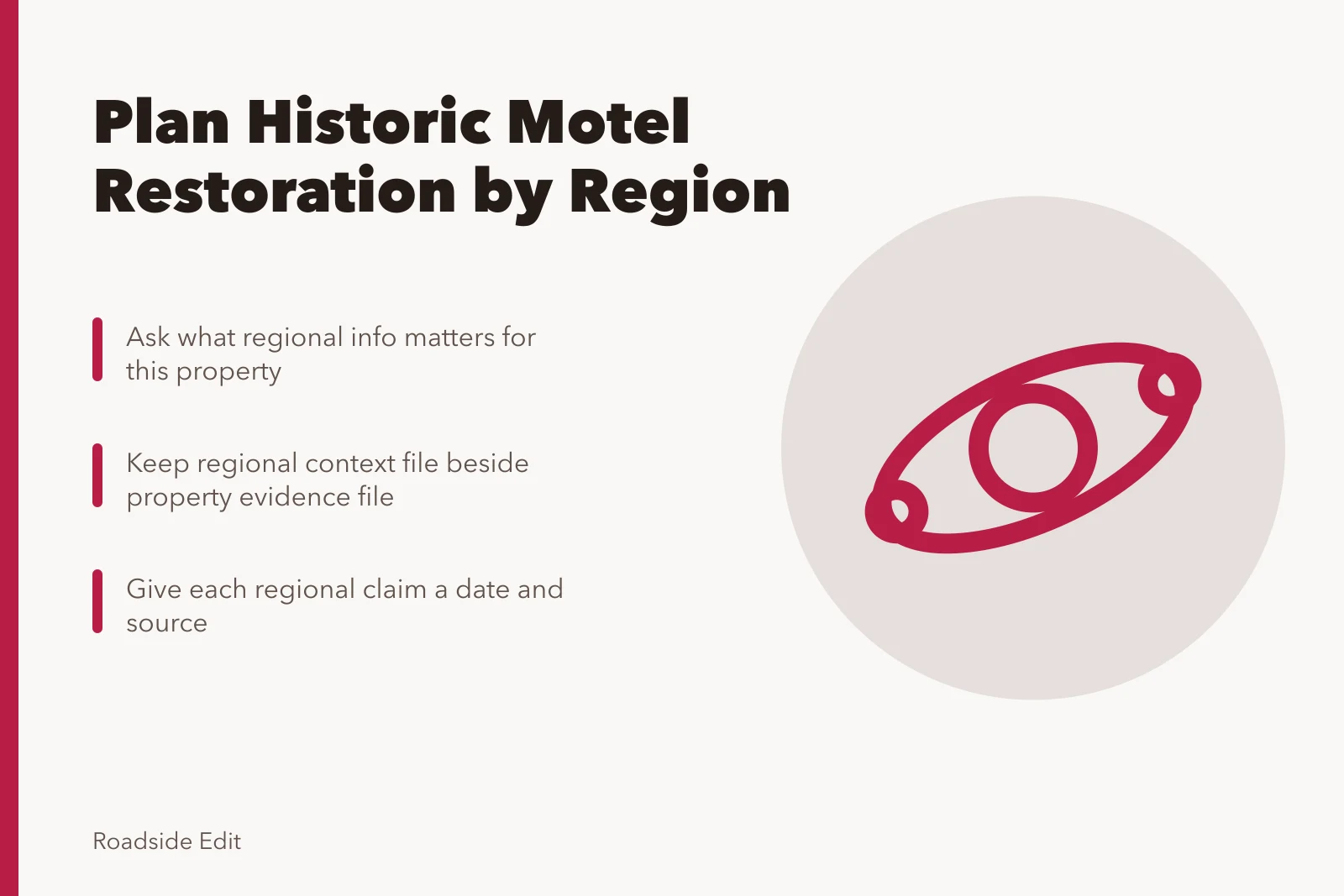
Keep a regional context file beside a property evidence file. The regional file may contain official climate material, disaster-planning pages, utility context, maps, and local planning records. The property file may contain dated photographs, drawings, reports, documented work, and notes about known historic features.
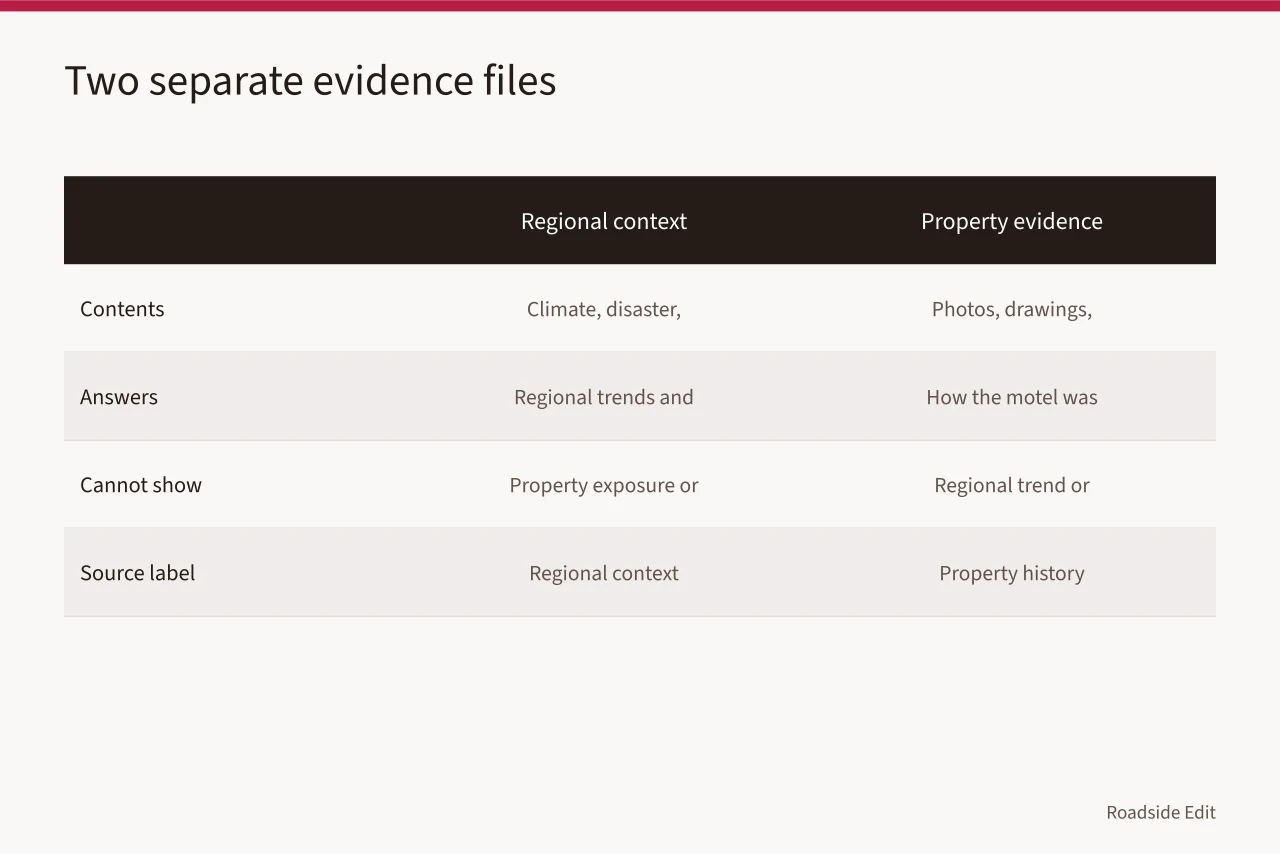
These files answer different questions. A regional source may explain that some communities prepare for a certain kind of event. It cannot show how the motel was built, whether it has experienced an event, or what work is appropriate. A property photograph may show a feature at a date. It cannot establish a regional trend.
Use a source label:
- Regional context
- Property history
- Current observation
- Regulatory source
- Decision record
- Work record
If a source does not fit a label, leave it out until its role is clear. This one small control prevents articles from borrowing authority from the wrong type of material.
Compare region and property without merging them
A regional plan is a comparison exercise. It should not assume that every feature reacts the same way or that every part of a state, county, or city faces identical conditions.
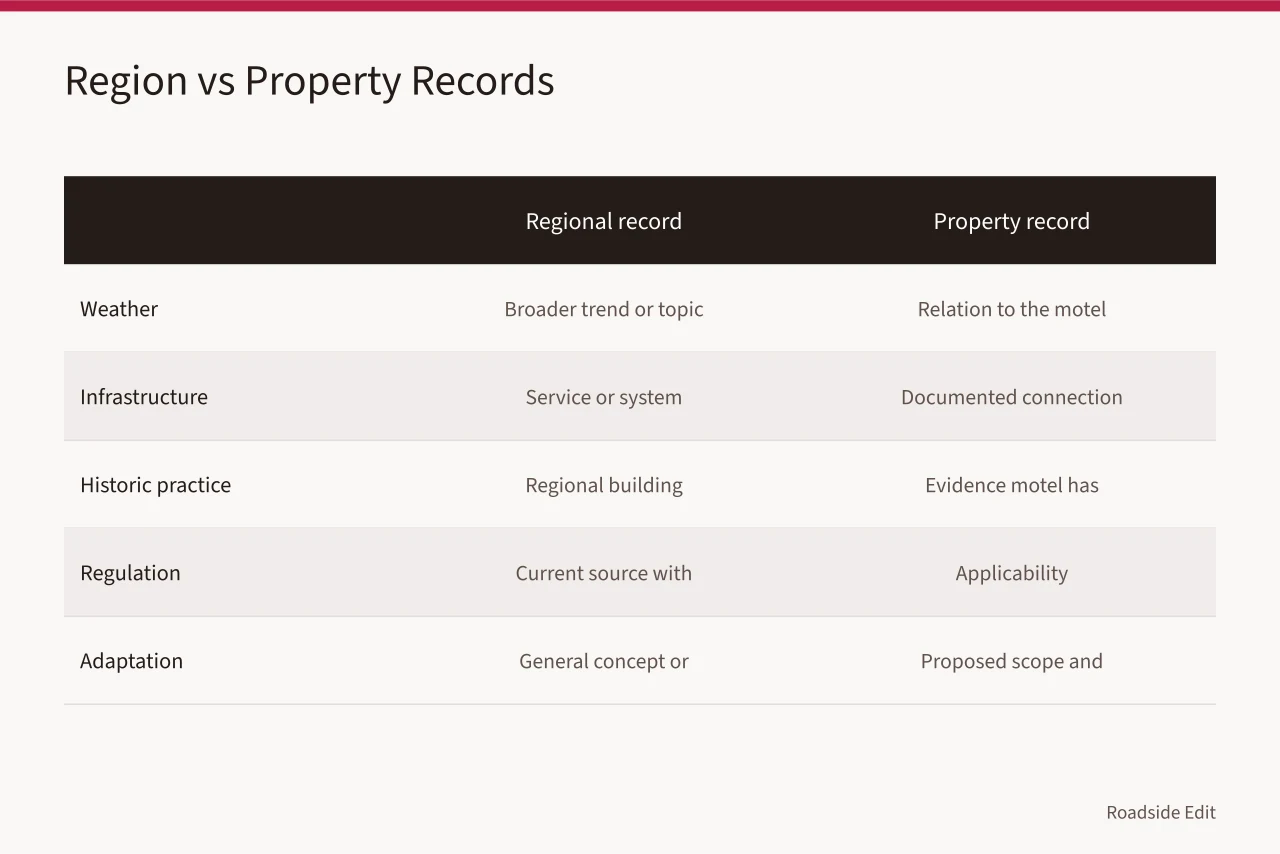
| Item | Regional record can say | Property record must show |
|---|---|---|
| Weather pattern | A broader trend or planning topic | How, if at all, it relates to the motel |
| Infrastructure | Service, planning, or public-system context | A documented connection to the property |
| Historic practice | A regional building tradition or example | Evidence that the motel has that feature |
| Regulation | A current source with geographic scope | Applicability confirmed for the project |
| Adaptation option | A general concept or studied alternative | A proposed scope, review, and decision |
Use plain language for the gap. "The regional source does not establish property exposure" is a useful sentence. It protects the page from making a confident leap and tells the next reviewer exactly what evidence is still needed.
Keep historic character in the decision record
Regional adaptation should not begin with an abstract list of improvements. Begin by documenting the spaces, materials, features, and visual qualities that give the property its recognizable character. The record does not need to decide which features are significant in a formal sense. It should simply preserve what the available sources identify and note where verification is missing.
Then list the planning question next to the character record. For example, an article can say that a future regional planning question exists for a sign, roofline, room block, or entry. It should not claim that the feature must be altered or that a particular approach would preserve it. Those are property-specific decisions.
This sequence also helps when an agency, consultant, business, or future owner joins the project. They can see the starting evidence and the question it was meant to answer rather than treating an old blog post as a complete plan.
Organize regional input by time horizon
Some information matters now, some needs seasonal review, and some belongs in a longer planning file. Label the time horizon instead of pretending every source has the same urgency.
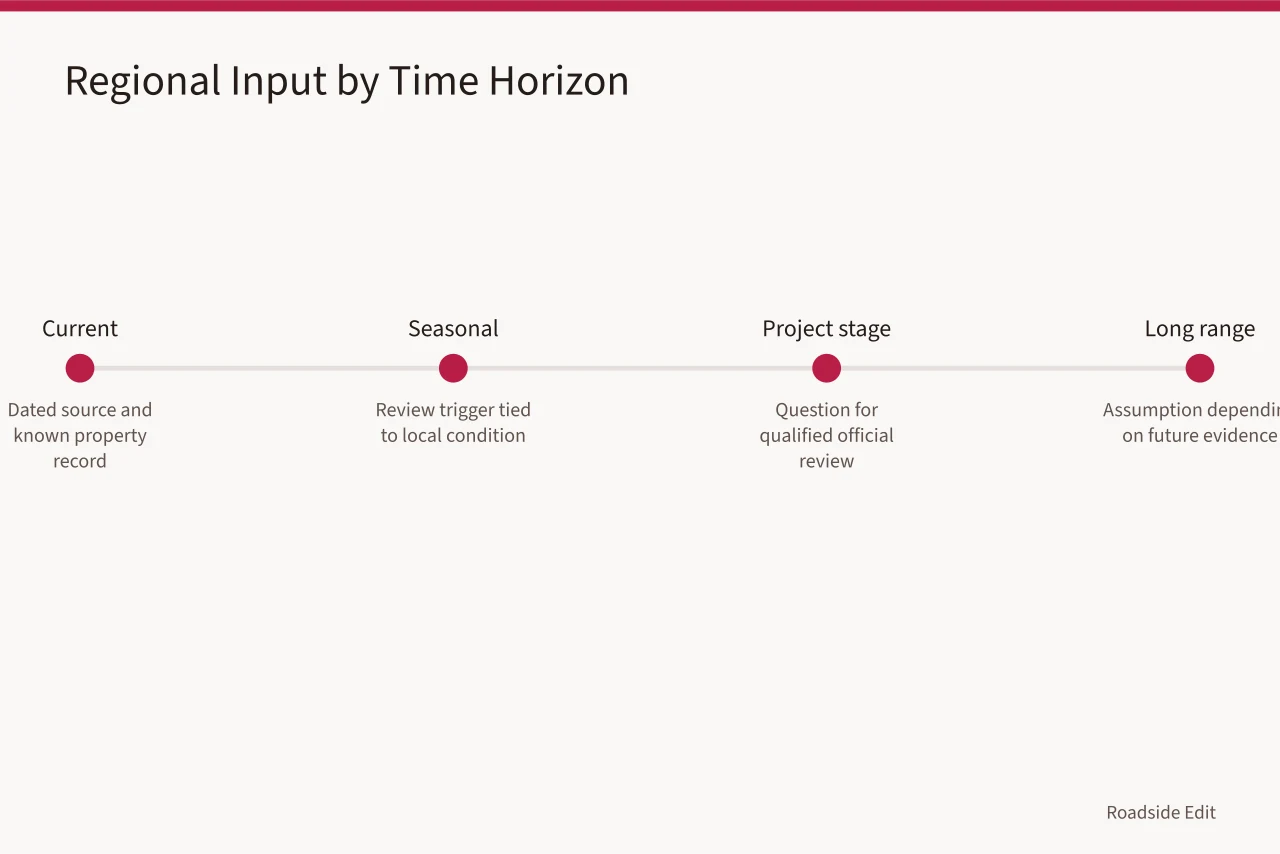
| Time horizon | What to record | Example status |
|---|---|---|
| Current | Dated source and known property record | Context documented |
| Seasonal | A review trigger tied to a local condition | Review scheduled |
| Project stage | Question for qualified or official review | Decision pending |
| Long range | Assumption that depends on future evidence | Monitor and update |
Do not attach a universal timetable to a regional source. An individual property may need a different process because its use, materials, records, and local requirements are different.
Make a decision note, not a recommendation
When a team decides to investigate an option, write a decision note with five parts:
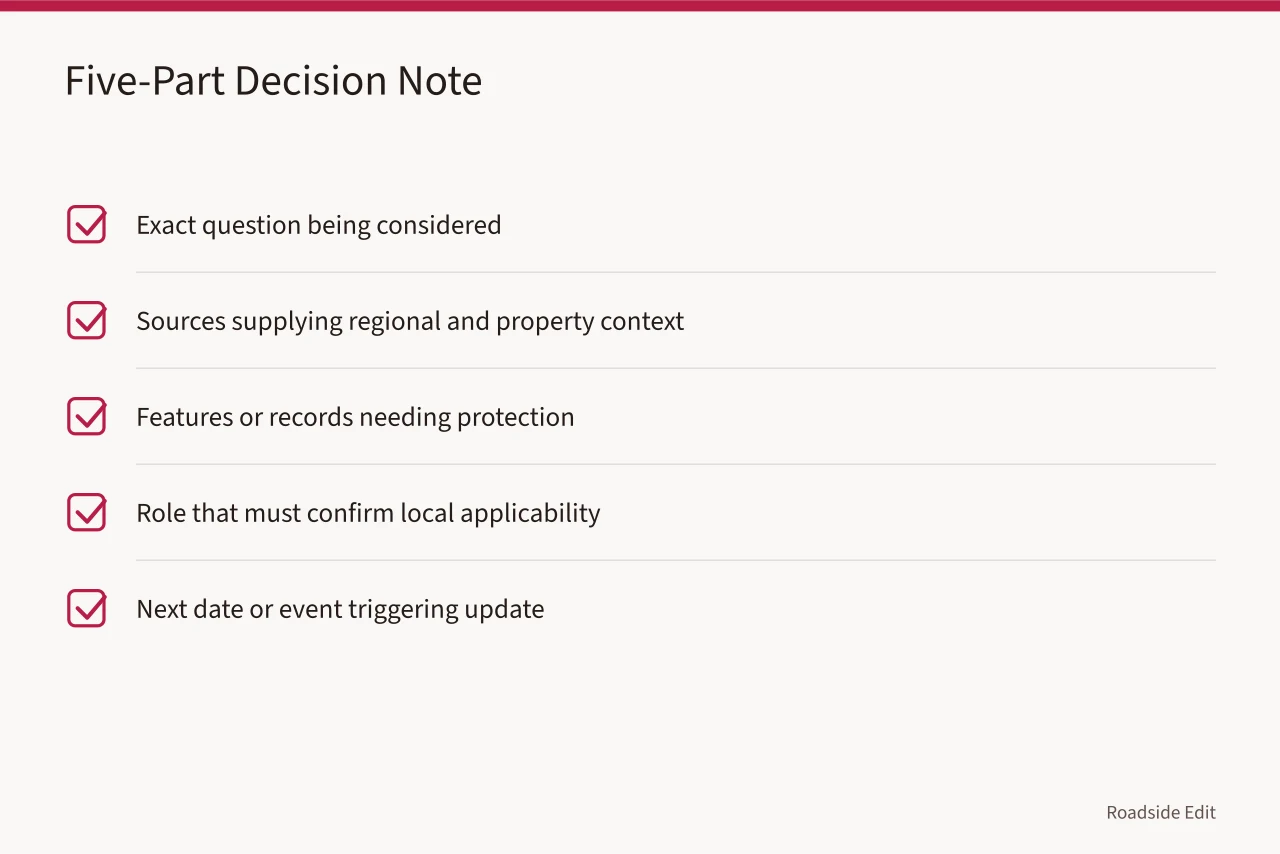
- The exact question being considered.
- The sources that supplied regional and property context.
- The features or records that need protection or verification.
- The role that must confirm local applicability.
- The next date or event that will trigger an update.
Avoid marketing-style language such as "future-proof," "weather-ready," or "resilient by design" unless a source supports the exact claim and a qualified review has determined it applies. For a public article, those phrases are more likely to confuse than help.
Regional planning also needs an explicit no-action option. A decision to monitor can be legitimate if the record explains why more information is needed and when the question will be revisited. The goal is an accountable choice, not a forced project.
Prepare a record for local review
When a regional question moves beyond research, prepare a short packet, not a long narrative. Include the defined property location, the dated regional source, relevant property records, and a list of unknown facts.
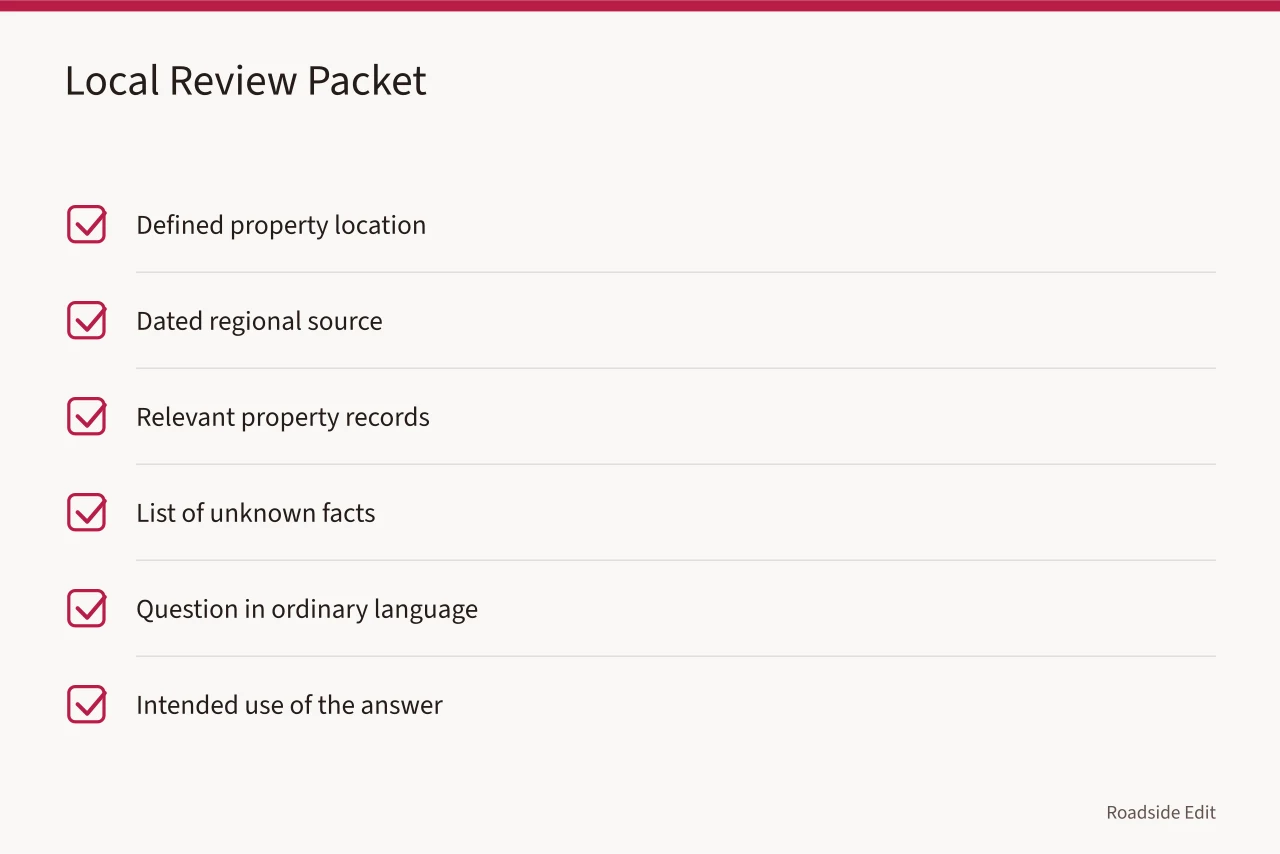
State the question in ordinary language, so a reviewer need not reconstruct it from a collection of links.
The packet should also name the intended use of the answer. Is it needed for a public article, a planning meeting, a design decision, a local inquiry, or a future study? This keeps a general context source from being applied to a decision it was never meant to support.
If a local answer cannot be obtained, record that result. "No current property-specific evidence found in the reviewed file" is a valid update. It is not a failure of research. It is an honest boundary that protects future writers from repeating a claim without support.
Use version names for packet updates. A later source may narrow the geography, identify a different historical feature, or change the status of a proposal. Preserve the older version and explain the reason for the update. That trail is especially important when articles are exported, imported, or reused across editorial systems.
It also gives agencies and project partners a clear starting point. They can add verified local material without needing to untangle an unsupported regional conclusion from the existing article.
Review before public use
Before publishing regional context, check whether every sentence is clear about its geographic scope. A county source should not become a statement about a block. A climate region should not become a prediction for a room. An institutional planning framework should not become a claim that the motel meets a requirement.
Remove private security information, personal contacts, access details, and unverified project claims. Keep sponsored or paid content separate from evidence records, and label it clearly. If a later source contradicts an earlier summary, publish a dated correction and retain the earlier source note.
A regional guide is useful when it makes the local research job easier. It becomes misleading when it pretends to finish that job.
The NPS climate-context overview describes effects on cultural resources as place-sensitive and notes that important threshold information may be incomplete. Read the NPS climate-context overview. Use this source to define context and open questions, not to assert a property condition or a particular action.
FEMA's mitigation-planning material discusses the connection between local planning, hazard mitigation, and cultural-resource considerations. Review FEMA's mitigation-planning guide. It does not set a project scope, eligibility decision, or outcome for a named motel.
NPS documentation standards call for reliable source material and stated limits that allow a record to be checked. Read the NPS documentation standard. Keep the regional source's date, geography, role, and property-connection limit with every claim used in the article.
Common questions
Does regional planning identify the right treatment for a historic motel?
No. It organizes context and evidence. Property-specific treatments need appropriate local, technical, and preservation review.
Can a statewide or national climate source prove a motel's risk?
No. It may provide regional context, but the property needs its own location, condition, use, and vulnerability evidence.
What should happen when regional and property evidence conflict?
Keep both records, note the conflict, and seek the relevant qualified or local review. Do not choose the more convenient statement without explaining the evidence.