Guides
Part of How to build a neon sign restoration guide around regional climate and records
Neon sign restoration: 2027 warning signs of a regional claim gone too far
Neon sign regional claim warning signs for 2027 help U.S. owners avoid turning broad data, old images, or provider claims into unsupported local conclusions.
Regional context can make a roadside feature richer, but it can also encourage overreach. Watch for language that uses a broad map, an old image, or an unrelated example to make a narrow conclusion about one sign.
What to take away
- A regional pattern is not a property finding.
- A historic image is not evidence of current condition or ownership.
- A business statement is not an independent certification.
- An unknown local rule should remain an unanswered question.
Check for these warning signs
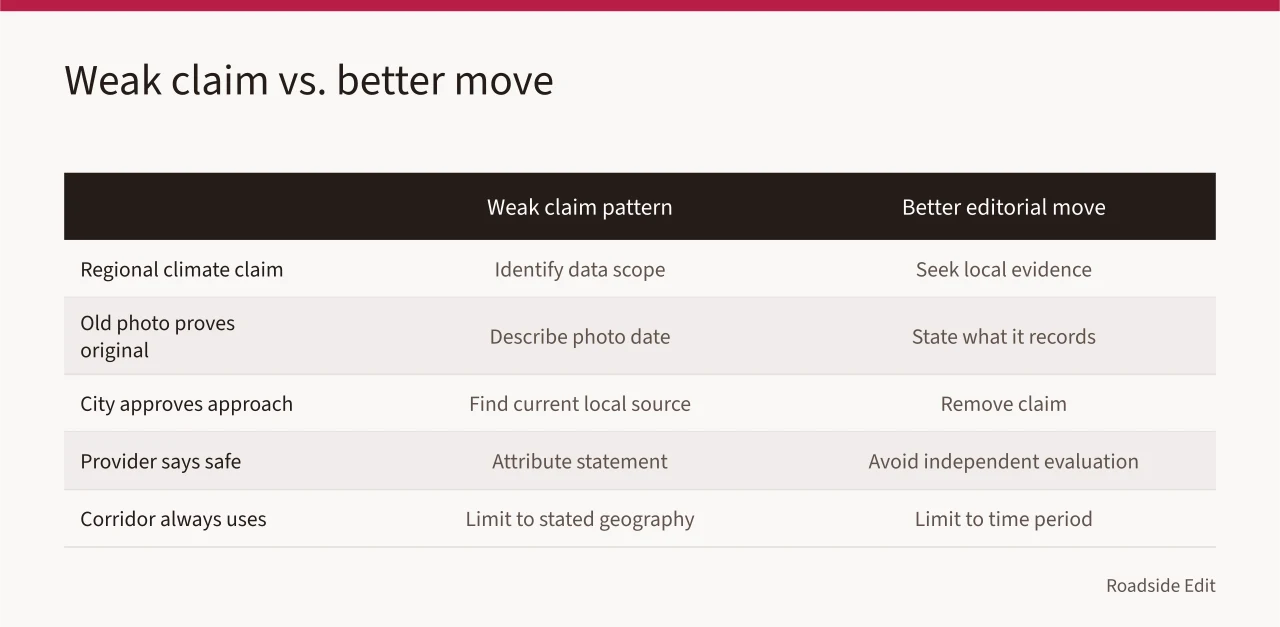
| Weak claim pattern | Better editorial move |
|---|---|
| "The regional climate means this sign needs..." | Identify the data scope and seek local, property-appropriate evidence |
| "This old photo proves the sign is original" | Describe the photo's date and what it visibly records |
| "The city approves this approach" | Find a current, specific local source or remove the claim |
| "A provider says it is safe" | Attribute the statement and avoid presenting it as independent evaluation |
| "This corridor always uses..." | Limit the claim to the source's stated geography and time period |
The National Park Service's sources-of-evidence guide describes ways that nomination files, maps, photographs, and bibliography material can contribute to historical understanding. It does not say that any one source resolves every present-day question. The editorial lesson is to preserve source type and purpose rather than stretch one record beyond what it documents.
Stop a weak claim before it spreads
Review the headline, image caption, opening paragraph, and any directory excerpt together. A careful body section cannot repair a headline that promises a local determination the article does not have. Use verbs such as "shows," "reports," or "describes" when they accurately identify a source's role.
Keep the correction clear
When an old regional statement is too broad, replace it with the supported fact and add a dated correction note in the archive. Do not hide the earlier source. Keeping the trail makes it easier to prevent the same overstatement from returning in a later article or paid profile.
Flag an image used outside its record
The caption should say whether an image is a local record, historic context, or a general illustration. A photo from one city cannot prove a sign's condition, ownership, date, or public status in another.
Keep the source page and item details. Keep claims about the article's subject separate from the visual context for the page.
The Library of Congress Prints and Photographs collections provide image records with descriptive and rights information. They do not establish a current local fact. They support checking the source record and limiting the caption to what the image can document.
Flag regional context presented as local evidence
Maps, climate products, corridor histories, and statewide reports can help explain a setting. The warning sign appears when a sentence jumps from that broad setting to a claim about one property without a relevant local record. Keep the source's geography, period, and stated purpose beside the claim. Then state what evidence would be needed to reach a more local conclusion.
The National Centers for Environmental Information Climate Atlas provides climate information for data-informed decisions. It is not a site-condition report for a neon sign. It supports using regional data as context while retaining the need for locally appropriate evidence.
Flag commercial wording presented as a public finding
Paid directory text, provider testimonials, and sponsor messages should never be written as if a public agency or independent editor verified them. Keep provider statements attributed and disclose payment or other material relationships. If a claim cannot be supported at the level promised by the wording, narrow it to the service description or remove it.
The Federal Trade Commission's endorsement guides address endorsements and testimonials in advertising. They do not certify providers or local projects. They support disclosure and clear attribution when commercial material appears next to regional editorial content.
Run a final claim-scope check
Before publishing, mark each substantive statement as local evidence, regional context, historic context, provider statement, or editorial analysis. If the label is unclear, rewrite the sentence or remove it. Keep the dated source record with the edit note so an update does not quietly widen the original claim.
Common questions
Does a state preservation source answer a city question?
Not automatically. It may provide statewide context, while the city question needs a current local source.
Can a historical photo be used in a current feature?
Yes, if credited and dated. Explain that it is historical context unless it documents the precise current fact being described.
Is a provider quote a bad source?
Not if it is labeled accurately. The problem is treating it as independent proof of a broader claim.