Guides
Part of How to build a neon sign restoration guide around regional climate and records
Neon sign restoration budget notes: how to separate regional costs in 2027
Regional neon budget notes for 2027 show how to separate permits, labor, glass, and review costs by Northeast, South, Midwest, and West without fake averages.
What to take away
- Separate regional costs by line item, not by a single city average.
- Use region buckets: Northeast, South, Midwest, West, and Mountain/Plains.
- Name the source, date, scope, and limit for every range.
- Treat permits, labor, glass, transformers, and review as different lines.
- Keep commercial quotes apart from public facts.
Build a region-by-region budget
A regional cost figure is only useful if it names a scope. Start with a budget notes line for each region. Then split it into categories such as permit review, electrical labor, glass tube work, transformer parts, and historic review. Do not merge them.
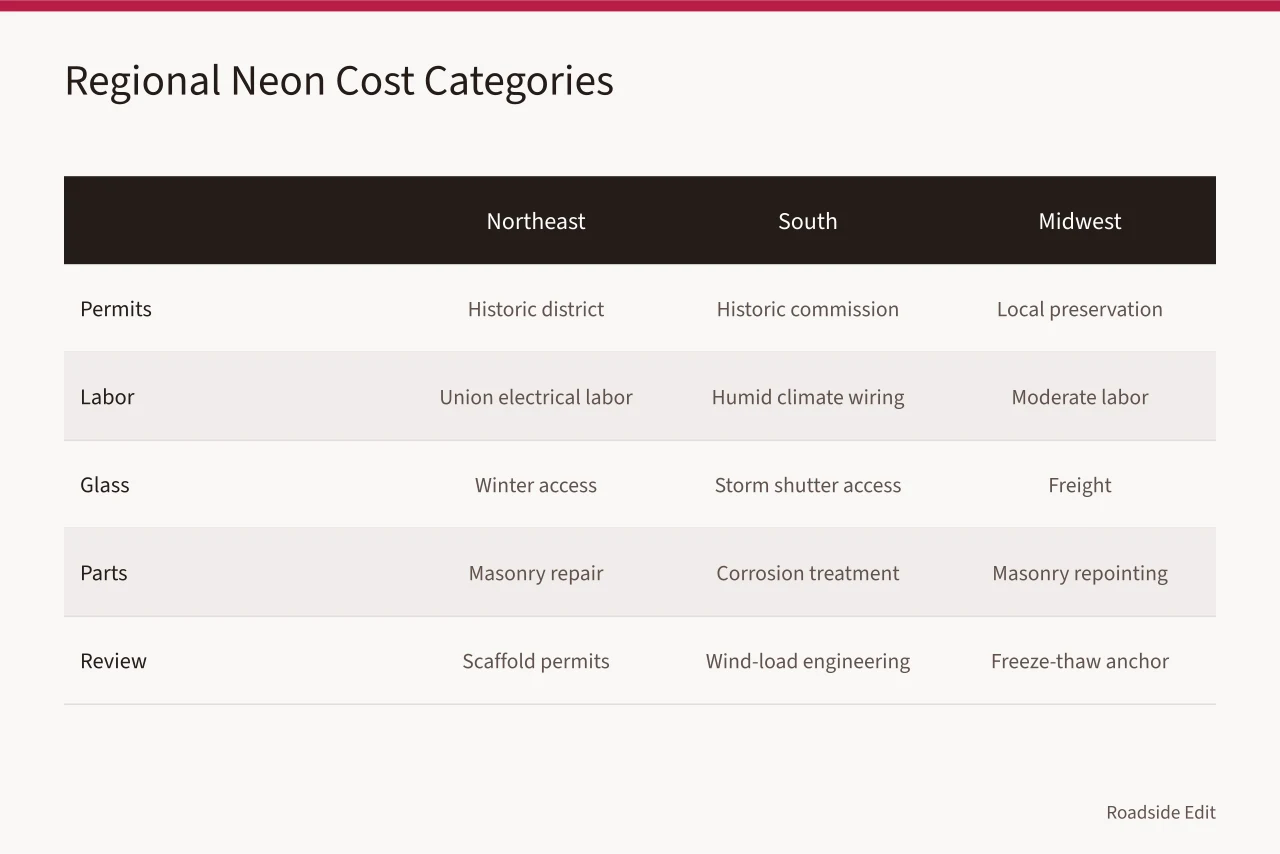
| Region | Cost categories to separate |
|---|---|
| Northeast | Historic district review, scaffold permits, union electrical labor, winter access, masonry repair |
| South | Wind-load engineering, corrosion treatment, historic commission review, storm shutter access, humid climate wiring |
| Midwest | Freeze-thaw anchor inspection, masonry repointing, local preservation grants, moderate labor, freight |
| West | Seismic bracing, long permit queues, environmental review, wildfire smoke cleaning, travel for glass blowers |
| Mountain/Plains | Travel fees, limited neon glass blowers, freight surcharges, weather delays, small-town permit review |
These are categories, not averages. A Northeast city may have a high permit fee and a low glass cost. A South project may need wind engineering but lower labor. Separate each line before you compare.
Name real tools and providers
Seven named resources can turn regional notes into action.
- National Electrical Code (NFPA 70) Article 600. It covers electric signs and outline lighting. Many local inspectors enforce it. NFPA offers free read-only access online.
- UL 48 Standard for Electric Signs. It tests sign components for safety. Some authorities require a listing. UL Solutions quotes testing fees by product.
- International Sign Association (ISA). It is a trade group for sign companies. It publishes signage research and advocacy updates. Membership dues are tiered.
- State Historic Preservation Office (SHPO). Each state has one. It reviews National Register nominations and tax credit projects. Federal review has no fee, but state steps vary.
- SBA 7(a) loan program. It backs small-business loans up to $5 million. Rates are variable and tied to prime. It can fund restoration work.
- SCORE. It offers free business mentoring from volunteers. No fee applies. It suits owners who need a plan before seeking a loan.
- Franceformer and Voltarc. They make neon transformers and electrodes. Replacement parts must match the sign load. Neither firm sets local restoration labor rates.
Use public facts for cost anchors
Public facts can anchor a regional budget without fake averages. The National Park Service's sample nominations guidance explains local, state, and national significance levels. It is not a cost standard. Use it to define review scope.
The National Park Service documentation standards and guidelines cover recording historic properties. They do not supply a budget formula. Use them to list documentation tasks.
The National Archives personal digital archiving guidance covers file preservation and description. It is not a project-cost guide. Use it to organize source logs and request notes.
Keep provider ranges separate
If a business supplies a range, keep the date, scope, exclusions, and source. Do not call it a regional average. If it is a paid placement, disclose that link. The Federal Trade Commission's endorsement guides address endorsements and testimonials. They do not validate estimates. They support clear disclosure when commercial ranges appear.
Track local source requests
Do not hide a local source inside a broad regional bucket. Record the office, archive, owner, or institution. State the specific question, request date, and follow-up. If no answer arrives, keep it as an open question. This makes the regional research category useful and keeps its amount tentative.
Explain every changed amount
When a line changes, say what caused it. List new local research, a revised owner instruction, an updated source, or an unresolved question. Save a dated note for each revised amount or scope line. Mark it as estimate, completed task, or open question.
Common questions
Why not list average regional restoration costs?
Averages blend different scopes, permits, buildings, and rules. Region-by-region categories show what must be priced before a site review.
Can a local sponsor fund research?
Yes. Disclose the relationship. Keep sponsor statements separate from public records and independent facts.
Does a regional source create a contingency?
Only if it names a question that needs local evidence or a responsible reply.