Guides
Part of How to build a neon sign restoration guide around regional climate and records
Neon sign restoration: regional comparison questions to ask before 2027
Neon sign regional questions guide for 2027 helps U.S. owners ask for local facts, preserve context, and avoid turning broad data into property conclusions.
Good regional questions for neon sign restoration identify the geographic scale, the source needed, and the decision that is still open. They do not ask a map, an old photo, or a general audience to settle a property-specific issue.
What to take away
- Ask for the local record or authority that can answer the narrow question.
- Keep historic context questions separate from current access questions.
- State the region covered by a data source before drawing on it.
- Retain the answer date and source before changing published copy.
- Ask whether the scope is repair, alteration, or replacement before requesting quotes.
- Request the provider's license, insurance, and permit responsibility in writing.
Replace broad questions with answerable ones
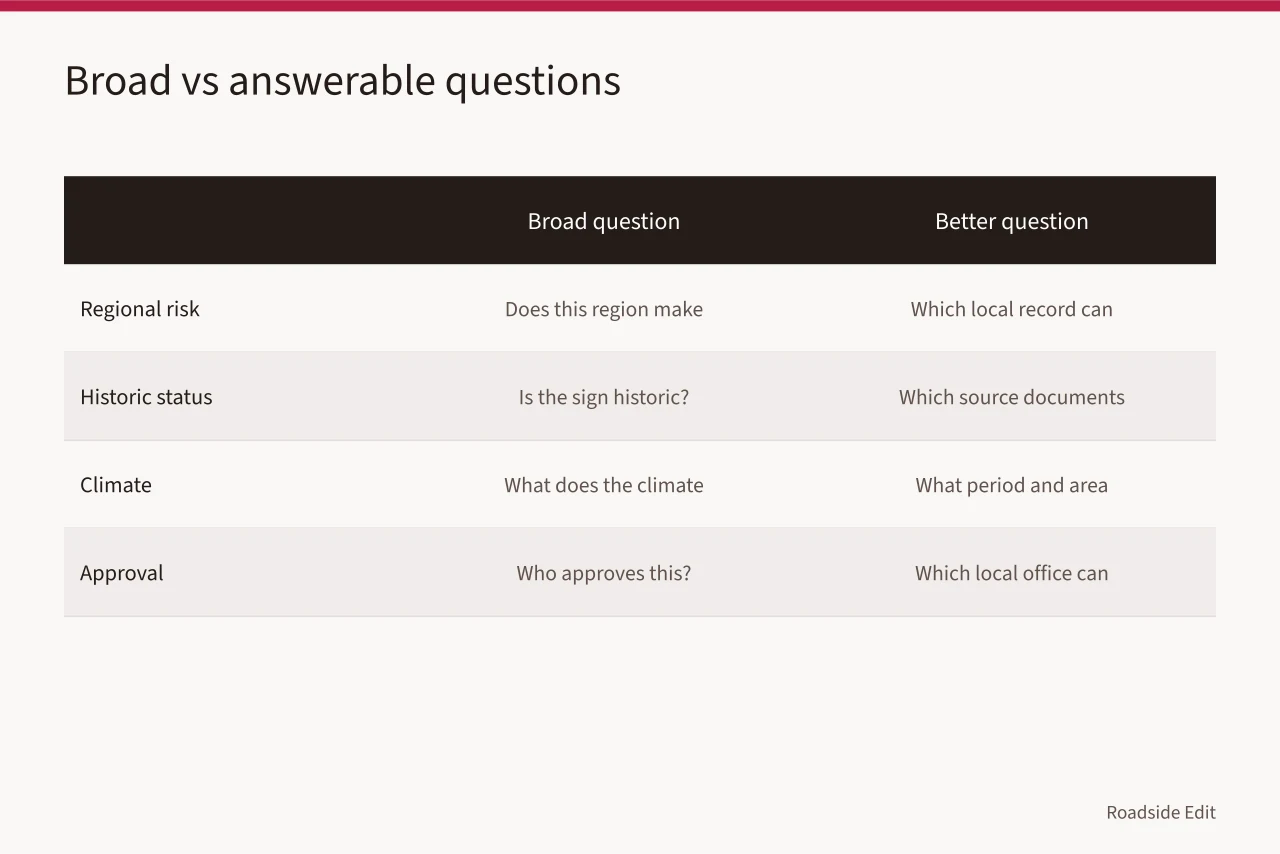
| Broad question | Better question |
|---|---|
| Does this region make the sign risky? | Which local record or qualified process can evaluate the reported property-specific concern? |
| Is the sign historic? | Which source documents the sign's local history, and what claim does it support? |
| What does the climate mean for it? | What period and geographic area does this climate source cover, and what local evidence is still needed? |
| Who approves this? | Which current local office or owner contact can identify the relevant public process? |
| Can you fix my neon sign? | Does the provider bend and pump glass tubes in-house, or send them to a regional shop? What is the turnaround? |
| Is neon restoration allowed here? | Which local sign code, historic district guideline, or preservation commission covers this address, and does it treat repair and alteration the same? |
| Will you replace the transformer? | Which listed neon transformer will you install, such as a Franceformer or Allanson unit, and does it match the tube length, voltage, and outdoor rating? |
| Can you convert it to LED? | Does the local historic review or owner allow an LED retrofit, and how would it change the sign's documented appearance? |
| What will it cost? | What are the hourly rate, minimum service charge, permit fees, lift or crane charges, and separate glass bending charges? |
| Are you insured? | Can you provide general liability, workers' compensation, and auto coverage for work at this address? |
| Who pulls the permit? | Will the sign company or the electrical contractor pull the sign and electrical permits, and who meets the inspector? |
| How soon can you start? | What are current lead times for glass bending, transformer delivery, and on-site installation in this region? |
| Does the work meet code? | Will the installation follow NEC Article 600 and use components with the relevant UL listing? |
The USGS Coastal Science Navigator provides access to coastal science data and planning resources. It does not decide a property's exposure or required action.
For neon restoration, a coastal dataset can flag salt air and flood exposure. It cannot say whether a transformer needs a special enclosure or whether local code requires a disconnect. The table follows that boundary: broad tool for context, local source for a site-specific answer.
Use separate questions for separate records
One question may concern a historical caption. Another may concern a current visitor instruction. A third may concern whether a regional data source belongs in a feature at all. Combining them can produce a vague reply that later gets misused.
For neon restoration, ask about the sign's historic tube color separately from current transformer replacement. Ask about the building's electrical service separately from the sign's historic appearance. Keep each question focused and record the response with its source.
For context, The Neon Museum in Las Vegas, the American Sign Museum in Cincinnati, and the Museum of Neon Art in Glendale, California, document and exhibit historic signs. Use their public collections to check sign history, not to settle a local permit question.
Preserve an unanswered question
An unanswered question is not a failure in the article. It is often the most accurate part of the record. State what is confirmed, say which source has been checked, and identify the person or public record that could clarify the gap.
For neon restoration, if the original transformer brand is unknown, say so. If no local record confirms the sign's 1950s date, label that date as an estimate. That is more trustworthy than a confident but unsupported local claim.
Ask what an image can actually establish
Before using a historic image, ask for the item record: stated date, location, creator when known, and rights note.
Then ask the editorial question: what does the image visibly show, and what lies outside its frame? A photo may support a caption about appearance or place. It cannot answer questions about current ownership, visitor access, equipment condition, or required review.
For a neon sign, the image may show tube color, letter style, and mounting. It cannot show transformer size, tube gas mix, or whether the building's electrical service can support restoration.
The Library of Congress Prints and Photographs collections provide image items with descriptive and rights information. They do not answer property-specific questions. They support using an image record to narrow a historic claim rather than turning visual context into a present finding.
Ask whether a source is regional or local
An article should identify a dataset's stated coverage before using it for context. If the source is regional, ask what local record would complete the story. If it is local but dated, ask whether a current source is also needed.
Put the answer beside the claim so a reader can see why one source provides context and another is required for a narrower statement. For neon restoration, a regional neon survey may list signs in a downtown district. A local permit file may show the sign's legal nonconforming status.
The National Park Service documentation standards and guidelines concern recording historic properties. They do not make a local regulatory or condition determination. They support documenting the scope and limits of evidence used to describe a specific historic resource.
Ask separately about sponsored information
If a provider asks to join a regional list, ask what claim it wants to make, what area it serves, whether the content is paid, and how the entry will be labeled. Do not fold those questions into a public-agency or historic-record inquiry.
Provider information can help readers when it stays attributed, current, and clear about the commercial relationship. For neon restoration, ask whether the company bends glass in-house, what brands of transformers it installs, and which counties it serves.
The Federal Trade Commission's endorsement guides address endorsements and testimonials in advertising. They do not confirm local qualifications or service territories. They support a clear disclosure when commercial information appears next to regional research content.
Common questions
Can a regional guide answer local permitting questions?
No. It can identify where to look for a current local answer, but it should not present a general source as a municipal determination.
Should a writer contact every possible agency?
No. Start with the source that has clear responsibility for the exact question and keep the inquiry limited and documented.
How should a response be quoted?
Attribute the speaker or office, preserve the date and context, and quote only what the response actually supports.
What should I ask a neon restoration provider first?
Ask whether the scope is repair, alteration, or full replacement. Then ask for the permit path, the written scope, and the warranty terms.
How many quotes should I get?
Get at least three written quotes for glass, transformer, and installation work. Give each provider the same scope so the numbers compare.