Guides
How to build a neon sign restoration guide around regional climate and records
A 2027 guide to neon sign restoration that names climate risks, records sources, transformers, tubing, electrodes, and local review steps for U.S. owners.
What to take away
- Build the guide around the sign's climate zone and public records, not general advice.
- Separate regional weather patterns from one property's actual condition.
- Name real parts, tools, and providers so owners can ask specific questions.
- Use climate data and local records before any restoration claim or public statement.
- Keep historical sources, current observations, and commercial information in separate sections.
Match climate stress to neon parts
Neon signs fail differently by region. Coastal salt air corrodes steel cans, transformers, and tube supports. Desert heat and UV dry out gaskets and fade painted letters. Freeze-thaw cycles crack glass and loosen anchors. Wind and hail bend channels and break tubes. Lightning surges can destroy transformers. Snow load can pull down heavy signs.
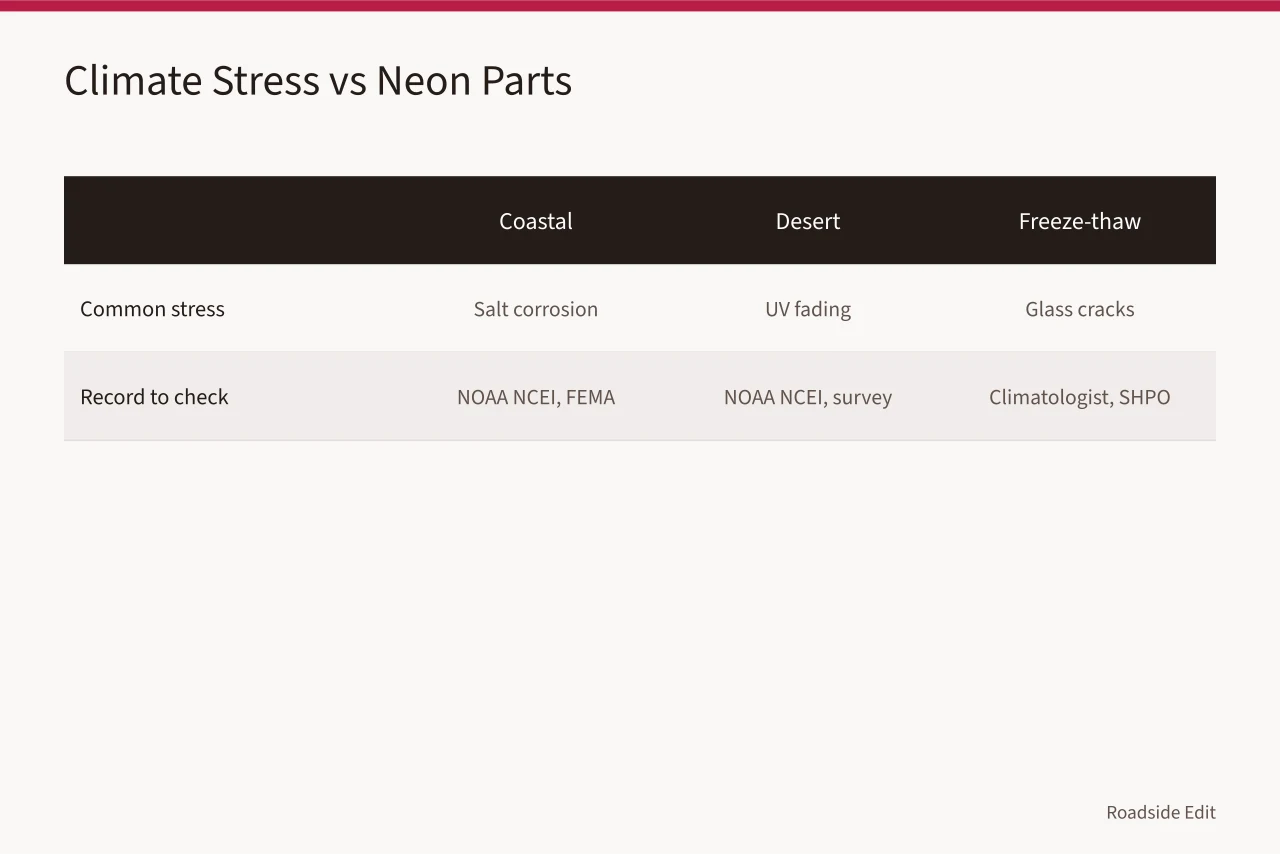
The National Centers for Environmental Information Climate Atlas gives temperature, precipitation, and storm data by region. Use it to describe climate context. Do not use it to diagnose one sign. A local inspection still decides whether a transformer, electrode, or tube support has failed.
| Climate zone | Common neon stress | Record to check |
|---|---|---|
| Coastal | Salt corrosion, wind, storm surge | NOAA NCEI, FEMA flood maps |
| Desert | UV fading, heat expansion, dust | NOAA NCEI, local survey |
| Freeze-thaw | Glass cracks, loose anchors | State climatologist, SHPO |
| Hail and tornado | Dented channels, broken tubes | NOAA Storm Events, permit office |
| Heavy snow | Load on supports, canopy damage | Building department, NOAA |
For records, start with the National Register Bulletin 15. It explains local, state, and national historic contexts. Pair it with your State Historic Preservation Office. SHPO staff maintain National Register files and can point to survey reports. Local historic district commissions hold design review records.
Name real parts and providers
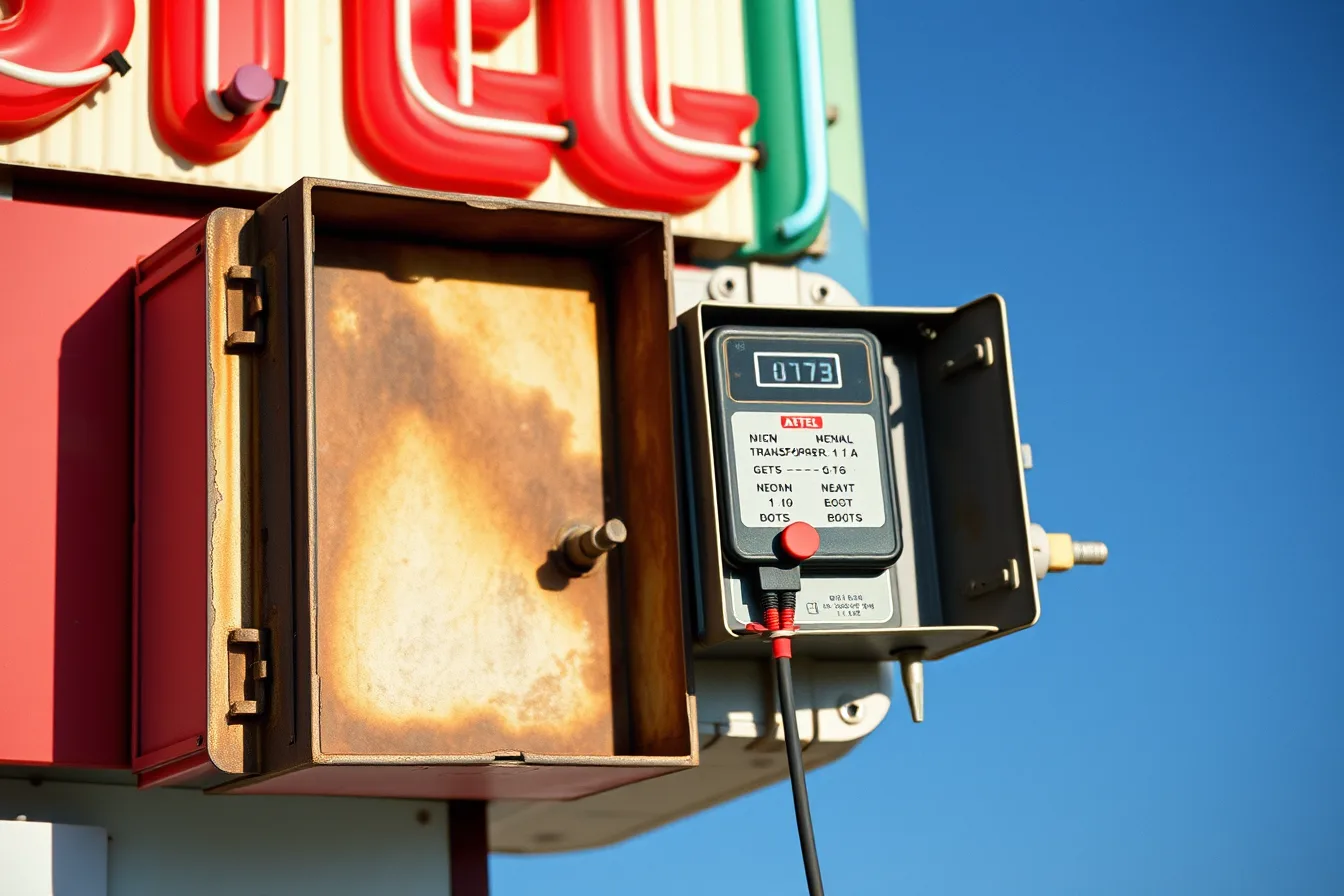
A useful guide names real parts. Franceformer makes neon transformers for sign shops. Match primary voltage, secondary voltage, and milliampere rating before ordering. Allanson sells outdoor-rated transformers for exterior signs. Check the secondary voltage limit and enclosure rating.
EGL Company makes electrodes that seal neon tubes. Replace electrodes when a tube flickers, leaks, or shows black sputtering. Euroglass supplies leaded neon tubing in 4-foot to 8-foot lengths. Tecnolux sells clear and phosphor-coated neon tubes for color work. Match the original tube diameter before ordering.
Supco GTO-15 cable is rated for 15,000 volts. Use it for secondary wiring between transformer and electrode. Robinair vacuum pumps, such as the 15120, evacuate tubes before filling. Smith Little Torch kits use small oxy-acetylene tips for bending. A high-frequency neon tester checks transformer output without touching wires.
For professional help, Neon Works in Oakland restores historic neon signs. Project pricing varies by sign size and tube count. The American Sign Museum in Cincinnati maintains sign history files and accepts research requests by appointment. These names give owners specific calls to make.
Name regional records and resources
State Historic Preservation Offices review National Register nominations and Section 106 projects. They can point to statewide survey reports. The National Register of Historic Places keeps nomination files and weekly listings. Use them for historic context, not design approval.
The Library of Congress HABS/HAER program archives measured drawings and photographs. Use it to document a historic structure. The FEMA Flood Map Service Center maps flood zones for coastal and riverine areas. Check it before writing about storm risk.
Local historic district commissions hold design review records and meeting minutes. City or county planning departments keep sign permits and zoning files. A public library special collection may hold business directories and photographs. The National Archives catalog can hold historic federal building photos. Each source has a scope and a date. Write both down.
Inspect before you quote
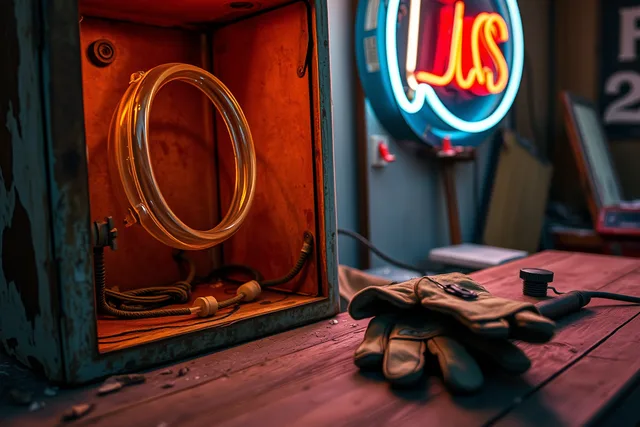
A restoration guide should tell an owner what to inspect. First, de-energize the sign at the disconnect. Second, check the transformer case for rust, bulging, or burn marks. Third, inspect GTO cable for cracks, cuts, or loose boots. Fourth, look for cracked glass, blackened electrode ends, and loose tube supports.
Test transformer output with a neon tester, do not touch secondary wires during it, and have a licensed electrician check line voltage.
Replace any transformer with matching voltage and current rating, and use new tube supports when old ones are brittle. Cap unused GTO leads with proper insulators, and check older transformer labels for PCB warnings; dispose via licensed handler.
Document every part with a photo, model number, and date. This record helps a sign shop quote the work. It also helps a local preservation office review a proposed change. Keep this record with the owner records, not with public history files.
Ask for a line item quote
Ask for line items on transformer, cable, tube, and labor. Add electrode, support, and painting lines if needed. Franceformer and Allanson transformers vary by voltage and current. Small tube repairs may cost less than a full rebuild. Neon Works and other shops often price by project. Get three quotes and compare part brands and warranty terms.
Check permits and electrical code
Local electrical codes and sign permits apply to neon work. Use UL-listed transformers and GTO cable. Keep the listing label visible. A licensed electrician should handle line voltage and disconnects. Historic district approval may be separate from an electrical permit. Ask the local building department which office holds each record.
Build the record layer
Use three record layers. First, historical sources. Second, current observations. Third, current public instructions. A historic photo shows an earlier look. It does not prove present operation, safety, or ownership. The Library of Congress Prints and Photographs collections provide image records with rights and captions. Use them as context, not condition reports.
A local public record can name a contact and a process. An owner statement can give access instructions. A regional data source can describe climate scope. Keep a source log with title, URL, date accessed, claim supported, and geographic scope. Label oral histories and sponsored submissions. The Federal Trade Commission's endorsement guides require clear disclosure for paid or provider-supplied material.
When you cite a local record, keep the issuing body and date visible. When you discuss a property record, separate history from current condition. When you make a property claim, tie it to a dated source and a qualified review. Keep owner files separate from public images.
Write restoration questions owners can answer
Use narrow questions: Which transformer model matches this sign's secondary voltage and current; has a licensed electrician checked line voltage and disconnect?
Which local office holds the sign permit or historic review file; what does the SHPO survey say about this corridor? Which climate data source covers this county and period?
Avoid asking a general audience if a sign is safe or what a restoration costs. Those answers depend on property facts, local rules, and professional judgment. A guide can prepare an owner for a contractor visit. It cannot replace that visit.
Create a region-aware publication checklist
- Identify the climate region and name its main stress.
- Name the record source and its geographic scope.
- List real parts, tools, or providers with a concrete fact.
- Separate historical claims from current observations.
- Label paid or sponsored material.
- Keep unresolved local questions as questions.
This checklist does not replace local review. It helps a reader ask better questions and compare quotes.
Preserve the regional record over time
When a source changes, add a dated note. A city page may move. An owner may update access. A climate product may revise data. Keep the old source date and scope. Use filenames and captions that state location and date without claiming condition.
Common questions
Does a regional guide tell an owner what work to perform?
No. It organizes climate context, records, parts, and questions. Work requires local and qualified review.
Can climate data prove a sign has a problem?
No. It can show regional stress. A property conclusion needs inspection and local evidence.
Can a state source establish a city rule?
Not necessarily. Use state context, then check the current city or county source.
What should a sponsored regional profile disclose?
State that it is sponsored, identify provider-supplied information, and keep it separate from independent history.