Guides
Part of Roadside architecture case study method: how to build a claim map before you draft
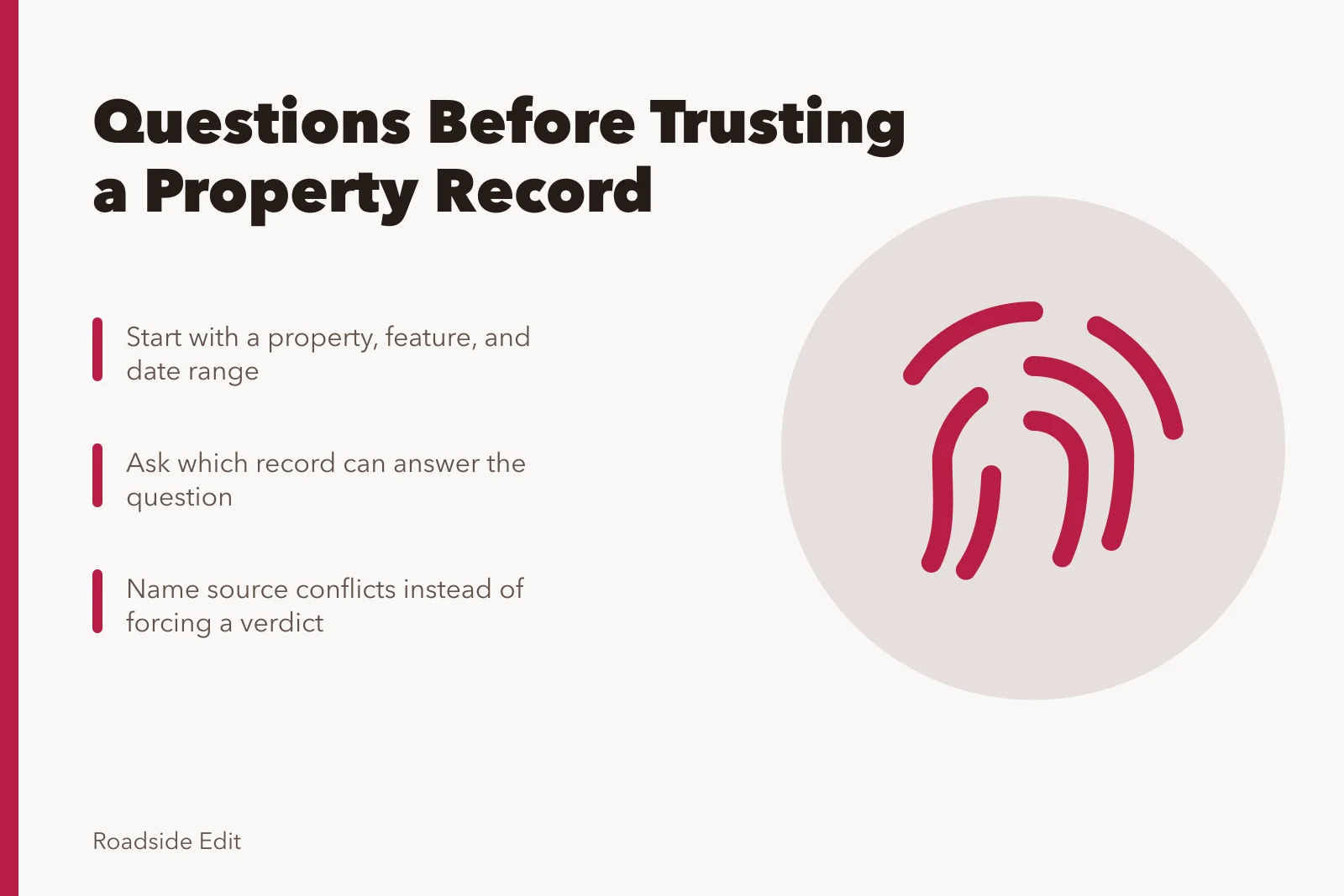
Roadside architecture case study questions to ask before you trust a property record
Roadside architecture case study questions for 2027 help writers choose property records, examine source types, and keep local history claims within evidence limits.
Good research questions prevent a case study from becoming a collection of unrelated facts. Ask what a record can establish about a defined roadside property, then choose sources that fit the question.
What to take away
- Begin with a property, feature, and date range.
- Ask source-specific questions rather than looking for confirmation of a conclusion.
- Primary and secondary sources have different jobs.
- Keep unanswered questions visible in the final article.
Ask which record can answer the question
The Library of Congress house-history guide points researchers toward varied primary sources, including deeds, directories, manuscripts, maps, photographs, and floor plans, along with secondary context. Use the Library of Congress house-history guide to plan source types. It is a research guide, not a verification of any roadside building's history.
NPS documentation standards require reliable sources and clear limitations so a reader can independently check the information. See the NPS documentation quality standard. Use that standard when choosing a source: the better source is not always the oldest or most detailed one. It is the source that answers the exact question without stretching past its evidence.
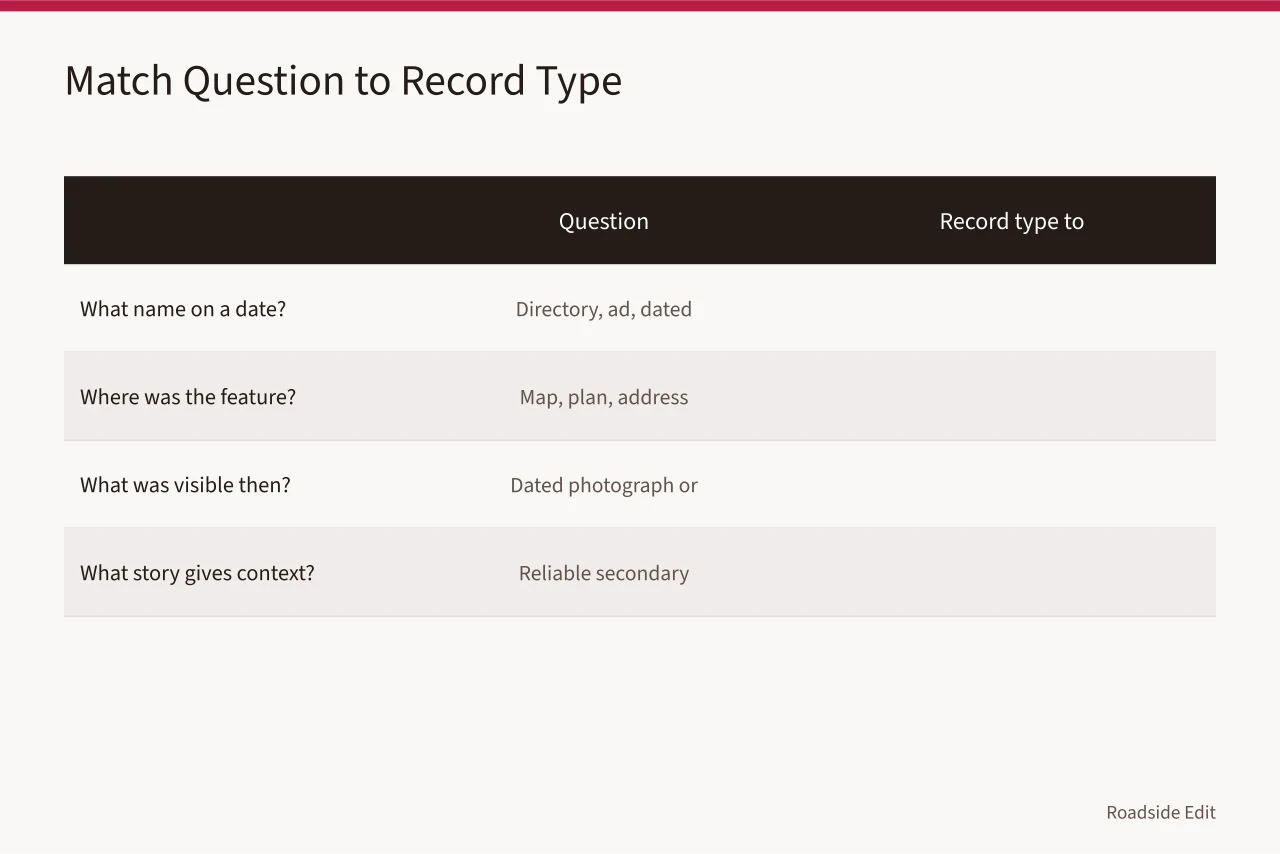
| Question | Record type to seek |
|---|---|
| What name did the property use on a date? | Directory, advertisement, or dated photograph caption |
| Where was the feature located? | Map, plan, address record, or source-provided location |
| What was visible at a point in time? | Dated photograph or drawing |
| What story gives context? | A reliable secondary source that identifies its evidence |
Use these question groups
- What does the source call the property, and when?
- What feature is actually in the source's frame or description?
- Is the source primary evidence, secondary context, or a lead for later research?
- Does the source identify a date, location, author, or collection?
- What statement would go beyond the record?
| Avoid asking | Ask instead |
|---|---|
| "Why did this place decline?" | "Does a record identify a dated change or cause?" |
| "Was this sign original?" | "What record identifies the sign's date or component history?" |
| "Is the motel historic?" | "What designation or source language is available, if any?" |
Ask the source before asking the story
The Library of Congress primary-source guide recommends observing and questioning a source before reaching a conclusion. Use the Library of Congress primary-source analysis guide. For a roadside case study, begin with the source's own details: who created it, when, for what purpose, and whether it identifies the property directly.
Then separate questions needing different records. A directory may help with a business name, a photograph may show a sign, and a project report may identify a repair.
Do not ask a directory to prove a sign's materials or a photo to prove why a business closed. This division produces a shorter, more accurate article than a broad search for one answer.
Handle disagreement without forcing a verdict
When sources conflict, keep both dates or descriptions in the research file and name the difference. NPS historical documentation guidance says to note and assess conflicts in source materials, not conceal them. Read the NPS historical documentation guidelines.
A published article can say available records differ and name each source. Avoid deciding the question until a stronger record appears.
That is not indecision. It is accurate reporting. A reader gains more from a documented conflict than from a smooth sentence that hides a weak choice.
Record the conflicting title, date, and page URL beside each claim. Later editors can see whether a new source resolves the difference or merely repeats one side.
Keep a question log
A question log prevents a useful lead from becoming a statement through repetition. Give each open question a source searched, date checked, and next possible record. When a question stays unanswered, the article can state that limit plainly or omit the claim. The log makes a later update faster without making absence of evidence sound like evidence of absence.
Common questions
Can a secondary source answer a property-history question?
It can provide context or point to records. Attribute it clearly and avoid using it as a substitute for a property-specific primary source when one is needed.
What if sources disagree on a date?
Record the conflict, attribute each date to its source, and do not choose one without a stated basis.
Should every question appear in the article?
No. Include the questions that help readers understand the evidence boundary or the next record needed.