Guides
Roadside building provider selection: how to compare scope before price in 2027
Compare roadside building providers in 2027 by lining up estimate line items, weighting what matters, and recording how each shortlisted name was chosen.
Two estimates for the same porcelain-enamel sign can differ by thousands and both be honest. One includes a dry-stand pipe inspection and a paint-match panel; the other prices a repaint and leaves the canopy soffit to someone else. Price compares nothing until the line items sit side by side.
This guide is about that comparison. It covers how to break an estimate into line items, how to weight the criteria that decide the award, and how to say in print why a provider's name appears at all.
It does not decide licensing, tax status or permit approval; those belong to your state board, your accountant and your local landmarks commission.
What to take away
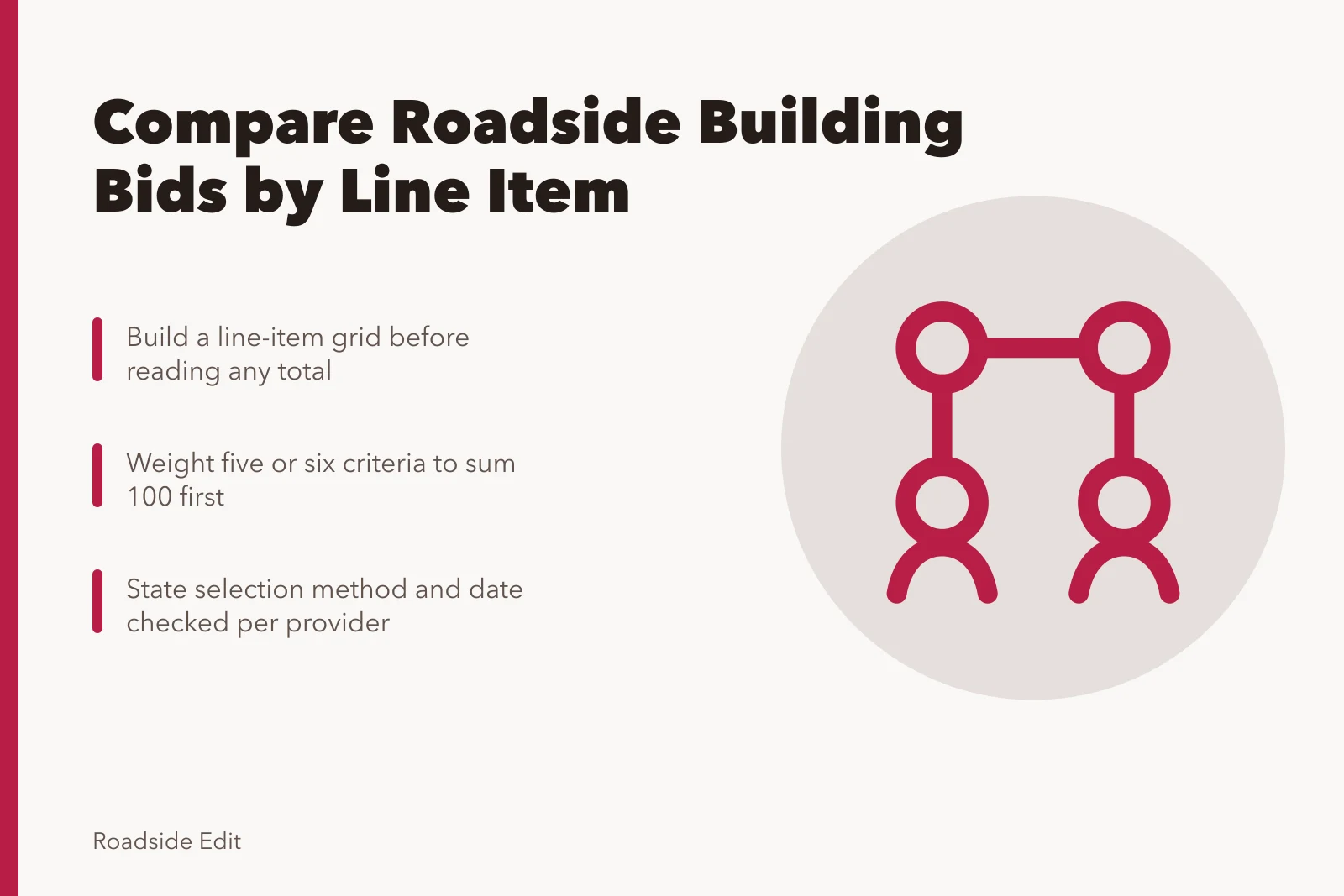
- Build the estimate comparison as a line-item grid before you read a single total.
- Mark every line included, excluded, unknown or not applicable; "unknown" is a finding, not a gap to fill by assumption.
- Write your criteria weights before proposals arrive, so the award is reviewable later.
- When you publish a provider's name, state the selection method and the date you checked it.
- Keep the request, the reply and the decision note in one dated file per candidate.
Break the estimate into line items, not totals
Ask every candidate to price the same scope in the same units. A roadside preservation job splits into a handful of cost structures: survey days, travel, fabrication, and the documentation that wraps the work.
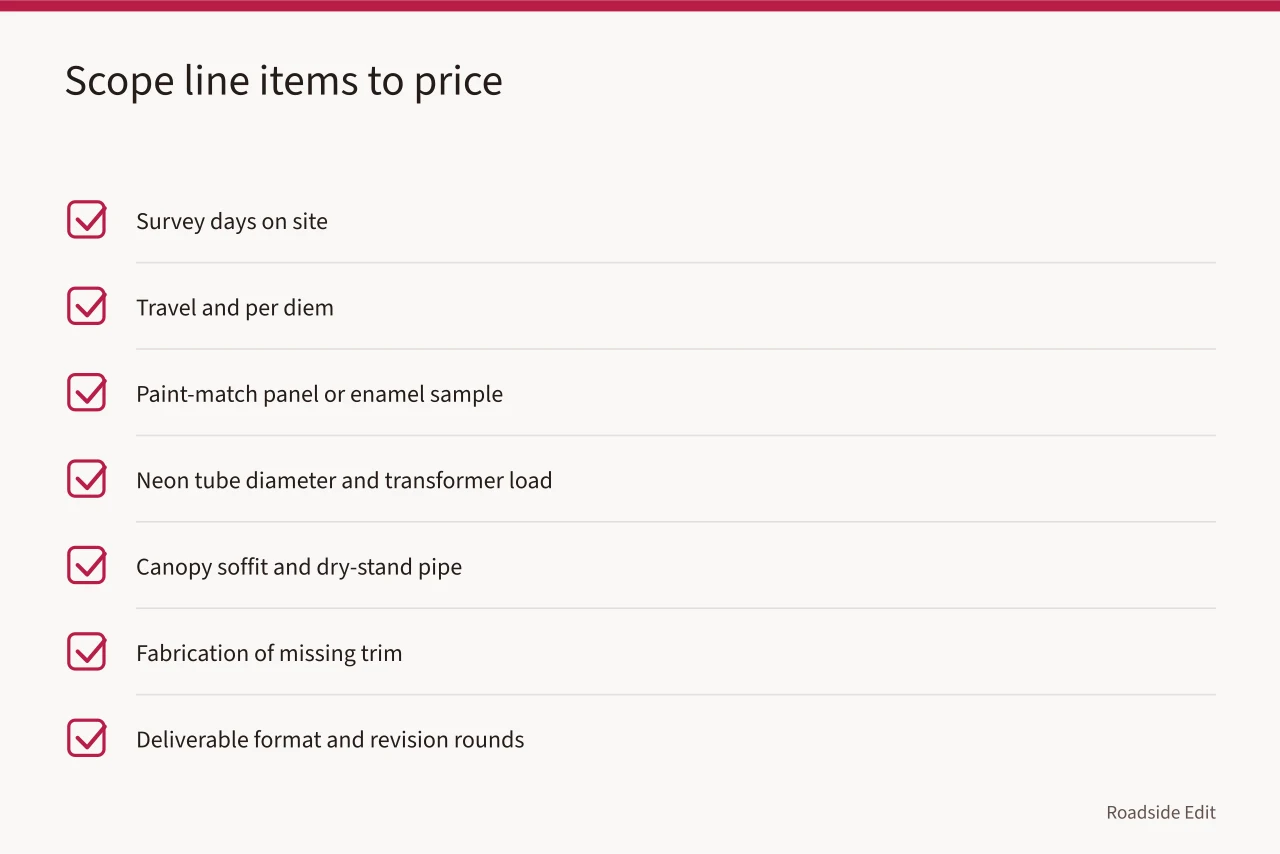
| Line item | Included | Excluded | Unknown | N/A |
|---|---|---|---|---|
| Survey days on site | ||||
| Travel and per diem | ||||
| Paint-match panel or enamel sample | ||||
| Neon tube diameter survey and transformer load check | ||||
| Canopy soffit and dry-stand pipe inspection | ||||
| Fabrication or reproduction of missing trim | ||||
| Deliverable format (report, image set, drawings) | ||||
| Revision rounds | ||||
| Permit or review filing |
Fill the grid from the written proposal, not from the site visit conversation. A line the provider never mentions is "unknown" until they answer in writing. Two "unknowns" in the same row across three candidates usually means the scope itself is underspecified, and the fix is a better request, not a fourth bid.
Marking a line "not applicable" is a decision you make and should be able to defend. If the property has no neon, the transformer load row is N/A. If it has a 1950s porcelain-enamel station sign, the enamel sample row is not.
Weight the criteria before the proposals arrive
A scorecard written after the bids is a justification, not a method. Set the weights first, then score.
Pick five or six criteria and give each a weight that sums to 100. The weights are yours; what matters is that they exist on paper before you open the first envelope.
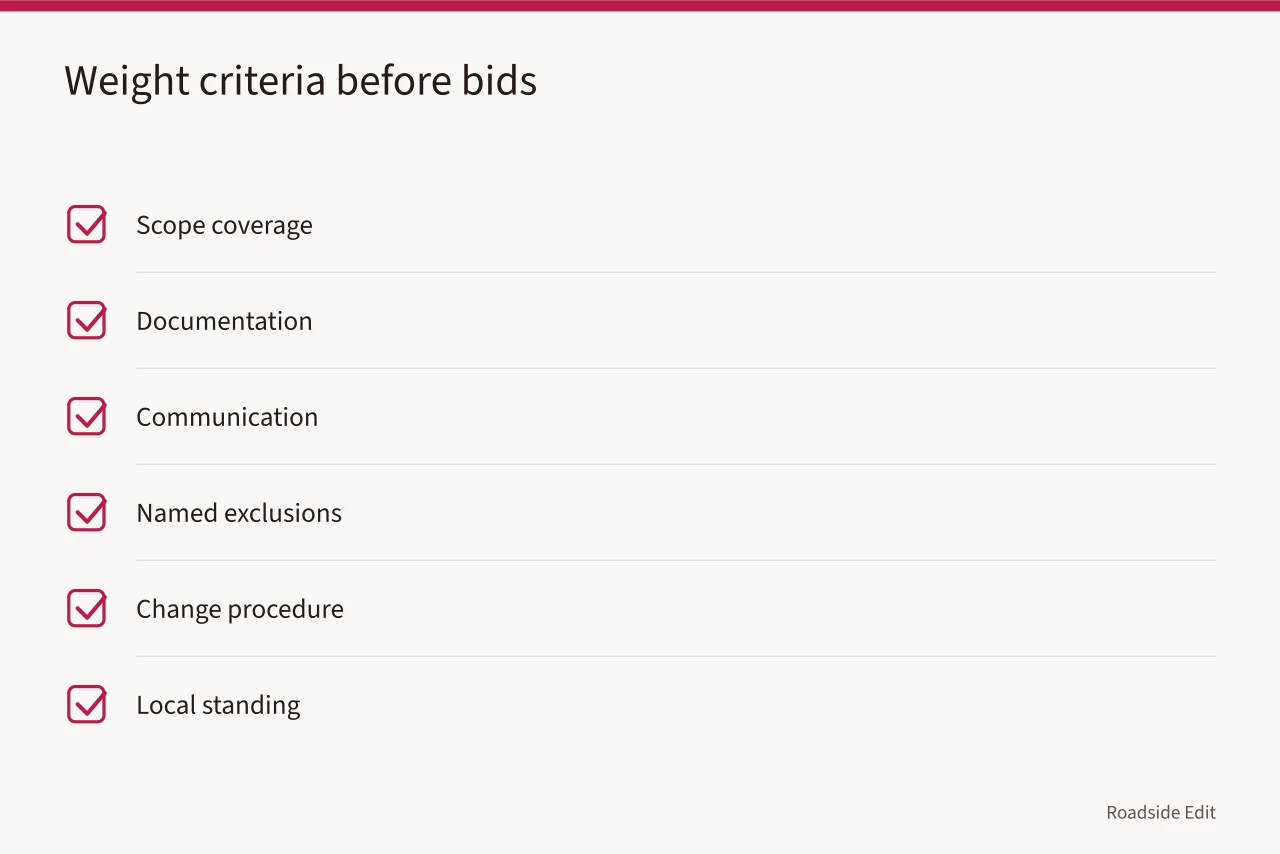
Score each candidate against the weights and keep the arithmetic. A weighted total of 74 against 71 is not a mandate; it is a record that the decision followed the stated method. Say so in the note.
Name how a provider was selected
When a provider's name appears in an article, a directory or a listicle, the reader deserves to know why it is there. The transparency method is one sentence:
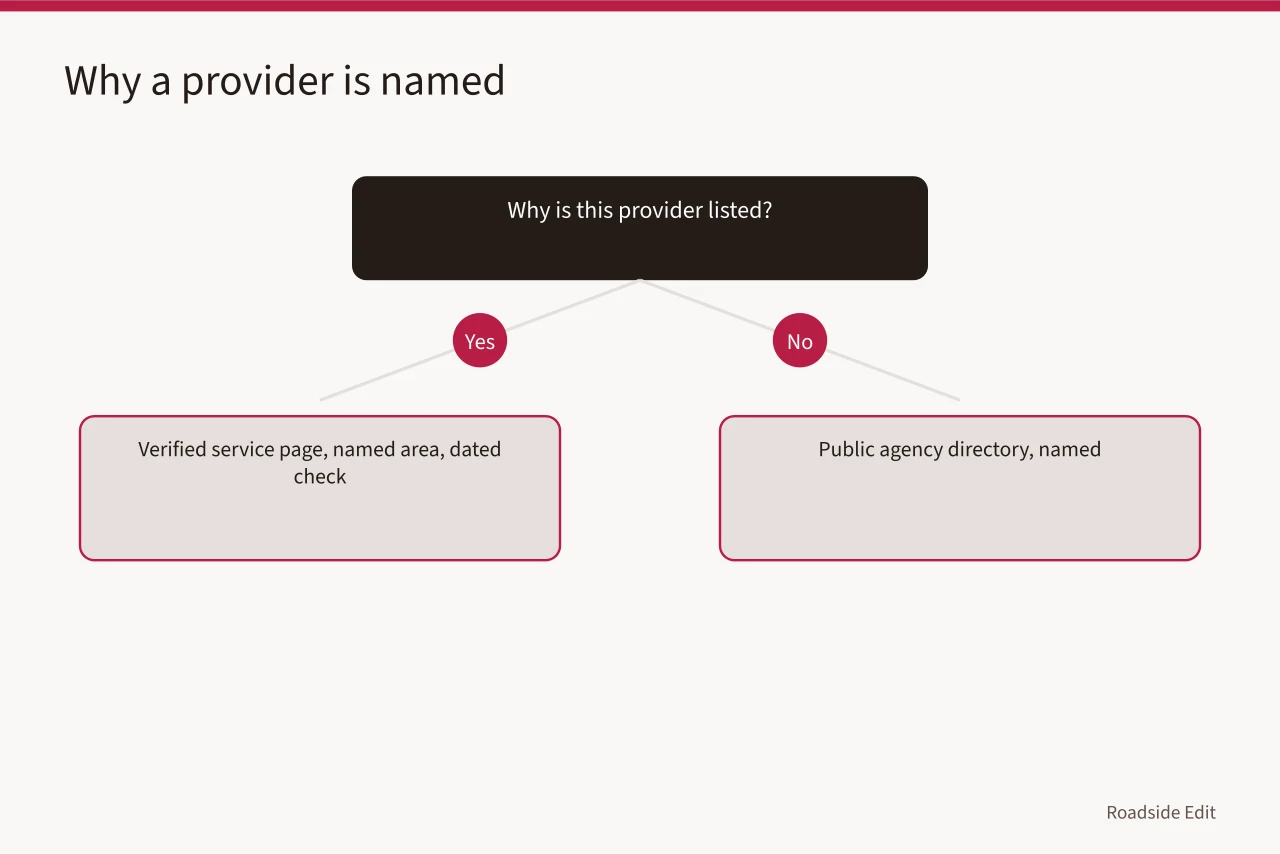
Included because the business's own service page states it performs neon tube survey work in the named corridor, checked 12 March 2027.
That sentence does three things: it names the source, it names the claim, and it dates the check. It does not say "best," "trusted" or "available now," and it does not imply the provider is the only option.
Three selection reasons exist and should never be blurred:
- Verified service page in a named area, checked on a stated date.
- A directory maintained by a public agency, named.
- A paid placement, disclosed as such under the platform's policy.
The Federal Trade Commission's endorsement guidance covers material connections that affect how a reader weighs a recommendation. Read the FTC's endorsement guides. A paid listing with no disclosure is a material connection presented as editorial judgment.
For consumer-facing home repair, the FTC also advises written estimates, license and insurance checks, and a careful read of the agreement before work starts. See the FTC's home-repair scam guidance. Contract requirements vary by state and municipality; confirm what applies to your project with the authority that issues the license.
A worked example: two bids for one sign
A 1950s porcelain-enamel station sign needs documentation and a paint-match panel. Bid A totals 100 units; Bid B totals 78.
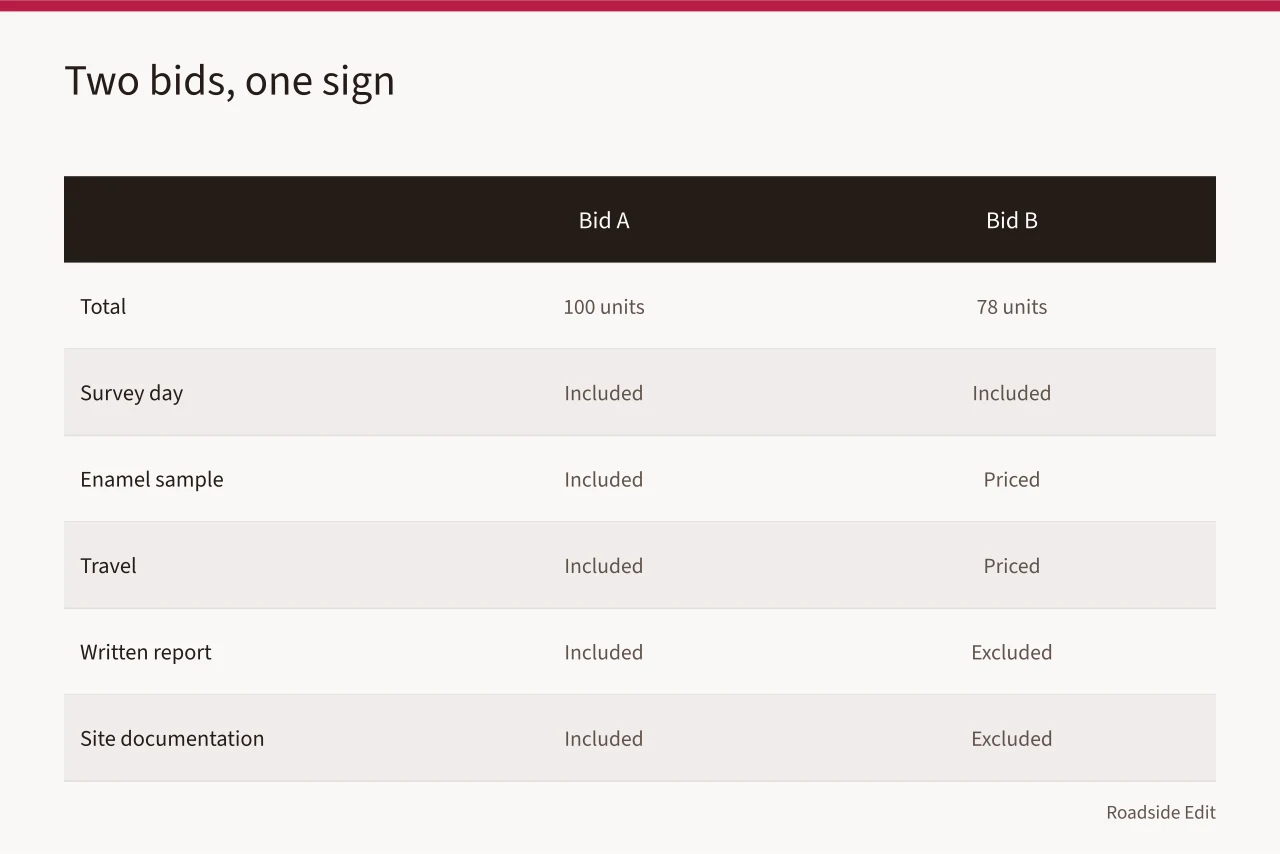
Line by line, Bid A includes the survey day, the enamel sample, travel and a written report. Bid B prices the sample and travel but lists "site documentation" as excluded and leaves the report to the owner. On the grid, Bid B has one excluded line and one unknown. The 22-unit gap is the documentation and the report.
That does not make Bid A the right choice. It makes the comparison honest. If you can produce the report yourself, Bid B may win on the weighted score. If the report is the deliverable, Bid B is not cheaper; it is incomplete.
Run the same arithmetic on your own figures: total difference divided by the line items that differ tells you what each excluded line actually costs.
Keep the file that proves the decision
One dated folder per candidate. It holds the request you sent, the reply, the proposal, and the credential record. It also holds these items:
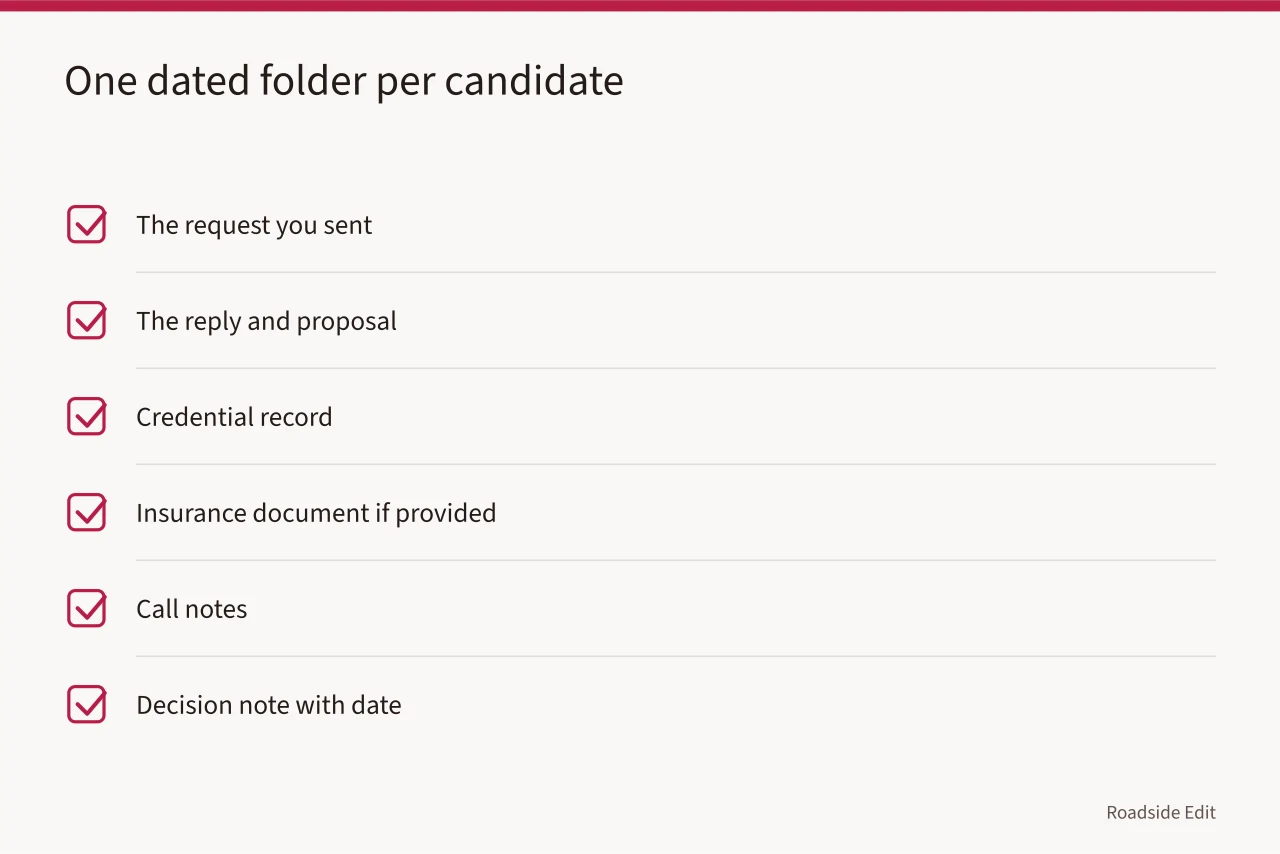
The National Archives recordkeeping requirements hold that related records should stay together when their relationship gives context. Read the agency recordkeeping requirements. A hiring file works the same way: the original request, the revision and the closeout belong in one place, not scattered across email threads.
The decision note needs the date, the proposals reviewed, the scope selected, the weighted scores, and any question still open. It does not need private financial detail.
Where the process stops and the professionals start
Some questions in a roadside project are not yours to answer from a comparison table. Route them.
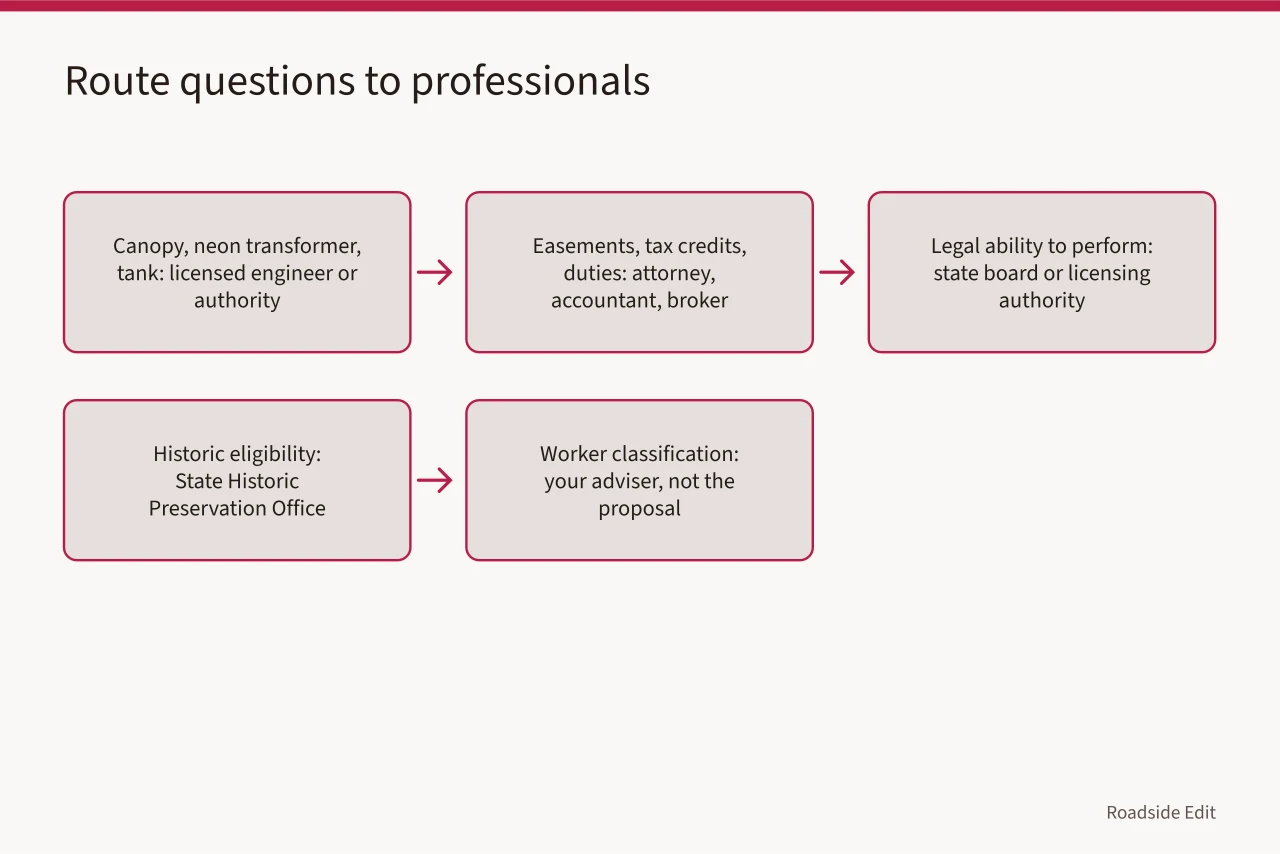
- Structural, electrical and hazardous-materials questions about a canopy, a neon transformer or an underground tank go to a licensed engineer, electrician or the environmental authority with jurisdiction.
- Easements, historic tax credits and cross-border import duties go to an attorney, an accountant or a customs broker. Salvage sourced from Canada and neon parts crossing a border carry paperwork that is not a scope line.
- Whether a specific provider may legally perform a task is a question for the state board or local licensing authority that sets the rule.
- Whether a property is eligible for a historic designation is a question for your State Historic Preservation Office or landmarks commission, answered against the adopted ordinance and the primary record.
The Internal Revenue Service worker classification overview explains that status turns on the relationship and the degree of control, not on an invoice or a short engagement. Read the IRS worker classification overview. Do not classify a worker from a proposal; send that question to your adviser.
If you are commissioning design work rather than trade work, the comparison shifts toward deliverable format and revision rounds. Choosing a roadside design studio covers how that scope is written.
When to stop the comparison
Pause when the request is still unclear, when a provider will not put the proposal in writing, when two documents contradict each other, or when someone pushes for a decision before the scope is settled. A pause is not an accusation; it is a signal that the grid has too many unknowns.
High-pressure language, blank fields in an agreement, and requests to skip ordinary recordkeeping are all reasons to slow down and verify through the proper authority.
Source image
The Library of Congress catalog describes this image as a large decorative pot at a downtown parking lot in Gallup, New Mexico.
Common questions
How many providers should a reader compare?
Compare enough written responses to fill the line-item grid without gaps. The FTC consumer guidance recommends three written estimates for home-repair work, which is a reasonable floor for a roadside project.
What if a provider leaves a line item blank?
Mark it unknown and ask in writing. A blank line is not an exclusion and not an inclusion; it is an unanswered question, and the answer changes the comparison.
Does a provider website prove credentials or coverage?
No. Treat it as a starting point for the selection sentence, then verify through the relevant licensing authority and the provider's current documents.
Can a provider be named in a sponsored article?
Yes, when the placement is disclosed and the article states the selection method and the date it was checked. The disclosure goes near the listing, not in a footnote.