Guides
Part of Roadside architecture case study method: how to build a claim map before you draft
How roadside architecture case study records keep sources, credits and corrections straight
Roadside architecture case study records for 2027 explain how to retain source IDs, image credits, claim notes, corrections, and unresolved local-history questions.
The article is only one part of a case study. Keep records that let a later editor see where a fact came from, which source supported a caption, and why a sentence was narrowed or corrected.
What to take away
- Save exact source pages and identifiers, not only a general collection name.
- Keep image credit records separate from the historical claims in an article.
- Record the date each source was reviewed.
- Preserve questions that the available records did not answer.
Start with the source identifier
The National Archives says its digitized still pictures are selections from much larger holdings, and it recommends catalog context and identifiers when seeking or verifying an image record.
Read the National Archives Still Picture Branch research guidance. The guidance supports careful source tracking but does not verify that an image outside the catalog depicts a particular roadside property.
National Archives guidance for digital photographic records also calls for unique identifiers, descriptive metadata, and captions that make an image understandable and retrievable. Review National Archives digital photo records guidance. In an editorial file, record the original image page, source date, caption, and any crop used in publication.
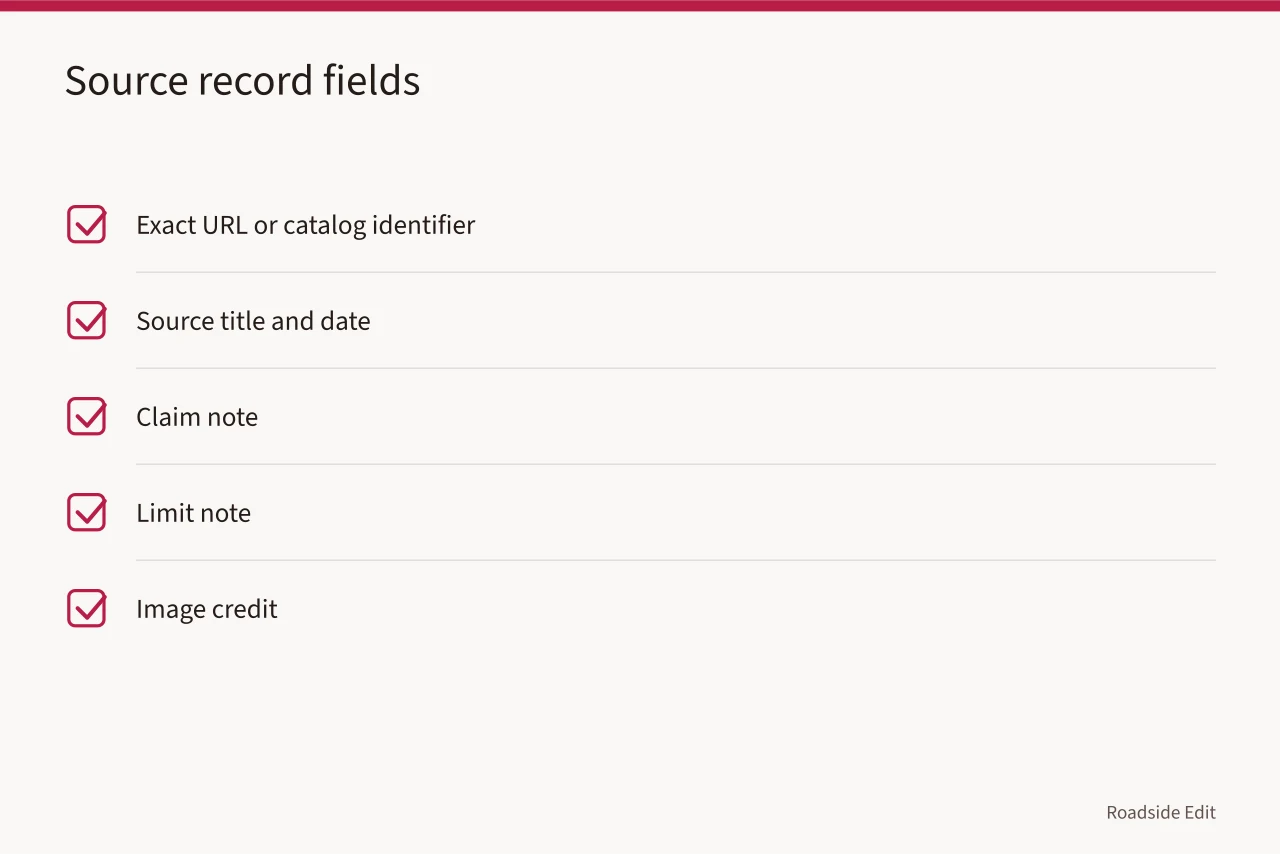
| Record field | Why keep it |
|---|---|
| Exact URL or catalog identifier | Lets another editor return to the same item |
| Source title and date | Distinguishes the source record from article publication date |
| Claim note | Shows the sentence the record supports |
| Limit note | Captures what the record cannot establish |
| Image credit | Separates media attribution from property research |
Maintain a correction trail
- Preserve the original wording and source note.
- Add the new source or corrected identifier.
- State which factual sentence changed.
- Recheck related captions, titles, and metadata.
- Keep unresolved questions open instead of hiding them in a revision.
| Change | Record to retain |
|---|---|
| New property identification | The old and new identifiers with the reason for revision |
| Revised date | The source that supplied the new date |
| Image removed | Credit page, caption, and replacement decision |
| Claim narrowed | The old phrase, new phrase, and evidence boundary |
Keep the claim map with the record
NPS documentation standards require reliable sources and stated limitations that permit independent verification. See the NPS documentation quality standard. A claim map makes that practice manageable: place each factual sentence beside the exact source that supports it, then note what the source leaves unknown.
Do not rely on a folder title such as "research" or a shared bookmark list. A later editor needs to know which record supported which sentence, not simply which sources were open during drafting. If a source changes, the map reveals the precise place to review.
Add later evidence without erasing context
New evidence may change a caption, date, scope, or property identification. NPS project-completion guidance calls for documenting discoveries and changes that alter a project's original scope. Read NPS project-completion record guidance. A case-study file can follow the same habit: retain the old note, add the new source, and list the specific text changed.
That record protects the article from silent drift. It also gives a publisher a clear answer if an owner, reader, or later researcher asks why the wording changed.
Review the record before changing the article
When new information arrives, read the existing claim map before touching the draft. Confirm whether the new record concerns the same property, feature, date, and statement. Then revise the smallest sentence that depends on the changed fact.
Check the title, description, image caption, and social copy for repeated wording. If the new source does not resolve the earlier question, add it as context rather than replacing a supported claim. This review prevents a correction from creating a second error somewhere else in the article.
Keep the review date with every completed correction entry.
Common questions
Should a case-study record include a screenshot of every source?
Keep records in the format appropriate to the publisher's policy. At minimum, retain the specific URL or identifier, review date, claim note, and limit.
Why track an image separately from the article source?
An image credit page identifies the media. It may not support the historical or condition claim in the surrounding text.
What if an archive item is unavailable later?
Keep the identifier, title, date checked, and claim note. Update the article if the source can no longer support the sentence as published.