Guides
Roadside architecture case study method: how to build a claim map before you draft
Roadside architecture case study method for 2027 gives writers a clear research design, evidence log, source limits, and fact-check process for local stories.
A useful roadside case study does not need to solve a building's physical problems or tell its entire history. It needs a defined question, a clear place boundary, evidence that fits the question, and an honest account of what remains unknown. That method works for a motel, diner, filling station, tourist court, sign, or commercial strip.
This guide is for writers, editors, local-history volunteers, and small publishers. It describes how to build a source-bound article, not how to assess a property, choose a preservation treatment, or verify a designation. The finished article should make it easy for a reader to see the difference between a documented fact, a visible observation, and an unanswered question.
What to take away
- Start with one research question instead of a broad story about a road or era.
- Define the property, feature, date range, and geographic boundary.
- Record why each source was used and what it cannot establish.
- Separate historical context from present-day observations.
- Keep the research file so a later editor can correct the article precisely.
Choose a question that records can answer
The best case-study question is narrow enough for a source to answer. "What makes this roadside place important?" is too wide. "Which dated records identify the original use of this named sign?" is workable. The difference is not academic. A narrow question tells the writer which records to find and which claims to leave out.
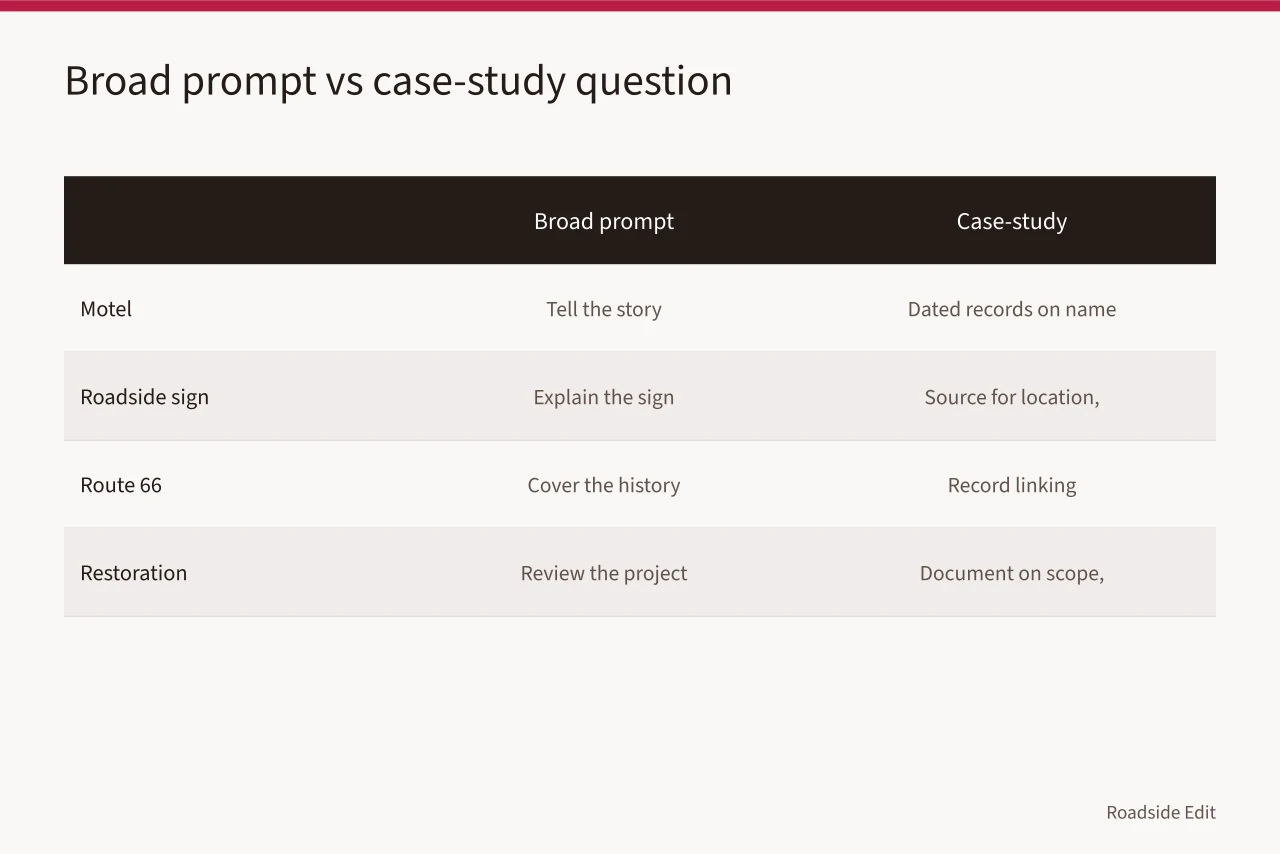
| Broad prompt | Case-study question |
|---|---|
| Tell the story of a motel | What do dated records say about the motel's documented name and appearance? |
| Explain a roadside sign | Which source identifies the sign's location, date, and visible form? |
| Cover Route 66 history | What record connects this defined property to the route or community? |
| Review a restoration | What document describes the reported project scope and its date? |
Do not begin by searching for proof of a favorite conclusion. Begin by listing the questions the article can answer. If a record does not identify a construction date, the article should not supply one from a visual impression. If an image caption is general, do not use it to establish ownership, current operations, or condition.
Write a short research design
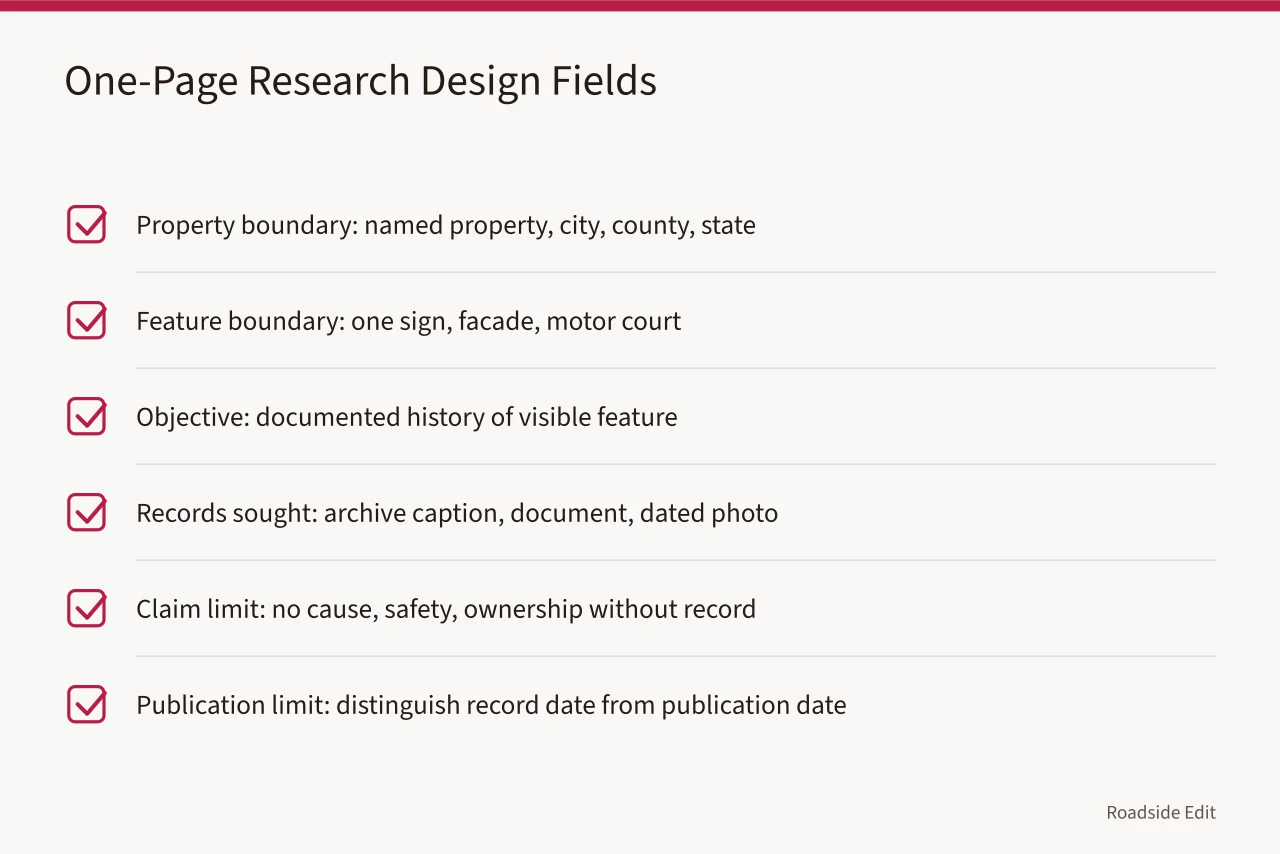
A research design can fit on one page. It names the objective, source types, proposed methods, limits, and sentence categories the article expects to publish.
The National Park Service says historical documentation should follow a research design with objectives that respond to planning needs, use an appropriate method, and record sources so other researchers can verify or locate the information. Read the NPS Historical Documentation Standards.
That guidance supports a disciplined research process. It does not authenticate a specific roadside property or approve work at one.
| Research-design field | Example entry |
|---|---|
| Property boundary | Named property, city, county, and state |
| Feature boundary | One sign, facade, motor court, storefront, or parking area |
| Objective | Identify the documented history of a visible feature |
| Records sought | Archive caption, public document, dated photo, map, or directory |
| Claim limit | No statement about cause, safety, ownership, or treatment without a suitable record |
| Publication limit | The article will distinguish record date from publication date |
The design can change when new evidence appears. Record the change rather than quietly changing the question after the fact. A new archive item may narrow the focus. A missing source may require the article to shift from a historical claim to a description of available records. Both outcomes are valid if the article says what happened.
NPS documentation standards require reliable sources, stated limitations, and information that permits independent verification. See the NPS documentation quality standard. A research design should make those limits visible before the prose makes them hard to find.
Establish a place record
Roadside names repeat. A business can move, change its name, share a name with another location, or exist in several branches. Start every case study with a place record that reduces the chance of mixing one property with another.
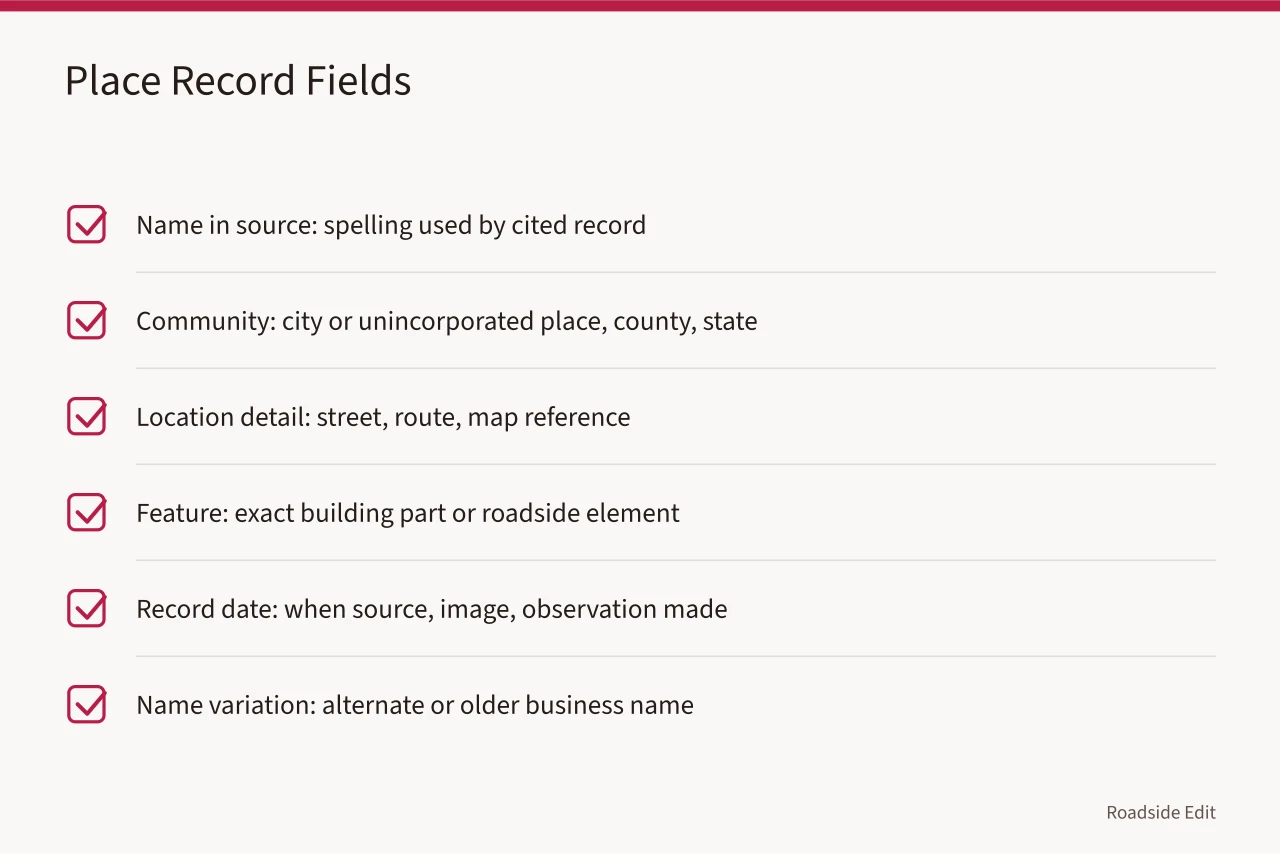
| Field | What to capture |
|---|---|
| Name in source | The spelling used by the archive, agency, or other cited record |
| Community | City or unincorporated place, county, and state |
| Location detail | Street, route, map reference, or other source-provided locator |
| Feature | The exact building part or roadside element under discussion |
| Record date | When the source, image, or observation was made |
| Name variation | Any alternate spelling or older business name used in a record |
The place record is not a legal property file. It is an editorial control. It stops a writer from applying an older image, a neighboring landmark, or a similar business name to the wrong site.
Gather evidence in separate folders
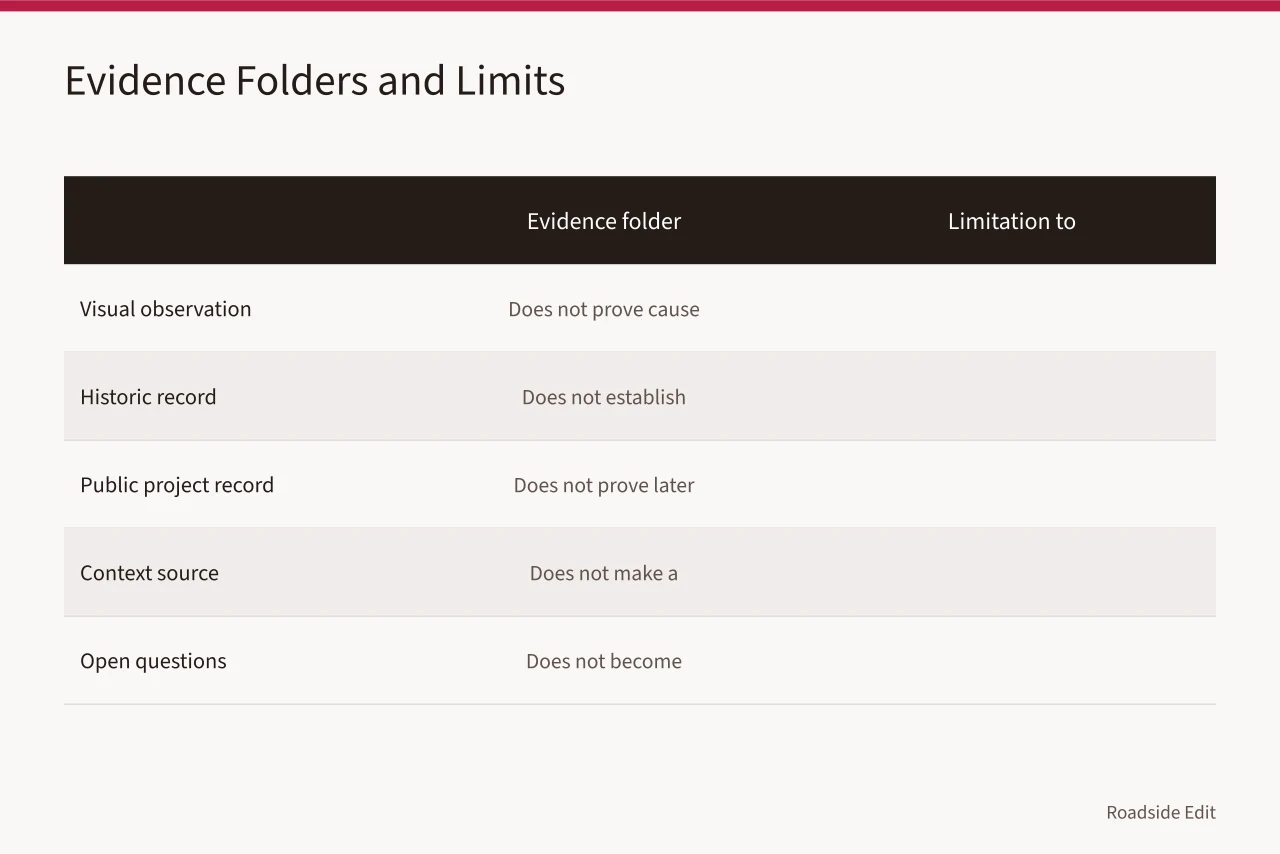
Do not keep all research in one undifferentiated pile; sort evidence by what it can do.
Photographs can show a view, public notices can describe a stated scope, and directories can record an address or listing on a particular date. A later article can offer context, but may not be primary evidence for a claim about one property.
| Evidence folder | Appropriate use | Limitation to state |
|---|---|---|
| Visual observation | Describe what is visible in a dated frame | Does not prove cause or condition beyond the frame |
| Historic record | Attribute a date, name, or description to the source | Does not establish current status |
| Public project record | Report a stated proposal, approval, or scope | Does not prove later completion |
| Context source | Explain a broader building type or research practice | Does not make a property-level finding |
| Open questions | Track needed records | Does not become evidence through repetition |
This separation makes later edits safer. If a historic caption is corrected, the writer knows which sentences depend on it. If a new photo shows a different condition, it belongs in the observation folder rather than replacing the historical record.
Build a claim map before drafting
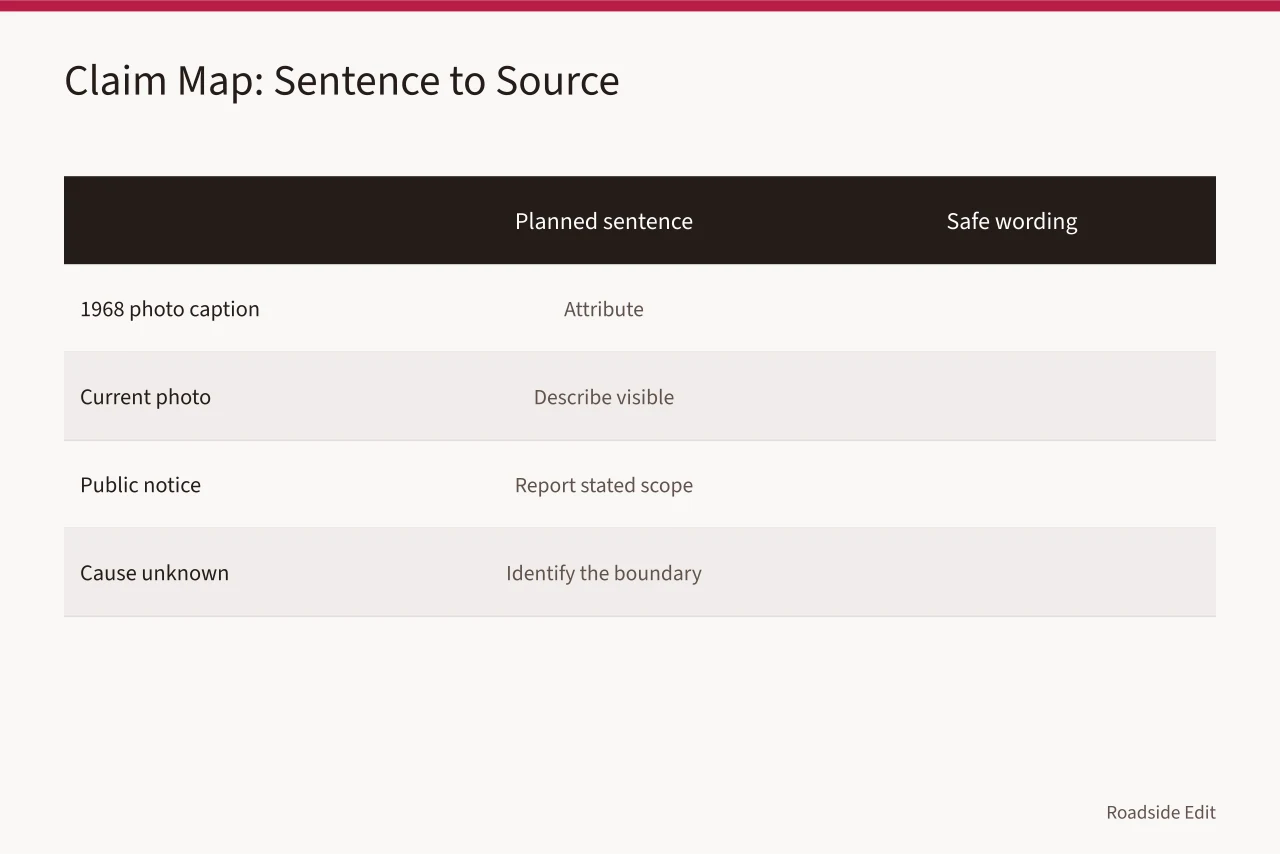
The claim map is a table that links each factual sentence to a source and a limit. A map is especially helpful when a case study mixes old material with new observations. It prevents a polished paragraph from quietly joining facts that came from different dates or places.
| Planned sentence | Source type | Safe wording |
|---|---|---|
| "The 1968 photo caption identifies the property as..." | Historic image record | Attribute the identification and date |
| "The current photo shows..." | Dated observation | Describe the visible feature only |
| "A public notice describes..." | Project record | Report the stated scope and document date |
| "The cause is unknown from the available records." | Research note | Identify the boundary plainly |
If a sentence cannot be linked to a record, decide whether it is an editorial opinion, a question, or an unsupported claim. Opinion should be labelled as opinion when appropriate. Questions can invite further research. Unsupported claims should be removed.
Compare records without forcing a before-and-after story
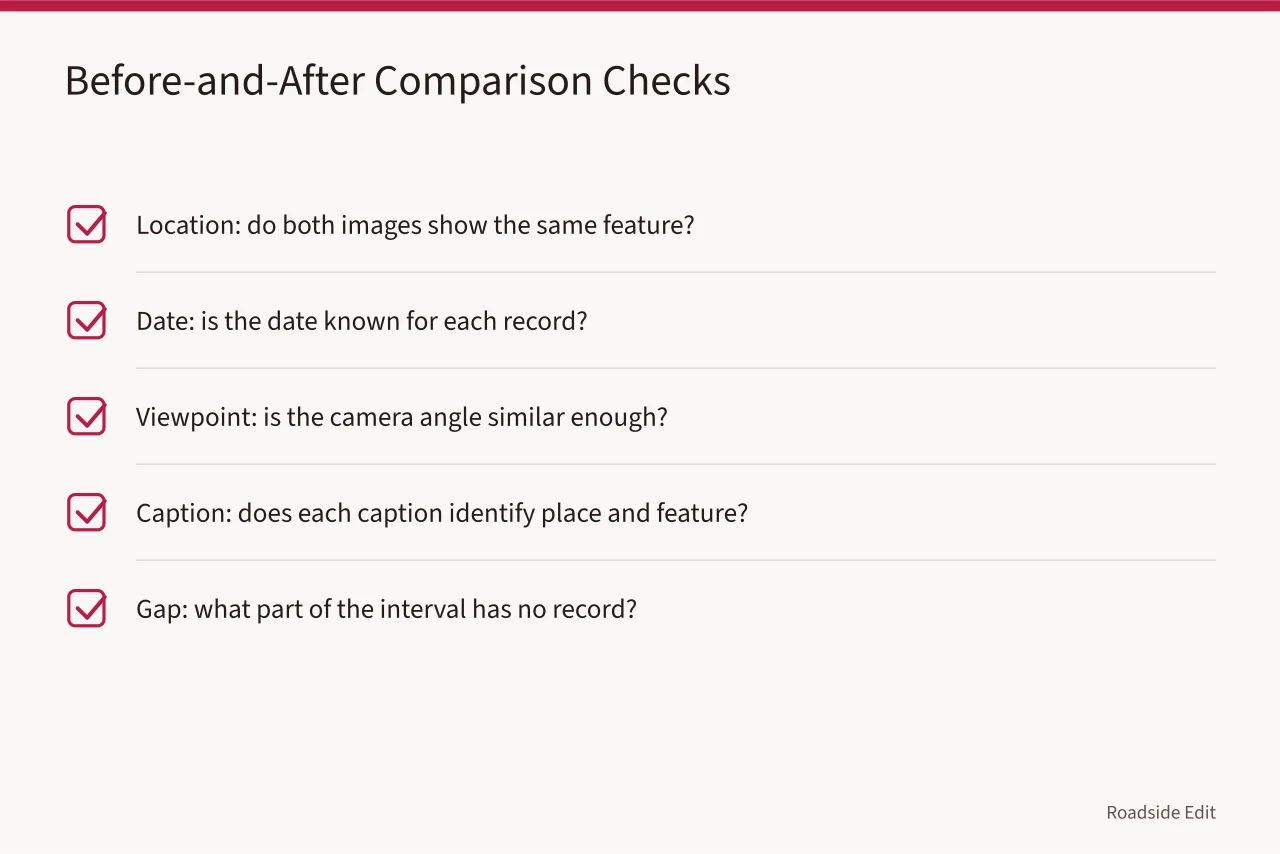
Readers often want a before-and-after comparison. Use it only when the records are comparable. A historical photo and a current photo may have different angles, seasons, camera positions, or crop boundaries. They can still be valuable, but the article should not claim that every difference represents a physical change at the property.
| Comparison check | Question |
|---|---|
| Location | Do both images show the same feature? |
| Date | Is the date known for each record? |
| Viewpoint | Is the camera angle similar enough to compare? |
| Caption | Does each caption identify the place and feature? |
| Gap | What part of the interval has no record? |
A careful comparison can say, "The two dated views show different portions of the sign." It should not turn that fact into a claim about removal, replacement, or deterioration unless a source identifies it.
Write the case study in layers
The article should move from the most certain information to the least certain. Start with the defined property and research question. Then give the source-backed record, add the visible observation if there is one, and end with the limit or follow-up question. That order lets a reader see how the conclusion was reached.
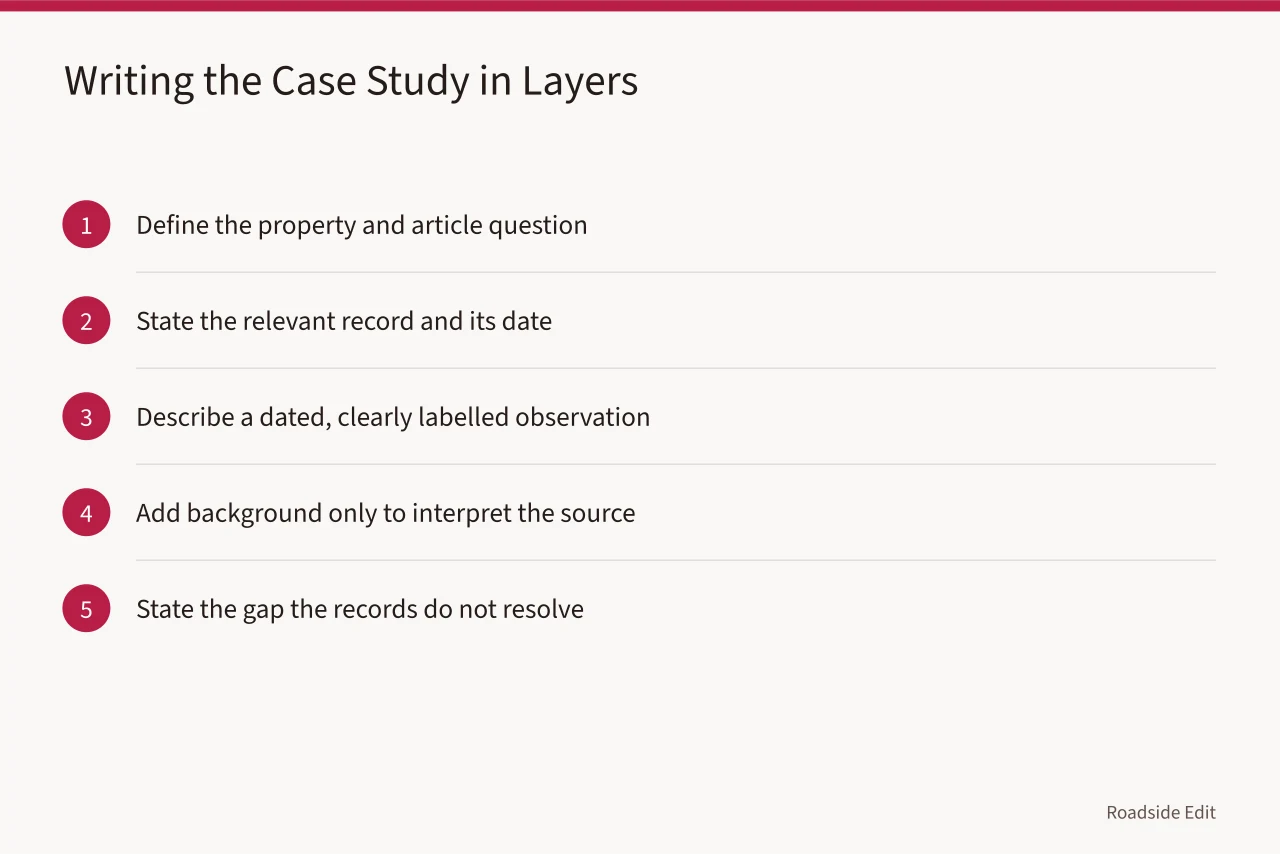
- Define the property and article question.
- State the relevant record and its date.
- Describe an observation only if it is dated and clearly labelled.
- Add background only when it helps interpret the source.
- State the gap that the records do not resolve.
Avoid a dramatic lead that tells readers what they should feel about a roadside place. The evidence should create interest on its own. A specific archive caption, a changed business name, or a clear visual detail is more useful than an unsupported label such as "forgotten," "endangered," or "abandoned."
Use the source limit in the article itself
Source limits belong in accurate public writing, not private notes alone.
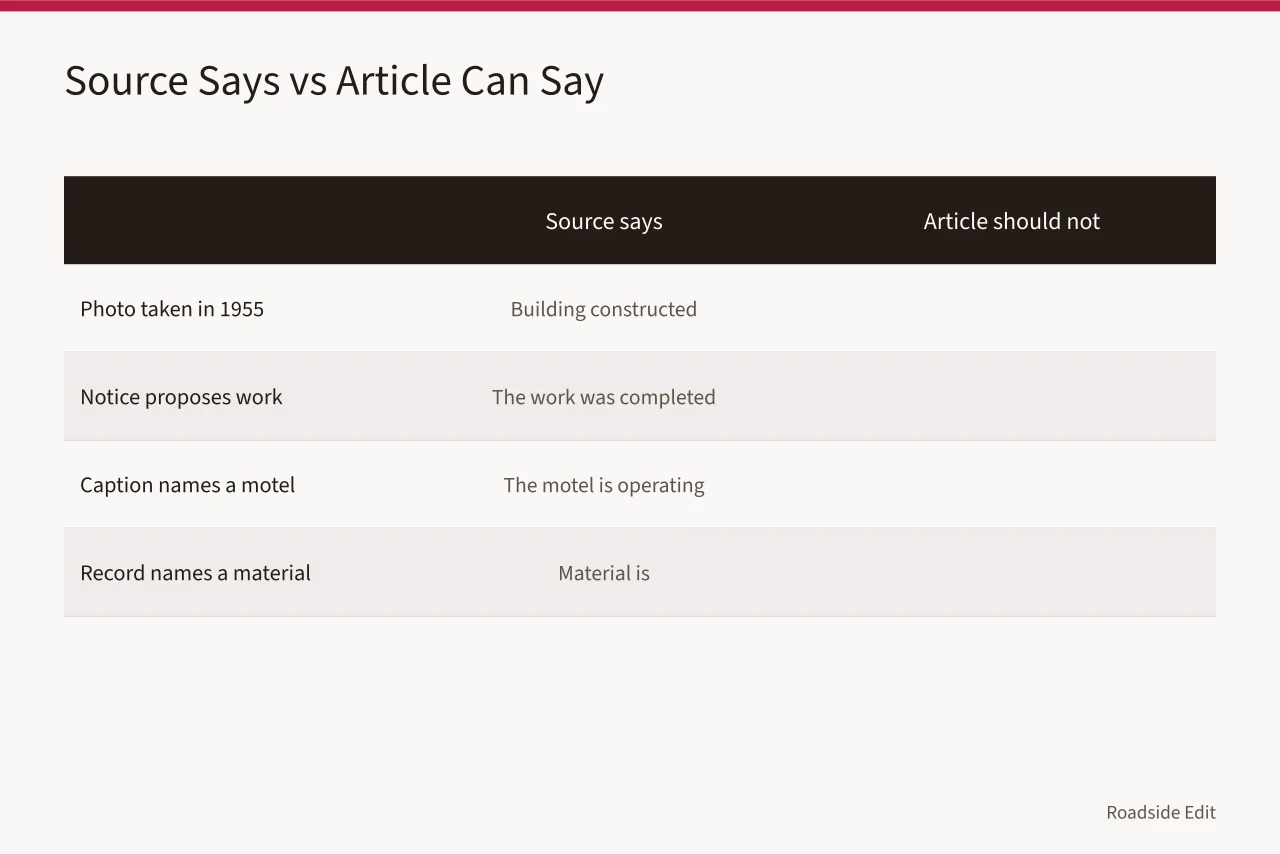
Use "The cited image identifies the location but does not give a construction date" when the limit affects a likely reader inference. Use "The available record describes a proposal, not a completed project" when a document could otherwise be read as evidence of completion.
| Source says | Article can say | Article should not say |
|---|---|---|
| A photo was taken in 1955 | The source dates the photo to 1955 | The building was constructed in 1955 |
| A notice proposes work | The notice describes proposed work | The work was completed |
| A caption names a motel | The caption identifies the motel | The motel is operating today |
| A record names a material | The record names the material | The material is appropriate for new work |
The limit protects a living business as much as it protects the article. It prevents an older image from being used to imply that an owner has not acted, a business has closed, or a feature is unsafe.
The Library of Congress primary-source guide recommends examining a source before drawing conclusions from it. Use the Library of Congress primary-source analysis guide. Put that step ahead of every major case-study assertion, especially a date, status, or condition claim that a reader may repeat later.
Keep a correction and follow-up log
A case study is not finished when it goes live. Keep the research design, source list, claim map, source dates, image credits, and unresolved questions. When a source changes, revise the exact sentence affected and record why. When a reader offers a lead, label it as a lead until a source verifies it.
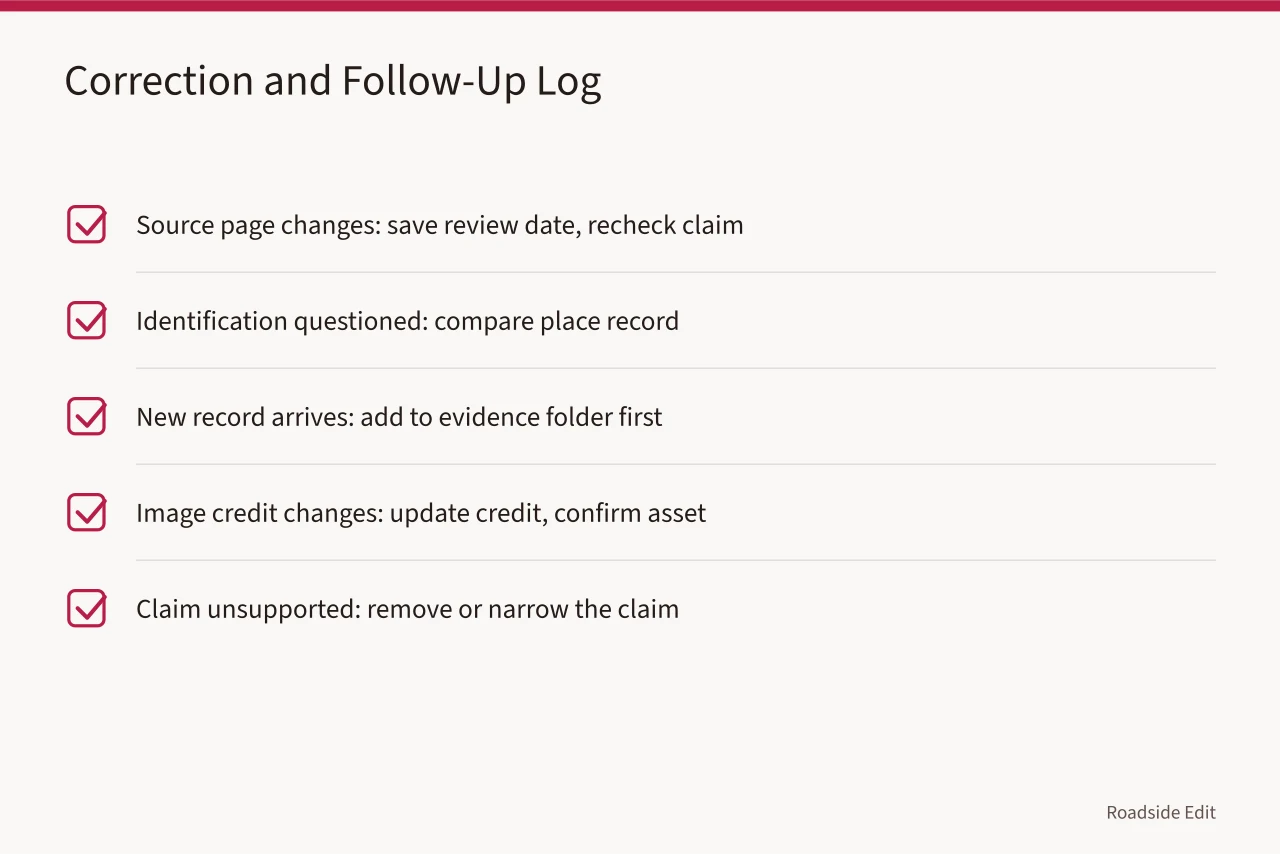
| Event | Action |
|---|---|
| Source page changes | Save the review date and recheck the linked claim |
| Property identification is questioned | Compare the place record with the new evidence |
| New record arrives | Add it to the evidence folder before revising prose |
| Image credit changes | Update the credit and confirm the local media asset |
| Claim cannot be supported | Remove or narrow the claim |
Image records need the same discipline. National Archives guidance for digital photographs calls for identifiers, descriptive metadata, and captions that make images understandable and retrievable. Review National Archives digital photo records guidance. Keep the original source page in the article file, then ensure the published caption stays within what that page establishes.
The method is deliberately modest. It does not turn an article into a preservation report. It makes each statement traceable, keeps old and current evidence distinct, and gives later editors a record they can improve.
Common questions
Can a case study use only one source?
It can, but it should state the narrow claim that source supports. A one-source article should not imply a complete property history or a condition assessment.
Is a photograph enough to establish a building date?
No. A photo can document its own date and visible content when the source provides that information. Construction timing needs a record that actually addresses it.
Should a case study include a project recommendation?
Not unless the article has appropriate, property-specific evidence and authority. This method is for source-bound editorial work.
In this guide
- How to build a roadside architecture case study checklist that editors trustRoadside architecture case study checklist for 2027 helps writers assemble a defined property record, evidence package, source limits, and publication notes.
- Roadside architecture case study questions to ask before you trust a property recordRoadside architecture case study questions for 2027 help writers choose property records, examine source types, and keep local history claims within evidence limits.
- How to write a roadside architecture case study budget note without false cost claimsRoadside architecture case study budget notes for 2027 help publishers plan source review, image records, and scope changes without false cost claims.
- Roadside architecture case study warning signs: how editors catch mixed time periodsRoadside architecture case study warning signs for 2027 help editors spot mixed time periods, unclear photos, unsupported condition claims, and blurred work records.
- How roadside architecture case study records keep sources, credits and corrections straightRoadside architecture case study records for 2027 explain how to retain source IDs, image credits, claim notes, corrections, and unresolved local-history questions.