Guides
Part of Historic motel restoration safety checklist: what owners must record in 2027
How historic motel owners should keep 2027 safety records separate from decisions
Historic motel safety records for 2027 show how to label observations, sources, decisions, corrective-action status, and limits without mixing their purposes.
Safety records help a motel distinguish what was observed, what source exists, what decision was made, and what still needs review. They are strongest when each entry has a clear role.
What to take away
- Give each record a source type and status.
- Preserve the difference between an observation and a correction.
- Keep private operational details out of public content.
- Use dates and correction notes to preserve the decision trail.
Build a record register
The National Park Service describes a risk-assessment worksheet used to identify and document risk factors and establish baseline data, alongside related emergency-planning forms. Review the NPS emergency-planning worksheet page. The resource is for NPS museum work, not a motel program, but it supports the discipline of documenting the source and purpose of each record.
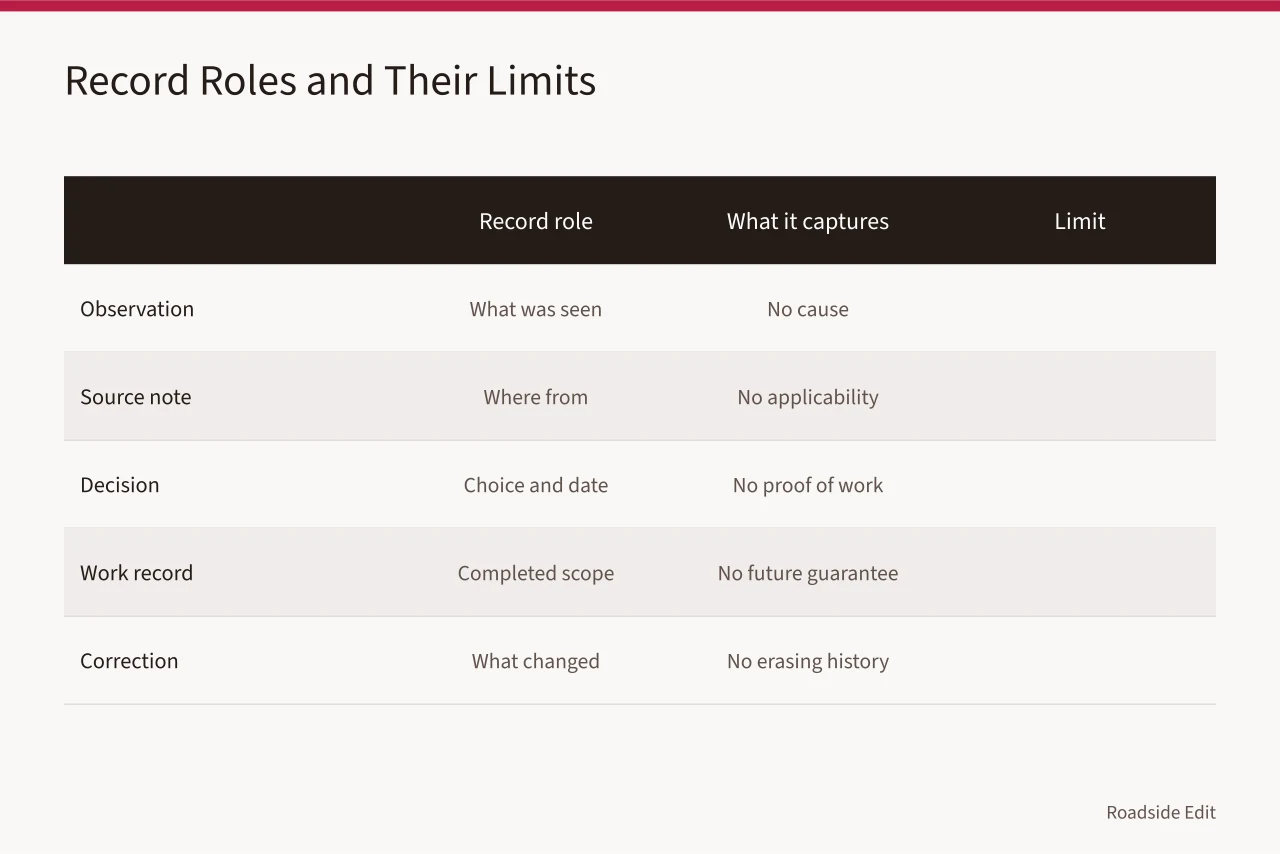
| Record role | What it captures | Limit |
|---|---|---|
| Observation | What was seen or reported | It does not establish cause |
| Source note | Where a statement came from | It does not decide applicability |
| Decision | A documented choice and date | It does not prove completed work |
| Work record | Reported completed scope | It does not guarantee future performance |
| Correction | What changed and why | It does not erase earlier history |
Keep evidence and decisions separate
NPS documentation standards call for reliable sources and stated limitations that allow another person to check a record. Read the NPS documentation standard. Give every entry a source title, source date, location label, record role, and limitation. If a record is incomplete, mark it as incomplete rather than letting the status field imply a conclusion.
The NPS fire-prevention overview describes building fire inspections as a route to identifying hazards and recommending prevention measures. Review the NPS fire-prevention overview. A public record is not that inspection. It can preserve the evidence trail and identify where property-specific review belongs without making a finding about a motel.
| If the record contains | Keep this status |
|---|---|
| A dated image or report | Observation or source note |
| A proposed action | Proposal, not completed work |
| A documented decision | Decision, with issuer and scope |
| A completion record | Work reported completed, with date |
| A later contradiction | Correction, with both records retained |
Keep public records safe to publish
Do not include emergency plans, equipment locations, access controls, contact lists, or other operational detail in public copy. A public-facing record should show how to label evidence, corrections, and limits. The responsible property and qualified reviewers should maintain the specific information in appropriate controlled records.
Preservation Brief 51 notes that code application to historic buildings needs a project-sensitive approach. Review NPS guidance on building codes. It does not establish a code result for this property. Keep the question and source in the record until an applicable review provides an answer.
Use a consistent correction format. Record the original claim, new source, review date, affected feature, and outcome. If a newer document conflicts with an older one, keep both entries and state the conflict.
The public article can call the record unresolved. Do not pick a result based only on which item is newer or easier to quote.
Maintain this history.
Add a correction trail
When a new source changes a record, retain the original entry and add a dated correction. Name the source, state what changed, and explain whether the update affects location, status, or wording. Do not silently turn an open question into a confirmed result.
Keep sensitive security, emergency, contact, and access details in the appropriate controlled system rather than a public article. The public-facing record should explain editorial limits, not expose operational information.
Check the status before reuse
Before copying a record into a new article, confirm its date, source role, and status. A two-year-old observation should not appear as a current condition. A decision note should not be written as completed work. If the underlying document cannot be found, label that limitation instead of treating a summary as the original evidence.
Common questions
Can an image be used as a safety record?
It can document appearance at a date and place. It cannot by itself prove a hazard, code status, or completed correction.
What should a correction include?
Include the date, new source, affected record, and reason for the change. Preserve the earlier entry with a clear superseded note.
Why label a work record separately?
A work record states what documentation reports as completed. It should not be confused with an observation, recommendation, or assurance about future results.