Guides
Part of Historic motel restoration safety checklist: what owners must record in 2027
Historic motel restoration safety checklist: how to scope 2027 observations and handoffs
A historic motel restoration safety checklist turns a field walk-through into recorded observations, named reporters, and licensed reviewer handoffs.
A safety checklist earns its keep when a stranger can stand at the same door, read the entry, and see the same thing. It records evidence and routes questions. It never rules on code.
What to take away
- One location label per entry, reused word for word in photos and later notes.
- Record the visible fact first. The cause goes in a separate field, unanswered.
- Every entry carries a source ID: photo frame, report date, or the words "no record."
- Name the licensed role that owns the next step, not the answer you think it will give.
- Keep access routes, alarm details and tank locations out of anything published.
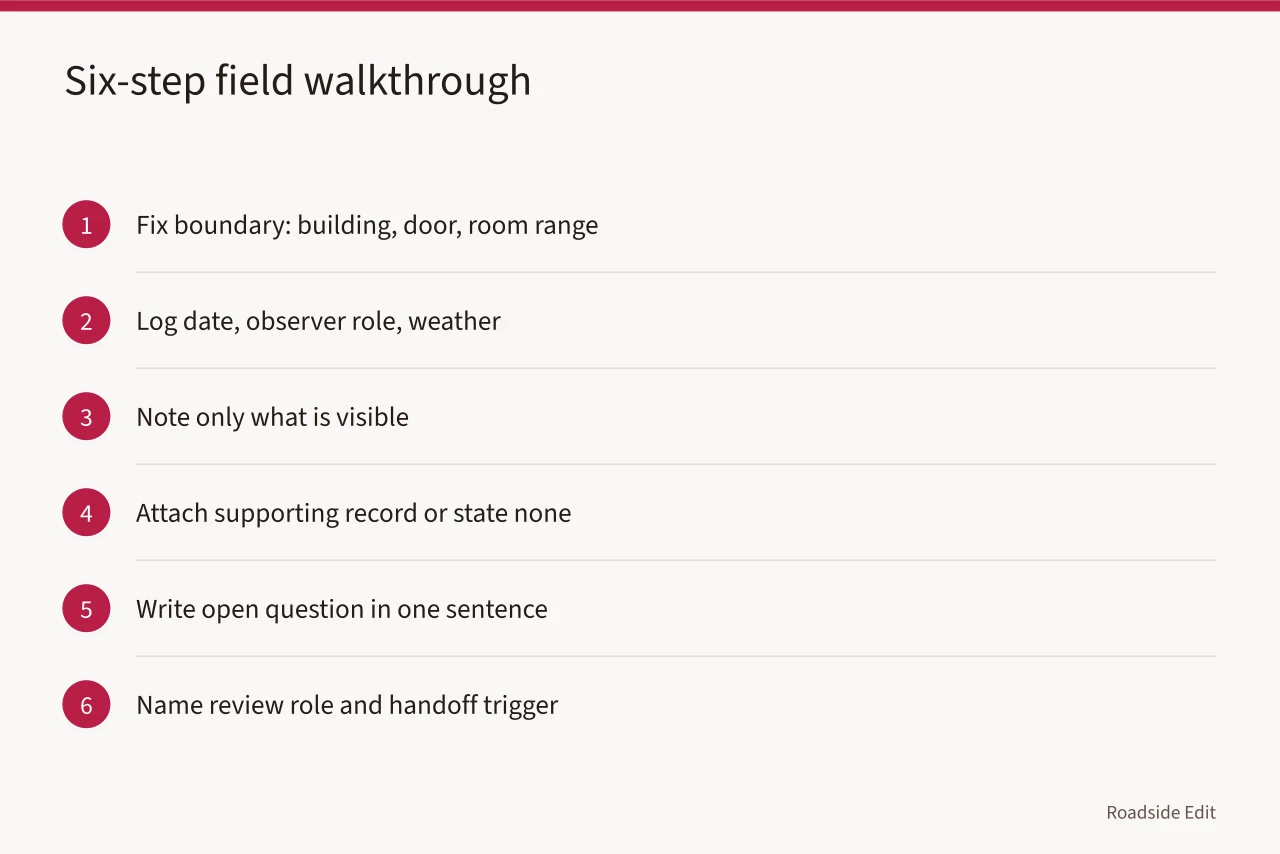
Walk the property in six steps
- Fix the boundary before you start: which building, which door, which room range. Write the access limits down.
- Log the date, the observer's role, and the weather if the observation depends on it.
- Note only what is visible, or mark the item as reported by someone else.
- Attach the supporting record or state that none exists.
- Write the open question in one sentence, without a guess at severity.
- Name the review role and what triggers the handoff.
Corrections stay visible. A later entry refines an earlier one. It does not erase what was known that day.
The field table
| Field | What goes in it |
|---|---|
| Location | Building, elevation, entrance, room range, or exterior area |
| Date | When the observation was made or the report received |
| Entry type | Observation, source note, secondhand report, or open question |
| Evidence | Photo frame, plan sheet, invoice, report, or none available |
| Status | Open, referred, decision documented, work documented |
| Next role | The person or authority who can review the question |
Read the feature before you name it
A 1950s porcelain-enamel station sign and a 1960s plastic-faced box sign photograph differently and fail differently. Enamel chips at the mounting holes; plastic yellows and the face cracks at the fastener. Write down which one you are looking at, because the replacement path diverges from there.
The same discipline applies to a motel exterior. Brick veneer, curtain-wall glazing and a butterfly roof each date a building and each carries its own maintenance history. A canopy soffit with a dry-stand pipe tells you the forecourt was plumbed for a system someone still owns. Record the pipe. Do not open it.
National Park Service guidance on building codes holds that historic buildings must meet current safety and performance requirements, and that applying code to them takes a project-sensitive approach. Read Preservation Brief 51 on historic building codes. That is a planning frame. It is not a finding about any motel.
Separate the observation from the report from the referral
The NPS fire-prevention overview describes trained building fire inspections as a way to find hazards and recommend strategies. Review the NPS fire-prevention overview. A public checklist is not that inspection and should not read like one.
Three entries, three fields. A photo of a damaged handrail at the north office entry is an observation. A May 2026 report mentioning a handrail concern is a reported item. A licensed reviewer deciding whether action is required is a referral. Blur them and the file loses its value the first time someone asks who said what.
Hand off by feature type
| Entry concerns | The checklist does | Who owns the next step |
|---|---|---|
| A visible feature | Photograph, date, locate it | The property's own maintenance process |
| A code question | Preserve the question and the date | The authority having jurisdiction, or a licensed design professional |
| A secondhand report | Keep the report date and the reporter's role | The role named in the property's process |
| An urgent concern | Follow the property's established emergency procedure | The property's emergency contact, not this page |
Structural, electrical and hazardous-materials questions leave the checklist entirely. A canopy, a neon transformer bank or an underground tank goes to a licensed engineer, a licensed electrician or the environmental authority for that jurisdiction. The checklist records that the referral happened and when.
Cite the source, state the limit
NPS documentation standards ask for reliable source material and stated limits, so another person can check the record. Read the NPS documentation standard. Put the source title, source date, location label and limitation on the same line as the entry.
If a source does not establish cause, severity or compliance, write that it does not. An empty field is honest. A filled field with a guess in it is not.
Write it so it travels
"Surface damage observed at north office entry" survives a change of editor. "Unsafe entry" does not, because it asserts a conclusion the file cannot support. Use the same location words in photos, notes and later project records so entries can be compared without guessing which door a previous writer meant.
NPS life-safety planning material treats records review and structure survey as one system. Read the NPS fire-protection assessment example. One photo of one room is not that survey. The checklist's job is to stop anyone treating it as one.
Keep the published version thin
Do not publish access routes, security arrangements, emergency controls or operational vulnerabilities. Public copy explains the difference between an observation and a decision, shows how to record a source, and says when a licensed or local review is needed. Property-specific operational material stays inside the property's own process.
Common questions
Is a checklist the same as an inspection?
No. A checklist captures observations and documents them. Formal inspection and code interpretation require the authority and the qualifications that go with them.
What if no source record exists?
Write that no record is available. A missing file does not prove a feature is absent, sound or noncompliant.
Can a public article list emergency details?
Keep controlled operational and security details out of published copy. The article covers recordkeeping boundaries and general practice, nothing site-specific.
Who decides whether an observation becomes a repair?
The owner, with the licensed professional who holds the relevant scope. The checklist's last field names that role and stops there.