Guides
Part of Historic motel restoration safety checklist: what owners must record in 2027
Historic motel restoration safety checklist: warning signs to catch before 2027
Historic motel restoration safety warning signs help writers catch unsupported hazard claims, drifting scope, and wording that needs a qualified reviewer.
A safety warning in an editorial record is a prompt for better evidence, not a diagnosis or a code conclusion. The wording that fails most often is not the dramatic claim. It is the quiet one: a sentence that starts on one canopy bay and ends on the whole motel.
What to take away
- Name the location, the date and the source in the same sentence, or cut the claim.
- Watch for "all," "every" and "the building" when the evidence covers one bay or one photograph.
- Keep "observed" and "assessed" as separate words with separate owners.
- Never publish access points, response steps or equipment locations.
- Route every hazard question to the authority having jurisdiction and a licensed reviewer.
The five-part scope-drift check
Run each sentence through five fields before it stays.
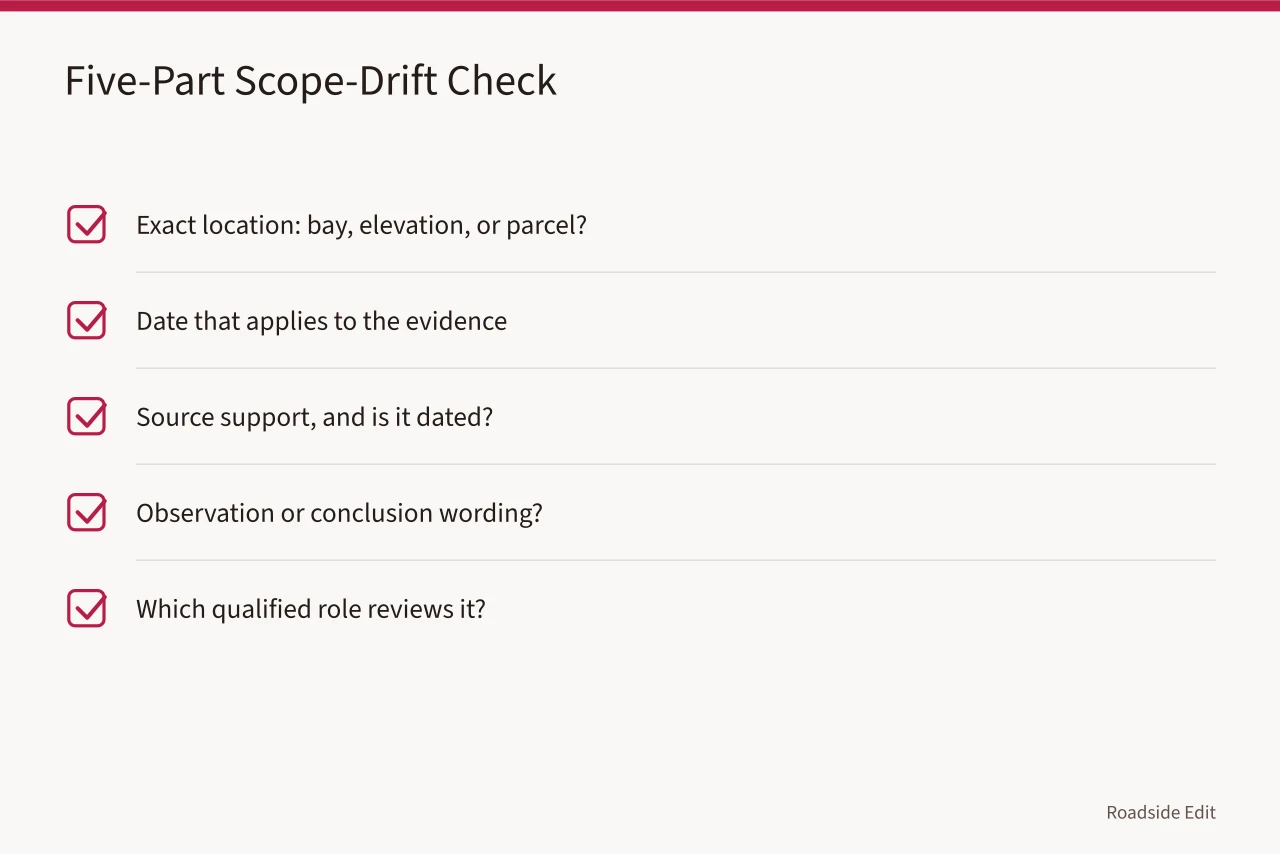
A sentence that cannot fill all five is not wrong. It is unfinished. Reduce it until it is true.
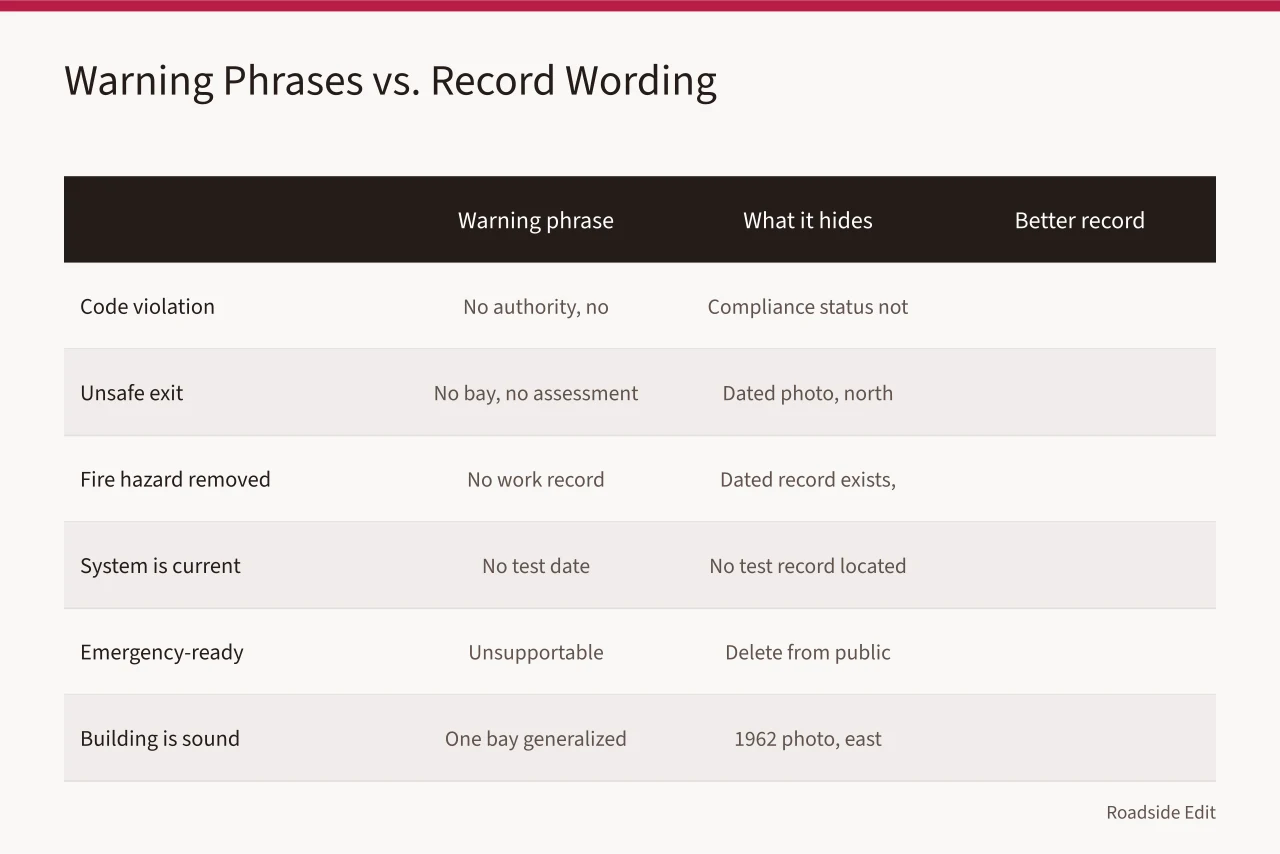
Warning phrases and the wording that replaces them
| Warning phrase | What it hides | Better record wording |
|---|---|---|
| "Code violation" | No authority, no citation | "Observed condition; compliance status not determined. Refer to the AHJ." |
| "Unsafe exit" | No bay, no assessment | "Photograph dated [date] shows this door at the north end of the canopy." |
| "Fire hazard removed" | No work record | "A dated work record exists; outcome not verified in available files." |
| "System is current" | No test date | "No test record located for this system as of [date]." |
| "Emergency-ready" | A public assurance nobody can support | Delete. Operational status does not belong in public copy. |
| "The building is sound" | One bay generalized to the parcel | "The 1962 photograph shows the east elevation only." |
| "All exits clear" | Survey covered one visit | "Conditions at the time of the [date] site visit, west side only." |
The National Park Service treats ignition prevention as the first line of defense and trained inspections as the way hazards get identified. See the NPS fire-prevention overview. That framework supports the need to separate a reported concern from an assessed condition. It does not license a public article to name a hazard at a specific motel.
Observations and assessments are different records
NPS life-safety planning material describes reviewing available records and surveying a structure as a total system. Read the NPS fire-protection assessment example. A writer can do none of that. A writer can say what a source records, what a dated image visibly shows, and what stays open for a licensed reviewer.
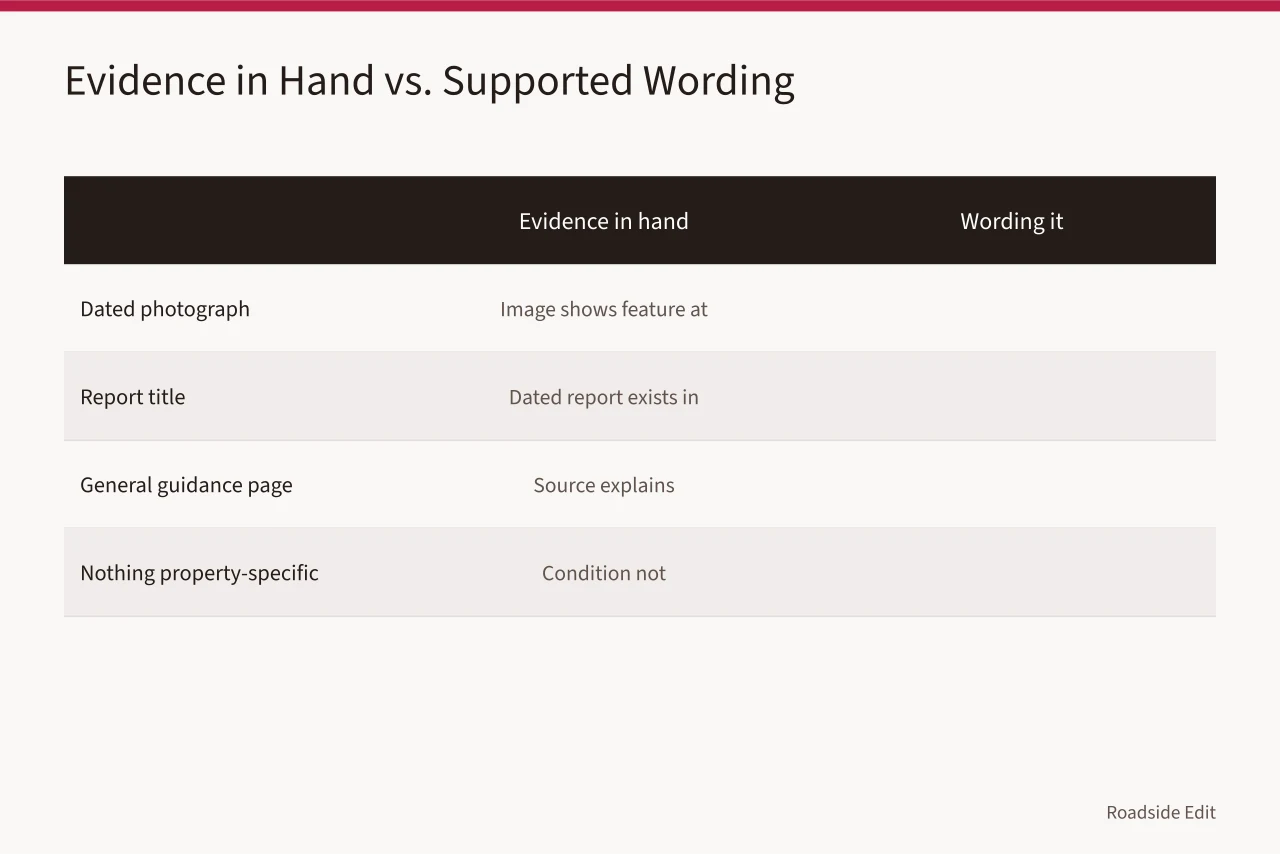
NPS code guidance holds that historic buildings must meet safety and performance requirements while project-specific application takes care. Review Preservation Brief 51. That brief is a framework. It is not a ruling on any motel, and no article should read as one.
Where drift enters a restoration article
Scope drift usually arrives with a real detail attached. A surveyor notes spalling on one canopy soffit. The draft says the canopy is failing. The next draft says the building is unsafe. Each step is small and each step is unsupported.
Three places to check:
- Captions. A caption is the easiest place to overreach, because it sits under a photograph that seems to prove it. Date the image and bound the frame.
- Headings. A heading that says "hazard" commits the section to a conclusion the body cannot deliver. Say "open questions" instead.
- Summaries. A summary compresses, and compression drops the location and the date first. Put them back.
NPS documentation standards call for reliable sources and stated limits so a record can be checked by someone else. Read the NPS documentation standard. The limit is part of the record, not a disclaimer bolted on at the end.
What never goes in public copy
Do not publish controlled access points, response procedures, equipment locations or security arrangements. That holds even when the detail is accurate and even when it came from a public meeting. The property and its qualified reviewers run the response through their own process.
The same restraint covers jurisdiction-specific questions. Permit approvals, compliance rulings and easement terms belong to the State Historic Preservation Office, the local landmarks commission or the adopted ordinance, and to the attorney or accountant who reads them. Name the authority. Do not state the rule.
A review note that travels with the file
Close every revised statement with four lines: the source examined, the property feature covered, the date, and the wording limit. A neon tube count from a 1968 sign permit, for instance, covers the sign face on that date and says nothing about the transformer load today.
Keep the note in the article's source file, not in the published text. It tells the next editor why the sentence stops where it stops, and it is the cheapest guard against a later hand adding a conclusion the cited record never made.
Common questions
Does a warning sign prove a danger exists?
No. It marks wording that claims more than the record supports. A property-specific conclusion needs an assessment by the qualified professional who owns that question.
Should an article name a code violation?
Only where a reliable, property-specific record supports the wording and publication is appropriate. Most editorial records should state the observation and refer the question to the authority having jurisdiction.
Why cut reassuring language?
"Safe," "ready" and "current" read as guarantees. A record should carry only what the dated evidence supports, and anything else invites reliance the writer cannot back.
Who reviews a sentence I cannot finish?
The role that owns the subject: a licensed engineer for structural questions, a licensed electrician for service equipment, the environmental authority for tanks and soils, the SHPO or landmarks commission for compliance. Name the role and stop.