Guides
Part of Historic motel restoration safety checklist: what owners must record in 2027
Historic motel safety checklist questions: what to ask before you decide
Historic motel safety checklist questions for 2027 help teams separate what a photo shows from what a licensed reviewer must decide on site.
The questions below are worth asking before anyone commits money to a historic motel. Each one names the record that answers it, because a question without a record request is just worry.
What to take away
- Ask for the record, not the verdict: the fire marshal's inspection report, the elevator certificate, the boiler inspection, the roof report.
- Match each question to the role that can answer it, so no one signs off outside their licence.
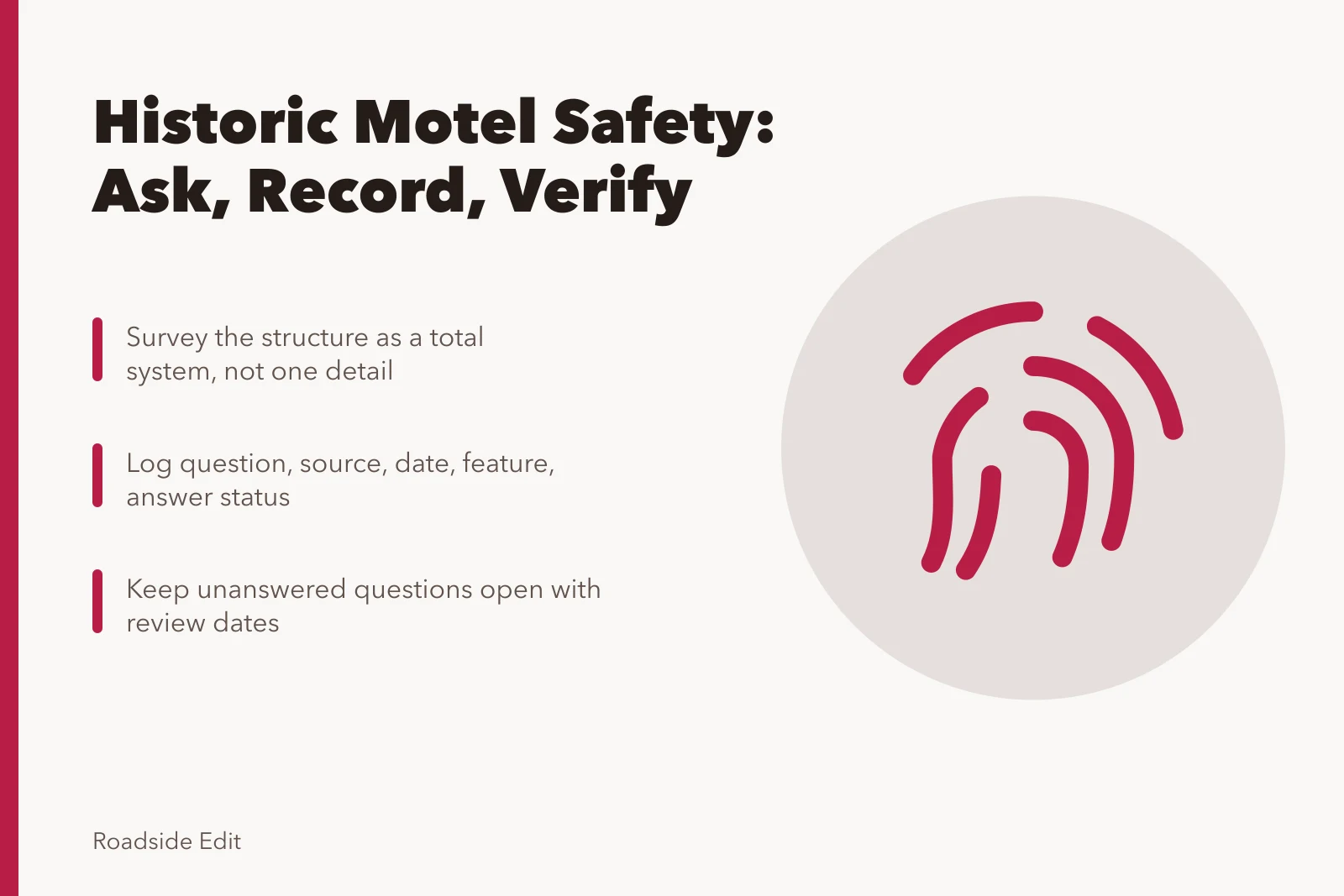
- Keep a question log with a stable ID, the date asked, and the record received.
- Never publish occupancy limits, travel distances, or risk ratings you cannot source to a dated document.
- A photo documents appearance at a time and place. It decides nothing about code.
The checklist questions, by category
Work down the list. The right-hand column is what a useful answer looks like.
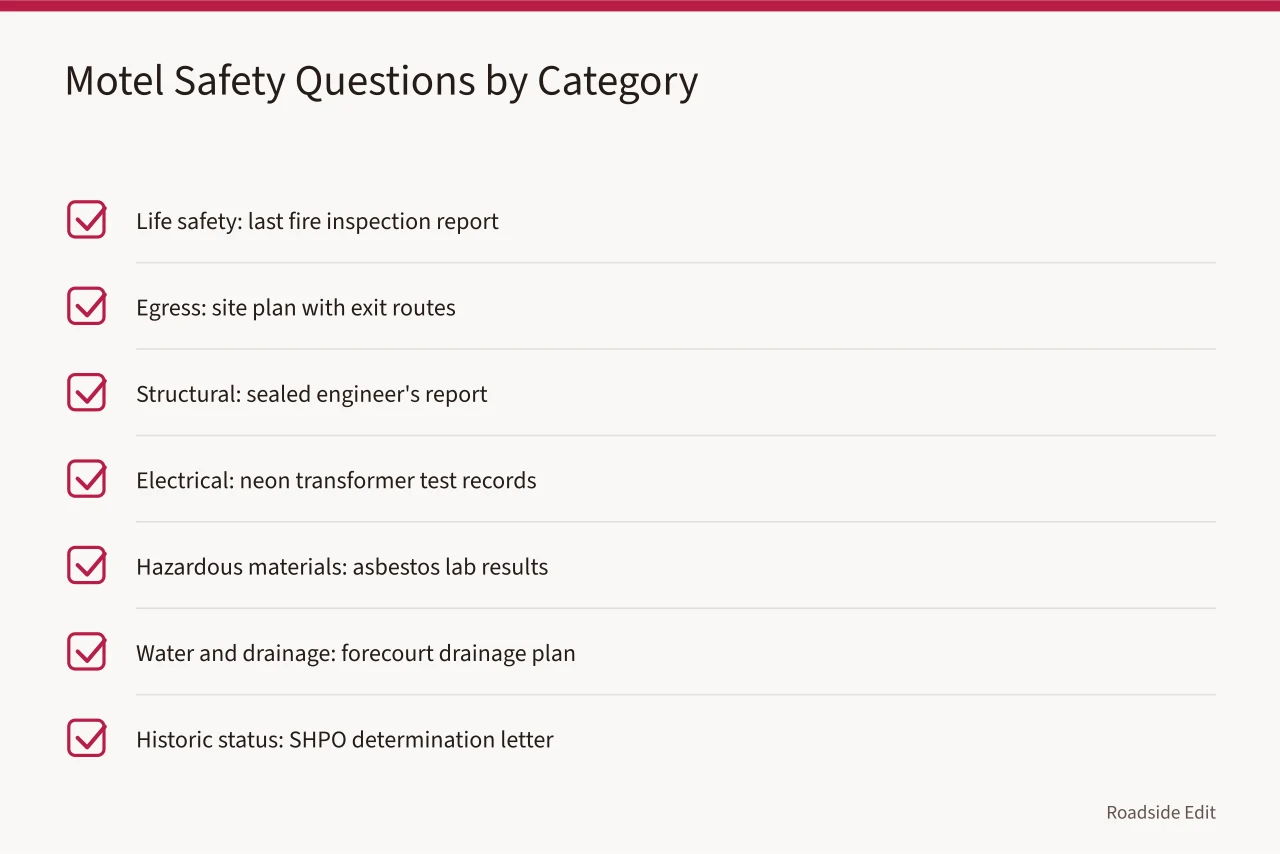
| Category | Question to ask | Record to request |
|---|---|---|
| Life safety | When was the last fire inspection, and who holds the report? | Dated inspection report from the fire marshal or AHJ |
| Egress | Which doors, stairs, and exterior walkways serve each unit? | Site plan with unit numbering and exit routes |
| Structural | Has a licensed engineer reviewed the canopy, balcony, or butterfly roof? | Sealed structural report, dated |
| Electrical | What feeds the neon transformer bank, and when was it last tested? | Electrician's report and service records |
| Hazardous materials | Has anyone sampled for asbestos in floor tile, mastic, or duct wrap? | Accredited lab results with sample locations |
| Water and drainage | Where does the forecourt and parking apron drain? | Drainage plan or civil drawings |
| Accessibility | What is the current route from parking to the office? | Accessibility survey by a qualified consultant |
| Historic status | Is the property listed, eligible, or within a survey area? | SHPO determination letter or survey record |
| Ownership | Who signs for work on the building? | Title record and written authorisation |
| Insurance | What does the carrier require before reopening? | Current policy conditions in writing |
What each question actually turns up
The fire inspection report is the single most useful document, because it lists observed conditions and the date someone looked. Ask for the full report, not a summary.
The elevator and boiler certificates matter in any motel with more than one storey or a central plant. They are renewed on a schedule, so a gap in the dates is itself information.
An asbestos survey tells you whether a licensed abatement contractor needs to be in the budget before anyone touches the tile.
The SHPO determination decides which review path applies. Preservation Brief 51 explains how historic buildings meet current codes through project-specific review, not blanket exemption.
Separate observation from assessment
An observation is what a dated photo or site visit shows. An assessment is what a licensed professional concludes. Keep them in different columns.
The NPS fire-prevention guidance treats inspection as the step that identifies hazards and recommends prevention measures. Read the NPS fire-prevention overview. That step belongs to the inspector, not to a public article.
The same discipline applies to documentation. The Secretary of the Interior's standards call for reliable source material and stated limits, so a record stays checkable years later.
Keep a question log
Give every question a stable identifier, such as HM-014, and never reuse it. The log row carries the question, the date asked, the record received, the feature it covers, and the role responsible.
A later answer cites the actual report and keeps the original limitation. That stops a broad question from being quietly rewritten as a claim the file never supported.
When a question has no answer yet, leave it open. An open row tells the next reviewer exactly what remains unresolved.
Write questions that can be answered
"Does the motel meet current fire code?" cannot be answered from a photo or a web page. "Which local official should assess the documented concern at the north entry?" can be routed to a person.
| Question type | Published limit |
|---|---|
| What does this image show? | Appearance only, at a stated date |
| What requirement applies here? | Set by the local ordinance, not this article |
| Was a concern reviewed? | Only a dated report or decision record proves it |
| What happens next? | Handled by the responsible property's own process |
Do not publish emergency equipment locations, access patterns, or controlled areas. The property manages those through its own channels.
Avoid false precision
Skip risk ratings, travel distances, occupancy limits, and performance labels unless a dated property record supports them. A number reads as useful while hiding an assumption nobody checked.
Where a figure matters and you do not have it, write the arithmetic in named variables. Cost per survey day times days, plus travel, plus fabrication, is honest. A single invented total is not.
"Not determined in available records" is a complete and defensible answer.
Where the questions overlap with other trades
Fuel forecourts, canopies, and underground tanks raise a parallel set of questions with their own authorities. Gas station preservation safety questions covers that side of the corridor.
For the recordkeeping method behind these questions, the NPS museum fire-protection chapter describes reviewing available records and surveying a structure as one system.
Common questions
Who should answer a safety question?
It depends on the question. The log should name the local authority, qualified professional, or responsible property role, without pretending an article can decide it.
Can a photo answer a code question?
No. It documents appearance at a time and place. Code interpretation belongs to the authority having jurisdiction.
Why keep unanswered questions?
They show the next reviewer what remains open and stop uncertainty from hardening into a claim no record supports.
Which record should I request first?
The most recent fire inspection report. It is dated, it lists observed conditions, and it names who looked.