Guides
Part of Historic motel restoration safety checklist: what owners must record in 2027
How to write historic motel safety budget notes for 2027 without price claims
Historic motel safety budget notes for 2027 label each figure by source, scope and status so no planning allowance reads as a project price.
A safety budget note records where a number came from, what it covers, and whether anyone has approved it. It is not a project estimate unless the source says so.
What to take away
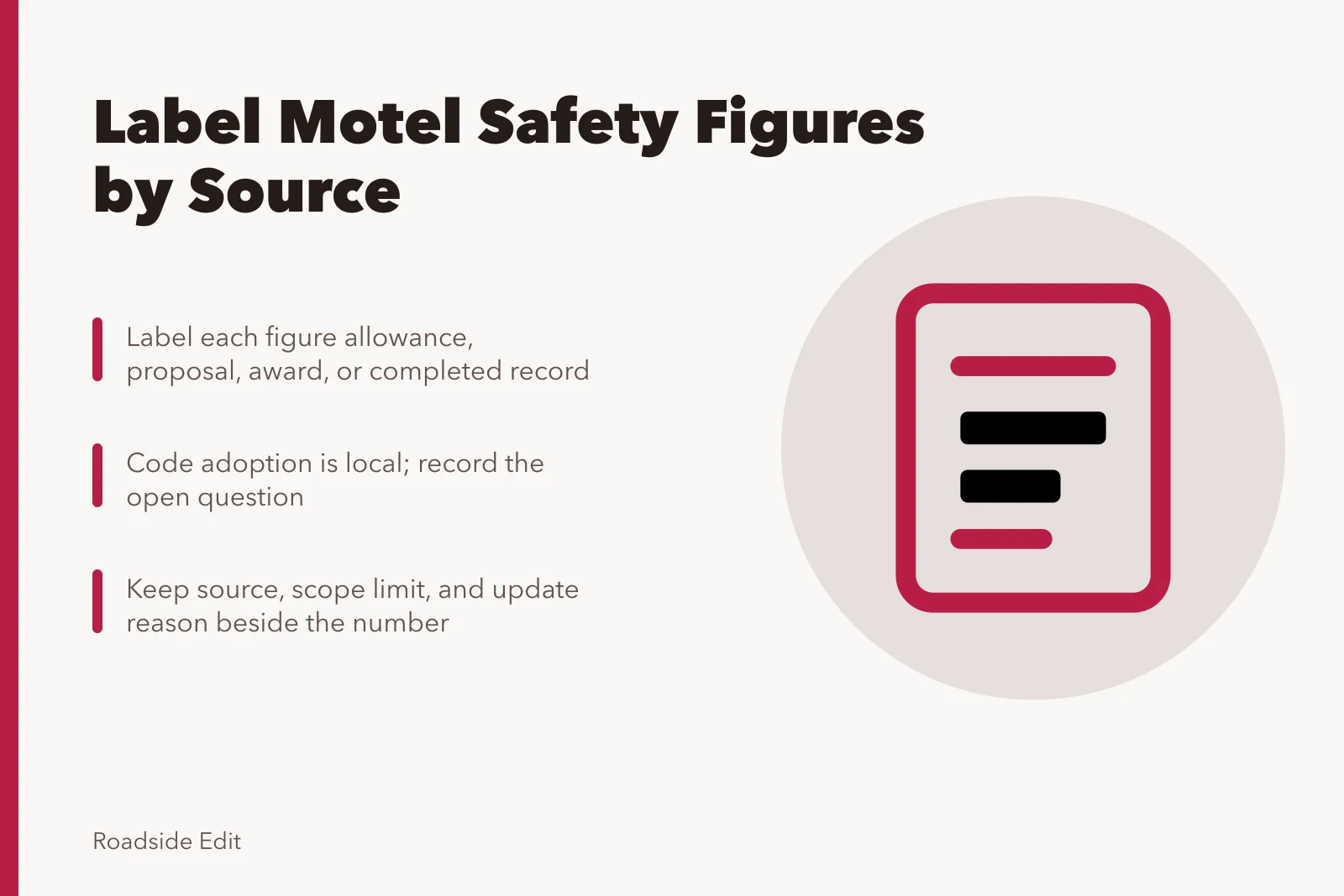
- Label every figure as allowance, proposal, award, or completed record, and date it.
- Code adoption is local. Write the open question, not an assumed requirement.
- Keep source, scope limit and update reason beside the number, not in a separate file.
- Never publish an inferred figure as a fact about a property.
- Re-check an old number against the new question before reusing it.
The code boundary is a question, not a line item
The National Park Service notes that code adoption varies by jurisdiction, and that early consultation helps a rehabilitation meet current requirements without losing character. Read NPS guidance on codes and regulatory requirements.
Nothing in that guidance sets a requirement or a cost for a particular motel. Your record should carry the question, the authority that answers it, and the date it was asked. The State Historic Preservation Office or the local landmarks commission answers the preservation side; the building official answers the code side.
Map the source to the label
Different sources produce different kinds of numbers, and the label should follow the source rather than the reader's hope.
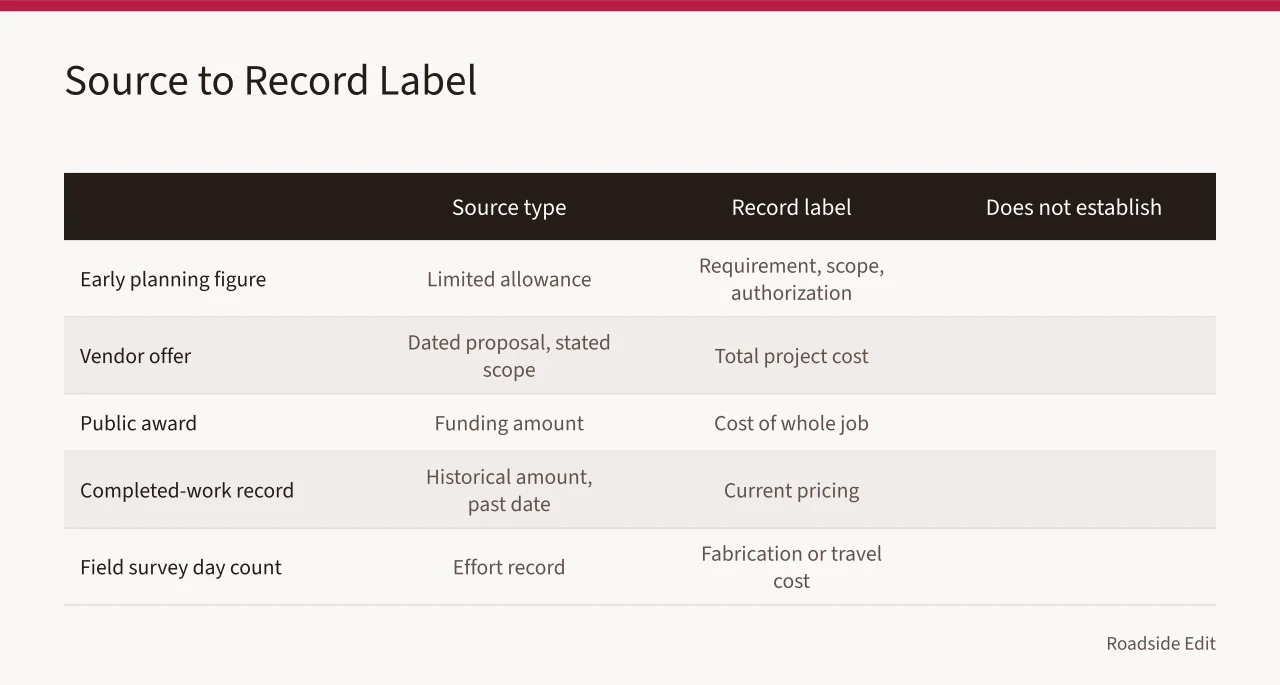
| Source type | Record label | What it does not establish |
|---|---|---|
| Early planning figure | Limited allowance | Local requirement, scope, or authorization |
| Vendor offer | Dated proposal with stated scope | Total project cost |
| Public award | Funding amount | Cost of the whole job |
| Completed-work record | Historical amount, past date | Current pricing |
| Field survey day count | Effort record | Fabrication or travel cost |
The NPS cost-estimate definitions separate conceptual, design and later estimate uses. Review the NPS estimate definitions. A safety budget note should keep the source's own label rather than upgrading it because it is the only number on the page.
The General Services Administration explains that estimates move as requirements and scope sharpen. Read GSA's cost-management guidance. A later number is therefore not evidence that the earlier one was wrong. Say what changed: scope, date, or the role of the source.
Cost structures worth separating
Roadside work rarely arrives as one figure. A canopy soffit survey, a dry-stand pipe inspection, a neon transformer load check and a booth laminate replacement are four different trades with four different rate bases.
Split the record along the lines the trades actually bill on: survey days, travel, and fabrication. A diner interior budget case shows the same split applied to laminate, chrome-edge trim and booth rebuilds.
Where a rate matters and you do not hold it, write the arithmetic in named variables. Survey days times day rate, plus travel, plus fabrication, equals the allowance. The reader substitutes their own figures and the note stays honest.
Status words do the work
"Five thousand dollars for safety work" tells a reader nothing. It could be an internal allowance, a quote for one task, or a figure lifted from another property.
Write the limitation into the entry: planning allowance entered for future review only, no local requirement, scope or authorization established by this record. That sentence is worth more than a precise-looking number with no basis.
Keep the record checkable
NPS documentation standards ask for reliable source material and stated limitations that let another person check the record. Read the NPS documentation standard.
Put the source date, location, status, scope and limit beside the number. A later editor can then correct the entry without stripping its context.
A worked entry
Take a butterfly-roof motel with a brick veneer front and a 1960s plastic-faced box sign. A surveyor spends three days on the corridor, the sign and the forecourt drainage. Nothing has been quoted.
The entry reads: survey effort, three days, travel included, dated.
Status open.
Scope limited to documentation.
No fabrication allowance.
Code question referred to the building official. No dollar figure appears, and none is needed.
Before you reuse an old number
Compare the old source title, date, scope and status against the new question. If they do not line up, call the figure limited context or leave it out.
Each entry should also name the condition that would retire it: a new scope document, a different answer from the authority, an approved decision, or a revised estimate. Add the new date and source rather than overwriting the old figure, so an early allowance never reads as a present commitment.
Common questions
Is a safety budget note an estimate?
Not automatically. It may be an allowance, a proposal, an award, or an invoice. It may also be a completed record. The status has to be stated.
Can a general article set a safety budget?
No. Property condition, jurisdiction, field evidence and qualified review determine any real figure. Name the authority and let the adopted ordinance answer.
Why record an update reason?
It shows whether a figure moved because of scope, new evidence, or approval status, which is what a later reader needs in order to trust it.