Guides
Historic motel restoration safety checklist: what owners must record in 2027
A historic motel restoration safety checklist records what was seen, who was told, and what stays unresolved before any 2027 work begins on site.
A historic motel safety checklist is a record of what was seen, who was told, and what remains unanswered. It is not a fire inspection, a code review, or an engineering assessment. Write that limit into the first paragraph, before the first entry.
What to take away
- Write a scope line before the first entry, so no later reader mistakes a note for a finding.
- Give every entry a defined location, a date, an observer, and the document behind it.
- Use four status labels only: open observation, referred question, decision documented, work documented.
- Keep observations separate from code interpretation, which belongs to the authority having jurisdiction.
- Record missing records as missing, never as proof that a system is absent.
Write the scope line first
The scope line is the sentence that keeps a checklist honest. It names the area covered and states what the record does not do. Everything below it inherits that limit.
This record captures observations and source documents for the defined motel area named above. It does not diagnose conditions, interpret codes, set emergency procedures, or replace direction from the authority having jurisdiction or a licensed professional.
Without that sentence, a note about a stair tread or a canopy soffit drifts into a conclusion the record cannot support. With it, the same note stays a note.
Four status labels, and nothing else
Most checklist confusion comes from labels that sound like findings. Use four, and hold the line.
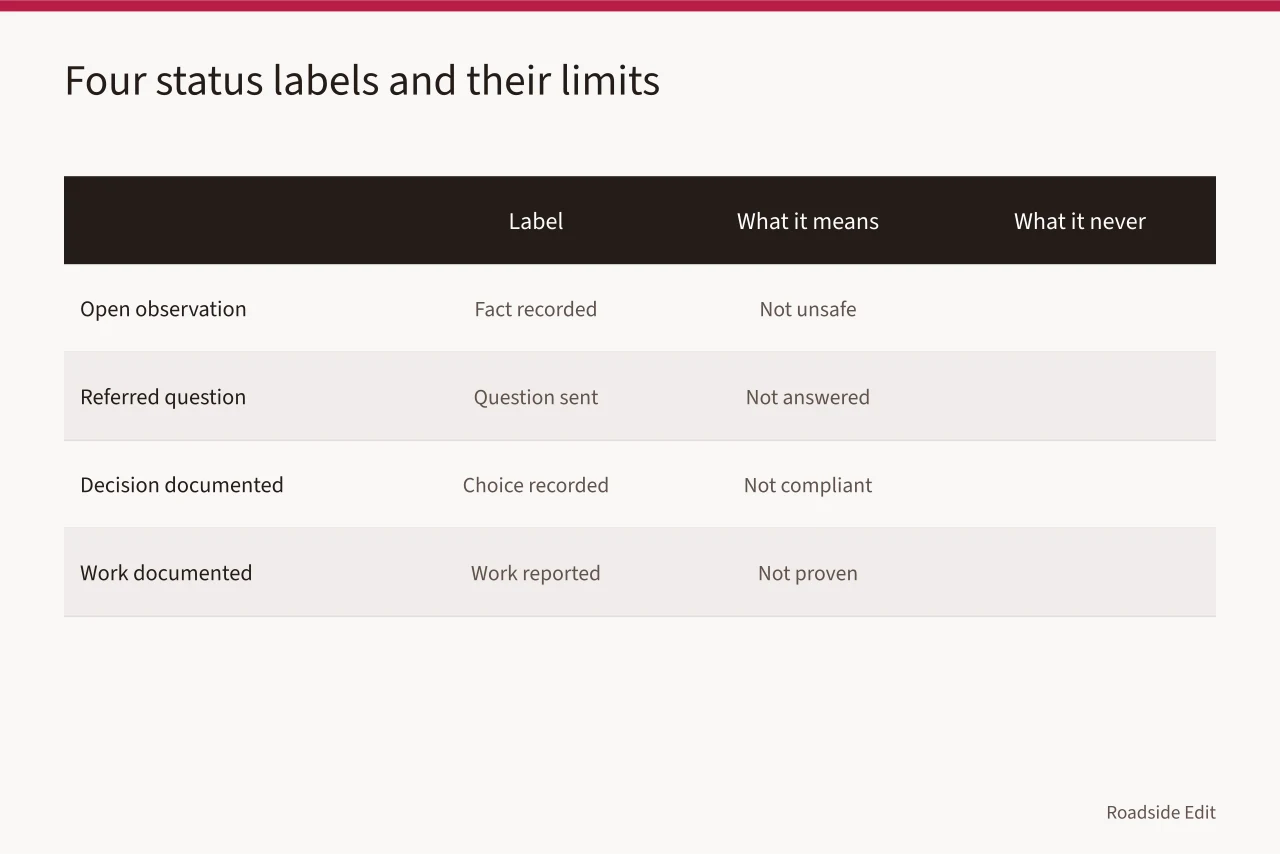
| Label | What it means | What it never means |
|---|---|---|
| Open observation | A fact or report was recorded, no assessment stated | That a condition is unsafe |
| Referred question | A defined question went to a named role | That the role has answered |
| Decision documented | A source records that a responsible party chose | That the choice complies |
| Work documented | A source records completed work | That the work performs as intended |
Retire "safe," "approved," "up to code," "hazard cleared," and "permanent fix." Each one claims an authority the checklist does not hold. When a contractor's invoice describes a repair, the entry is work documented, and the invoice date and stated scope travel with it.
Field examples from roadside properties
The examples below are composites drawn from survey practice, not reports on any named property. Each shows the entry type, the wording, and the reason the wording holds.
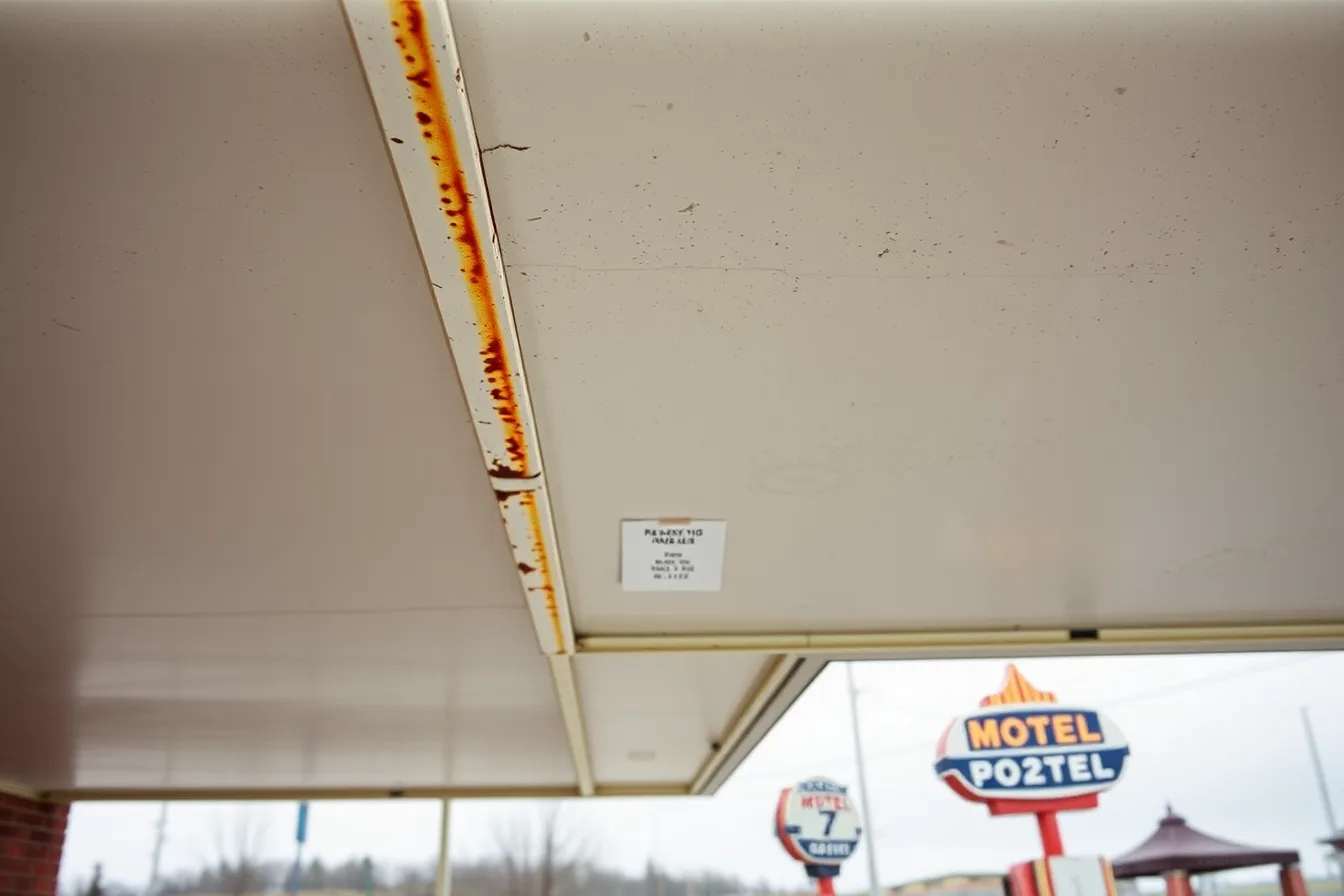
Canopy soffit, 1950s enamel station. A surveyor notes rust staining along a soffit seam above the pump island. The entry reads: "Soffit seam, east canopy bay, staining observed 2026-04-12, photo E-03. Cause not determined. Referred to licensed structural engineer."
The checklist does not guess whether the deck is sound. That question belongs to an engineer, and any repair touching the canopy follows the Secretary of the Interior's Standards for Rehabilitation. Review the Secretary of the Interior's Standards.
Neon transformer, 1960s plastic-faced box sign. A manager reports a buzzing transformer and a dark section of tube. The entry reads: "Box sign, north face, one tube section dark, reported by manager 2026-04-14. No access to sign can. Referred to licensed electrician."
Voltage, load, and tube diameter are electrician territory. The record keeps the tube diameter in millimeters if someone measured it, and stops there.
Dry-stand pipe at a motor court. A walk-through finds a capped pipe stub near the office wall. The entry reads: "Capped pipe, north wall of office, observed 2026-04-15. Function unknown. Referred to local fire authority." A stub is not evidence of a working system, and its absence from a drawing is not evidence that it never existed.
Curtain-wall glazing at a 1962 motel. A glazing panel at the stair tower shows fogged seals. The entry reads: "Stair tower glazing, panel 3, seal failure observed 2026-04-16, photo E-07. Replacement material not selected. Referred to preservation consultant." Material choice is a preservation decision, and the checklist only holds the question open.
Each example shares one habit: the entry names the thing, the place, the date, and the next role, and then stops.
Date the exterior before you write the scope
A checklist written without a date range drifts. Motel exteriors read by decade, and the reading shapes what a surveyor looks for.
Brick veneer with a running bond and a flat canopy points to the 1950s. Curtain-wall glazing with aluminum mullions points to the early 1960s.
A butterfly roof over the office wing points to the same period and often signals a later reroof. Porcelain-enamel signage belongs to the earlier group; plastic-faced box signs belong to the later one.
Record the dating evidence in the scope line, because it tells a later reader why certain elements were examined at all.
The same discipline applies to a corridor. A Route 66 survey maps by decade and material, and a checklist inherits that map. See the planning questions that shape a roadside survey before fixing the scope.
Separate safety questions from project decisions
Safety records touch preservation, operations, accessibility, and local regulation. They feed a project decision. They are not the decision.
Preservation Brief 51 explains that code application to historic buildings needs a project-specific approach. Review the NPS guidance on building codes. It does not decide local compliance. The checklist records the question and names the review path.
NPS treats fire planning for historic structures as a broad strategy covering ignition risk, protection systems, notification, training, and inspection schedules. Read the NPS overview of structural fires and cultural resources. That breadth is the reason one checklist section cannot carry the whole record. Split it.
Keep an escalation record short
An escalation record is a handoff, not a warning. Six lines carry it.
- Record ID and defined location.
- Neutral description of the observation or report.
- Date and the files that travel with it.
- The role receiving the question.
- The scope of review requested.
- Current status and what triggers the next check.
Keep access codes, personal contact details, and emergency procedures out of public copy. Those belong in controlled property records. NPS describes trained inspection as a way to identify hazards and recommend prevention strategies.
Review the NPS fire-prevention overview. A checklist is not that inspection.
It preserves the observation, the reporter, the date, and the open question without making a finding.
Record completed work without overclaiming
When a document reports completed work, record who supplied it, the stated scope, and the issue date. An invoice dated April 20 describing a fixture replacement at the office entrance is a record of reported work. It does not establish that every related issue is closed.
This matters more in historic settings, where a later reader needs to know what was altered and why. Over-painting original enamel, replacing neon with LED, and discarding provenance records are the failures that follow a thin paper trail.
A dated entry is what prevents them. Keep the source records that prove a sign's history alongside the work entries, so a future owner can trace both.
Common questions
Can a checklist prove a motel complies with code?
No. It organizes records and questions. Code requirements, inspections, and compliance conclusions belong to the authority having jurisdiction and to licensed professionals.
What goes in the entry when a condition is unclear?
The defined location, the available evidence, the date, and the question that needs review. The status stays open until a property-specific record supports a change.
Should a public checklist include emergency procedures?
No. Keep operational details in the controlled property system and coordinate them with the responsible local roles.