Guides
Part of How to avoid common neon sign restoration mistakes before you publish
How neon sign restoration owners can build source records that prevent mistakes
Neon sign source records guide for 2027 helps U.S. publishers organize sources, image credits, provider material, updates, corrections, and unresolved questions.
The best protection against a repeated article mistake is a clean source record. It should show where a claim came from, what it supports, when it was checked, and what the article still does not know. It is not an inspection report or a substitute for a qualified property review.
What to take away
- Keep claims, images, provider material, and corrections in separate sections.
- Use source-specific notes rather than a vague list of links.
- Preserve a prior version when a material claim changes.
- Give unanswered property-specific questions a clear handoff status.
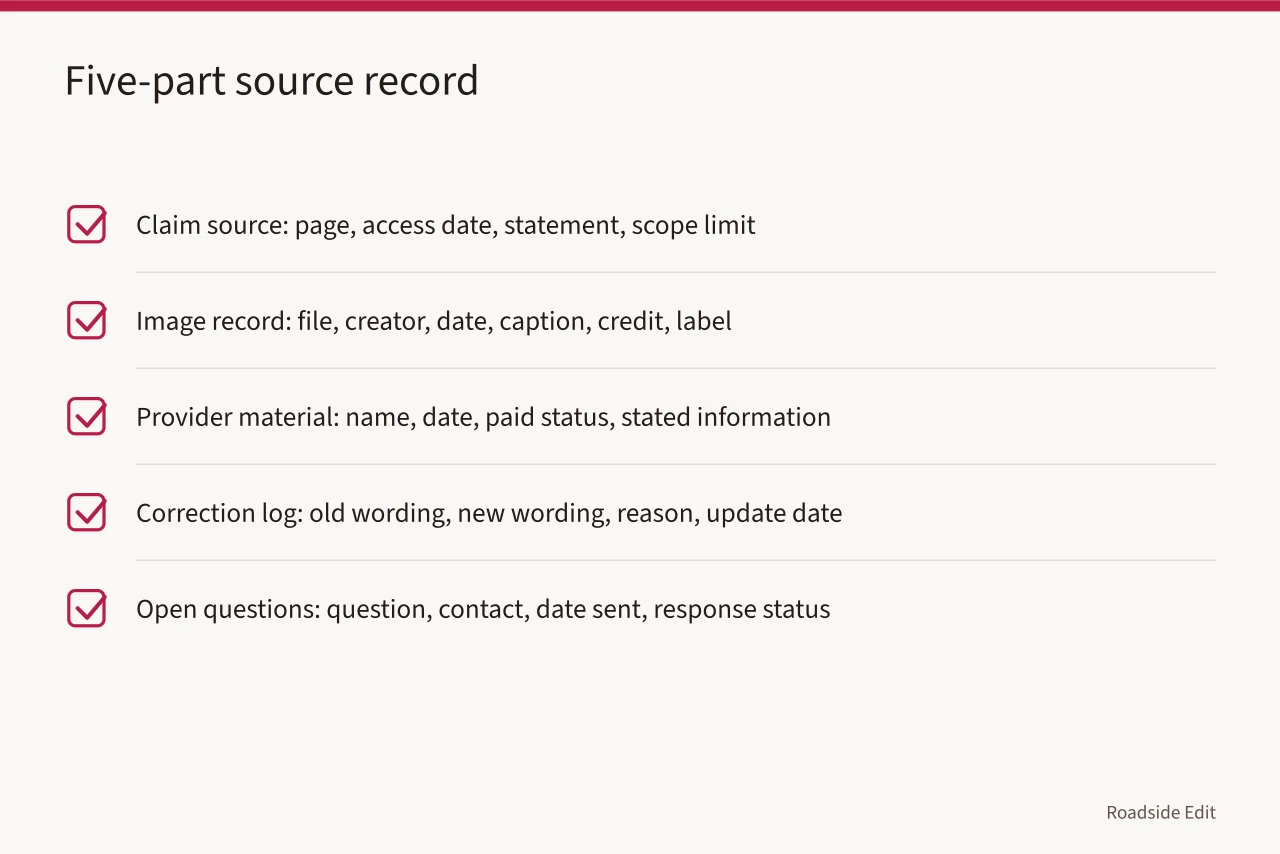
Use a five-part record
| Section | Minimum information |
|---|---|
| Claim source | Specific page, access date, exact statement supported, scope limit |
| Image record | File, creator or collection, date, caption, credit, and illustration label |
| Provider material | Provider name, submission date, paid or unpaid status, stated information |
| Correction log | Old wording, new wording, source reason, and update date |
| Open questions | Question, responsible contact or record, date sent, and response status |
The National Archives' still-picture research guide explains that pictorial materials are organized through record groups and finding aids. It does not establish facts about a particular sign. It supports a practical editorial habit: retain enough source information that a later editor can find the original record rather than relying on a copied caption.
Give a source a defined role
One source might support a historical date. Another might supply a current visitor instruction. A provider may describe its own services. Write the role next to each entry. This prevents a current statement from being used as proof of historical fact or a historical image from being treated as a current condition report.
Preserve corrections instead of hiding them
When a material claim changes, keep the dated record of why. A concise note is enough: "Updated the reported opening date after the archive record corrected its caption." The public article does not need every internal detail, but the editorial file should make the change traceable.
Store a claim with its source limit
For each claim, record the article sentence and the direct source page. Note the source type, date checked, the narrow fact supported, and a scope-limit note.
For example, an archive image may support an earlier appearance, not a present condition. An owner message may support a visitor instruction, not an independent historical statement, and this prevents reusing a correct source for an unrelated claim.
The National Park Service documentation standards and guidelines concern recording historic properties. They do not evaluate a specific neon sign. They support keeping descriptive evidence, dates, and source limits with the material used in a historical feature.
Store an image with its item record
Keep the image's source page, stated title, creator when known, date, location, rights information, caption, and any crop used in the article. If the image is contextual, say so in the caption. A dramatic photograph must not carry a claim about a different place or time.
A later editor should locate the original record and understand why the image was included.
The Library of Congress Prints and Photographs collections provide image records with descriptive and rights information. They do not establish a site's current status. They support checking image context before visual material is used as evidence.
Store commercial material apart from source evidence
Keep provider-submitted descriptions, testimonials, sponsored placements, quotes, and service-area claims in a distinct field. Preserve the disclosure wording and the published version. A provider can supply useful information about its own business, but it should not be converted into a historical fact, public approval, or independent assessment of a property.
The Federal Trade Commission's endorsement guides address endorsements and testimonials in advertising. They do not verify provider claims or property outcomes. They support disclosure and attribution when commercial content appears with editorial material.
Prepare a correction handoff
When an editor leaves or a claim is challenged, make a short handoff note listing the affected article sentence, source record, current public wording, prior wording, correction reason, and next review date. Keep unanswered questions visible rather than filling them with inference. This makes a source record useful after the original writer is no longer available.
Common questions
Should every URL be saved?
Save the specific URLs that support factual claims or image credits, along with the date accessed and the claim they support.
Can a source record include a sponsor submission?
Yes. Label it as provider or sponsor material and keep it separate from independently sourced evidence.
What happens when a source page disappears?
Record the access date, retain any permitted citation details, and seek a current replacement source before relying on the old claim.