Guides
Part of How to avoid common neon sign restoration mistakes before you publish
Neon sign restoration: a mistake prevention checklist before your 2027 story runs
Neon sign evidence mistake checklist for 2027 helps U.S. publishers test sources, captions, dates, disclosures, and claim limits before an article goes live.
Use this checklist before publishing a neon sign feature, listicle, or paid profile. It does not evaluate a sign. It checks whether the article is accurately using the evidence it has.
What to take away
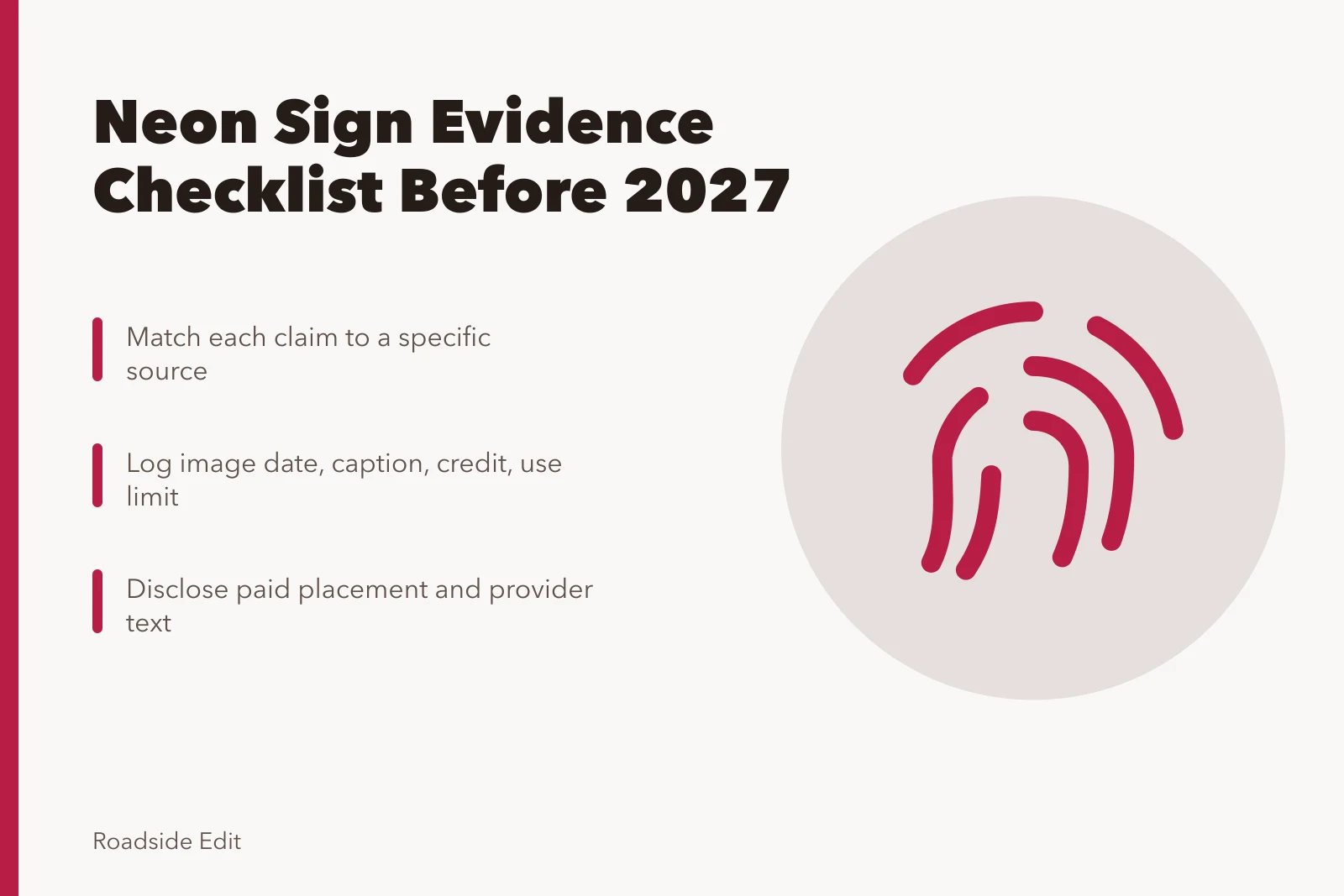
- Match every material claim to a specific source or attribution.
- Give each image a date, caption, source, and credit.
- Keep provider and owner statements labeled.
- Remove conclusions that are broader than the evidence.
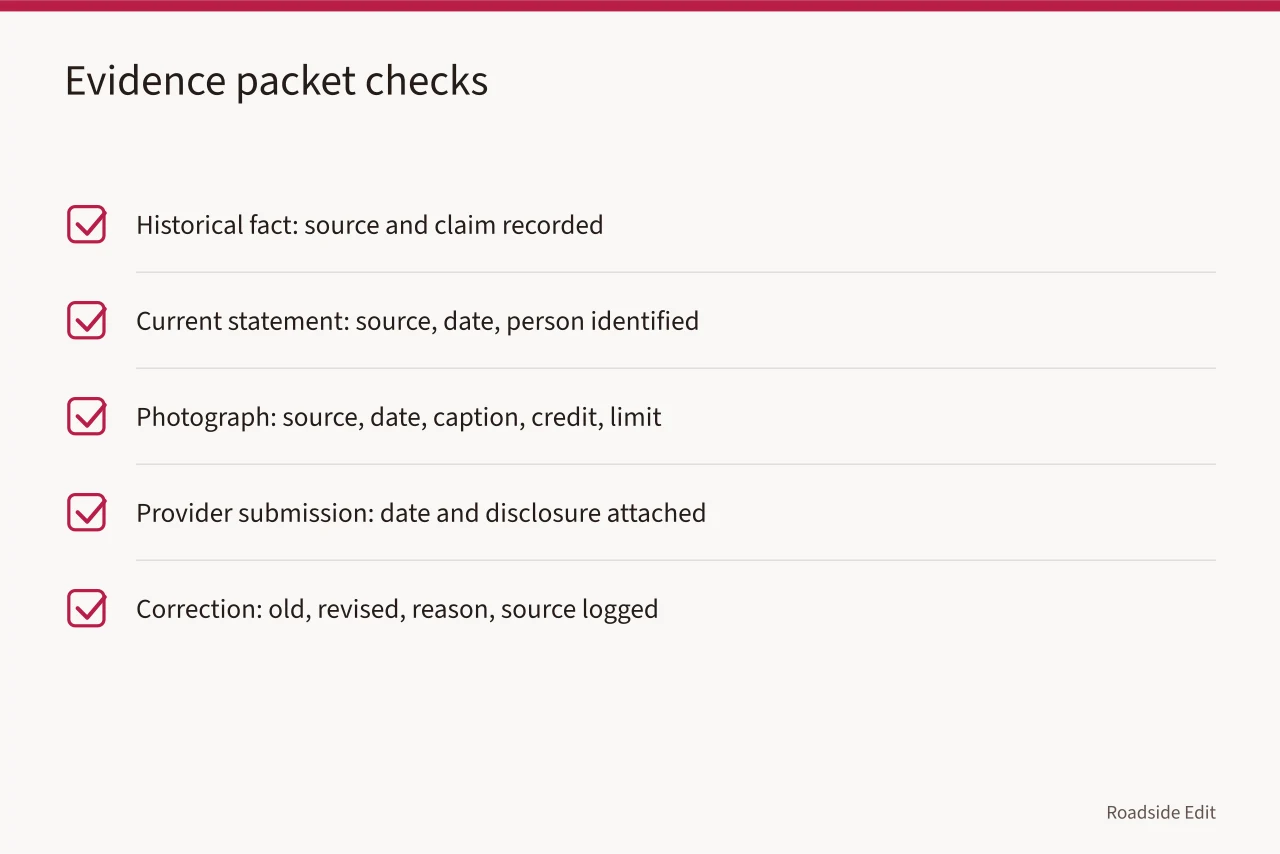
Check the evidence packet
| Item | Pass condition |
|---|---|
| Historical fact | Specific source and claim are recorded |
| Current statement | Source, date, and responsible person or office are identified |
| Photograph | File source, date, caption, credit, and use limit are retained |
| Provider submission | Date and disclosure language are attached |
| Correction | Old wording, revised wording, reason, and source are logged |
The Library of Congress notes in its photograph-care guidance that photographic materials can have different formats and condition needs. This is not a care instruction for readers. It supports the limited editorial rule that an image should not be treated as self-explanatory evidence without a source, caption, and clear record of what it represents.
Check the language
Scan for unearned certainty: "safe," "approved," "original," "best," "restored," or "official." If a source does not support the exact word, replace it with an attributed, factual phrase. Say what the source shows or reports, not more.
Check the disclosures
If a business paid for placement, supplied its own text, or is otherwise connected to the feature, disclose that relationship. A clear disclosure protects the reader and lets the business participate without appearing to control independent editorial findings.
Save the review date
Add the review date to the source packet and to any published update note. A reader may see the year in a title, but the editorial record should still show when each claim and image credit was last checked. This makes later updates faster and helps prevent an old source from being mistaken for a current one.
Check whether the source has the right scope
Read the page behind each major claim, not its title, and ask if it is a public record, a historic source, an owner statement, a provider statement, or general background. Then state only what that source can support.
A historic documentation source cannot establish current condition, and a provider description cannot establish an independent site finding. A photo can show an appearance on a date, not a diagnosis.
The National Park Service documentation standards and guidelines concern recording historic properties. They do not determine a neon sign's condition or treatment. They support identifying the date, visual material, and descriptive limits attached to a historic-source claim.
Check commercial copy before it reaches the page
Set aside provider-submitted text and compare it with the editorial copy. Mark what is supplied, whether payment or another material relationship exists, and how the relationship will be disclosed. A service listing can be useful when it stays attributed. It becomes misleading when a provider phrase appears as though it were independent certification of a property or project.
The Federal Trade Commission's endorsement guides address endorsements and testimonials in advertising. They do not confirm sign history or safety. They support transparent disclosure when commercial copy appears in an editorial feature or list.
Check that a correction can be traced
For a corrected sentence, keep the earlier wording, the new wording, the date, the source that prompted the change, and a short explanation of the limit that was fixed.
Do not quietly swap a broad statement for a narrower one and lose the reason. A visible internal trail keeps that unsupported phrase from returning in another article or later campaign.
The National Archives personal digital archiving guidance concerns preserving digital records and their context. It is not an editorial style guide. It supports keeping the source copies and dated notes that make a correction checkable later.
Make the final review repeatable
Use the same checklist for every update, paid placement, and new feature. Record the reviewer and date beside the result.
Common questions
Is one source enough for every article claim?
No. One source may support one fact but not a broader conclusion. Keep each claim within the source's actual scope.
What should happen to an unsupported claim?
Remove it, qualify it as an attributed report, or leave it as a question until a suitable source is available.
Can an old photo be used as an illustration?
Yes, if it is credited, dated, and clearly described as historical context rather than a current record.