
Guides
Part of How to avoid common neon sign restoration mistakes before you publish
Neon sign restoration: budget notes that help owners avoid costly mistakes
Real 2027 neon sign restoration budget notes name YESCO, Neon Works, The Neon Museum, Franceformer, and Transco with public cost ranges and scopes.
Documentation budget notes work best when they pair work categories with real price ranges. A single-storefront neon sign needs diagnosis, transformer work, tube replacement, permits, and contingency.
What to take away
- Diagnostic visit: $150 to $500. YESCO and Neon Works quote this step first.
- Transformer and wiring: $300 to $1,200 installed. Franceformer and Transco units often cost $60 to $250.
- Tube replacement: $75 to $250 per segment. EGL and Voltarc tubes and electrodes often cost $20 to $150.
- Full restoration: $3,000 to $15,000 for a small facade sign. Large marquees can exceed $50,000.
- Permits and engineering: $100 to $2,500. Local fees and stamped drawings vary.
- Contingency: 10 to 20 percent. Track unknown access or missing parts.
- Keep provider ranges dated and separate from source notes.
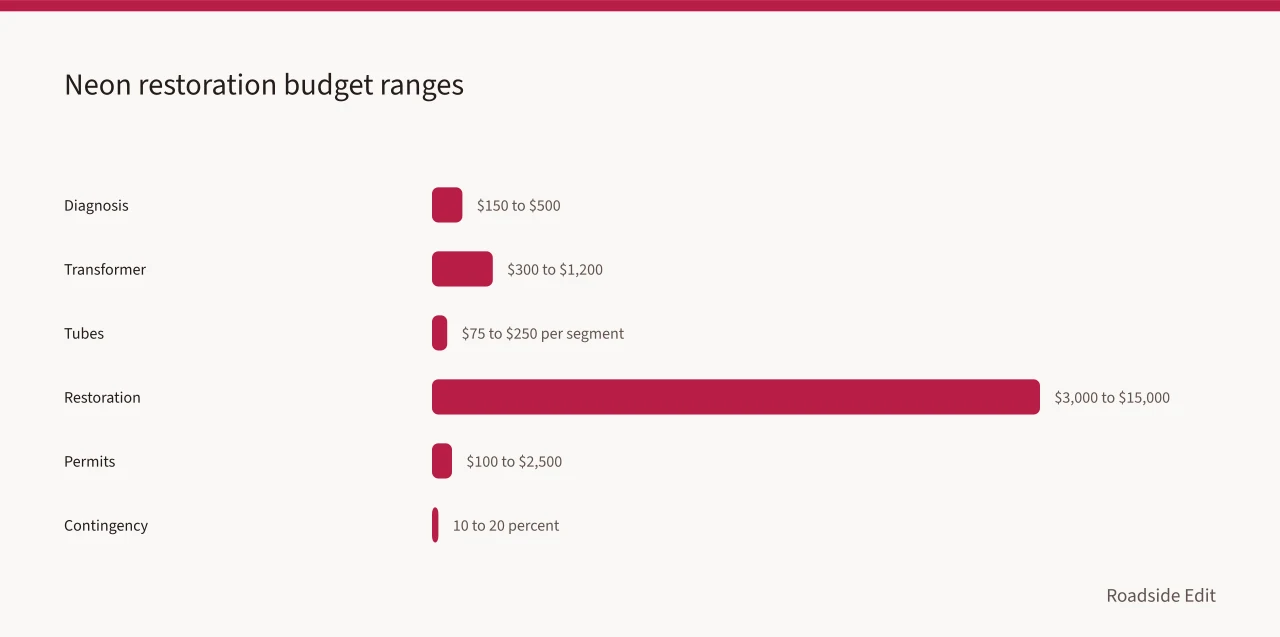
Budget ranges to plan around
| Category | Range | What it covers |
|---|---|---|
| Diagnosis | $150 to $500 | Inspection, transformer test, tube map |
| Transformer | $300 to $1,200 | Franceformer or Transco unit, wiring, electrodes |
| Tubes | $75 to $250 per segment | EGL or Voltarc glass, bending, pumping |
| Restoration | $3,000 to $15,000 | Glass, paint, electrical, reinstallation |
| Permits | $100 to $2,500 | Local fees, drawings, sign permit |
| Contingency | 10 to 20 percent | Unknown access, historical review |
The National Archives' preservation strategies page emphasizes that storage and organization affect long-term preservation. It does not set neon prices. Use it to define record storage, not a budget formula.
Keep commercial information clear
If a provider supplies a range, preserve its date, scope, and exclusions. Call it provider-supplied information, not a regional average. If it appears in a paid profile, use disclosure and keep it separate from independent source notes.
Name the provider. YESCO, Neon Works, and The Neon Museum use different scopes for restoration, display, or reference. The Neon Museum preserves historic signs but does not quote facade work.
Review categories, not promises
At the next review, ask whether each category still has a purpose. A source request may be answered, a correction complete, or a qualified question open. Update the record with the reason. This keeps a planning note transparent without making a cost promise.
Budget evidence as separate work
An evidence category should say what will be checked: a dated image record, an archive reference, a rights note, a disclosure review, or a correction note. Do not fold that into a broad restoration research line. Separating the work shows which output is editorial and which question needs a property-specific process.
The National Park Service documentation standards and guidelines concern recording historic properties. They do not create a cost estimate. They support defining photographic, descriptive, and source-record work before an article suggests a broader treatment result.
Keep a quote separate from an article plan
A provider range has a service, date, exclusions, and commercial source. It is not interchangeable with source research or correction review. Keep the original provider material with the disclosure decision. State only what the provider supplied. Do not call a range a typical price or an expected result for another property.
The Federal Trade Commission's endorsement guides address endorsements and testimonials. They do not validate prices or treatment needs. They support clear disclosure when provider material appears beside an editorial budget note.
Record the reason for a contingency
Write a contingency as a specific unanswered question, not a catchall amount. Note the missing source, responsible party, request date, and next review date. A missing image date or unconfirmed owner statement can be tracked without assuming an outcome. This prevents a later editor from reading a temporary unknown as a technical conclusion.
The Library of Congress photograph-care guidance concerns preservation of photographic materials. It is not sign-restoration advice. It supports giving image records their own planning category rather than treating a photograph as context-free proof.
Review categories before approving an update
At each review, mark a category as complete, pending, replaced, or no longer needed. Keep the reason and source beside that decision. If new evidence changes the article, update only the sentence it supports. Do not expand an unconfirmed claim elsewhere on the page.
Common questions
Why avoid a typical restoration price?
Typical figures hide different evidence, access, site conditions, authority, and scope. Dated categories are more accurate at an article-planning stage.
Can a sponsor fund a historical feature?
Yes, with disclosure. The sponsor's role should not change how the article separates evidence from promotional claims.
Is a correction cost part of the plan?
It can be a category for editorial review and source verification, but not a technical project estimate.