Guides
Part of How to report regional adaptation in vintage diner interiors without overpromising
How to build a vintage diner interiors regional checklist for source notes
Use this 2027 vintage diner interior regional checklist to document climate sources, locations, image limits, owner updates, disclosures, and corrections.
Use this vintage diner interior regional checklist to organize editorial evidence, not to rate a property. It helps a writer identify a source's region, date, and limit before making a climate-context claim in 2027.
What to take away
- Match every regional claim to a named source and place.
- Do not extend regional context into a building diagnosis.
- Keep image dates and owner relationships visible.
- Disclose paid placement where the reader will see it.
Create a complete source note
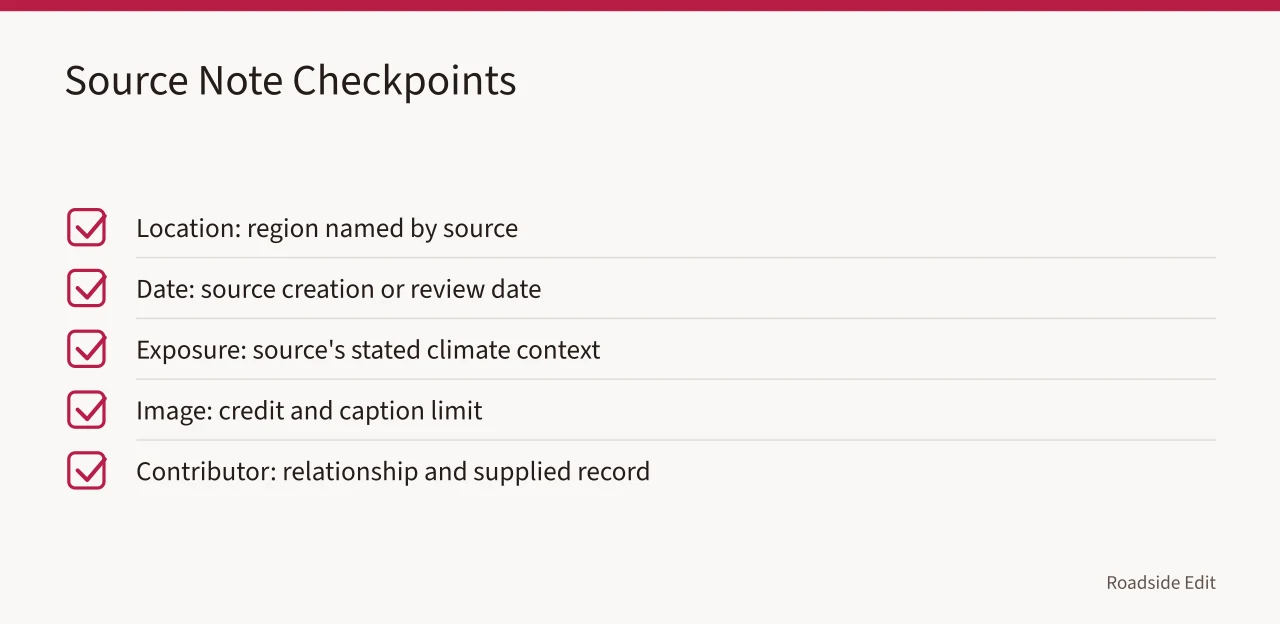
| Checkpoint | Record | Do not claim |
|---|---|---|
| Location | Region named by the source | Conditions at every local diner |
| Date | Source creation or review date | Present facts from old material |
| Exposure | Source's stated climate context | A property-specific risk |
| Image | Credit and caption limit | Current interior condition |
| Contributor | Relationship and supplied record | Independent verification |
The National Park Service evaluates park climate vulnerability with exposure, sensitivity, and adaptive capacity among its factors. Its NPVuln overview supports a narrow editorial lesson: regional context requires defined inputs and limits. It does not assess a diner or provide a checklist for a private property.
Use the publication checklist
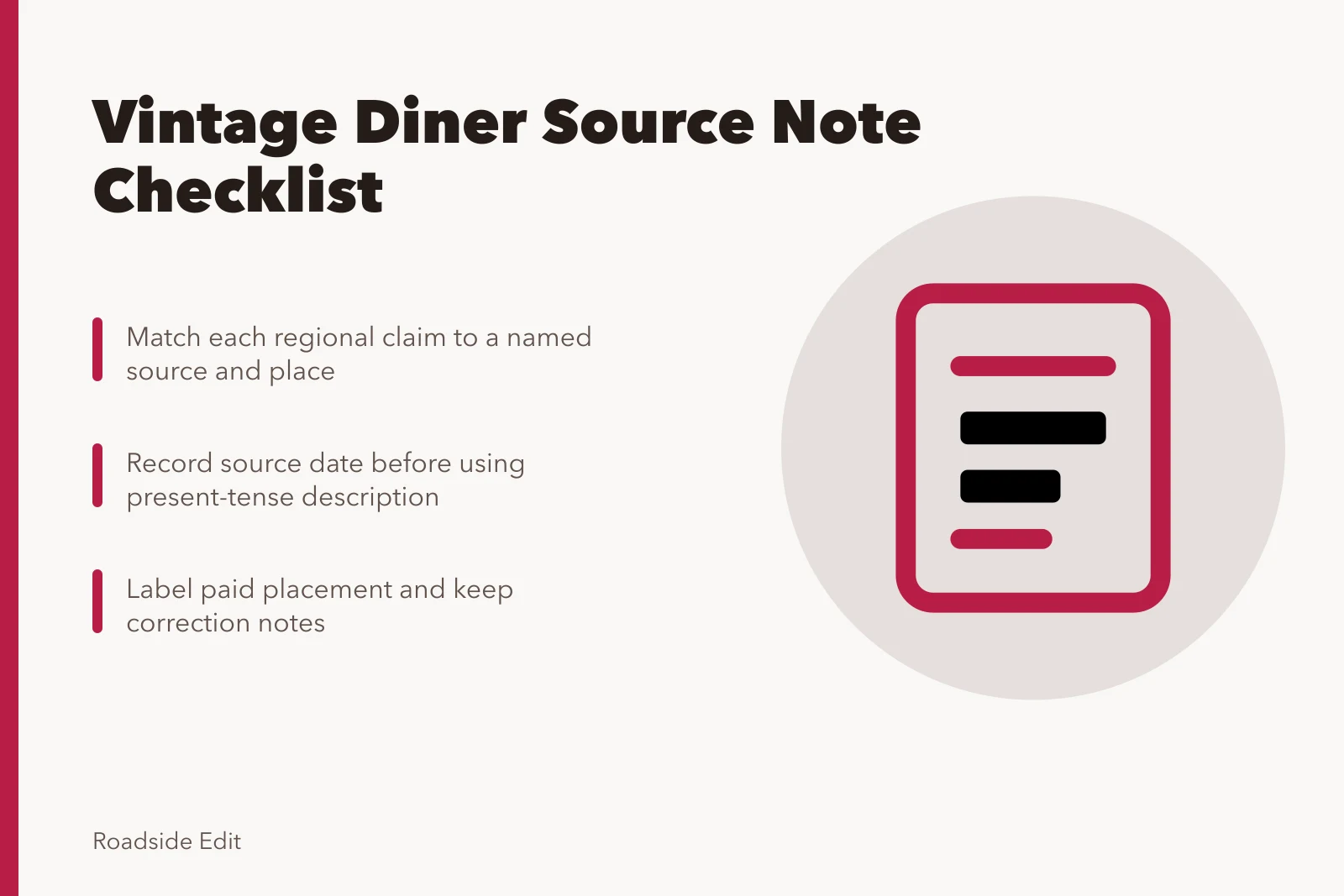
- Read the source and identify the exact area it covers.
- Record its date before using a present-tense description.
- Attribute owner or business updates instead of converting them into findings.
- Caption an image as historical or illustrative when appropriate.
- Add a clear label to any paid placement.
- Keep a correction note for changed regional claims.
The checklist is valuable because it makes a writer pause before using broad words such as humid, coastal, dry, or storm-prone. Those words may describe a source's region, but they do not establish a specific interior condition. If the record is incomplete, limit the article or leave the claim out.
For listicles, repeat the same checks for every entry. A consistent record prevents one business from receiving a stronger regional description simply because it supplied more promotional copy.
The National Archives explains why a record can be a primary source. That supports recording who produced a regional image or report and what date it covers. A primary record may be useful context, but it still may not establish a present condition at a diner.
The Library of Congress primary-source analysis guide begins with observation, then reflection and investigation. This sequence supports a careful caption: state the place and date a source identifies, then seek further evidence before drawing a larger conclusion.
The Federal Trade Commission's endorsement guidance supports disclosing a material relationship that could affect how readers judge a statement. A paid placement needs a clear label; the label does not validate a regional claim.
Use consistent regional labels
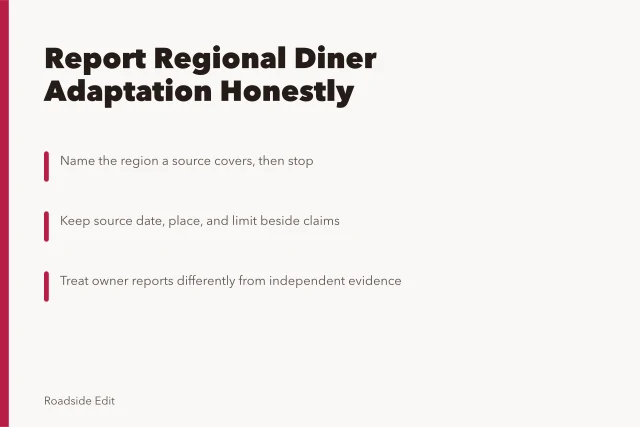
Choose the geographic label from the source itself. If it names a state, county, watershed, park, or coastal area, use that term and do not silently reduce or expand it. A report about a region can help readers understand public context. It cannot show the climate exposure, interior condition, insurance status, or future needs of an individual business.
Keep a review trigger for every time-sensitive source. Reopen the record when an agency revises a page, an archive corrects a caption, or an operator supplies a dated update. Compare the existing wording with the new evidence. If the article previously said more than the record supports, correct the sentence instead of attaching the new source to an old conclusion.
The same discipline improves paid and unpaid list entries. Apply one inclusion basis, state it plainly, and preserve a correction route. Readers should be able to see whether an entry reflects an archival record, a public context page, an attributed update, or advertising.
Before publishing an entry, test its wording against a simple counterexample. Could the same sentence be true for every diner in the named region? If so, it is probably too broad to describe one business. Rewrite it to identify the report, geography, date, and stated context instead. This small test keeps the guide focused on research rather than regional stereotypes.
Those limits also protect readers from unsupported local conclusions today.
Common questions
Can a regional climate page prove a diner needs work?
No. It gives context about a region, not a property assessment.
How should a business update appear?
Attribute it, record its date, and disclose a paid relationship if one exists.
Why preserve a correction record?
It shows what changed, why it changed, and what source supported the revision.